
The first thing her brother did after their mother suffered a massive stroke was change the locks on the three-bedroom apartment in Obolon.
Their mother was still lying unconscious in the intensive care unit when he decided that the apartment was no longer hers.
“Legally, my son lives here now. The documents were notarized three years ago. So wipe your tears and take her home with you to Troieshchyna,” he said in his hoarse voice, pushing a bag of medicine into his sister’s hands.
He said it without the slightest hesitation.
As if they were discussing an unwanted piece of furniture rather than their eighty-two-year-old mother.
Their mother had always been a difficult woman.
For most of her life, she had been a mathematics teacher—strict, demanding, and feared by generations of students. She had believed that discipline solved everything and that kindness was something people used when they were too weak to control others.
But age had taken its toll.
And after the stroke, everything changed.
The woman who had once marched through life with an iron will could no longer get out of bed without assistance. One side of her body was paralyzed. Her speech had become slow and slurred. She needed help eating, bathing, changing clothes, and even turning over in bed.
Yet somehow, one thing had survived the stroke completely.
Her temper.
When they transferred her from intensive care to a regular ward, she opened her eyes, saw her daughter standing beside the bed, and immediately began giving orders.
“Come here, you worthless girl,” she rasped through her cracked lips. “Wash me. You’re supposed to do it. I gave birth to you. You owe me your life.”
Her daughter stood silently beside the bed.
She had heard those words her entire life.
You owe me.
It was the phrase that had followed her from childhood into adulthood.
She didn’t remember her mother holding her when she was frightened.
She remembered a metal ruler striking the skin above her left eyebrow.
She remembered watching her older brother receive the best pieces of meat at dinner while she was told to be grateful for whatever remained.
He was taken to the seaside during school holidays.
She stayed home.
He received new clothes and expensive gifts.
She was expected to clean the apartment.
When he made a mistake, their mother always found an excuse for him.
When she made one, she was called stupid.
“You’re a good-for-nothing girl. The only thing you’re capable of is washing floors.”
When she was fourteen, her mother accused her of stealing a large amount of money the family had supposedly saved.
The girl denied it.
Her mother insisted.
Her brother believed their mother immediately and attacked her with the cord from an old electric kettle.
Years later, she discovered that their mother herself had hidden the money.
There had never been an apology.
Now that same beloved son was getting the valuable old apartment overlooking the Dnieper.
And she was expected to become their mother’s full-time nurse.
“I won’t take her home,” the daughter said quietly, looking directly into her brother’s eyes. “And I won’t move in with her either.”
Her brother stared at her in disbelief.
His twenty-five-year-old son stepped forward.
The young man had never held a steady job, but apparently that didn’t stop him from considering himself the rightful owner of his grandmother’s apartment.
“You ungrateful monster!” he spat. “We’ll take you to court! You’ll have to pay for her care! You’re her daughter. It’s your duty!”
“Your father and I have businesses to run,” he continued. “We’re busy people. And what are you? A lonely failure!”
The daughter didn’t answer.
While the family argued over property, her mother screamed at nurses, threw a metal bedpan across the room, and demanded that her daughter quit her job at the engineering institute.
She wanted her daughter beside her every hour of every day.
She wanted to be washed by her.
Fed by her.
Turned in bed by her.
And, most importantly, she wanted someone nearby whom she could continue to control.
The first major twist came when the daughter went to the notary.
Her brother had tried to access the remainder of their mother’s pension savings, but during the legal process they discovered something unexpected.
Several years before the stroke, their mother had transferred ownership of her small country house near Osokorky to her daughter.
The house had taken twenty years to renovate.
A cozy two-story property surrounded by trees, with a small garden and a quiet terrace.
But the mother hadn’t transferred it out of love.
She had done it because she believed the property would keep her daughter tied to her.
She thought that once the daughter legally owned the house, she would feel obligated to care for her in old age.
Even from a hospital bed, their mother had still been trying to control her daughter’s life.
But this time, her plan had backfired.
When the daughter came to collect her mother’s belongings, the old woman erupted.
“Nothing is going to belong to you!” she screamed. “You’ll wash me every day! You’ll listen to me tell you how much I hate you! I gave birth to you so there would be someone to bring me a glass of water. So bring it!”
The daughter didn’t argue.
She went home.
And over the next three days, she made a decision that nobody in the family expected.
She found tenants for the country house.
The rental contract was signed for three years in advance, with a substantial security deposit.
Then she used the money to place her mother in a private care facility near Irpin.
It wasn’t a neglected state institution.
It was a private country complex with round-the-clock medical supervision, pressure-relief equipment, four meals a day, professional caregivers, and comfortable rooms.
When the medical transport arrived at the facility, her brother and nephew were already waiting at the entrance.
They were furious.
“She has no right to do this!” her brother shouted at the director. “This is abuse! Our mother belongs at home!”
The daughter stepped out of the vehicle.
“At whose home?” she asked calmly.
Her brother fell silent.
“The apartment belongs to your son now, doesn’t it?”
Neither man answered.
“Then take her home with you. Turn her every two hours. Change her diapers. Feed her. Bathe her. Listen to her screaming at three in the morning. Take care of her yourselves.”
She pointed toward the entrance.
“Go ahead.”
Her brother’s face immediately went pale.
Her nephew suddenly became fascinated with his phone and pretended to be taking an important business call.
A week later, the second major twist arrived.
Their mother refused to eat and demanded a family meeting.
Everyone gathered in her room: her son, her grandson, two distant female relatives, and her daughter.
“She locked me away!” the old woman screamed, pointing at her daughter. “She put me here so she could steal my property! She’s a monster! Someone help me! She’s destroying me!”
The relatives immediately joined in.
“How could you do this to your own mother?”
“She has no compassion!”
“You’re still her daughter!”
Her brother then made a grand declaration.
“I’ll file a complaint against you for mistreating an elderly person.”
“Fine,” the daughter replied.
She opened her bag and placed a thick stack of documents on the table.
“Here are the invoices. Nineteen thousand hryvnias every month.”
Everyone fell silent.
“I paid the first three months using the money from the rental of the country house.”
She looked around the room.
“If you believe I’m cruel, that’s perfectly fine. Tomorrow I’ll cancel the arrangement, take back the money, and the facility will discharge her.”
Then she placed a set of keys on the table.
“These are the keys to the apartment. Which one of you is taking her home first?”
Silence.
Nobody moved.
One of the relatives suddenly remembered that she had a train to catch.
The other began staring at the floor.
Her brother became strangely interested in a pattern on the linoleum.
Her nephew slowly edged toward the door.
The daughter looked at them all.
“No one?”
Her voice was quiet.
“None of you want to show this great compassion you’ve been preaching about?”
And that was when their mother made her final move.
She grabbed a heavy plastic pitcher and hurled it at her grandson.
It smashed against the doorframe less than an inch from his ear.
“Get out!” the old woman screamed.
“Everyone get out!”
Then she pointed a trembling finger at her daughter.
“Only her…”
Her voice broke.
“Only she pays for me.”
It wasn’t a touching reconciliation.
There were no tears.
No apologies.
No sudden realization that everything could be repaired.
It was simply the moment when everyone finally saw the truth.
A month later, the daughter returned for her regular visit.
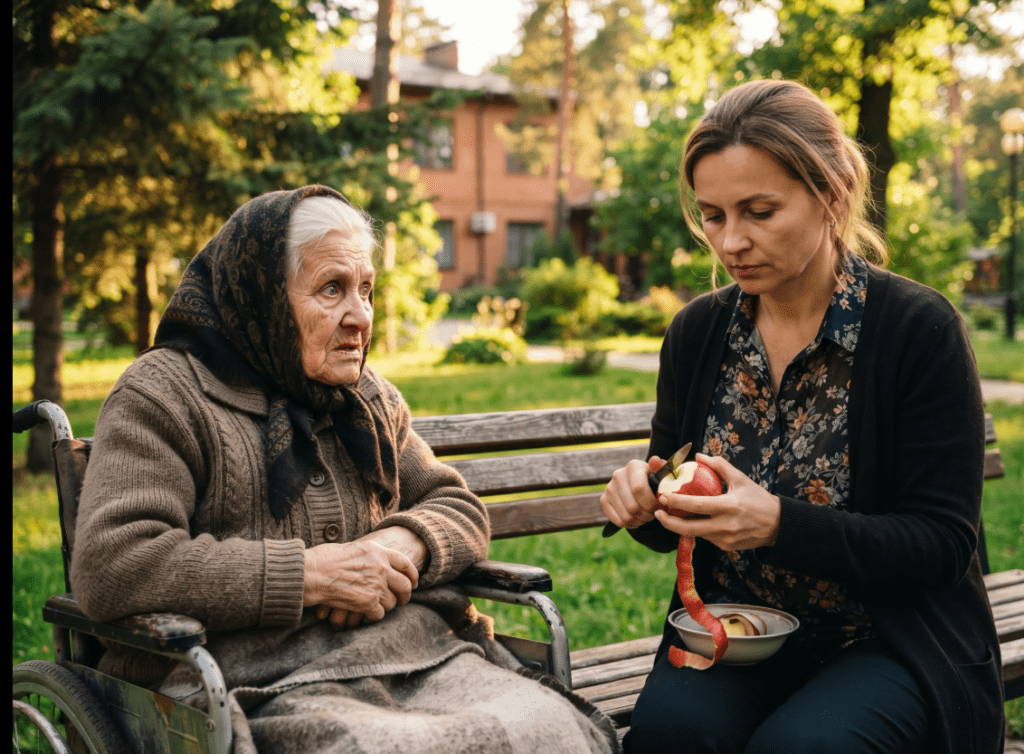
Her mother was sitting in a wheelchair in the facility’s garden.
Her hair was clean.
Her clothes were neatly arranged.
A caregiver sat nearby.
She looked healthier than she had in the hospital.
When she saw her daughter, she didn’t cry.
She didn’t apologize.
She simply stared at her.
“You think you’ve bought your freedom?” the old woman whispered after the caregiver stepped away.
“You think putting me in this place makes you a good daughter? You sent me here because you’re afraid to look me in the eyes. You’ve been afraid of me your entire life.”
The daughter sat down on the bench opposite her.
She took an apple from her bag and slowly began peeling it.
“I haven’t been afraid of you for twenty years, Mom.”
Her mother frowned.
“I simply bought myself some peace.”
She continued peeling the apple.
“Your hatred costs me nineteen thousand hryvnias a month.”
She looked up.
“And honestly, that’s the best investment I’ve ever made.”
“I’ll sue you!” her mother hissed.
“You won’t.”
The daughter calmly cut another slice of apple.
“But your beloved grandson has already put your apartment up for sale.”
Her mother’s expression changed.
“They’re planning to leave,” the daughter continued. “You aren’t useful to them anymore.”
She paused.
“Not healthy. Not sick. Not with an apartment. Not without one.”
For the first time, her mother’s face showed genuine pain.
She finally understood.
The son she had always favored and the grandson she had protected had become people who were perfectly capable of abandoning her when she became inconvenient.
She had spent eighty-two years demanding loyalty while giving almost none.
And now she was discovering what that kind of family could look like from the other side.
After a long silence, she whispered:
“And you?”
The daughter looked at her.
“Why do you keep paying for me?”
The daughter stood up.
She placed the peeled apple in her mother’s lap.
“So I don’t become you.”
Then she turned and walked toward the gate.
She stopped for a moment without looking back.
“I’ll see you next month.”
Then she added calmly:
“If the caregiver tells me you’re causing another scene, I’ll move you to a three-person room without a view of the garden.”
The relatives still send messages in the family group chat.
They call her heartless.
They accuse her of abandoning her own mother.
They say she chose freedom over family.
The daughter simply blocked every one of them.
Once a month, she transfers the money to the care facility.
She visits her mother.
She walks with her through the garden for forty-five minutes while listening to complaints, insults, and curses.
Then she leaves.
She returns to her small apartment in Troieshchyna.
She closes the door.
And for the first time in forty years, she sleeps peacefully.
No shouting.
No threats.
No metal ruler.
No accusations.
No one telling her that she owes them her life simply because she was born.
For the first time, she understands what silence feels like.
And she realizes that sometimes protecting yourself doesn’t mean abandoning someone.
Sometimes it means helping them from a safe distance without sacrificing your entire life in the process.
What would you have done in her place?
Would you have taken responsibility for caring for a mother who had spent your entire life controlling and humiliating you because of a supposed “family duty”?
Or would you have helped her receive professional care while finally choosing to protect your own peace?

