How a German Shepherd Saved His Owner During a Nighttime Breathing Crisis: A Story of Quiet Devotion
That night, I woke up in pitch darkness and knew within seconds that something was terribly wrong. Air felt trapped deep inside my chest, as though an invisible weight were pressing down on my lungs, and my inhaler was just out of reach. I opened my mouth to call for help, praying someone in the house might hear me, yet my voice refused to cooperate. Instead of words, only a weak, raspy sound escaped into the quiet room—and at that exact split second, Rex, my German Shepherd, lifted his head.
He had always been an observant dog, sensitive to shifts in my mood and daily routine, but his reaction that night was almost instantaneous. Rex jumped down from the bed in one fluid motion, walked over to where I was struggling, and gently pressed his cold nose against my cheek as if checking whether I was still breathing. Immediately afterward, he turned his gaze toward the nightstand and looked right back at me. He didn’t need a single word of explanation; he already understood that I was facing a serious emergency and needed urgent help.
Animals often sense distress long before humans can put it into words. Their awareness doesn’t depend on language—just a fleeting expression, a subtle change in the rhythm of breathing, or a small, uneasy movement in the dark.
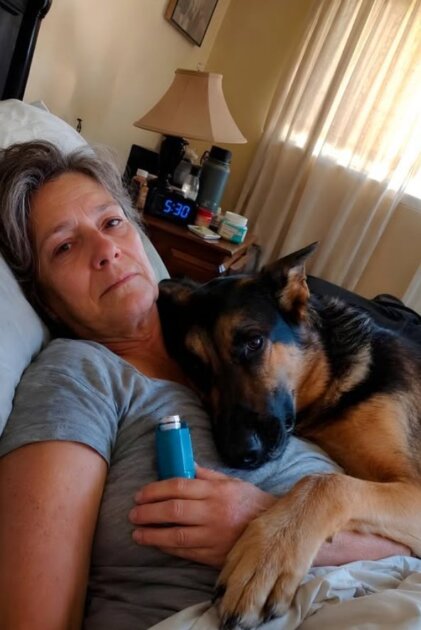
I tried to push myself up and reach the nightstand, desperate for relief, but my body wouldn’t listen. My hand was trembling uncontrollably, my shoulder ached from the strain of trying to draw air in, and my vision was blurring around the edges. Seeing how helpless I had become, Rex didn’t hesitate. He leaped up and braced his front paws against the edge of the nightstand, stretching upward, though he couldn’t quite reach the top surface. Stepping back a couple of paces, he took a quick running start and launched himself into the air again. The wooden furniture swayed softly, a table lamp slipped off and landed quietly on the rug, and finally, my inhaler tumbled down onto the floor.
For all the raw power packed into his frame, Rex didn’t snatch it roughly or toss it aside. Instead, he took the small plastic inhaler into his mouth with remarkable care, carrying it over to me as gently as if he were holding something spun from glass. When my stiff, shaking fingers couldn’t close around it right away, Rex nudged it softly with his nose directly into my open palm. That quiet, steady gesture gave me what I needed to start fighting for my breath again.
He didn’t panic when the quiet of the night turned frightening.
He quickly understood that I was in trouble and needed immediate assistance.
He brought the inhaler carefully and accurately, handling a fragile object with surprising gentleness.
He stayed right beside me through every minute until the worst had passed and I could breathe more easily.
The very first puff barely seemed to change anything, leaving me gripping the inhaler and waiting anxiously for a sign of relief. Soon, however, cool air began returning little by little. With each slow breath that followed, my chest opened up a fraction more, and that suffocating tightness started to recede. All the while, Rex sat directly in front of me without looking away for even a second. He didn’t bark wildly or pace nervously around the room—he simply watched me with steady focus, as if counting every inhale and every exhale until he was sure I was safe.
Once my breathing steadied enough that I could stop focusing on every gasp, I sank down onto the floor beside him and drifted off into sleep without even realizing it. When I finally opened my eyes around 5:30 in the morning, I discovered I had spent the rest of the night resting my head against his flank just like a warm, comforting pillow. Rex hadn’t moved from his spot. He was warm, calm, and astonishingly patient, letting me lean on him without a single restless shift.
Looking down at the inhaler still clutched tightly in my hand, my chest filled with a deep, aching gratitude. Rex had stayed awake through the dark hours, listening closely to the sound of my breathing and standing guard until the crisis had truly passed.
Not every hero wears a uniform or speaks words that make headlines. Sometimes a hero lies quietly beside your bed in the dark and watches over your next breath.
Later that morning, sitting next to him on the floor, I found myself reflecting on how unfairly people sometimes judge large dogs. Too often, strangers notice only their size, jaw strength, or imposing build, overlooking the tenderness, loyalty, and attentiveness living inside them. To me, Rex wasn’t merely a beloved pet—he was a true lifeline in the hour I needed one most.
Since that frightening night, I’ve changed everyday habits I used to take for granted: I keep a spare inhaler closer to my bed and make sure my supply is always replenished well ahead of time. More importantly, I am no longer afraid of the night. Knowing that there is someone right beside me who will notice my distress before anyone else changes everything. Rex doesn’t just love me; he guards my peace of mind, my breathing, and my life. Every evening, when he settles down beside me for the night, I’m reminded of how much devotion can mean when it arrives on four paws with a kind, watchful gaze.
True care rarely announces itself with drama; it usually shows up quietly and simply. Sometimes rescue doesn’t sound loud at all—it arrives softly, carried by the patience, loyalty, and love of someone who stays right by your side until morning.