
The Homeless Man I Married Always Drank His Coffee Black
Six days after Larry’s funeral, a letter arrived in his shaky handwriting.
I almost threw it away.
I assumed it was his final goodbye.
Instead, the first sentence made my stomach twist.
“Sarah, I need to apologize before I thank you.”
I read it twice.
Then a third time.
The handwriting was unmistakable—the same uneven, trembling handwriting I had watched him use at the hospice.
The postmark was dated one day before he died.
I held the envelope in both hands, suddenly afraid of what I was about to learn.
Then I read the next line.
“Nobody was ever going to bury me as a John Doe.”
My smile disappeared.
I sat down.
“No…”
Less than a month earlier, Larry had been sitting outside my subway station with a piece of cardboard across his knees.
Written in thick black marker were five words:
MARRY ME. I HAVE ONE MONTH LEFT TO LIVE.
I had known Larry for almost two years.
Every weekday morning, I stopped at the little coffee kiosk beside the station and bought two coffees.
Mine had cream.
His was always black.
Larry never begged me for money.
He never followed me.
He never asked for anything.
Some mornings, we talked about the weather.
Other mornings, he complained about the pigeons.
Once, he looked at my office heels and said they looked like they had been designed by “someone who hated human feet.”
I laughed so hard I nearly spilled my coffee.
Usually, I stayed for five minutes before rushing to work.
But that Tuesday morning, something was different.
Larry looked sick.
Not tired.
Not cold.
Sick.
His skin had a strange yellow tint, and his hands trembled as I handed him his coffee.
I pointed at the cardboard sign.
“What is this?”
He looked down at it.
“The doctors say I probably have a month.”
My smile vanished.
“What?”
“Liver failure.”
The noise of the traffic seemed to fade around us.
I sat beside him on the freezing pavement.
“Larry, I’m so sorry.”
“Don’t make that face.”
“What face?”
“The face people make when they’re already standing at your funeral.”
Even then, he managed to make me laugh.
But I couldn’t stop looking at the sign.
“Why marriage?”
Larry stared into his coffee.
“I don’t want to die belonging to nobody.”
“You don’t belong to nobody.”
“That’s a nice thing to say, Sarah.”
He looked toward the street.
“But it’s different when there’s paperwork.”
He explained that he had no legal family.
If he died, strangers would make the arrangements.
Someone at the county office.
Someone at the hospital.
Someone who had never known his name.
He swallowed.
“I just want one person who can say, ‘He’s mine. I’ll take care of him.’”
I should have walked away.
Instead, I thought about the man who had been sitting outside that station every morning for nearly two years.
The man who never asked me for anything.
The man who remembered exactly how I took my coffee.
I was single.
Larry was dying.
And I had always been much better at solving problems than walking away from them.
Two days later, we went to the courthouse.
Larry wore a clean blue shirt someone at the shelter had given him.
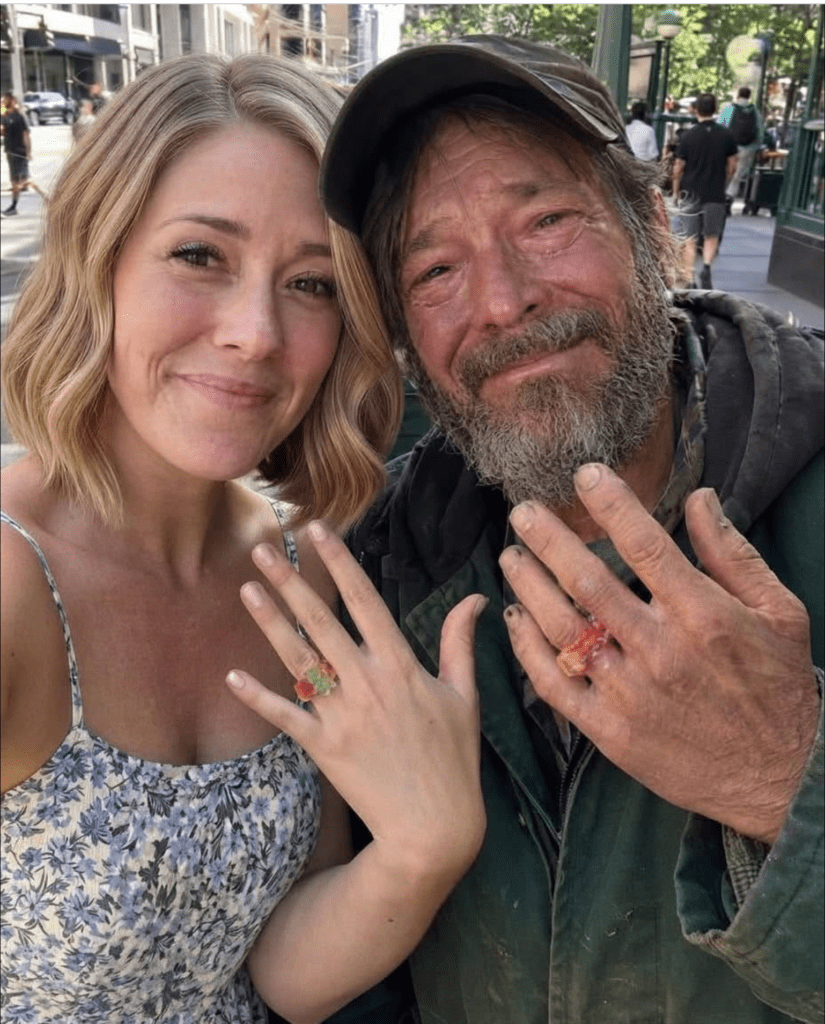
I wore my navy work dress.
When the clerk asked whether we had rings, Larry dramatically checked his empty pockets.
“Knew I forgot something.”
I laughed.
Eleven minutes later, I became Larry’s wife.
Three weeks later, I sat beside his hospice bed holding his hand as his breathing slowly stopped.
And now, six days after his funeral, I was reading a letter that told me the marriage had never been what I thought it was.
I forced myself to continue.
“The liver failure was real. The month was real. But I lied about why I asked you to marry me.”
I lowered the letter.
Then picked it up again.
His next words made my chest tighten.
“My arrangements were already taken care of. Hospice or the county would have handled everything. I wasn’t going to disappear without a name.”
I stood so quickly the chair scraped against the floor.
“What did you do, Larry?”
He was dead.
There was no way to call him.
No way to demand an explanation.
No way to make him sit across from me and watch the expression on my face.
I kept reading.
“If I gave you a problem you could solve, I knew you would solve it.”
That sentence hurt more than anything else.
Because he was right.
For two years, I had constantly tried to help Larry.
Coffee.
Food.
Warm socks.
Shelter phone numbers.
During one brutal winter, I had spent half my lunch break calling shelters until I found him a bed.
Every time, he thanked me.
But I had never realized that while I was learning how to help him, he had been learning something about me.
He knew exactly how to ask me for help.
Near the bottom of the page, he had written:
“Before you decide what kind of jerk I was, go back to the courthouse where we got married. Ask for Margaret. Tell her you’re my wife.”
I almost threw the letter away.
Instead, an hour later, I was standing inside the courthouse.
The same courthouse where Larry and I had been married three weeks earlier.
Couples sat everywhere.
A woman in a white jumpsuit was fixing her lipstick while her fiancé held a bouquet.
A toddler crawled underneath the chairs while his father tried to catch him.
I remembered Larry sitting there beside me.
His palms had been sweating.
His hands had been shaking.
“You’re nervous,” I’d teased.
“I’m dying,” he’d replied. “I think I’m allowed to shake.”
At the time, I believed him.
Now I wondered how many things I had accepted simply because I hadn’t thought to ask another question.
At the records counter, a clerk pointed me toward an older woman wearing red glasses.
“Margaret?”
She looked up.
“Yes?”
“My name is Sarah.”
I swallowed.
“I’m Larry’s wife.”
Her hands froze above the keyboard.
“Larry?”
I nodded.
She slowly stood.
“Oh, sweetheart.”
Before I knew what was happening, she walked around the counter and hugged me.
When she pulled away, her eyes were wet.
“When did he pass?”
“A week ago.”
She looked down.
“I knew he was sick. I didn’t know it was that close.”
I stared at her.
“You knew Larry?”
Margaret frowned.
“Of course I did.”
“How?”
She glanced around the courthouse.
“He worked here.”
I blinked.
“Here?”
“For twenty-eight years.”
My mouth fell open.
“Then how did he end up homeless?”
Margaret’s expression changed.
“His health started failing after retirement. His medical bills consumed his savings. Then he lost his apartment.”
She sighed.
“Larry was too proud to ask anyone for help.”
“What did he do here?”
“Marriage licenses.”
She smiled faintly.
“He never told you?”
“No.”
“That sounds like Larry.”
“What does that mean?”
Margaret hesitated.
Then she stood.
“Come with me.”
She led me down a hallway into a small civil ceremony room.
A wooden wedding arch stood against the wall.
I recognized it immediately.
“This is where Larry and I got married.”
“I know.”
I turned toward her.
“You were here?”
“No.”
She walked to an old cabinet.
“But Larry was here the afternoon before.”
“Why?”
Margaret unlocked a drawer and pulled out a thick binder.
“He sat in that chair for almost an hour.”
She pointed toward the seat beside the arch.
“What did he want?”
“Nothing.”
She smiled.
“He said he was nervous.”
I almost laughed.
“A man who worked around weddings for twenty-eight years was nervous about getting married?”
“That is exactly what I told him.”
She placed the binder on the table.
Then opened it.
My heart stopped.
Inside was an old marriage record.
Two names appeared at the top.
Near the bottom was a familiar signature.
Larry.
Beside his name was one word.
WITNESS.
Margaret turned the page.
Another couple.
Larry.
Witness.
Another page.
A different couple.
A different year.
The same signature.
Larry.
Witness.
Again.
And again.
And again.
I stared at her.
“What is this?”
“Sometimes couples came here without anyone with them,” she said. “Larry would leave his desk and sign as their witness.”
She turned another page.
“He hated the idea of someone getting married with nobody standing beside them.”
I ran my finger over one of Larry’s old signatures.
It was strange seeing his handwriting from decades before I knew him.
The same narrow L.
The same crooked y.
“How many times did he do this?”
“Hundreds, probably.”
Margaret smiled.
“He used to joke that he’d attended more weddings than anyone in the courthouse but never had an anniversary of his own to remember.”
A laugh escaped me.
Then another thought hit me.
“Was Larry ever married before?”
Margaret slowly closed the binder.
She didn’t answer.
“Margaret?”
“Once.”
My stomach tightened.
“To whom?”
She looked directly at me.
“You.”
I couldn’t breathe.
For twenty-eight years, Larry had watched strangers enter that building as separate people and leave legally connected.
Whenever someone came without a friend or family member, he stepped forward.
His name appeared again and again in those records.
Always beside the same word.
Witness.
Never husband.
Never spouse.
Not until me.
Margaret opened another drawer.
“There is something else.”
She pulled out a clear plastic sleeve.
“Larry asked me to keep this after your marriage was recorded, in case you ever came looking for me.”
Inside was a copy of our marriage certificate.
My name.
Larry’s name.
And beside his name:
SPOUSE.
I remembered how carefully Larry had folded his copy after our ceremony.
How he’d asked the clerk twice where he needed to sign.
I’d teased him.
“You’re acting like this is an actual wedding.”
He had gone quiet.
Then smiled.
“First marriage. Let me be nervous.”
I’d laughed.
Now, sitting in that courthouse, I couldn’t.
Margaret sat beside me.
“Did Larry tell you why he wanted to marry you?”
“He gave me a reason.”
I told her about the letter.
The burial arrangements.
The way he had admitted he’d made the situation sound more desperate because he knew I couldn’t resist solving a problem.
Margaret listened quietly.
When I finished, she didn’t defend him.
“That wasn’t fair to you.”
I looked at her.
“He knew you’d say yes to a problem,” she continued. “Larry was always much better at asking someone for practical help than asking someone to choose him.”
My throat tightened.
“What was I actually saying yes to?”
Margaret glanced at the marriage certificate.
“That isn’t my story to tell.”
I wanted to demand an answer.
But then I remembered the rest of Larry’s letter.
He had specifically told me to come here.
He wanted me to see the records.
The hundreds of witness signatures.
The couples he had stood beside.
And finally, our certificate.
The word spouse.
I left the courthouse and took the subway home.
But when the train reached Larry’s old station, I stepped off.
The woman at the coffee kiosk recognized me.
“Two?”
For a moment, I almost said no.
Then I looked toward Larry’s old place beside the station entrance.
“Yeah.”
She handed me my coffee with cream.
And Larry’s black coffee.
I carried both cups outside.
Then I sat where Larry used to sit.
For two years, I’d never stayed there long enough to finish a cup.
That day, I did.
I placed Larry’s coffee beside me.
Then unfolded the next page of his letter.
At the top, he had written:
“I didn’t need a wife to make my life matter, Sarah.”
Beneath it:
“But I wanted to know, just once, what it felt like to have somebody choose that word with me.”
I stopped.
Steam curled from the black coffee beside me.
My eyes filled with tears.
I whispered to the empty space beside me.
“Then why didn’t you just tell me?”
The answer was already waiting on the page.
“Because then I would have had to listen while you decided whether loneliness was a good enough reason.”
I closed my eyes.
Suddenly, two years of mornings with Larry looked different.
He continued:
“I made it easier for you by turning loneliness into paperwork. I knew you would understand paperwork.”
My fingers tightened around the letter.
“You had the right to know the truth. I’m sorry.”
I stared at the words.
“You should have told me.”
A subway train thundered beneath the pavement.
I kept reading.
“You were always trying to fix things for me. I liked that about you, even when you drove me crazy.”
Despite myself, I smiled.
During our three weeks of marriage, I’d bought Larry warm socks, toiletries, a phone charger, and a new blanket.
Enough supplies to last six months.
Every time I visited him at hospice, I arrived carrying something.
And every time, Larry said the same thing.
“Sit down, Sarah.”
And every time, I’d answer:
“In a minute.”
There was always another nurse to find.
Another form to complete.
Another problem to solve.
Then I reached the next sentence.
“I didn’t need better socks nearly as much as you thought I did.”
I laughed through my tears.
“You’re welcome, Larry.”
Then I read the line beneath it.
“I needed you to sit down.”
My smile disappeared.
I looked at the empty place beside me.
Our final Tuesday together came rushing back.
I’d brought his usual black coffee.
“You staying?” he’d asked.
“Five minutes.”
“Big spender.”
I’d stayed twelve.
Twelve minutes.
Maybe those twelve minutes had meant more to him than everything I’d carried through the hospice doors.
Then I reached the final paragraph.
“Don’t turn me into another person you failed to save.”
My fingers stopped.
Because that was exactly what I had been doing since his funeral.
If I’d noticed sooner.
If I’d found a better doctor.
If I’d found permanent housing.
If I’d done more.
Maybe he would still be alive.
Then I read the next line.
“You were not my failed rescue.”
The sentence below it was the one that broke me.
“You were my wife for three weeks. I liked it.”
A laugh escaped through my tears.
“Idiot.”
I folded the letter carefully around our marriage certificate.
For twenty-eight years, Larry’s name had appeared beside one word.
Witness.
For three weeks, it had appeared beside another.
Spouse.
A shadow fell across the pavement.
“Excuse me. Is anyone sitting here?”
A man with a worn backpack pointed toward the empty space beside me.
My first instinct was to reach for my purse.
Then I stopped.
“No.”
He sat down.
For a moment, neither of us spoke.
I almost asked whether he wanted food.
I almost offered him money.
I almost started searching for a shelter on my phone.
Then I remembered Larry’s final lesson.
“Next time you start trying to fix somebody’s life, ask what they actually want first.”
So I said nothing.
We simply watched the commuters hurry toward the station.
After a while, I held out my hand.
“I’m Sarah.”
The man looked surprised before shaking it.
“Jeremy.”
“Nice to meet you.”
I picked up the second coffee.
Black.
I took a sip.
Immediately, I made a face.
Jeremy looked at me.
“Bad?”
I smiled.
“No.”
I looked toward the empty place where Larry had sat every morning for two years.
“Just not mine.”
I stood and walked back toward the kiosk.
The woman behind the counter smiled when she saw me.
“Another black?”
I shook my head.
“Actually…”
I glanced at the coffee in my hand.
“Could you put some cream in this one?”
When I returned to the bench, Larry’s letter and our marriage certificate were still beside me.
For once, I wasn’t rushing to work.
I wasn’t making phone calls.
I wasn’t filling out forms.
I wasn’t trying to rescue anyone.
I simply sat there.
And for the first time in two years, the coffee in my hands tasted like it belonged to me.

