
My daughter had spent years avoiding dates and photographs because of the birthmark covering one side of her face. So when she finally brought home the man she planned to marry, I watched him carefully.
Dinner went perfectly.
At least, it did until my daughter left the room.
Then Graham leaned toward me and quietly said:
“I’ve done my part of the deal. Now it’s your turn.”
I froze.
“What deal?”
But to understand why those words terrified me, you need to know about Marissa.
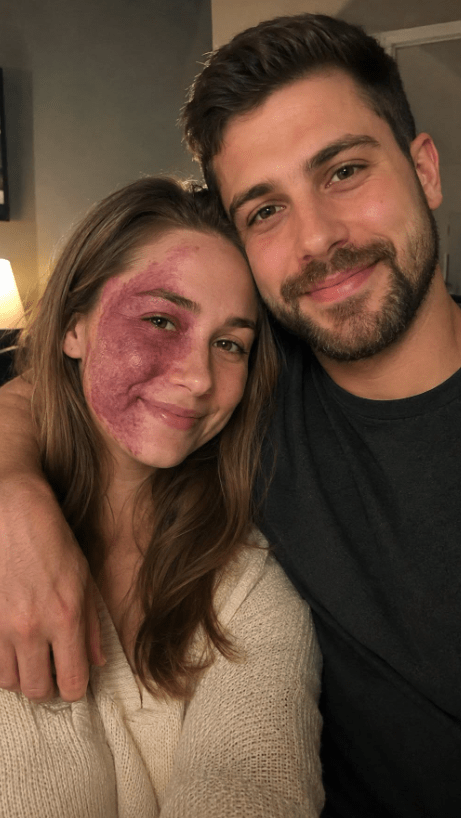
She was born with a dark red birthmark covering much of the left side of her face.
When she was little, she barely noticed it. At four, she once drew a picture of herself and colored half her face purple.
“Purple is prettier than red,” she announced proudly.
Then she started school.
Other children taught her that her face was something she needed to be ashamed of.
By seven, she knew exactly which side to turn toward the camera during group photos. By eleven, she knew how to tilt her head whenever someone pulled out a phone.
By fourteen, she refused to let me take a picture unless she could inspect it first.
Dating was even harder.
Her biological father had disappeared from our lives years earlier, leaving me to explain why a man who was supposed to love his child had simply chosen not to stay.
Henry came into our lives later.
He never tried to replace her father. He simply stayed.
He was there through birthdays, school plays, bad days, good days and everything in between. He never once treated Marissa like a stepdaughter.
Eventually, she stopped expecting him to leave too.
Still, she never brought a boy home.
Not once.
Until six months earlier, when she called me.
“Mom… I met someone.”
And now that someone was standing on our doorstep.
I opened the door.
Graham was handsome in that effortless, slightly annoying way some people are.
For one terrible second, a thought flashed through my mind.
Please don’t let this be another cruel joke.
I hated myself for thinking it.
Graham handed me a bottle of wine.
“Mercy?”
“That’s me.”
“I’m Graham.”
Before I could answer, Marissa appeared behind me.
“Hi, Graham.”
His entire face lit up when he saw her.
Dinner went better than I could have hoped.
Graham asked about Henry. He listened while I told him about raising Marissa before Henry came into our lives. He knew which ingredients Marissa hated in lasagna. He refilled her glass while she talked and never interrupted her.
At one point, Marissa started telling us about a disastrous weekend trip they had taken.
Graham pulled out his phone.
“No,” she warned.
“Oh, yes.”
He showed me a photograph.
Marissa was standing beside a dead campfire, her hair blowing across her face, laughing so hard that her eyes were almost closed.
Her birthmark was completely visible.
There was no flattering angle.
No carefully chosen lighting.
Nothing hiding it.
Years ago, she would have snatched the phone from his hand.
Instead, she sighed.
“Let me see.”
“Delete it.”
“Is it really that bad?”
“That photo is evidence of a crime.”
We all laughed.
After dinner, Marissa suddenly stood.
“I forgot the cheesecake. I’ll be right back.”
She disappeared upstairs.
Graham put down his fork.
The warmth disappeared from his expression.
He leaned toward me.
“I’ve done my part of the deal. Now it’s your turn.”
My hands went cold.
“What deal?”
He gave a nervous laugh.
“Mercy, please tell me Henry explained everything.”
“Explained what?”
My mind raced.
Had Henry paid him?
Had he somehow arranged this relationship?
“If someone paid you to date my daughter…”
Graham stared at me in shock.
“What? No!”
“Then what deal are you talking about?”
“Come with me.”
He led me outside.
At the far end of the yard, someone was standing beside the shed.
Then the garden light came on.
I gasped.
“HENRY?”
My husband raised both hands.
“Hi.”
“You’re supposed to be four hours away!”
“I was. This morning.”
“And you didn’t tell me?”
Henry glanced toward something covered beside the shed.
“If I had, it would have ruined everything.”
Graham pulled off the cover.
Underneath was an old cream-colored vanity table.
I knew it immediately.
I had bought it for Marissa when she was six.
The little drawers. The round mirror. Even the tiny crack along the top.
I remembered her sitting there for hours, singing into a hairbrush and covering herself in glitter she called makeup.
Years later, she had moved the vanity into the garage.
“I don’t want something in my room whose only job is to look at me,” she had told Henry.
I thought we had thrown it away.
We hadn’t.
Henry had spent weeks restoring it.
Just then, Marissa stepped outside.
“Why is my old vanity here?”
Henry looked at her.
“Because you never told me to throw it away.”
Marissa walked closer.
Graham finally explained.
Months earlier, he had asked Henry what he thought about proposing to Marissa.
Henry hadn’t given him permission. Marissa didn’t need anyone’s permission.
Instead, he asked Graham one question.
“What do you like most about her face?”
Graham hadn’t known how to answer.
“I didn’t know how to answer without making it sound like I was picking her apart,” he admitted.
So Henry told him about Marissa’s habit of checking every photograph.
“Do I look okay?”
“Can I see it?”
“Delete that one.”
Then Henry asked Graham not to constantly reassure her.
Just love her normally.
And if one day she stopped checking every photograph, he wanted Graham to tell him.
“That was the deal,” Henry said.
“And I restored the vanity if that day ever came.”
Marissa sat in front of the mirror.
I almost said, “You’re beautiful.”
But I stopped myself.
She leaned closer.
“Oh my God.”
“What?” I asked.
She pointed at her hair.
“Is that a gray hair?”
Graham burst out laughing.
“Marissa, there might be several—”
“If you finish that sentence, there will be no wedding!”
Henry started laughing too.
And I finally understood something.
For years, I had thought protecting my daughter meant making sure nobody noticed her birthmark.
But perhaps, without realizing it, I had taught her to notice it first.
Marissa reached for my hand.
“You were just trying to help, Mom.”
“I know. But I need to learn when you don’t need my help.”
That night, we carried the vanity to Marissa and Graham’s apartment.
Later, as we were leaving, I looked back one last time.
Marissa was sitting in front of the mirror, taking off her earrings. Graham stood behind her, brushing his teeth.
Their eyes met in the reflection.
“Stop staring at me, you weirdo,” Marissa teased.
“I’m brushing my teeth.”
“You’re staring suspiciously hard.”
Graham flicked some water at her.
She squealed.
For a moment, I almost walked back inside.
My old instinct told me to check on her. To protect her. To make sure everything was okay.
But this time, I closed the door.
Because sometimes loving your child doesn’t mean protecting them from every possible hurt.
Sometimes it means trusting them enough to know when they need you—
and having the courage to step back when they don’t.

