The Signature They Demanded
“If you’re so obsessed with paperwork, sign this too—and finally get out of our company.”
My husband, Gergő, didn’t move a muscle.
He knew full well what his mother was demanding of me. He also knew that just three days earlier, he had begged me not to sign anything until the two of us spoke alone.
Yet there he sat beside me in the dining room of the family house in Székesfehérvár, studying the breadcrumbs of breaded pork left on his plate as if our marriage had nothing to do with any of it.
“Mom, maybe keep it a little calmer,” he said eventually.
“Calmer?” Ilona snapped. “She’s been living off our family for twelve years, and now she’s standing in the way of my own daughter finally getting what she deserves!”
My sister-in-law, Réka, stood by the window. She was thirty-four and had moved back to Székesfehérvár from Budapest two months earlier after losing her job at an event-planning agency. Before that, she had shown up at our family business maybe four times a year—usually before Christmas, wanting to put together gift packages for clients.
Now she wanted my seat.
“Zsófi, don’t make this personal,” Réka spoke up. “Mom just wants the company to stay genuinely in the family.”
I looked at her. “And what have I been until now?”
Réka shrugged. “You’re Gergő’s wife. That’s different.”
My mother-in-law nodded with satisfaction. “Exactly. Marriage isn’t blood. Anything could happen between you two tomorrow, and then our business’s fate would be in a stranger’s hands.”
Slowly, I pulled the papers from the folder.
At the top of the first page: Business Share Transfer Agreement.
The second document was my resignation as managing director.
The third was a general waiver stating that I had no further claims against the company.
I paused at the last one. “Who drafted these?”
“A lawyer,” Ilona answered.
“Which one?”
“Does it matter?”
“Yes.”
Gergő finally looked up. “Zsófi, just look them over. You don’t have to sign right here.”
Ilona shot him a look that silenced him immediately.
And suddenly, something clicked for me. This wasn’t just a Sunday lunch gone sour. The decision had already been made without me.
Twelve Years Behind the Scenes
Twelve years earlier, when I met Gergő, his family ran a small metalworking shop on the outskirts of Székesfehérvár. His father, Lajos, made railings, staircases, and custom metal components. Four people worked there; Lajos kept track of invoices by hand in a worn notebook and handled clients mostly by phone.
Back then, I worked as a procurement coordinator at a local construction firm. I wasn’t wealthy—I rented a two-bedroom apartment and budgeted carefully every month—but I understood contracts, deadlines, and how to keep a small business from falling apart the moment a major order came in.
When Lajos had to step back for months due to heart trouble, Gergő asked for help in sheer desperation. We weren’t even engaged yet. For three months, I worked evenings for free organizing invoices, talking to suppliers, and setting up a basic order tracker.
Later, I quit my job. The workshop became an LLC (Kft.), and I received a 20% stake after putting in a substantial share of my savings. Gergő held 50%, and Lajos held 30%. When Lajos passed away four years later, his children inherited his share, leaving Gergő with 65%, Réka with 15%, and me with 20%.
Gergő and I ran the company as co-managing directors with clearly divided roles. I handled finances, major contracts, and administration; Gergő oversaw the shop floor, production, and technical work. In six years, we grew to nineteen employees.
Mostly, my mother-in-law saw her son leaving for work at six in the morning while I occasionally handled tasks from home. “Easy for you sitting in front of a computer,” she used to say. “My boy supports the company.”
For a long time, I let it go. I didn’t want every family lunch to turn into an argument. That Sunday, though, I couldn’t stay quiet.
“Fine,” I said, closing the folder. “If you want me out, we can talk about it.”
Gergő’s face relaxed. Réka smiled. Ilona leaned back. “There we go. I knew we could reason with you.”
“On one condition,” I added. “My own lawyer reviews every document. We bring in an independent appraiser to value my share, and until the transfer, I’ll only fulfill existing obligations. I’m not signing any new contracts.”
Ilona’s smile vanished. “What new contracts?”
“Any of them.”
Gergő sat up straight. “Zsófi, let’s at least hold off on the Győr project…”
I stared at him. The Győr project—the contract I’d been asking to discuss for three weeks, whose annexes he still hadn’t sent me, scheduled to be finalized Monday morning. For the first time, he looked at me as if he grasped what my leaving actually meant.
“You’ll still sign that one, right?” he asked quietly.
“I don’t even know what you want me to sign.”
Réka chimed in: “Gergő, don’t worry. I’ll handle it.”
In that moment, I knew my sister-in-law wasn’t just eyeing my chair. She had already promised something to someone.
The Hidden Contract and the Bank Clause
I arrived at the office at 7:20 a.m. on Monday. The plant sat on the edge of an industrial park behind a small office wing, where the same gatekeeper had waved me in for eight years. Machines were already running. None of my coworkers knew about Sunday lunch—or so I thought.
On my desk lay a plain white envelope with no return address. Inside was a printed email and a short handwritten note: “Zsófi, please read this before signing anything. I don’t want trouble, I just don’t want the blame later.”
The printed email was from Réka to a financial advisor in Budapest, asking how quickly a new managing director could be registered and bank account signatories updated. One line stood out: “The departure of the current financial managing director is already decided; only the formal handover remains.” It was dated two weeks earlier. While Gergő told me his mother was just angry, Réka was already arranging my exit.
I called our accountant, Judit. Before I could even ask my question, she asked if Réka was really taking over finances. On Friday, Gergő had asked Judit to prepare data for changing bank permissions, claiming I had already agreed.
It wasn’t being pushed out of the business that hurt most—it was knowing my husband had been in on it all along.
Gergő arrived before eleven carrying two paper cups of coffee, acting like any normal Monday. When I confronted him with the printout, he called Réka “over-enthusiastic” and claimed he just wanted peace. Pressed on the Győr contract, he admitted it was worth roughly 240 million forints in its first year—with around 40 million in required pre-financing and no finalized bank loan yet.
That afternoon, I got the full draft contract directly from a client contact in Győr. Pages one through twelve looked standard. Page thirteen contained an annex naming a subcontractor: RÉKÁTOR Projekt Kft., registered at a Budapest apartment, founded six weeks earlier, with Réka as managing director. Under the terms, our company was to forward 18 million forints from the client’s advance payment to her firm for “project coordination and procurement services”—despite its having no known metalworking track record, while I had been negotiating with the client since the previous year, our engineer drew the technical plans, and our existing carrier handled logistics.
Half an hour later, Ilona walked into my office instead of Gergő. She argued her daughter needed a start, claimed company funds were family money, and eventually dropped her guard: “If you leave, Réka won’t constantly have to hear that she’s good at nothing.”
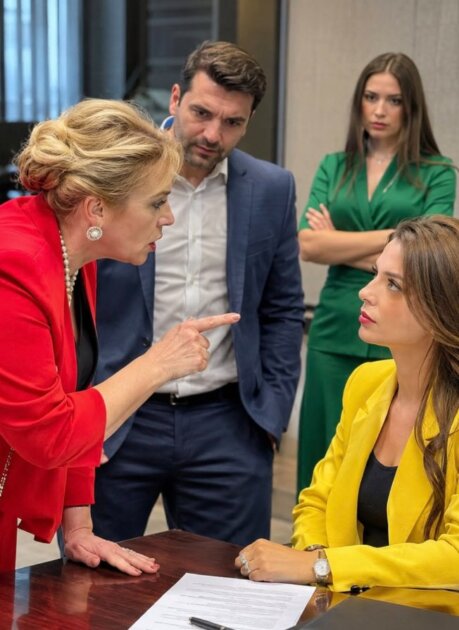
For years, Ilona had compared her children—Gergő the dutiful son carrying on his father’s shop, Réka the chronic starter-over—always finding someone else to blame for Réka’s setbacks. Helping Réka by handing her someone else’s work wasn’t help at all.
The next morning at nine, Gergő called an extraordinary members’ meeting. My lawyer, Dr. Eszter Varga, came with me. Ilona attended as “Mother,” though Eszter noted she had no voting rights. Gergő presented a revised draft cutting Réka’s fee to six million forints in three installments, still without defining the services. When Gergő pushed to buy me out and install Réka, I agreed to negotiate a share sale under lawful terms, refused to sign the Győr contract as written, and let him threaten to sign alone.
Then Eszter pulled out another document.
Three years earlier, rising energy costs and late customer payments had nearly drained our working capital. A local bank had granted us a credit line requiring joint signatures from both managing directors on key financing documents and relying on my financial control system. It also included a change-of-management notification and review clause. Leaving meant the bank could reassess the facility—the very facility needed for the Győr deal.
Gergő had wanted me to sign the contract first and leave afterward, hoping to smooth things over later. Once Eszter laid out the banking reality, Ilona turned on Gergő for not telling her, and Réka realized the business wasn’t just keys and a business card.
In the hallway afterward, Gergő admitted Réka had around eight million forints in personal debts—loans, credit cards, money borrowed from acquaintances—and needed startup capital too. That night, I stayed at my sister Nóra’s place. I still loved Gergő, but I didn’t know if I could trust him.
Boundaries, Apology, and a New Plaque
The next morning, Réka texted to meet alone at a café near the train station. Tired and out of her meeting blazer, she admitted she hadn’t known about the bank terms or how problematic the contract was, though Gergő had called the payout a standard fee. She shared how Ilona used to tell her Lajos wished Zsófi were his daughter or to be persistent like me—and said she no longer wanted my job after reading a full manufacturing contract the night before and realizing the liability she had nearly signed up for.
That afternoon, Gergő called saying his mother wanted a lawyer to settle marital finances so I couldn’t later claim half the business. I told him the saddest part was that every sentence of his started with “Mom says.”
Over the next two weeks, the Győr contract was postponed, the bank was notified of the potential leadership change and requested a new financial plan, and an independent appraiser valued my stake much higher than Ilona had expected. Eventually, Gergő asked me to stay, admitting he had gotten used to me fixing everything—including smoothing over his mother and helping Réka—and was finally seeing my boundaries.
Three weeks later, Ilona invited me to Sunday lunch with Gergő backing me up. Over soup and paprikás csirke, Ilona said Réka didn’t want to be managing director anymore and had applied for a logistics role. Voice trembling, Ilona admitted Lajos had praised how orderly the business became after his heart surgery, confessed she had feared losing her connection to what Lajos built after his death, and offered a plain apology without excuses.
Two days later, sixty-two-year-old locksmith Pista bácsi—who had worked at the shop since Lajos’s time—handed me a yellowed envelope Lajos had left for Gergő in case of a serious rift. Inside was a photo of Lajos and me by the first new sign, with a note on the back reminding Gergő that Zsófi stepped up because the family mattered to her, and that family comes from standing beside one another in trouble, not birth name.
When Gergő read it that evening, he said his father got one thing wrong: he didn’t need to choose between his mother and what was right—he needed to grow up.
The next day, we canceled the scheduled share transfer. We began looking for an external finance lead to gradually take over part of my daily administration, worked with the bank on financing terms, renegotiated the Győr deal without the unsupported subcontracting fee on a smaller scale, and helped Réka start paying off her debts through a new job without mixing family aid and company money. I cut back to four days a week, delegated more decisions, and started couples therapy with Gergő—not certain of the outcome yet, but no longer carrying everything alone.
Months later, Ilona called bringing apple pie and asked for advice on accounting internships for a neighbor’s grandchild—simply because I knew the field.
Then, on a Friday in December, Gergő mounted a new plaque beside the office entrance. Beneath the family name, smaller lettering read: “Founded by Lajos Tóth. Developed further by Gergő Tóth and Zsófia Tóth.” He had told her, without asking permission first, and carried his father’s old photo in his pocket.
Over twelve years, I had signed countless contracts affecting nineteen livelihoods. My most important decision took no signature at all—only saying I would no longer take responsibility for others while being treated as worth nothing. Strangely, they only began treating me like true family when I was ready to walk away.