What Happens When a Family Patriarch Tells a Nine-Year-Old to Walk in -9°C Snow?
“There wasn’t enough room left in the car, so Grandpa told me to walk.”
When Claire Morel heard those words, she first thought she had misheard. Her nine-year-old daughter, Léa, sat huddled in the front passenger seat with blue lips and eyelashes damp from melting snow. Claire had just found her alone on a narrow country road in the Ain department, nearly three kilometers from her parents’ house.
Outside, the thermometer read -9°C, and a sharp wind whipped across the frozen fields.
“Tell me again, word for word, what happened.”
Léa looked down.
“Grandpa let Hugo and Maxime into his SUV. Uncle Julien was in the front. I asked if I could come too because I was cold.”
Uncle Julien laughed. He said walking would do her good… and that “our side of the family ought to stop expecting everything to be handed to us.”
Claire felt her throat tighten.
“And your grandfather?”
“He looked at me through the glass. He said, ‘Learn to stay in your place.’ Then they drove off.”
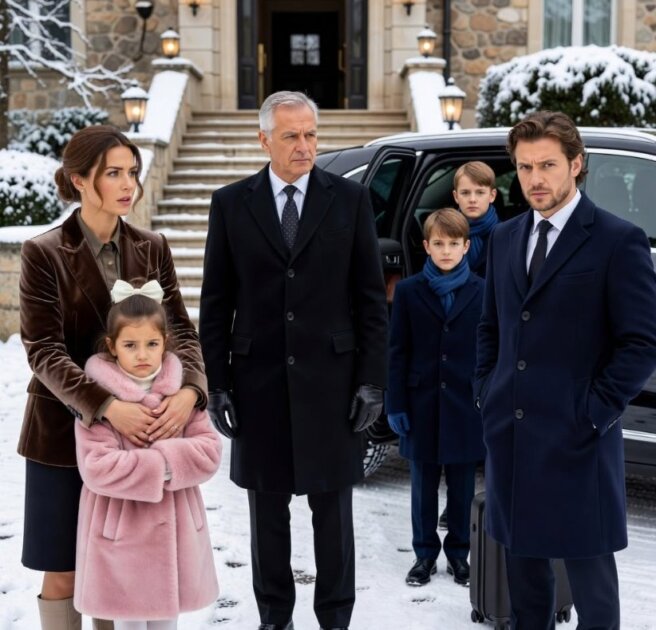
At that exact moment, her father’s large black SUV passed along the road—warm, windows rolled up tight. In the back, her nephews were playing on a console. Her brother, Julien, was laughing with a coffee in his hand.
Nobody slowed down.
Claire wrapped Léa in her own coat and pulled away.
For years, Claire’s father, Gérard Morel, had treated her like an ungrateful daughter who “abandoned the real world” to become a commercial lawyer in Lyon. Yet six years earlier, when Morel Travaux Publics was on the brink of bankruptcy, she was the one who restructured the debt, signed personal guarantees, and sent money every month to keep credit lines open.
Her father took her money without ever acknowledging her authority.
Her brother, meanwhile, boasted everywhere that the company had survived thanks to his “on-the-ground instincts.”
That evening, after warming Léa up, Claire received two messages.
Gérard: “Stop making a scene. She had a coat. Life will teach her.”
Julien: “She made it back in one piece, didn’t she? See you Sunday.”
Claire read both lines again, then opened her laptop.
She logged into the secure portal of the bank financing the family business.
One line appeared: “Monthly support to guarantee account — €8,500.”
She clicked “permanently cancel.”
Next, she opened a folder named ÉLÉONORE, her late mother’s first name.
Inside were bank statements, articles of association, shareholder agreements, and six years of audits that neither her father nor her brother knew she possessed.
Claire picked up the phone and called the bank’s risk director directly.
“Tomorrow morning,” she said calmly, “let the payment default trigger.”
Silence.
“Claire… that could bring Morel TP to its knees.”
She looked at Léa sleeping beneath the blanket.
“No. It will only show who is still standing.”
Part 2: 487,000 Euros in Hidden Leaks
At 8:12 a.m. the next morning, Claire’s phone began vibrating nonstop.
At 9:00 a.m., Gérard and Julien walked into her house without waiting for the door to open.
“What have you done?” her father shouted. “The bank blocked the fuel cards! Two suppliers are refusing to deliver!”
Julien stepped forward. “Call them right now and say it’s a mistake. You can’t destroy a company over a car ride.”
Claire slowly set her mug down. “A car ride?”
“Léa didn’t die,” Julien snapped. “She walked. End of story.”
Claire stared straight at him. “Step back.”
Something in her voice forced obedience.
Gérard shifted his tone. “Fine. I admit we could have taken her. I’ll buy her a new coat. I’ll put €500 in her savings account. Now restore the transfer. Think of the employees.”
Claire smiled, though there was no warmth in it. “You want to talk about the employees? Then let’s talk about the money Julien is stealing from them.”
She opened her laptop.
In the first file, €96,000 had been paid for alleged “site marine equipment.” In reality, it was a boat bought in the name of a company owned by Julien.
In the second file, €180,000 was written off as “earthmoving losses” on a contract Morel TP never won. That money funded a restaurant Julien opened in Annecy that closed eight months later.
In the third file, three utility vans declared out of service had been transferred for €1 to a personal entity, and then pledged as collateral for a speculative loan.
Gérard went pale. “Julien… tell me this isn’t true.”
“She’s being dramatic! It was optimization!”
Claire turned the screen toward them. “€487,000 diverted in 24 months. And you, Dad, signed off on multiple reclassifications without even reading them.”
Julien abruptly regained his confidence. “All right. Even if that were true, you’re stuck with us. You guarantee the loans. If the company goes down, you go down too. Dad and I hold the majority. You have no leverage.”
Claire opened a second document bearing her mother’s signature.
“That’s where you’re wrong.”
Gérard lifted his head. “What is that?”
“A shareholder agreement Éléonore had drawn up before she died. The agreement you never bothered to reread.”
Claire slid the updated voting register across the table. “For 18 months, I’ve been quietly buying up the shares you tried to get cheaply from former partners. Yesterday, two of them gave me proxies for an extraordinary general meeting.”
Julien’s face drained of color. “How much?”
Claire crossed her arms. “Enough to remove both of you on Friday morning.”
This time, nobody shouted.
Part 3: Building a Place Where Cruelty No Longer Pays
On Friday at 10:00 a.m. sharp, the boardroom at Morel Travaux Publics felt freezing—not only because the heat was turned down from temporarily frozen credit lines, but because the room itself felt locked in ice.
Above the long table hung a framed photograph of Éléonore Morel. Wearing a white hard hat with rolled plans under her arm, she smiled in front of the company’s very first job site in 1989.
Gérard sat on the right, slumped in a suit that had grown too large for him over forty-eight hours. Beside him, Julien had a cold expression and bloodshot eyes.
Claire took the head of the table alongside Maître Sophie Lambert, a partner at her law firm, the bank’s risk director, and two longtime former shareholders.
She opened the register.
“The extraordinary general meeting is called to order. The voting rights present and represented form the majority required under the shareholder agreement.”
Julien pushed his chair back. “This is a farce. My lawyer will file for an injunction this afternoon.”
Sophie Lambert placed a black binder in front of him. “Your lawyer can also answer questions regarding €487,000 in personal expenses charged to the company, asset transfers to affiliated entities, and several falsified records.”
Julien froze. “Who did you give this to?”
“The auditors, the bank, and a criminal attorney instructed to refer the matter to the prosecutor if the reviews confirm misappropriation,” Claire replied.
Gérard closed his eyes. “Claire… we can still settle this as a family.”
She turned toward him. “As a family?” Her voice stayed steady. “When Léa was out in the cold, she was family too. When I paid for six years so this company wouldn’t go under, I was family. When Mom worked for thirty years while you took all the credit, she was family.”
Gérard bowed his head.
Claire continued. “First item on the agenda: removal of Gérard Morel as chairman for serious breach of executive duty and failure of internal controls.”
Gérard looked up again. “You’re really going to do this to your own father?”
Claire answered without hesitation. “No. I’m doing this to the executive who let his son strip the company and let his own granddaughter walk alone in minus-nine-degree weather just to teach her ‘her place.’”
The resolution passed. Gérard lost all executive authority on the spot.
“Second item: removal of Julien Morel as deputy managing director, effective immediately.”
Julien jumped up. “Without me, you won’t have a single person left to run the job sites!”
One of the former partners, Michel Perrin, let out a dry laugh. “You never ran job sites. Site superintendents run job sites. Mostly, you ran failed restaurants and weekend trips by the lake.”
Julien remained deathly pale.
Claire went on. “Your access badges, fuel cards, and IT credentials will be deactivated at noon. An inventory of your office will be taken in the presence of a bailiff.”
“You think you’ve won?” Julien yelled. “The accounts are frozen! Payroll is due Monday! The workers will walk out!”
Claire turned to the bank director, who opened his file.
“Last night we approved a refinancing package conditioned on a leadership change and an equity injection.”
Julien caught his breath.
Claire picked up a pen. “My investment company is putting €900,000 into Morel TP. In return, the bank will lift the freeze, restore operating credit lines, and release my personal guarantees.”
She signed.
“Wages will be paid on time. Priority suppliers will be paid. Not a single job site will shut down.”
She looked at her brother. “The company isn’t failing. Only the two of you are.”
The silence that followed hit harder than any argument.
Aftermath in the Months That Followed
Over the next several weeks, the audit confirmed the core findings. Julien had used Morel TP accounts as his personal cash register: a boat, a restaurant, vehicles, fictitious expenses, speculative invoices. On his lawyer’s advice, he eventually admitted to several counts of misuse of corporate assets and entered a payment plan to avoid harsher prosecution. His house was sold. His boat was sold too. His relationship did not survive the scandal.
Gérard did not face criminal charges; investigators found a mix of negligence, pride, and willful blindness. Even so, he lost everything that fed his patriarchal image: his title, company car, expense allowances, corner office, and a portion of his shares transferred under the refinancing deal. He had to sell the large family house on the slopes of Bourg-en-Bresse to cover personal obligations.
Claire felt no gloating when she saw the real estate listing. She had never wanted his house. She simply wanted power to stop rewarding cruelty.
For six months, she served as interim chairwoman of Morel TP. Afterward, she appointed Nadia Benali as CEO—a civil engineer with fifteen years at the company whom Gérard had always refused to promote on the grounds that she “wasn’t the type to give orders to men.” Nadia cut wasteful spending, put straightforward controls in place, gave site superintendents more autonomy, and introduced performance- and safety-linked bonuses. For the first time in a long while, employees heard about the company through its work rather than Morel family feuds.
One spring morning, Claire had a bronze plaque mounted on the facade of company headquarters:
ÉLÉONORE MOREL — FOUNDER AND ENGINEER
Looking at it, she stood silent for minutes. Her mother finally had her name back.
Three months later, Gérard asked to see Léa. He wrote one letter, then another, offering to take her to the movies or a restaurant, or to buy her a bicycle. Claire did not answer for her daughter. She simply placed the letters in front of her.
“It’s your choice.”
Léa read them carefully, then shook her head. “He didn’t want me when he had his big car. Now that he doesn’t have anyone left to boss around, he wants to be nice.”
Claire felt a tug at her heart. “People can feel genuine remorse.”
“Maybe,” Léa answered. “But I still don’t want to see him.”
Claire nodded. “Then you won’t.”
That day, she understood that setting a boundary is not revenge. Sometimes it is the earliest form of safety a child learns to recognize.
A Year and a Half Later
Eighteen months after the freezing day, winter returned to Ain. Claire waited outside Léa’s school in an ordinary gray SUV chosen for safety rather than prestige. Snow fell heavily.
When Léa appeared, she ran toward the car holding a poster board against her chest.
“Mom!”
She climbed inside, shook off her boots, and proudly held up a medal. “I got first place in the school science competition!”
Claire smiled. “For what?”
“Bridge structures. My teacher says I have an engineer’s brain.”
Claire laughed. “You got that from your grandmother.”
Léa buckled her seatbelt and watched snow swirl past the window. After a few seconds, she asked, “Do you remember the day Grandpa told me to stay in my place?”
Claire placed her hand on the steering wheel. “I remember.”
“I thought about that a lot.”
“And did you find your place?”
Léa smiled. “Yes.”
Claire glanced at her in the rearview mirror. “Where?”
Léa pointed to the road ahead. “Where nobody decides for me that I have to stay in the back.”
Claire did not answer right away. Slowly, she pulled forward. The car turned onto the white road—warm, steady, quiet. This time, no child was left behind.
And Claire finally understood what Éléonore had tried to teach her all along: dignity does not mean tolerating family at any cost. Sometimes loving the people you care about means protecting those who have no power yet from those who abuse it. And sometimes the best answer to people who order you to “stay in your place” is simply building a place where they no longer have the right to say where you belong.