The Fence Behind the Sandbox: A Neighbor’s Secret and a Shared Courtyard
When my seven-year-old son ran up to the third floor in tears, I had no idea that a single afternoon would turn our entire apartment building upside down.
Bence leaned on the doorbell as if someone were chasing him. When I opened the door, he was clutching his toy car, a dusty patch standing out on his knee.
“Mom, I really didn’t do anything,” he said, sobbing. “The lady said this isn’t our yard anymore.”
I knelt down in front of him. “Which lady?”
“From the second floor. The one who always yells from the window. She took our ball too.”
In the courtyard of our apartment building in Debrecen’s Vénkert district, there was an old, well-kept playground: two swings, a slide, a sandbox, and a bench a few parents had painted together in the spring.
Bence had been playing there since he learned to walk.
That was why I first assumed there had been some misunderstanding.
Then I looked out the window.
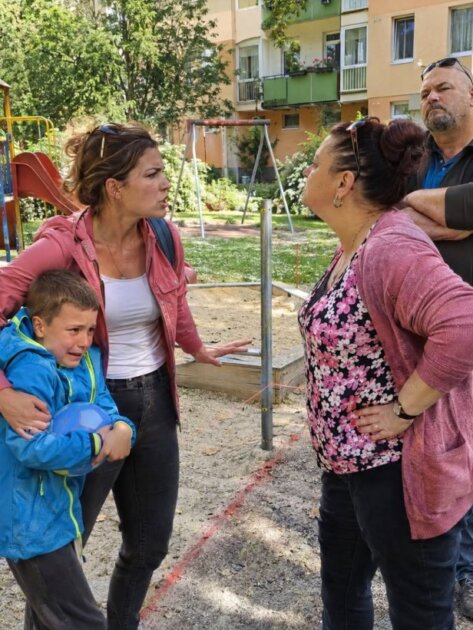
Standing beside the sandbox was Ildikó Farkas, our second-floor neighbor. In one hand she held Bence’s blue ball; with the other, she was explaining something to a young mother.
At fifty-eight, Ildikó had a firm opinion about everything. She complained about storing bicycles, watering plants in the stairwell, and once even reported someone for vacuuming at ten o’clock on a Sunday morning. Still, she had never chased a child out of the yard before.
“Stay here, sweetheart,” I told Bence. “I’ll be right back.”
Out in the courtyard, Ildikó spotted me from afar.
“If you came for your son, I hope you’ll explain to him that other people’s property must be respected!”
“What property are you talking about?” I asked.
“This area.” She gestured around. “The kids scream all afternoon. My husband is sick and needs rest. We’ve put up with it until now, but that’s over.”
“Ildikó, this is a shared courtyard. Every resident can use it.”
She smiled. “You still believe that?”
Just then, her husband, Lajos Farkas, stepped out of the stairwell.
Lajos was a former construction contractor—tall and broad-shouldered—who spoke even at residents’ meetings as if he were giving orders to his crew.
“What’s all this yelling?” he asked.
“Your wife claims my child can’t play here.”
Lajos reached into his pocket, pulled out a folded piece of paper, and waved it. “Then it’s good you’re finding out now. We’re sectioning off the back part of the yard. There’s going to be a fence behind the sandbox, all the way to the garages.”
“On what grounds?”
“Based on an owners’ decision.”
“Which owner decided that?”
“Whoever has the right to.” He folded the paper back up. “And if you know what’s good for you, don’t start making trouble.”
With that, they both walked away.
I stood there by the sandbox and noticed, for the first time, three lines drawn in red paint on the concrete.
Someone had already marked where the fence would go.
Red Paint and a Surveyor’s Sketch
That evening, my husband, Gábor, came home late from work. As an electrician, he often worked on construction sites out of town, and by the time I told him what had happened, it was nearly nine o’clock.
“I’ll talk to the building manager tomorrow,” he said.
“Do you think they can actually do it?”
“If it’s common property, they certainly can’t decide on it alone.”
The next morning, however, brought another surprise.
Pinned to the stairwell notice board was a sheet of A4 paper: NOTICE REGARDING COURTYARD MAINTENANCE.
Beneath the heading, it stated that landscaping work would begin on part of the yard, and residents were asked not to let their children near the marked area.
At the bottom of the notice was Lajos’s name.
Not the building manager’s. Lajos’s.
I took a photo of the paper and called our building manager, Éva Szabó. At first, she didn’t even know what I was talking about.
“What landscaping?”
“The one the Farkases announced.”
There was a long silence. “There was no resolution passed at a general meeting about this,” she said finally. “And no permit request came to me either.”
“Then why are they acting like it’s already decided?”
“I’d like to know that too.”
When I came home that afternoon, a white van was parked in the courtyard. Two workers were unloading steel posts from it while Lajos stood beside them holding a tape measure.
“What are you doing?” I asked.
“Preparing the work.”
“According to the building manager, you don’t have permission for this.”
Lajos’s face tightened. “Éva doesn’t know everything.”
“Then show me the paper that authorizes you.”
He stepped closer. “You’re digging in the wrong place.”
“Is that a threat?”
“A warning. Tell your husband too—it would be better if you didn’t get involved.”
One of the workers spoke up. “Uncle Lajos, it might be good to check that surveyor’s drawing one more time. The spots for the posts don’t match—”
“Just pack up!” Lajos cut in.
The worker fell silent. I, however, remembered his words. What surveyor’s drawing was he talking about? And why had Lajos gotten so nervous?
Later that evening, I ran into Aunt Ilonka on the stairs. At eighty-two, she had moved into the building with her husband when it was first finished. When I showed her the photo of the red lines, her shopping bag nearly slipped from her hand.
“Oh, my dear girl…” she whispered. “Right there they want to cut it off?”
“Why? What’s there?”
Aunt Ilonka glanced toward the stairwell door. “I thought that had been settled a long time ago.”
“What was settled?”
She took my arm. “Come up to my place tomorrow. There’s something I need to show you. But don’t let the Farkases know.”
The Old Photograph and the Outbuilding
I was awake by six the next morning. Bence was sleeping peacefully, and Gábor was making coffee in the kitchen.
“I don’t like the look of this,” Gábor said when I told him what Aunt Ilonka had said.
“What do you think she knows?”
“No idea. But if Lajos really is hiding something, he’s not rushing to build a fence by accident.”
Just after eight, I went up to the fourth floor. Aunt Ilonka was already waiting. On her living room table lay a yellowed envelope filled with old photographs and a hand-drawn sketch of the courtyard.
When I looked at one of the photos, I froze. Where the playground stood today, there had once been a vegetable garden. Standing at the edge of the picture was a young Lajos. Beside him was someone I recognized immediately—even though that man had supposedly been dead for eighteen years.
It was Gábor’s father, István Varga.
I had never met him in person; Gábor was twenty when his father passed away, though I had seen his face often in family photo albums.
“What was my father-in-law doing here?” I asked.
Aunt Ilonka looked surprised. “Didn’t you know? István was the building caretaker for years. He organized the yard cleanup back then.”
Gábor had never mentioned it.
Aunt Ilonka pulled out another photo. “He came up with the playground idea too. There were lots of young kids living here back then. The residents pitched in money, and István got everything sorted.”
“And Lajos?”
“He had just moved in. At first, they were very good friends.” The old woman slowly put the photos back. “Then they fell out.”
“Over what?”
“Over the yard.”
It turned out there had once been an old, unused storage shed behind the building. The residents tore it down and incorporated the space into the shared courtyard. At the time, Lajos wanted garages built on the cleared land, while István insisted on keeping the green space and the playground.
“The general meeting sided with István,” Aunt Ilonka said. “Lajos never forgave him for that.”
“That was more than twenty years ago.”
“True enough. Only Lajos never forgot.”
I brought copies of the photos home and showed them to Gábor. When he saw his father, he stayed quiet for a long time.
“I remember that shirt,” he said at last. “Mom sewed it for him.”
“Why didn’t you tell me your dad worked here?”
“Because when we were kids, we didn’t talk about it much. Dad worked non-stop—here and elsewhere. Then when he got sick, he stopped everything.” Gábor stared at the photo. “You know what’s strange? After Dad died, Lajos came to see Mom once. He was looking for papers. Said it was because of some old settlement.”
“Did she give him anything?”
“Mom sent him away.”
The next day, Éva called an extraordinary general meeting for the following week and sent Lajos a written notice telling him not to start work until then.
Lajos didn’t wait for the meeting.
On Friday morning, we woke to the rattle of a hammer drill in the yard. The workers had already drilled two holes into the concrete. Gábor went down right away, and Bence and I followed a few minutes later.
“Stop the work!” Gábor shouted.
At first, Lajos acted as if he hadn’t heard.
“I said stop! You don’t have general meeting approval.”
“Young man, don’t lecture me in my own yard!”
“This isn’t your yard!”
Lajos swung around toward Gábor. “You’re just like your father. He was always sticking his nose into everything too.”
Gábor’s face went pale. “Leave my dad out of this.”
“It started because of him!”
The yard fell silent. Ildikó stepped quickly beside her husband. “Lajos, come inside.”
But he was too angry. “Your father thought he could rule over everyone! And now the son wants to tell me what I can do?”
Gábor answered calmly. “My father died eighteen years ago. You started tearing up a shared courtyard on your own this morning. The two have nothing to do with each other.”
The workers finally stopped. Éva arrived as well and stated that the condominium association would take legal action if construction continued. Lajos withdrew in a rage.
I thought we had bought ourselves a few days. I was wrong.
Sunday evening, someone slipped an envelope under our door. Inside was a copy of a land registry map and a short, anonymous note: “Don’t just look at the playground. Look at where the fence leads.”
Gábor and I spread the map out on the table. The boundaries of the building’s plot were clear, but the planned fence wouldn’t just cut the playground in two—it would also block the path leading to a long-closed outbuilding at the back of the yard.
No one had set foot in that outbuilding for years. At least, that’s what we thought.
On Monday after work, Gábor and I walked around the small brick structure. Its windows were dirty and a rusty padlock hung on the door, but along the wall in the muddy earth we saw fresh tire tracks.
“Someone comes in here regularly,” Gábor said.
“Who?”
We got our answer the next morning when Éva called.
“I spoke with the land registry office and checked the building’s records,” she said. “Something is seriously wrong.”
The outbuilding was common property of the condominium; according to the land registry, there was no separate privately owned plot attached to it. Months earlier, however, Lajos had hired a surveyor to draw up a sketch showing a separable usage area around the outbuilding. That alone gave him no ownership rights.
Yet there was another document: a copy of minutes from a general meeting twenty years earlier, in which Lajos claimed the residents agreed he could have exclusive use of the outbuilding and the area in front of it. Several signatures appeared at the bottom—including István Varga’s.
“That’s impossible,” my husband said. “Dad wouldn’t have signed that.”
“We can’t be sure yet,” Éva replied. “We have to find the original document.”
Things grew increasingly awkward. Lajos began telling neighbors that Gábor was only objecting to cover up his father’s old affairs, and some believed him. One evening on the second-floor landing, an older man stopped Gábor.
“If your dad agreed to it back then, what’s all this circus now?”
Gábor didn’t answer. At home, though, he was angrier than I had ever seen him. “Dad was an honest man. I’m not going to let anyone smear his memory.”
Then I remembered Aunt Ilonka’s envelope. I went back upstairs to her.
“Do you happen to have any papers from that old general meeting?”
She thought for a long time. “I don’t. But I know who kept everything.”
“Who?”
“István’s wife. Gábor’s mother.”
The General Meeting and the Hidden Business
My mother-in-law, Aunt Marika, lived in a small house with a yard in Hajdúsámson. When we called her, she took the news with surprising calm.
“I knew Lajos would bring this up again someday,” she said.
We drove out to see her the next afternoon. Aunt Marika placed an old black ring binder on the kitchen table.
“Your father left this with me,” she told Gábor. “He asked me that if Lajos Farkas ever talked about the old yard again, I should give it to whoever is the building manager then.”
“Why didn’t you give it over earlier?”
“Because nothing happened for years. I thought Lajos had finally left the building alone.”
Inside the binder were bills, letters, minutes from general meetings, and handwritten notes. One document stood out: the original minutes from the general meeting twenty years ago. Lajos’s proposal for exclusive use of the outbuilding was indeed recorded there—and voted down by the majority of owners. István’s signature was at the end, too, not under an approved agreement, but on the attendance sheet.
Someone had copied signatures from the attendance sheet onto another document.
We notified Éva immediately.
The evening of the general meeting, the ground-floor storage room was packed. Some people brought folding chairs; others stood along the wall. Lajos arrived in a smart jacket carrying a thick folder, with Ildikó sitting beside him.
He began speaking confidently. “Esteemed co-owners, I would like to finally close this artificially stirred-up dispute. I have had a legitimate usage claim to this area for twenty years.”
Éva asked him to present his papers. Lajos pulled out the copy of the minutes.
Then Gábor stood up. “We have my father’s original documents too.”
Lajos froze with the paper in his hand. Éva placed the documents side by side so everyone could see the difference. One set of minutes showed the proposal rejected; the other showed it accepted, bearing the exact same signatures in the same order as the original attendance sheet.
“That doesn’t prove anything!” Lajos snapped.
“Then the proper legal procedure will clarify it,” Éva said.
From the back of the room, someone asked, “Lajos, what do you even need that old building for?”
He didn’t answer.
Then Petra, the young owner of a ground-floor apartment, spoke up. “I know what for.” She turned to face everyone. “For three weeks, strangers have been coming into our courtyard. One of them rang my bell by mistake once and said he was looking for the storage unit he rents.”
Lajos’s face turned red. “It’s none of your business who my guests are!”
“Except he wasn’t a guest,” Petra continued. “He said he pays forty-five thousand forints a month to store his business tools there.”
Several people began talking at once. Éva raised her hand. “Quiet, please. Lajos, is this true?”
After a long silence, he shrugged. “The building’s been unused for twenty years. At least someone’s making use of it.”
“And where is the rent being paid?” Éva asked.
“To me.”
“Since when?”
“None of your business.”
It was very much our business. From records gathered later and conversations with the renters, we learned that Lajos had been collecting money for the shared outbuilding for more than three years without any agreement with the condominium. He wanted to put up the fence so the path to the storage space would look like exclusive territory and renters wouldn’t have to walk past the playground.
The playground hadn’t bothered him because of children’s noise. It was in the way of his business.
Reconciliation and a Lasting Legacy
The story didn’t end there. After the meeting, Ildikó caught up with me in the stairwell. At first, I braced for another argument. Instead, she spoke quietly.
“Could we talk privately?” She held Bence’s blue ball. “I wanted to give this back.”
I took it from her. “Why did you hurt my son? He didn’t do anything.”
Ildikó wiped her eyes. “I know.”
“Then why?”
A long silence followed. “Lajos said if the kids disappeared from there, the others wouldn’t pay as much attention to the yard either. So I did what he asked.”
“You humiliated a seven-year-old so your husband could make money.”
“You’re right,” she whispered.
I couldn’t bring myself to feel sorry for her. Then she said something I hadn’t expected.
“You know, my husband hasn’t had a construction business for a long time. It closed two years ago. Our last savings are gone too. I didn’t know he was hiding money from the storage space. I thought he only wanted to fence off the yard because of his old grudge.”
“Then why help him?”
Ildikó lowered her head. “Because I was afraid we’d lose everything all over again.”
I didn’t answer. There were no words that could express both my anger and my understanding of her desperation.
Over the following weeks, the association took action with the help of a lawyer. The unauthorized use was ended, the tools were removed from the storage building, and the fence plan was dropped for good. The holes already drilled into the concrete were repaired at Lajos’s expense. Later, residents agreed to renovate the outbuilding together and turn it into a lockable bicycle shed.
More than anything, Gábor was glad his father’s name had been cleared. One Saturday morning, we took out the photo of István standing beside the playground while it was still being built. Gábor looked at it for a long time.
“Dad always used to say a person doesn’t become a good neighbor by liking everyone,” he said. “They become one by staying decent even when they disagree with someone.”
In the spring, the residents refurbished the playground together. We brought in new sand, repainted the swings, and planted two young trees beside the old bench. Bence ran around happily with his friends.
One afternoon, I noticed my son talking to someone by the bench. It was Ildikó. My stomach tightened, and I was about to walk over when Bence ran up to me.
“Mom, you know what Aunt Ildikó said?”
“What?”
“That she’s sorry for sending me away back then. And that now every kid really can play here.”
“What did you say to her?”
Bence thought for a moment. “That it’s okay. Just not to take my ball next time.”
I laughed and pulled him into a hug.
A few days later, Gábor mounted a small wooden plaque on the bench next to the playground, unanimously approved at a general meeting. It read:
In memory of István Varga, who believed a courtyard is most beautiful when it belongs to everyone.
When Aunt Marika saw it, tears filled her eyes. Yet the most moving moment was still ahead. Bence walked over to his grandmother and asked, “Grandma, did Grandpa really make this playground so kids would have a place to play?”
“Yes, sweetie.”
“Then did he know I’d play here someday too?”
Aunt Marika stroked his cheek. “He couldn’t have known that, darling.”
Bence looked toward the swings. “Well, I think he’d be happy about it.”
Gábor put his arm around his mother. Watching them, I thought how strange life can be: one man held onto anger for twenty years over a lost vote and was ready to put up a wall between people just to prove himself right, while another man, long gone, brought neighbors together through what he left behind.
That night, after Bence went to bed, I looked out into the courtyard one more time. The freshly painted swings stood still in the lamplight, and the breeze gently moved the leaves of the two young trees beside the bench. On the second floor, Ildikó’s window was open; Lajos’s I hadn’t seen open in weeks.
The next morning, Bence took my hand before leaving for school.
“Mom, they’ll never build a fence here, right?”
“I hope not, sweetheart.”
“Because you know what I thought?”
“What?”
“If someone fences everything off for themselves, they end up all alone inside.”
For a moment I couldn’t speak. Then I squeezed his hand. He was seven, yet he understood what had happened in our courtyard better than some adults.
Walking toward school together, I thought back to the afternoon he ran up the stairs crying. Back then, I thought I was only standing up for a ball and a playground. In the end, it turned out to be about much more: that in a shared home, no one should claim extra rights just because they speak louder than everyone else—and that sometimes the most important inheritance isn’t an apartment, a plot of land, or a bank account, but a place where our children never have to ask permission to laugh happily.