
“Since You’re No Longer Part of Our Family, Give Back the Earrings!” My Sister-in-Law Demanded. I Returned Them, Never Suspecting That They Weren’t the Only Reason She Had Come…
Rita called me on Wednesday, just as I was struggling to reconcile the accounts for a businessman’s five auto parts stores. The delivery notes were scattered across three different folders. I had found some in his car’s glove compartment, and he had even sent me a photograph of one on a napkin. Needless to say, I had already run out of patience for the day.
“Nadya, it’s Margarita,” Rita introduced herself, as she always did, as if I had at least twenty Margaritas saved in my phone.
“Hi, Rita. What’s happened?”
“Since you’re no longer part of our family, I’d like you to return Grandma’s earrings.”
I put down my pen.
“Which earrings?”
“Don’t pretend you don’t know! Mom’s. The ones with rubies. Grandma gave them to Mom, and she wanted them to stay in the family. You’re no longer one of us, so it’s time to give them back.”
I almost laughed. Not because what she said was particularly funny, but because I remembered how those pieces of jewelry had ended up in my possession.
Five years earlier, after the funeral, Rita herself had pressed the little velvet pouch into my hand.
“Keep them, Nadya! They’ll be safe with you. Kira loses everything.”
The earrings had been resting in one of my dresser drawers ever since. I had never worn them, and no one else had ever asked to borrow them.
I could have reminded Rita of all this, but instead I simply said:
“Fine. Come and get them. I’ll give them to you.”
There was silence on the other end of the line.
“That’s it?” she finally asked. “You’re not going to argue? You’re not going to list all the things you’ve done for us?”
“Rita, I’m working. Would Saturday at noon suit you?”
“Yes. Pasha and I will come. And while we’re there, we’ll talk about Grandma, too.”
My pen stopped moving.
“Which grandma?”
“Nadya, don’t start!”
And with that, she hung up.
There was only one grandmother in this story, and she was sitting in the next room in her favorite armchair, with her glasses pushed up onto her forehead.
Grandma Klava was eighty-eight years old and had a remarkable ability. She could barely hear the television, so she constantly asked me to turn up the volume. But if I was talking to someone in the next room, she never missed a single word. She remembered people’s tone of voice as easily as other people remembered their shopping lists.
When I walked into her room, she spoke before I even had a chance to look at her.
“Margaritka called. She’s coming for the earrings.”
“Rajisa’s earrings, the ones with rubies. You don’t mind, do you, Grandma Klava?”
“Why would I mind? If she wants them, give them to her! Rajisa found them heavy, too. She had thin earlobes. Margaritka has the same kind. She probably won’t wear them either. She’ll put them in a drawer and take them out from time to time just to count them.”
She lowered her glasses on her nose and gave me one of those looks only she could manage.
“But remember one thing, Nadya, sweetheart! Margaritka never comes for just one thing. She always comes for two.”
“And what’s the other thing?”
“You’ll find out on Saturday.”
Then she turned back to her television show and turned up the volume.
At the time, I had no idea just how right she would be.
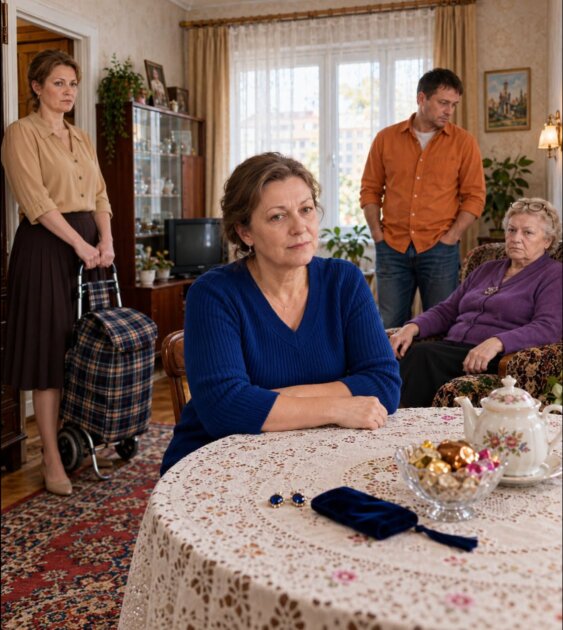
To understand why Grandma Klava was living with me, we need to go back five years.
Rajisa, Stas’s mother, died unexpectedly one February night. Grandma Klava lived in a tiny one-room apartment on the fifth floor of an old building without an elevator. After the funeral, it quickly became clear that she could no longer manage on her own.
She could still make her way downstairs, stopping two or three times to rest, but she could no longer manage the climb back up.
The family gathered to decide what to do with her. We met at Rita’s apartment because they had a larger living room and a snow-white sofa that Rita was particularly proud of.
“I have a shop,” she began immediately. “I haven’t had a single day off in two weeks. Pasha works twelve-hour shifts. Kira is in her final year of school, and her exams are coming up. Stas is always on the road. Everyone has their own problems, Nadya.”
“I have to work, too,” I replied.
“But you work from home!” Rita shot back. “It’s easier for you.”
Stas joined in.
“Nadya, what would be so difficult about it? You’d only have to take her in for a little while.”
That “little while” turned into five years.
Meanwhile, Grandma Klava sat on a small stool in the hallway. Nobody invited her to sit on the beautiful white sofa. She heard every word but didn’t interrupt. She only raised her head when everyone else had finally fallen silent.
“I’ll move in with Nadya if she agrees. But bring my armchair over! Your sofa is like a sack stuffed with feathers. I’m never getting up from that thing again.”
The old armchair remained on the fifth floor. Nobody felt like carrying it downstairs, so the apartment was locked up just as it was. Grandma Klava refused to rent it out to strangers and continued paying the electricity and water bills.
I, on the other hand, ordered her a new armchair with a high seat and sturdy armrests that would help her get up more easily.
It cost 13,900 rubles. Delivery was free because I had also added a rug to my shopping cart.
I’m an accountant. If I’m going to spend money, I might as well make sure the numbers add up.
It soon became clear that living together with Grandma Klava would never be boring.
She had spent thirty-four years working behind the counter of a household goods store on Koltsovskaya Street, and even in retirement, she evaluated everything as if customers were still standing in front of her.
“We used to sell this frying pan for four rubles and twenty kopecks,” she said one day, tapping my cast-iron pan with her fingernail. “A person could leave one of those to their grandchildren. And what is this?”
“A new frying pan, Grandma Klava.”
“I can see it’s new. You paid eleven hundred rubles for it, didn’t you? It shines like a Christmas ornament, but when you actually try to fry something in it, I bet it gets offended.”
Her pension was delivered to our home by Aunt Sura, the postal worker. Grandma Klava always counted the money twice in front of her, and Aunt Sura patiently waited.
Every month, Grandma Klava gave me ten thousand rubles for groceries.
At first, I protested, but one day she looked at me so seriously that I never dared argue again.
“I’m not a dependent. I’m a tenant. Tenants pay rent.”
She kept the rest of her pension for herself. I never asked what she was saving for. Anyone who had spent thirty-four years counting other people’s small change hardly needed help managing her own savings.
Stas left me a year before Rita called about the earrings.
It started in June. For days, he wandered around the apartment as if everything had suddenly become too cramped for him: the living room, the kitchen, our marriage, perhaps even me.
Then one evening, he announced that he wanted to live independently for a while.
A week later, I discovered that his idea of independence involved Oksana, a colleague from work.
After twenty-four years of marriage, I didn’t make a scene. I simply sat on the edge of the bed and thought about how strange it was that, after sharing an entire life with someone, all that remained in your hands was a single suitcase of belongings.
We handled our divorce at the civil registry office because we had no minor children. Dividing our property didn’t take long, either. The car and our savings went to Stas, while the apartment remained mine.
My lawyer, Yulia Mikhailovna, explained in her calm, slightly tired voice:
“The property settlement has been notarized. Everything is legally in order.”
As for Grandma Klava, Stas called a week after he had taken his last box away.
“Nadya, let Grandma Klava stay with you for now! I’m renting a place, and there’s only a sofa there.”
“And how long is ‘for now’ supposed to last?”
“Until I get things sorted out.”
“What things?”
“Nadya, please don’t start! I’m working.”
He hung up.
That was the whole conversation.
He didn’t ask what I had going on in my life. He didn’t care how I would manage my work, the household, and the care of an elderly person. He simply assumed I would take care of everything.
And I did.
He worked, I worked, and Grandma Klava sat in her armchair, occasionally remarking that people these days couldn’t even manufacture a decent frying pan.
When Rita called on Wednesday, I visited Yulia Mikhailovna that evening.
“The earrings aren’t part of your property,” she explained. “They belonged to your former mother-in-law, and the heirs are your ex-husband and his sister. If you want to return them, you can. If you don’t, nobody can force you to.”
“And what about Grandma Klava? Rita said we needed to talk about her, too.”
My lawyer’s expression grew more serious.
“Then remember this carefully! If Grandma Klava is mentally competent and capable of making her own decisions, she gets to decide where she wants to live. Neither her grandson nor his sister can take her away against her will.”
“And what if she wants to move out herself?”
“Then, of course, she has that right. But you must ask her first, rather than making the decision on her behalf.”
On my way home, I called Stas.
“Rita is coming for the earrings on Saturday. I’ll give them to her.”
“Fine,” he replied indifferently. “Let her take them! What would I want them for anyway?”
“And what about Grandma Klava?”
“Nadya, I’m working.”
He hung up.
That same evening, I knocked on the door of our neighbor, Galina. We had lived next door to each other for eleven years, and Galina was famous for never wrapping her opinions in decorative paper.
She listened to everything I had to say, then folded her arms.
“Give them the earrings! Let them enjoy their rubies. But don’t give them Grandma if she doesn’t want to go! She’s settled in with you, Nadya. At her age, home isn’t just four walls. It’s knowing who will come into your room at night when you’re thirsty.”
I didn’t answer immediately because I knew she was right.
On Saturday, Rita arrived with Pasha at exactly noon.
Her husband was pulling a large, checkered rolling suitcase behind him. He lifted it over the threshold as though he were afraid the very presence of the suitcase might be considered an insult.
“Hi, Nadya!” Rita greeted me.
“Hi. Here you go.”
I handed her the velvet pouch.
Rita tipped the earrings into her palm, then turned toward the window and examined them in the light. She studied the rubies as if she suspected someone had replaced them with glass during the past five years.
“Are they both here?”
“Both of them.”
“Thank you for not making us argue,” she said, carefully putting them away in her bag. “I thought this would be harder.”
Then she turned to Pasha.
“Take the suitcase into the bedroom!”
Pasha stopped.
“Which bedroom?”
Rita looked at him as if he had asked a stupid question.
“Grandma’s bedroom. Nadya, we’re taking her back with us, too. We have a room available now that Kira has moved out. Mom would never forgive us if her own mother were living with a woman who isn’t even family.”
Pasha scratched the back of his neck awkwardly.
“Rita, shouldn’t we have asked her what she wanted first?”
“Pasha, don’t you start, too!”
“I’m just saying that maybe…”
“That’s enough!”
That was when I finally understood what Grandma Klava had meant when she said Rita always came for two things.
The earrings and Grandma.
Grandma Klava was sitting in her armchair. She wore a beige blouse with her favorite brooch pinned to it, the one she usually wore on special occasions. Her hair was neatly combed, and she had her shoes on.
I looked at her and immediately understood: she knew everything. Perhaps she had been preparing for this conversation for days.
Rita walked over to her.
“Grandma, come on! Let’s pack your things.”
“Where are we going?”
“Home. Back to the family.”
Grandma Klava looked her up and down.
“I’m already with family, Margaritka.”
Rita let out an impatient sigh.
“Grandma, don’t do this! Stas and Nadya are divorced. Nadya is no longer your relative.”
“I know they’re divorced. But I haven’t divorced anyone. I don’t even have papers saying I have.”
“Please, don’t joke around now! Pasha and I have discussed everything. You have a place with us. We’ll pack your belongings, and then we’ll leave.”
“And I’m not going anywhere.”
Rita turned to me.
“Nadya, tell her, too!”
“Tell her what?”
“That this is the right thing to do!”
“Rita, I’m not keeping her here against her will. If you want her to come with you, ask her properly!”
“That’s exactly what I’m doing!” she snapped. “Grandma, get up!”
Grandma Klava gripped the armrests of her chair with both hands.
“The earrings are yours. You have them now, so wear them in good health! But I belong with Nadya.”
For a moment, even the air in the room seemed to stand still.
Rita’s face turned red.
“You don’t even know what you’re saying!” she said, suddenly adopting an entirely different tone. Her voice became as sickly sweet as a kindergarten teacher’s when speaking to a tantrum-throwing child. “You’re old, and they’ve obviously turned you against us here.”
“I am old,” Grandma Klava agreed. “But my mind still works.”
Then she thoughtfully folded her hands in her lap.
“I remember what you brought me last New Year’s. A chicken. So tiny that even a sparrow would have felt sorry for it. I bit into one side, and there was nothing but bone on the other. I wasn’t offended because I know how much things cost.”
“We were working!” Rita snapped.
“Exactly! So what has changed now? Have you stopped working, or did you simply happen to have a spare room become available?”
Rita opened her mouth, but no sound came out.
A few seconds later, she managed to speak.
“People keep asking why our grandmother is living with our brother’s ex-wife. They say it to my face at work!”
“Then tell them I live with the person who didn’t abandon me,” Grandma Klava replied. “If they have the courage to ask, perhaps they’ll also have enough sense to understand the answer.”
“Mom would never have left Grandma with strangers,” Rita said, her voice trembling.
But Grandma Klava stood her ground.
“Don’t cry, Margaritka! You can come and have tea with me anytime. My door isn’t locked.”
Rita turned toward me, anger flashing in her eyes again.
“Nadya has turned you against us!”
“Nadya hasn’t said a single bad word about any of you in five years,” Grandma Klava replied. “If she had tried, I would have noticed.”
But Rita refused to give up.
“Or maybe she promised you the apartment? Nadya, don’t take me for a fool! Stas left, Grandma stayed here, and her pension ends up in your hands. It all adds up to me.”
“My pension ends up in my hands because it’s my money,” Grandma Klava interrupted. “Nadya accepts ten thousand rubles from me for groceries, and even then only because I keep insisting until she finally takes it. And you were the one who first brought up the apartment.”
Pasha set the suitcase down beside the wall.
“Rita, Grandma has answered you. Let’s go!”
Rita turned to him in disbelief.
“Whose side are you on?”
“Grandma’s,” he replied. “And I think it’s time we stopped this nonsense. I’m embarrassed by the whole thing, too.”
“I’ve had enough!” Grandma Klava declared. “Pasha, take the suitcase away!”
Pasha looked down at the checkered bag.
“It’s a suitcase.”
“All the more reason.”
Rita stormed silently into the hallway. Pasha followed, dragging the luggage behind him, but he turned back at the threshold.
“Nadya, forgive me! I told her on the way here that this wasn’t right. She wouldn’t listen.”
“It’s all right, Pasha.”
“It isn’t all right with me. You two have been here all these years, and I haven’t even hammered a single nail into your wall. If you ever need anything, call me! Putting up a shelf, fixing a tap, anything…”
“Thank you.”
Rita was already waiting on the stairs.
“Nadya, you’ll regret this!” she shouted over her shoulder.
I simply replied:
“Take care of the earrings, Rita! Don’t lose them!”
The door opposite ours opened a crack. Galina peeked out, but as soon as she realized I had seen her, she quickly retreated inside.
After the door closed behind them, Grandma Klava was still sitting upright in her armchair. I sat on the arm of the sofa, and for a long time, neither of us said a word.
Eventually, I broke the silence.
“Grandma Klava, do you realize that, on paper, I’m practically nobody to you now? Rita is your blood relative. Besides, they have a spare room.”
Grandma Klava looked at me as if I were failing to understand something very simple.
“And who am I to you on paper, Nadya, sweetheart? A pensioner. So what? You’re not related to me, either, yet you’re the one who brings me water at night. You’re the one who asks whether anything hurts. You’re the one who buys me a new armchair so I can get up more easily.”
She paused, then added:
“I have blood relatives. And my blood relatives just went home with the ruby earrings in their bag. I don’t choose my family based on what’s written in my passport.”
I felt a lump forming in my throat.
“Had you already decided this on Wednesday?”
“I decided when you told Rita she could come and that you would give her the earrings. I thought to myself, this girl doesn’t bargain. She doesn’t make demands. She doesn’t create a scene. In other words, those earrings aren’t as important to her as making sure everything is settled properly.”
“I really never wanted those earrings.”
“I know. You never ask for anything for yourself. Stas took advantage of that, too.”
“Oh, Grandma Klava, let’s not talk about Stas!”
“I’m not talking about him. He already takes up too much space in my head as it is. Put the kettle on instead! I want sugar in my tea because Margaritka has completely dried out my throat.”
We burst out laughing.
Then we sat down and watched the rest of her television series. Grandma Klava criticized the leading lady for being unable to settle even a simple matter with basic human decency, while I sat beside her with my accounting papers.
Rita didn’t call for an entire month.
Pasha, however, suddenly showed up one day with a sack of potatoes he had brought from his aunt. Then he repaired the bathroom faucet, which had been dripping since autumn.
Rita waited for him in the car.
Pasha spread his hands apologetically, and we both pretended it was perfectly normal for him to come upstairs alone.
After that, he visited us once a month. Rita stayed in the car every time.
My daughter, Alisa, had recently started coming over on Thursdays. That was the day I had to take the accounting documents to the businessman, and I usually got home around six in the evening.
By then, Alisa and Grandma Klava would already be sitting together in the bedroom. I would hear them whispering, followed by the familiar words:
“Shh! Mom will hear us!”
“What’s going on?” I would ask when I walked in.
Alisa always looked at me as though I had just caught her in a lie.
“Grandma’s secrets.”
“What secrets?”
“It’s about socks,” she would finally reply.
“Socks?”
“Yes, Mom. Socks.”
As early as autumn, Grandma Klava had announced that she wanted wool socks. Alisa promised to order some for her, but I never saw a new pair.
I didn’t ask questions. I assumed they were planning some little surprise.
Starting in January, Grandma Klava developed another peculiar habit: she stopped eating sweets.
Previously, she would always have two Belочка candies in the evening. Now she declared that she was tired of them and banished the candy bowl to the back of the cupboard.
She continued giving me ten thousand rubles every month for groceries. Whenever I suggested buying her something new for the winter, she simply waved me away.
“I have everything I need, Nadya, sweetheart. Don’t waste money!”
In March, she turned ninety.
We didn’t plan a big celebration. She herself forbade us from organizing a party.
“I’m not a piano you can put on display in some hall for everyone to walk around and admire!”
In the end, it was just Alisa, Galina, and me, along with a Napoleon cake.
Naturally, Grandma Klava inspected that, too.
“Four hundred rubles for this brick? In my day, it cost two rubles, and the cream wasn’t made from some powdered mixture!”
That morning, Rita called to wish her a happy birthday.
Grandma Klava answered the phone, listened to the greeting, and replied warmly:
“Thank you, Margaritka. Come visit sometime, and we’ll have tea!”
After she hung up, she looked at me.
“She says she’s wearing the earrings.”
“I’m glad to hear that.”
Grandma Klava pursed her lips.
“She’s lying. I can hear it in her voice. They’re probably still sitting in that drawer.”
At noon, Stas called, too. They spoke for three minutes, and then Grandma Klava handed the phone back to me.
“He wished me a happy birthday. That’s enough.”
At four in the afternoon, Alisa took a small box out of her bag and placed it on the armrest of Grandma Klava’s chair.
“Grandma, come on! Let’s do this!”
“Always rushing me! Nadya, sit down!”
I started toward the sofa, but Grandma Klava immediately called out.
“Not there! Here, opposite me, so I can see you!”
I sat down on the little stool.
Grandma Klava took the lid of the box between two fingers and slowly opened it, with the same careful movement she might once have used in the shop when opening a box of merchandise before handing it to a customer.
Inside lay a pair of small, round gold earrings. Dark red stones glittered in the center of each one.
At first, I didn’t understand what I was looking at.
“Garnets,” Grandma Klava said. “I can’t afford rubies, but garnets are red, too. From a distance, even an expert might not notice the difference.”
Then she raised her chin proudly.
“Twenty-six thousand four hundred rubles. Down to the very last kopeck. Alisa has kept the receipt.”
I looked at my daughter, then back at Grandma Klava.
“Grandma Klava, how on earth did you…”
“Wait! I haven’t finished!”
She straightened the sleeve of her blouse and continued as though she were presenting an important business report.
“I put aside one thousand rubles from my pension every month. That makes twenty-four thousand. The remaining two thousand four hundred came from the Belочка candies.”
“The candies?”
“Exactly! I haven’t eaten any since January. I used to eat two every evening, at twenty rubles apiece. That’s forty rubles a day. Over sixty days, that comes to two thousand four hundred. See? The math is simple!”
I was speechless.
“You went without sweets for two months just so you could buy me earrings?”
“Don’t be dramatic, Nadya, sweetheart! I’m ninety years old. At this age, you already know what truly matters to you.”
Then she pointed at the box.
“These are mine. I chose them, I paid for them, and I’m giving them to you. Rajisa’s earrings belonged to the family. If Rita wants to keep them in a drawer, let her! But these are my own pieces of jewelry. And from now on, they belong to you.”
My eyes filled with tears.
“Grandma Klava…”
“Don’t cry now! People will think I’ve said something awful.”
Alisa smiled.
“So that’s why the socks were important?”
“Exactly,” my daughter replied. “While you were busy with your accounting, Grandma and I chose the earrings, went to collect them, and organized everything.”
Grandma Klava sat up proudly.
“Your daughter is an accountant, Nadya. She understands numbers, not people. Alisochka, tell her instead how we went to Kirov Street!”
“On Thursday, in a taxi. Grandma insisted on sitting in the front.”
“Of course! I can’t see anything from the back. I’m not going to walk around alone with my cane, but I can certainly choose my own earrings!”
Galina, who was sitting on the edge of the sofa and wiping her eyes for the third time, finally spoke.
“Klavdiya Stepanovna, your mind is like a cash register!”
“That’s exactly what I am!” Grandma Klava replied. “Everything has its place, and every penny has a story.”
Then she looked at me.
“Nadya, what are you waiting for? Put them on!”
With trembling hands, I took the earrings out of the box. Alisa pulled a small mirror out of her bag and handed it to me.
I put one earring in, then the other.
The room fell silent. Grandma Klava watched with narrowed eyes, Galina pressed her hand over her mouth, and Alisa held the mirror with a smile.
Finally, Grandma Klava nodded.
“Well, now that’s much better!”
Then she leaned closer and added, with her usual sternness:
“The left one is crooked. Straighten it!”
Laughing, I adjusted it.
At that moment, I understood that the people who share our blood are not always the people who truly belong to our family.
Sometimes, our real family consists of those who stay by our side even when they have nothing left to gain in return.
Rita took the rubies. She got what she believed was the family inheritance.
But Grandma Klava gave me something she had chosen with her own hands and paid for with her own savings. Not because she was obligated to, and not because she expected anything from me.
But because five years earlier, when everyone else had made excuses about their own responsibilities, I had simply said to her:
“Come and live with me, Grandma Klava! We’ll figure it out.”
And sometimes, that’s all it takes for two strangers to become family.

