
Rachel was a struggling single mother who worked long hours at a small coffee shop, doing everything she could to provide a better life for her two children. Every day was a battle against exhaustion, mounting medical bills, and a mortgage that seemed to grow more impossible to pay with each passing month. Despite her worries, Rachel tried to keep a smile on her face, determined to protect her children from the financial struggles that threatened to overwhelm their family.
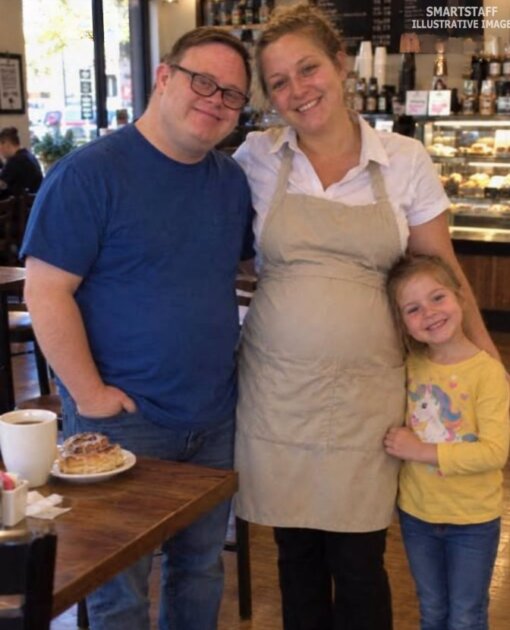
Among the coffee shop’s regular customers was a man named Clark, who had Down syndrome. He visited almost every day, always chose the same table, and never left without giving Rachel a five-dollar tip. But it wasn’t the money that made him special to her. Clark treated her with genuine warmth and respect. He listened when she spoke, remembered little details about her children, and asked about their lives with an interest that never felt forced or insincere.
Clark never questioned Rachel about her financial difficulties or made her feel sorry for herself. He simply showed up, offered a kind smile, and sometimes said a few encouraging words that made even her hardest days feel a little lighter. Over time, Rachel began to look forward to his visits. His quiet presence had become a comforting part of her routine, a small reminder that kindness still existed in a world that often seemed determined to test her strength.
Then, one day, Clark stopped coming.
At first, Rachel assumed he might be sick or dealing with a personal problem. She expected him to return the following day, perhaps with his familiar smile and the five-dollar bill he always left behind. But days turned into weeks, and his usual table remained empty.
Every time the bell above the coffee shop door rang, Rachel found herself glancing up, hoping to see Clark walk through it. She never imagined that she would never see him again.
Eventually, Clark’s sister came to the coffee shop looking for Rachel. With sadness in her eyes, she delivered the devastating news: Clark had passed away.
Rachel was heartbroken. Although they had never been related—or so she believed—they had developed a quiet connection that meant more to her than she had realized. The thought that she would never again hear his gentle voice or see his familiar smile left an emptiness she struggled to explain.
But Clark’s sister had something else to tell her, something that would change Rachel’s life forever.
Clark had secretly been a highly successful children’s author. His books had sold remarkably well, earning him a considerable fortune, yet he had never spoken about his wealth at the coffee shop. He had lived a modest, unassuming life, keeping his success largely to himself.
Before his death, Clark had prepared a will that left his entire fortune to Rachel. He had also established educational funds for her children, ensuring that they would have the opportunity to pursue their dreams without worrying about how their family would afford their education.
Rachel could hardly believe what she was hearing.
Why would a man she had known only as a regular customer leave everything to her? Why had he chosen her children, too? And why had he cared so deeply about a family that, as far as she knew, had no connection to him?
As she began examining the documents and learning more about Clark’s life, one detail caught her attention. His real last name was identical to the surname of her late husband, Mike.
Suddenly, questions she had never thought to ask began racing through her mind.
Determined to uncover the truth, Rachel visited Mike’s mother, Martha. She confronted her with what she had discovered and demanded an explanation. At first, Martha tried to avoid the subject, offering vague answers and insisting that Rachel was misunderstanding something. But Rachel refused to leave without the truth.
Eventually, Martha broke down and revealed a family secret that had been buried for decades.
Clark had been Mike’s biological brother.
Years earlier, Martha had given Clark up for adoption. As time passed, the family’s connection to him faded, and his existence became a subject they rarely discussed. But when Clark grew older, he attempted to reconnect with his biological family. He hoped that he might finally meet the people he had been separated from at birth and build a relationship with the brother he had never truly known.
Mike, however, had rejected him cruelly.
Rather than welcoming Clark or giving him a chance to become part of the family, Mike had refused to accept him. He had shut the door on his own brother, leaving Clark to face the painful reality that the people he longed to know wanted nothing to do with him.
Rachel was devastated by the revelation.
The kind man who had visited her coffee shop day after day had not been merely a friendly stranger. He had been part of her family all along. Clark had been Mike’s brother, which meant he was connected to Rachel’s children, too.
Suddenly, his daily visits took on an entirely different meaning.
Clark had not simply been stopping by for coffee. He had been finding a quiet way to remain close to his brother’s family, even after Mike had rejected him. Perhaps sitting across from Rachel and listening to her talk about the children allowed him to feel connected to the family he had always wanted to belong to.
Then Rachel discovered another heartbreaking detail.
Clark had kept a drawing that her daughter, Emma, had made of their family. It was an ordinary child’s drawing, filled with colorful figures standing side by side. To anyone else, it might have seemed like nothing more than a sweet childhood creation. But Clark had treasured it.
For him, that little piece of paper may have represented something he had spent his entire life longing for: a place in a family.
Rachel finally understood why Clark had returned to the coffee shop so faithfully. He wanted to be near his brother’s children. He wanted to know how they were growing up, what made them happy, and what their lives were like. Perhaps, in his own quiet way, he had hoped that one day he might become more than a familiar face at their mother’s workplace.
He had never demanded recognition. He had never insisted that Rachel acknowledge their relationship. He had simply chosen to love them from a distance, giving what he could without asking for anything in return.
The inheritance transformed Rachel’s life.
For the first time in years, she could breathe without feeling that financial disaster was waiting around the corner. She paid off her crushing medical debts and settled her mortgage, finally freeing herself from the constant fear of losing the home where she was raising her children.
The educational funds Clark had established gave her children something even more precious: the security of knowing that their future would not be limited by their family’s financial circumstances.
Rachel could now imagine a life in which she no longer had to choose between paying a bill and buying something her children needed. She could give them opportunities she had once believed were beyond their reach.
Yet the greatest gift Clark left behind was not his money.
It was the realization that someone had cared for her family deeply and sincerely, even when the world had given him every reason to feel rejected. Clark had possessed considerable wealth, but he had never used it to impress people or demand attention. Instead, he had quietly chosen to help the people who had made him feel connected to something he had lost.
One afternoon, Rachel took her children to visit Clark’s grave.
They stood together in front of the headstone, surrounded by the quiet rustling of trees and the soft breeze moving through the cemetery. Rachel had spent days thinking about what she wanted to tell Emma, and now she gently explained the truth.
Clark had actually been her uncle.
Emma stared at the headstone, trying to understand how the kind man her mother had spoken about so often could have been part of their family without them ever knowing. Then she reached into her bag and pulled out a new drawing she had made especially for him.
Carefully, she placed it beside the headstone.
This time, she had drawn the family with another figure standing among them. Clark was no longer someone left outside the picture. In Emma’s drawing, he finally had a place beside the people he had loved from afar.
Rachel watched her daughter with tears gathering in her eyes.
Before they left, she reached into her purse and took out a five-dollar bill. She bent down and tucked it beneath a small stone near the grave, securing it so the wind could not carry it away.
It was the same amount Clark had left her every day at the coffee shop.
But this time, it was not a tip.
It was a thank-you. A final gesture of love for the man who had quietly supported their family without ever asking for recognition, and who had found a way to care for them even when he could not openly claim them as his own.
As Rachel stood up, she felt both the pain of losing Clark and a deep sense of gratitude for having known him.
She finally understood that Clark had left them far more than money. He had shown her that family bonds can survive rejection, that love does not always need to be spoken aloud, and that the smallest acts of kindness can carry a meaning far greater than anyone realizes.
Clark might never have been able to sit openly at the family table or call Mike’s children his own. But through his quiet visits, his treasured drawing, and the fortune he left behind, he had made sure that his love would not disappear with him.
And although his usual table at the coffee shop would remain empty, Rachel knew that his memory would live on in her family.
Every time she offered someone a helping hand, every time she showed kindness to a stranger, and every time her children learned to look beyond appearances and welcome someone who felt alone, a little piece of Clark’s goodness would continue to live.
Because sometimes, the people who love us most are the ones who ask for the least—and sometimes, the greatest inheritance is not the fortune someone leaves behind, but the love that finally helps us understand who they truly were.

