# **My Cat Kept Waking Me Up Every Night. After My Vet Suggested Installing a Camera in My Bedroom, I Discovered the Terrifying Reason**
For three weeks, my cat refused to let me sleep through the night. Every morning, I woke up exhausted, frustrated, and increasingly worried about her strange behavior. At first, I thought she was hungry or simply demanding attention. But after speaking with my veterinarian, I decided to install a small camera in my bedroom to find out what was happening while I slept.
What I discovered on the recording left me completely speechless. My cat hadn’t been disturbing my sleep for the reason I had imagined. In fact, she had been trying to tell me something much more important. 😱
I woke up again at exactly four in the morning when Martha slapped my head with her paw.
She was sitting on my side of the bed, right on top of the blanket. I tried to gently push her away, hoping she would settle down and let me sleep for another few hours. Instead, she leaned forward and bit my shoulder so painfully that I jumped out of bed.
The moment my feet touched the floor, Martha jumped down and hurried out of the bedroom toward the living room.
I stared after her, completely bewildered.
This had become our nightly routine.
For three weeks, I hadn’t managed to sleep peacefully. Sometimes Martha woke me with a sharp tap of her paw against my face. Other nights, she meowed insistently until I finally got out of bed.
The strangest part was what happened afterward.
As soon as I stood up and left the bedroom, Martha became perfectly calm. She followed me into the living room, climbed onto the sofa, and curled up near my feet as if nothing unusual had happened.
I eventually started keeping two pillows beside the sofa. When she woke me, I would move there, prop myself up against the cushions, and try to get a little more sleep.
I was simply too exhausted to return to the bedroom and go through the same struggle all over again.
At first, I assumed Martha was hungry.
She had always been a cat with a healthy appetite, so I began leaving a full bowl of food out for her before going to bed. When that made no difference, I tried something else.
One night, at around four in the morning, I opened a packet of her favorite wet food.
Usually, Martha came running the moment she heard the familiar rustling of the packaging. But that night, she didn’t even approach the bowl.
She stood in the hallway, staring at me.
I called her name and encouraged her to eat, but she remained exactly where she was. Eventually, I walked toward the living room, and she followed me.
I couldn’t understand it.
Why would a hungry cat refuse her favorite food just to make me leave my bedroom?
The following night, I decided to close the bedroom door.
I thought perhaps Martha had developed a habit of waking me because she wanted company. Maybe if I stopped responding to her demands, she would eventually give up.
I was wrong.
Within minutes, she began meowing loudly outside the door. Then I heard her scratching at the wood. The noise became so persistent that I finally gave in and opened it.
Martha immediately stopped making a sound.
She looked at me, watched me get out of bed, and quietly followed me into the hallway.
The next morning, I discovered fresh scratches on the bedroom door. I stood there looking at them, wondering whether something was wrong with my cat.
In eight years, Martha had never behaved like this.
She had always been affectionate, gentle, and fairly independent. She liked sleeping near me, but she had never demanded attention in the middle of the night or behaved aggressively when I tried to move her.
After the incident with the bite, I decided it was time to take her to the veterinarian.
At the clinic, Martha behaved like an entirely different animal. She calmly allowed the veterinarian to examine her, purred when he touched her head, and even rubbed her cheek against his hand.
While he listened to her heartbeat, I watched them and felt slightly embarrassed.
From the outside, my story probably sounded ridiculous. Here was a perfectly healthy-looking cat, peacefully sitting on the examination table, while I explained that she had made me afraid to go to sleep in my own bedroom.
The veterinarian listened carefully.
“Her examination looks normal,” he finally said. “But I’d like to understand exactly what happens before she wakes you. Does she make any unusual noises? Does she seem frightened?”
“I honestly don’t know,” I admitted. “I’m asleep when it happens. I only wake up when she starts hitting me or biting me.”
He thought for a moment before making a suggestion.
“Try recording her overnight. It would be helpful to see what she’s doing before she approaches you. Something might be bothering her, or perhaps she’s reacting to something you’re doing while you’re asleep.”
I hadn’t considered that possibility.
That evening, I told my daughter about the appointment. She immediately offered to help. She had a small indoor camera that she normally used to check on her dog while she was at work.
We placed it on the dresser opposite my bed and adjusted the angle until the entire bed was visible. We made sure it could record in the dark, including the pillow area and the part of the blanket where Martha usually slept.
Before going to bed, I checked the camera one last time.
Martha was already curled up near my legs.
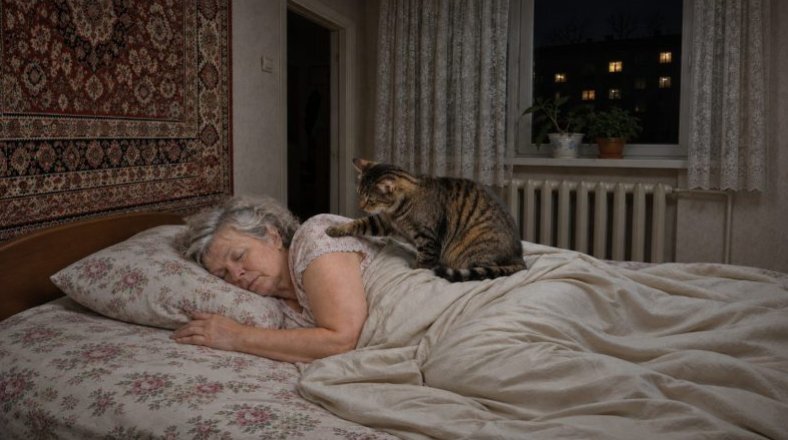
“Let’s see what you’re planning tonight,” I whispered, gently stroking her back.
She opened one eye, looked at me, and went back to sleep.
I had no idea that the following morning, that little camera would reveal something that would change the way I understood my cat’s behavior forever.
When my daughter and I sat down to watch the recording, we initially expected to see Martha wandering around the bedroom, playing with something, or perhaps looking for attention.
Instead, we witnessed something that left us horrified.
The first few minutes seemed completely ordinary.
I was sleeping peacefully, occasionally moving beneath the blanket. Martha was lying near my feet, barely moving.
Then my daughter suddenly paused the recording.
“Mom, listen.”
I leaned closer to the screen.
At first, I couldn’t understand what she wanted me to notice. Then she played the recording again and turned up the volume.
I could hear myself breathing.
There was a quiet, regular sound at first, followed by a faint snoring noise. I almost laughed because I had never realized how loudly I snored.
But then something changed.
My snoring suddenly stopped.
The bedroom became completely silent.
A few seconds passed.
Then I took a sudden, loud breath, as though I had been struggling to get enough air.
Martha immediately lifted her head.
She stared at me for several seconds, her ears pointed forward. When the same thing happened again, she got up and moved closer.
She climbed onto my side and gently touched my shoulder with her paw.
I moved slightly in my sleep but didn’t wake up.
Martha tried again.
This time, she reached toward my head.
My daughter rewound the recording.
“Mom, look at the time between your breaths,” she said quietly.
We watched the same section again.
And then again.
It was impossible to ignore.
My breathing repeatedly stopped for several seconds before suddenly starting again. Sometimes the pauses were longer. Each time, Martha seemed to notice immediately.
She would lift her head, watch me, and then approach me, touching my shoulder or face with her paw.
I felt a chill run down my spine.
All those nights, I had believed Martha was being difficult. I thought she was demanding food, attention, or simply refusing to let me sleep.
But the recording suggested something entirely different.
She had been reacting to my breathing.
I suddenly remembered all those mornings when I woke up with my heart racing. I had always assumed it was because Martha had startled me by jumping onto the bed.
I also remembered how exhausted I felt during the day, even after spending what should have been enough hours in bed.
I had blamed stress, age, and my increasingly disrupted sleep.
I had never imagined that something might be happening to me while I was unconscious.
That same day, I showed the recording to my doctor.
He watched it carefully and asked me several questions about my sleep, daytime tiredness, and whether I ever woke up feeling short of breath.
After hearing my answers, he recommended an overnight sleep study.
I was referred to a sleep clinic, where specialists attached several small sensors to monitor my breathing, oxygen levels, heart rate, and sleep patterns throughout the night.
The next morning, the doctor explained the results.
I was experiencing repeated interruptions in my breathing while asleep.
He told me that the findings were consistent with obstructive sleep apnea, a condition in which the upper airway repeatedly becomes blocked or narrowed during sleep. As a result, breathing can stop temporarily before the brain triggers a brief awakening to restore normal airflow.
Sometimes people with this condition don’t remember waking up at all. They may simply experience poor-quality sleep, morning fatigue, headaches, or unexplained exhaustion during the day.
I sat quietly, trying to process everything.
I asked the doctor why I hadn’t noticed what was happening.
He explained that these interruptions can occur without a person becoming fully conscious. I might briefly wake up or change my breathing without remembering anything the following morning.
Suddenly, the past three weeks made sense.
I had remembered only the final moments of each episode: Martha touching my face, me getting out of bed, and her following me to the sofa.
I had never known what happened before that.
After discussing the results with my doctor, I was fitted with a CPAP machine to help keep my airway open while I slept.
The first few nights were not particularly comfortable. I had to get used to wearing a mask and sleeping with a small tube beside my face.
Martha was fascinated by the equipment.
She spent a long time sniffing the mask, inspecting the hose, and looking at the machine as if she suspected it might be some strange new animal that had invaded her territory.
Eventually, she accepted it.
More importantly, she stopped waking me every night.
At first, I still opened my eyes several times out of habit. Whenever I woke up, I would look toward the other side of the bed, expecting to see Martha sitting beside me with her paw raised.
But she was usually asleep, curled into a little ball near my feet.
For the first time in weeks, our bedroom was peaceful again.
A couple of weeks later, something happened that made me smile.
I felt a gentle tap against my shoulder.
I immediately opened my eyes and looked at the clock.
It was 7:20 in the morning.
Sunlight was beginning to filter through the curtains, and Martha was standing beside me, looking unusually impatient.
She jumped down from the bed, hurried into the hallway, and stopped in front of her empty food bowl.
I stared at her for a moment.
Then I started laughing.
I got up, opened a packet of her favorite food, and placed it in the bowl.
Martha immediately began eating, completely satisfied with herself.
This time, there was no mystery. No strange behavior. No frightening recording waiting to be discovered.
She was simply hungry.
And I had never been so happy to be woken up by my cat.
I often think about those three weeks now.
I used to complain about Martha’s nighttime interruptions and wonder why she wouldn’t leave me alone. I even considered closing her out of the bedroom permanently.
But the little camera showed me something I would never have discovered on my own.
While I was asleep and unaware of what was happening, my cat had been responding to changes in my breathing.
I can’t know exactly what she understood or whether she realized how serious the situation was. But she clearly noticed something unusual and repeatedly tried to get my attention.
Martha couldn’t explain what was wrong.
She couldn’t tell me to see a doctor or describe what she was hearing.
All she could do was climb onto the bed, touch my shoulder, and keep trying until I finally got up.
Now, whenever I see her sleeping peacefully at the foot of my bed, I feel an overwhelming sense of gratitude.
I thought she was the reason I couldn’t sleep.
It turned out that she might have been the reason I finally discovered what was happening while I slept.
And I will never look at her little midnight paw taps the same way again. ❤️