
“I Refuse to Sit in the Same Car as Your Mother!” My Mother-in-Law Caused a Scene Before the Wedding, and When My Husband Suggested Leaving My 71-Year-Old Mother at a Bus Stop, I Finally Stood Up for Her
It was half past eight on a Saturday morning, and we were standing outside our house in Székesfehérvár. The trunk of the car was open, my husband had already packed the wedding gift, and my mother was waiting beside the gate in a beautiful light-blue suit. She was holding a small pearl-colored handbag.
She was seventy-one years old, and that morning was the first time I had seen her wearing the outfit she had spent months saving up to buy.
My mother-in-law, Ilona, stood directly opposite her, pointing in her direction as though we were trying to smuggle an unwelcome stranger into her car.
Except the car wasn’t hers.
It was mine.
“Ilona, please don’t do this,” I said quietly. “We’ve all been invited. We’re all going to the same wedding.”
“I don’t care who invited her!” she snapped. “I am not spending three hours trapped in a car with that woman!”
My mother lowered her eyes.
My husband, Gábor, nervously checked his watch.
“Zsófi, we’re going to be late. Can we please find a solution?”
I thought he was finally going to tell his mother to stop making a scene.
Instead, he turned toward me.
“Listen, why don’t we drop your mother off at the bus stop near the train station? There must be a bus going toward Tatabánya. She can change somewhere along the way.”
For a moment, I genuinely thought I had misheard him.
“You want to leave my seventy-one-year-old mother at a bus stop? Dressed up for a wedding, carrying a present, simply because your mother refuses to sit beside her?”
“Don’t make it sound so dramatic!” Gábor snapped. “I’m just trying to find a solution.”
My mother-in-law folded her arms with satisfaction.
“See? At least my son knows how to think sensibly.”
And that was when I did something I had never done during our twelve years of marriage.
I took the car keys out of Gábor’s hand.
“Fine. Then you can go without me.”
My husband laughed in disbelief.
“Are you joking?”
“No. And my car isn’t going anywhere with you, either.”
That was when the real argument began.
Gábor’s cousin, Réka, had invited us to her wedding in Esztergom. After a civil ceremony near the Basilica, the newlyweds were hosting a reception at a restaurant overlooking the Danube.
Réka was thirty-two and worked as an accountant in Budapest. I had known her since childhood because she was still in high school when Gábor and I got married.
She had always shared a particularly close relationship with my mother.
Réka’s own mother, Márta, had passed away several years earlier. During family celebrations, my mother often helped them with all the preparations, stepping in whenever they needed someone to organize things. She baked cakes, arranged the tables, and looked after the children.
That was why Réka had invited her personally.
Not through us.
She had sent my mother a beautiful cream-colored invitation with a handwritten message:
“Dear Auntie Marika, I would be so happy if you could be there with me on this very special day.”
My mother read it three times.
When she called to tell me about it, her voice trembled with emotion.
“You know, sweetheart, I never thought I would still matter so much to someone in this family.”
At the time, I didn’t understand why she said that.
Now I did.
Ilona had never liked my mother.
There had never been an open confrontation between them. Instead, their relationship was filled with little remarks that always seemed designed to hurt.
Whenever my mother brought homemade cakes, Ilona would comment that nowadays you could buy perfectly good ones from a bakery.
Whenever Marika complimented our garden, Ilona immediately reminded everyone that she had originally recommended the roses.
If my mother started talking about a trip organized by her pensioners’ club, Ilona would visibly yawn.
For years, I convinced myself that they simply had different personalities.
My mother was a quiet, modest woman. She had worked for forty years as an assistant at a kindergarten in Székesfehérvár. After my father died, she lived alone in her small apartment and never wanted to become a burden to anyone.
Ilona, on the other hand, loved controlling everything.
Even at sixty-eight, she behaved as though the entire family would be incapable of organizing a Sunday lunch without her instructions.
Two days before the wedding, she called and announced that she would be traveling with us.
“Gábor told me there’s room in the car,” she declared.
“Of course,” I replied. “My mother is coming too, so there will be four of us.”
There was a sudden silence on the other end.
“Marika is coming?”
“Yes. Réka invited her personally.”
“How interesting.”
“What do you mean?”
“Nothing. We’ll talk later.”
We didn’t talk again.
Not until Saturday morning.
The moment Ilona saw my mother standing by the gate, her expression changed.
“Nobody told me about this!”
“I told you on Thursday,” I reminded her.
“I thought you were joking!”
Then came the sentence about refusing to spend three hours in the same car as my mother.
But the most painful part wasn’t Ilona’s behavior.
It was the way Gábor immediately took her side.
When I refused to hand over my car, he became furious.
“Zsófi, stop acting like a child! My mother has a bad knee. She can’t travel by bus.”
“My mother had hip surgery two years ago.”
“But she gets around better!”
At that moment, my mother quietly intervened.
“Sweetheart, it’s all right. I’ll call a taxi to the station and take the train.”
“No, Mom.”
“I really don’t want you fighting because of me.”
Ilona interrupted her.
“Then you should have arranged to travel alone in the first place.”
My mother’s face went pale.
And that was when I noticed something.
A white envelope was sticking out of her handbag. Someone had carefully written a name on it in blue ink.
Réka.
When my mother realized I was looking, she quickly pushed the envelope back inside.
Her hands were trembling.
“Mom, what did you bring for her?”
“Just a little present.”
Ilona suddenly lifted her head.
“What present?”
My mother didn’t answer.
“Marika, I asked you a question!” my mother-in-law demanded.
My mother slowly raised her eyes.
“Yes, Ilona. I brought something for Réka. That’s exactly why I’m here.”
For the first time that morning, I saw genuine fear in my mother-in-law’s expression.
And I had no idea why.
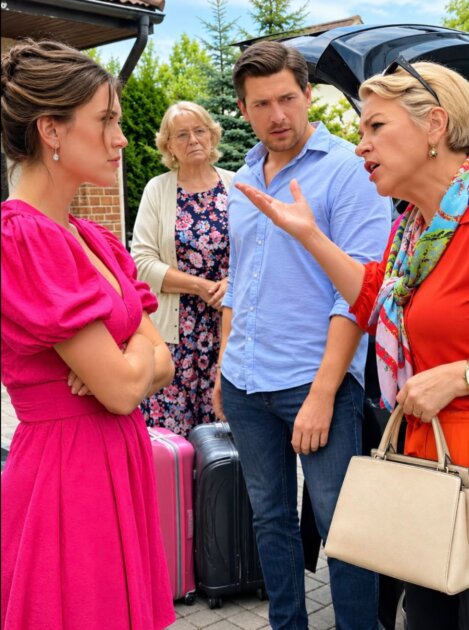
“You promised me!” Ilona hissed.
She stepped so close to my mother that I instinctively moved between them.
“What did she promise you?” I demanded.
“That is between the two of us!” Ilona snapped.
My mother spoke in a voice I rarely heard from her.
“No. It isn’t just between us anymore.”
Gábor ran his fingers through his hair.
“Can someone please explain what’s going on?”
“After the wedding!” his mother declared. “Now, let’s get in the car!”
“You are not getting into my car,” I replied.
Ilona stared at me.
“Excuse me?”
“I don’t want to spend another three hours listening to arguments. Mom and I are going separately.”
Gábor’s voice hardened.
“So you’re leaving me here?”
“No. You’re choosing to go with your mother.”
“Do you have any idea how much a taxi to Esztergom would cost?”
“There’s a train.”
“My mother isn’t traveling by train!”
“Then borrow a car. Rent one. Find another way.”
Gábor stared at me for several seconds.
Then he said something that would echo in my mind for the rest of the day.
“For once in your life, you could show some consideration for my mother’s feelings.”
I didn’t answer.
I knew that if I opened my mouth, I would say something I might regret.
Instead, I placed my mother’s small suitcase in the trunk, opened the passenger door for her, and got behind the wheel.
Ilona shouted after me.
“If you leave now, don’t expect us to pretend nothing happened!”
I slowly reversed out of the driveway.
In the rearview mirror, I saw Gábor standing by the roadside with his mother.
Neither of them waved.
We were heading toward the M7 motorway when my mother finally spoke.
“Sweetheart, perhaps it would have been better if I had stayed home.”
“Please don’t say that.”
“I don’t want to ruin your marriage.”
“You’re not ruining anything, Mom.”
We drove in silence for a while.
An old Hungarian song played on the radio, but neither of us was paying attention.
Eventually, I asked the question that had been bothering me.
“Mom, what’s inside that envelope?”
She looked out of the window at the trees rushing past.
“A letter.”
“From whom?”
“Réka’s mother.”
I was surprised.
“Márta? But she’s been dead for eight years.”
“I know.”
“Then why are you giving it to Réka now?”
My mother placed her hand over her handbag.
“Because eight years ago, I promised someone I wouldn’t give it to her until the right time.”
I still didn’t understand how much that promise had cost her.
Márta, Réka’s mother, had not only been Gábor’s aunt. She had also been my mother’s close friend.
They had worked at the same kindergarten in Székesfehérvár when they were young. Later, Márta got married and moved to Esztergom, but they remained in regular contact.
My mother helped prepare the food for Réka’s christening.
She even sewed a little white blouse for her first school celebration.
When Márta became ill, my mother frequently traveled to visit her, bringing groceries and spending hours sitting beside her.
I knew all of that.
But I had never heard what my mother told me next.
“During her final months, Márta was very worried that Réka would be left alone with her grief,” she began. “She said there was something she wanted her daughter to have one day, when she was finally ready to be happy again.”
“She wrote her a letter?”
“Yes. She wrote it for her wedding day.”
My throat tightened.
“Why didn’t Réka receive it earlier?”
My mother took a deep breath.
“Because Ilona took it away from me.”
I tightened my grip on the steering wheel.
“What?”
“Not literally. She persuaded me not to give it to her.”
“Why?”
“She said Márta had written things that could destroy the family. She told me Réka must never discover everything about her parents’ marriage.”
I glanced at her.
“And you believed her?”
“At the time, yes. Everyone was devastated after Márta died. Ilona told me that if I truly loved Réka, I wouldn’t bring back painful memories.”
“But now you’re giving her the letter.”
“Because I finally read it.”
I almost pulled over.
“You never read it before?”
“No. Márta trusted me with it, and I wanted to respect her wishes. But a few weeks ago, Réka called and asked whether I had a photograph of her mother. She wanted to display it at the wedding. I took out the old box where I had kept some photographs and found the envelope.”
My mother’s voice trembled.
“That’s when I realized someone had taken terrible advantage of my trust.”
“What does the letter say?”
“I can’t tell you. It’s meant for Réka.”
That was the first moment I understood that my mother hadn’t insisted on attending the wedding simply because she had received an invitation.
She wanted to make something right.
And Ilona was determined to stop her.
Near Tatabánya, my phone rang.
It was Gábor.
I put him on speaker.
“Where are you?”
“On the road.”
“My mother is absolutely devastated because of you.”
“I’m sorry she feels that way.”
“Is that all you have to say?”
“What exactly do you want me to say?”
There was a brief silence.
Then my husband asked something unexpected.
“Does your mother still have that envelope?”
My mother looked at me.
“Yes,” I answered.
“Zsófi, please don’t let her give it to Réka.”
My stomach tightened.
“You know what’s inside?”
“Not exactly.”
“Then why are you asking me?”
“Because my mother says it will only cause trouble.”
“Gábor, have you even listened to my mother?”
“Don’t start this again!”
“I’m not starting anything. I asked you a simple question.”
“Look, Mom says it’s an old family matter. Réka doesn’t need to know about it.”
“A letter written by her own mother?”
There was silence on the other end.
“She didn’t tell me that,” he finally admitted.
“Then perhaps you should ask her why.”
I ended the call.
My mother gently squeezed my hand.
“Please don’t be angry that I’ve dragged you into this.”
“Mom, the letter isn’t what dragged me into anything.”
What I wanted to say was that I was ashamed of how many years I had allowed other people to decide how much my mother’s dignity was worth.
But I kept that thought to myself.
We reached Esztergom shortly before noon.
The ceremony was scheduled for half past one, so we had enough time to park, have a coffee, and freshen up.
Réka was getting ready in her hotel room. When she learned we had arrived, she sent a message saying she wanted to see my mother before the ceremony.
We went upstairs.
The bride was standing beside the window in her wedding dress. Her hair was half pinned up, and her makeup wasn’t quite finished.
The moment she saw my mother, she rushed over and hugged her.
“Auntie Marika! I’m so happy you came!”
“I’m happy to be here too, darling.”
Réka noticed the tears in my mother’s eyes.
“Is everything all right?”
My mother nodded.
Then she reached into her handbag and took out the envelope.
“I brought something for you.”
Réka looked at the familiar handwriting.
Her smile slowly disappeared.
“That’s… my mother’s handwriting?”
“Yes.”
“How did you get this?”
My mother sat down on the edge of the bed.
“She gave it to me shortly before she died. She asked me to give it to you when you got married.”
Réka covered her mouth.
“Why didn’t you tell me about it?”
“Because I made a mistake.”
The bride stared at the envelope for a long moment.
Then she carefully opened it.
She didn’t read the letter aloud.
My mother and I stood by the window, trying not to intrude.
At first, Réka smiled.
Then she suddenly sat down.
A few minutes later, she pressed the letter against her face and began to cry.
My mother approached her.
“Please forgive me.”
Réka shook her head.
“Auntie Marika… did you really not know?”
“Know what, sweetheart?”
The bride looked up.
“That my mother had savings in my name?”
I froze.
“What savings?” I asked.
Réka pointed to the letter.
“She says that when I was born, my parents opened a bank account for me. They deposited money into it every month. Mom wanted me to have something to help me start my own life.”
“But your father…” I began.
“Dad never mentioned anything. He always said that during Mom’s illness, they had used up all their savings.”
My mother shook her head in confusion.
“I only knew Márta had written you a letter. I had no idea about the account.”
Réka looked at the paper again.
“She even wrote down the name of the bank and an old account number.”
Then she read the final paragraph.
Her expression changed completely.
“She says that if anything happened to her, Ilona would help Dad organize the finances.”
Suddenly, I remembered my mother-in-law’s terrified expression that morning.
And her desperate insistence that my mother stay home.
During the next half hour, we didn’t try to investigate anything.
It was Réka’s wedding day. We didn’t want to take that away from her.
The bride carefully folded the letter and placed it in her small handbag.
“Thank you for bringing this to me. We’ll find out the rest later.”
At the ceremony, we sat in one of the front rows.
Réka looked beautiful.
When she said, “I do,” even the elderly gentleman sitting beside my mother reached for his handkerchief.
Gábor and Ilona arrived only after the ceremony.
Apparently, after traveling by train from Székesfehérvár, one of my husband’s colleagues had driven them from Budapest to Esztergom.
Ilona entered the restaurant looking furious.
The moment she saw me, she marched over.
“We need to talk!”
“Not now.”
“Did you give it to her?”
I didn’t answer.
I didn’t need to.
My mother-in-law’s face went pale.
“You have no idea what you’ve done,” she whispered.
“Then explain it.”
She glanced around.
“Not here.”
“Fine. After the wedding.”
“By then it will be too late!”
And then something happened that none of us expected.
Réka’s father, László, had been standing nearby and overheard her final words.
“Too late for what, Ilona?”
My mother-in-law froze.
“Nothing.”
László was sixty-two, a quiet man who had worked at an auto-parts business in Esztergom until retirement. He had never liked getting involved in family arguments.
But now he looked directly at his sister.
“Réka showed me Márta’s letter.”
Ilona covered her mouth.
“Laci, I can explain.”
“I certainly hope so.”
“It isn’t what you think.”
“Then why did you tell me years ago that Márta’s papers had all been destroyed?”
My mother quietly gasped beside me.
And suddenly I understood that this story had begun long before that Saturday morning argument.
László didn’t cause a scene.
He simply said:
“On Monday, we’re going to the bank. And you’re coming with us.”
Ilona barely spoke for the rest of the evening.
Gábor tried to make peace with me, but I refused to discuss our marriage in the middle of the wedding celebration.
I sat beside my mother during dinner.
We were served crispy roast duck with braised cabbage, followed by stuffed cabbage rolls, just as you would expect at a traditional Hungarian wedding. The band played old favorites, and little candles flickered on the tables.
Shortly before midnight, Réka came over.
“Auntie Marika, would you dance with me?”
My mother laughed.
“With these old legs?”
“Then we’ll dance slowly.”
The two women walked to the edge of the dance floor.
Réka took my mother’s hands, and they gently swayed to the music.
I think that was the most beautiful moment of the entire day.
On Monday, Réka, her father, and Ilona went to the bank.
The old account had already been closed, but the bank records revealed that a few months after Márta’s death, the money had been withdrawn on László’s instructions.
At the time, the amount had been slightly more than four million forints.
László was devastated.
He didn’t deny signing the paperwork.
But Ilona had told him that they needed to settle an urgent medical debt or risk losing their home to foreclosure.
“I was so frightened that we would lose everything,” he later explained over the phone. “After Márta’s funeral, I could barely think clearly. I trusted my sister.”
The money hadn’t gone to Réka.
And it hadn’t been used to pay hospital bills.
Ilona had used it to settle debts belonging to her son, Gábor.
When my husband was thirty, he had owned a small construction company. The business eventually collapsed, leaving him with debts that took years to resolve.
I had always believed his mother had helped him using her own savings.
By the time I met Gábor, the whole situation was supposedly behind him.
Or so I thought.
Back then, Ilona had been afraid that Gábor would lose his apartment and that one of his creditors would take him to court.
So she made a decision: she would save her son using money that belonged to her brother’s daughter.
She told László that everything was under control and that the debts had been settled.
She told Gábor that she had paid his debts with her own money.
And for twelve years, she kept the truth hidden from both of them.
When Gábor finally discovered what had happened, he refused to believe it.
“Mom, tell me this isn’t true!”
Ilona burst into tears.
“I did it for you!”
“But that was Réka’s money!”
“She was only a little girl! They were going to take everything you owned!”
Gábor remained silent for a long time.
Then he asked:
“And if Auntie Marika hadn’t brought that letter, would you ever have told us?”
Ilona didn’t answer.
Réka didn’t want to begin with a police complaint. First, she wanted to understand exactly what had happened and what legal options were still available after so many years.
She hired a lawyer, gathered the remaining documents, and eventually Ilona admitted in writing what she had done with the money.
Resolving everything wasn’t going to be easy.
Ilona didn’t have four million forints available.
She had transferred part of her house to Gábor’s name years earlier, and now the family had to decide how to make things right.
My husband offered to use some of his own savings to repay part of the amount, with the remainder to be paid in installments by him and his mother.
Réka accepted only on one condition.
“I don’t want any more lies. Not a single one.”
I thought that after everything that had happened, Gábor would finally understand what he had done to me that Saturday morning.
But our conversation turned out to be much harder than I expected.
One Thursday evening, while I was washing dishes in the kitchen, he approached me.
“I know you’re angry.”
“I’m more than angry.”
“Then what are you feeling?”
I turned off the tap.
“Shame.”
“Because of me?”
“Yes.”
Gábor lowered his head.
“You know I never wanted to hurt your mother.”
“Then why did you want to leave her at a bus stop?”
“Because I didn’t know how to handle my mother.”
“And humiliating mine was easier?”
He had no answer.
I sat down opposite him.
“Gábor, for twelve years, I’ve always been the one who gives in. If your mother doesn’t like the Christmas menu, I cook something else. If she gets offended, I call her. If she insults my mother, you tell me to ignore it because that’s just how she is.”
My husband stared at his hands.
“I didn’t realize it had become this serious.”
“Because you’ve never had to choose. I’ve always been the one expected to fix everything for you.”
We sat in silence for a long time.
Finally, Gábor looked up.
“Do you think we can repair this?”
I didn’t say yes.
But I didn’t say no, either.
“That depends on whether you’re capable of behaving differently the next time your mother demands something.”
The following Sunday, Gábor went to visit my mother alone.
He didn’t call ahead. He simply phoned me from outside her apartment.
Marika was making homemade chicken soup.
Gábor didn’t bring flowers or a present.
He stood in the hallway and said:
“I want to apologize for what happened at the bus stop.”
My mother later told me that my husband had nearly burst into tears.
“It wasn’t the thought of having to take a bus that hurt me,” she told him. “It was the feeling that nobody cared whether I arrived at all.”
Gábor sat down at the kitchen table.
And for the first time, he didn’t try to defend his mother.
He simply listened to mine.
A few weeks later, Réka and her husband invited us over for lunch.
Ilona wasn’t there.
Some relatives thought we had been too hard on her. Others believed she had finally been forced to face the consequences of her actions.
I no longer wanted to judge everyone or settle every family disagreement.
After coffee, Réka brought out a small framed photograph.
It had been taken at her wedding.
She and my mother were dancing together, holding hands, both smiling through tears.
“I want you to have this,” she said.
My mother was visibly moved as she gently touched the edge of the frame.
“But this is your wedding photograph.”
“Exactly. And I want you to remember that you were there on the day I needed you most.”
Then Réka turned toward me.
“You know, Zsófi, there was something else in my mother’s letter.”
I looked at her in surprise.
“What?”
“She wrote that when I eventually got married, I shouldn’t judge someone by how loudly they say they love me. I should pay attention to how they treat me when standing up for me becomes inconvenient.”
I looked at Gábor.
He looked back at me.
And this time, he didn’t turn away.
On the drive home, my mother was sleeping in the back seat.
Gábor was driving.
When we stopped at a gas station to buy her some water, my husband quietly asked:
“Do you think your mother has forgiven me?”
“I think she has.”
“And you?”
I stared at the illuminated parking lot.
“I’m still learning how to.”
Gábor nodded.
He didn’t rush me.
He didn’t ask me to forget everything.
He simply returned to the driver’s seat and waited until I had fastened my seat belt.
A few minutes later, my mother woke up.
“Children, are we still far from home?”
“No, Auntie Marika,” Gábor replied. “We’ll be home soon.”
Then he glanced at her in the rearview mirror.
“And if you get tired, please tell me. We can stop as many times as you need.”
My mother smiled and leaned back against the seat.
I thought about how strange it was that an entire family’s secrets had begun to unravel over a single argument about a bus stop.
Ilona had believed that the biggest problem that Saturday would be having my mother travel with us.
But what she was truly afraid of was that my mother would finally reach her destination.
And after twelve years of marriage, I had learned something I should have understood much earlier: keeping the peace doesn’t always mean staying silent to make everyone else comfortable.
Sometimes, peace only begins when we finally find the courage to say no.
When we arrived outside my mother’s apartment in Székesfehérvár, Gábor got out, opened her door, and walked her all the way to the entrance.
My mother gently took his arm.
“You know, son, that morning I wasn’t actually afraid of having to take a bus.”
“I know, Auntie Marika,” Gábor whispered.
“I was afraid my daughter would learn to tolerate humiliation just as I had done for most of my life.”
Gábor said nothing.
My mother turned toward me and smiled.
“But fortunately, I was wrong.”
That was when I finally understood why she had insisted so strongly on attending the wedding.
She hadn’t only wanted to deliver Márta’s letter.
She had also wanted to see her daughter stand up for herself.
And perhaps that was the most valuable gift anyone received that day.
Because unlike the money in that old bank account, its worth could never be measured in forints.

