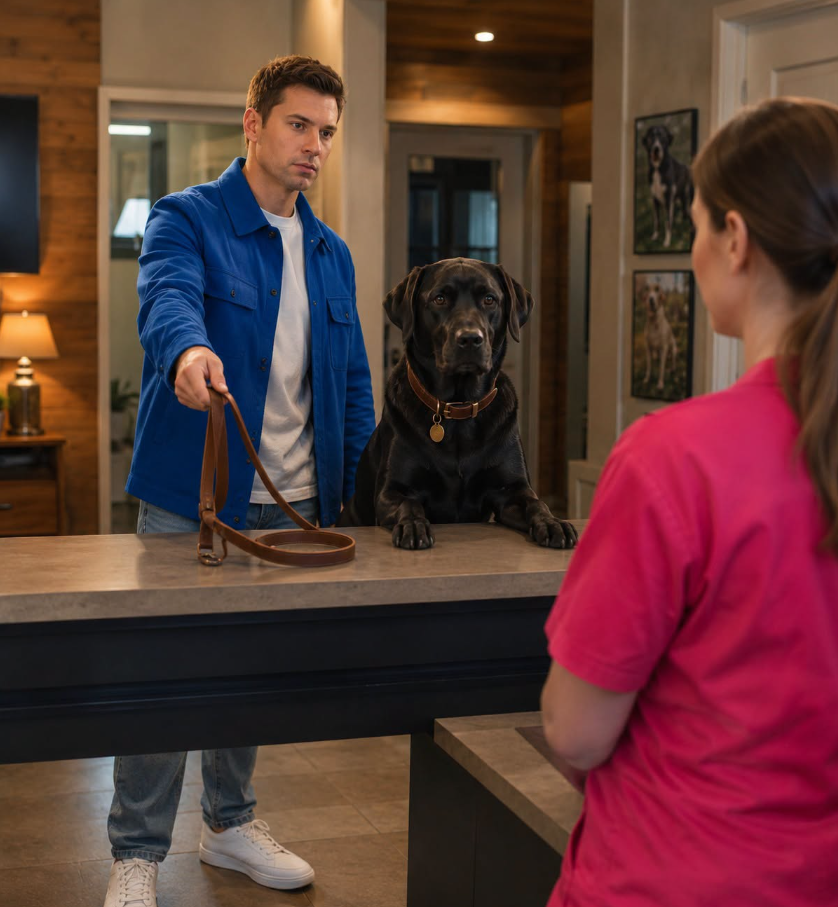
“If you don’t take this dog today, I’ll tie him up by the highway and be done with it!” the man snapped, shoving the leash across the veterinary clinic counter.
Vera slowly raised her head.
At the other end of the leash sat a large black dog. He was perfectly still. He didn’t bark, whine, or try to run away. He simply watched the man with deep, sorrowful eyes, as if he understood exactly what was happening.
“Where is his owner?” Vera asked calmly.
“Dead,” the man replied shortly. “My uncle. He had a stroke. I don’t need the dog.”
Something felt wrong.
The man seemed far too calm for someone who had recently lost a family member. There was no grief in his face—only impatience.
“What’s the dog’s name?”
“Grom.”
The dog’s ear twitched slightly.
When the man left, Grom remained at the clinic. He refused food all evening. Instead, he sat by the door, watching it as if he were waiting for someone.
The next morning, he was gone.
Vera searched the surrounding streets in panic, but there was no sign of him.
At the same time, forty-eight-year-old librarian Nadezhda Sergeyevna was returning home to her apartment building. As she reached her floor and prepared to unlock her door, she noticed something lying in front of the neighboring apartment.
A large black dog.
“Grom?” she asked in surprise.
The dog slowly lifted his head.
Nadezhda recognized him immediately.
Everyone in the building knew Grom. His owner, Semyon Arkadyevich, was a retired man who walked his beloved companion every day at the same hour. A week earlier, however, an ambulance had taken him away, and no one had seen him since.
The residents knew only what Semyon’s nephew, Igor, kept telling everyone.
“My uncle passed away. I’m handling the inheritance.”
Yet something about the story felt strange.
No one had seen a funeral.
For three days, Grom remained outside his owner’s apartment door. Nadezhda brought him water and a blanket, but the dog barely moved. His eyes never left the door.
On the third day, Igor arrived with potential buyers.
“Excellent neighborhood,” he said enthusiastically. “This apartment won’t stay on the market long.”
At that moment, Grom stood up.
He didn’t growl.
He didn’t attack.
He simply walked to the door and stood there, staring directly at Igor.
A few minutes later, the buyers left.
After witnessing the scene, Nadezhda became increasingly convinced that something was terribly wrong.
That evening, she sat beside Grom in the hallway.
“If your owner is really gone,” she whispered, “why does this whole thing feel like a lie?”
Grom gently rested his head on her knee.
The next morning, Nadezhda spoke with the building caretaker, Aunt Sura.
“I remembered something,” the elderly woman said. “I overheard Igor on the phone. He said, ‘We have to hurry before he regains consciousness.’”
Nadezhda’s heart skipped a beat.
Before he regains consciousness?
Could Semyon still be alive?
That evening, another strange thing happened.
Grom began scratching at the rug in front of the apartment door.
Curious, Nadezhda lifted the edge of the rug.
A key lay underneath.
Beside it was a folded note.
“If anything happens to me, call Vitaly Petrovich.”
Without hesitation, she dialed the number.
An elderly man answered.
“Dead? Who told you that?” he asked, astonished. “Semyon is alive. He’s in a rehabilitation center. I spoke with him last week.”
Nadezhda could hardly believe her ears.
She immediately contacted Vera, who recognized the story of the missing dog. The next day, the two women drove together to the rehabilitation center.
The moment they arrived, Grom became alert.
He pulled strongly toward one particular room.
Inside sat a thin, exhausted, but very much alive elderly man by the window.
Semyon Arkadyevich.
When he saw his dog, tears filled his eyes.
“Grom…” he whispered.
The dog approached slowly and rested his head on his owner’s knees.
For several seconds, the room was completely silent.
Then the old man began to cry.
Later, the truth emerged.
Igor had known all along that his uncle was alive.
Believing Semyon’s recovery would take months, he had tried to seize the apartment for himself. He changed the locks, removed important documents, and began searching for buyers.
His greatest mistake, however, was getting rid of Grom.
The dog simply refused to abandon his home.
A few days later, Igor appeared at the rehabilitation center, hoping to explain himself.
But Semyon already knew everything.
Slowly, with great effort, he raised his hand and pointed toward the door.
“Leave,” he said quietly.
That was all.
The color drained from Igor’s face.
Soon afterward, a police investigation confirmed that he had no legal right to sell the apartment.
Months passed.
Semyon gradually recovered and eventually returned home.
Nadezhda visited often. She helped with groceries, medications, and countless everyday tasks. Vera also stopped by regularly.
The apartment that had once been silent and lonely slowly filled with life again.
One spring evening, Nadezhda was preparing to leave when Grom stepped into the doorway and blocked her path.
“Grom, let me through!” she laughed.
The dog didn’t move.
Semyon watched the scene with a smile.
“Stay… a little longer,” he said softly.
Nadezhda blushed.
Perhaps for the first time in many years, she felt that she truly belonged somewhere.
As time passed, an unusual little family formed around them.
They were not connected by blood.
They were connected by trust, kindness, and a remarkably loyal dog.
One evening, Grom lay down on the living room rug. He rested his head on Nadezhda’s feet and placed one paw on Semyon’s knee.
It was as though he were protecting them both at the same time.
The old man stroked the dog’s graying head.
“You know, my friend,” he said quietly, “you saw the truth long before the rest of us did.”
Nadezhda smiled as she watched them.
Because sometimes the people—or animals—who save us are not the strongest or the loudest.
They are the ones who never give up.
And Grom was exactly that kind of soul: a faithful dog who not only saved his owner, but also brought hope, companionship, and a second chance at happiness into the lives of lonely people.