— Sonia will sleep on a mat in the hallway. Nothing will happen to her — said Sergei, pulling my daughter’s school backpack out of the wardrobe.
His movements were calm, almost indifferent, as if he wasn’t rearranging a fourteen-year-old girl’s life, but simply shifting objects from one place to another.
Her clothes began to land on the bed one by one: shirts, notebooks, felt-tip pens, a worn-out sweater. Sonia’s world was being dismantled in silence, layer by layer.
I stood in the doorway and watched my husband erase my child’s space without a word. In our two-room apartment, Sonia’s room was the only place that truly belonged to her — her desk, her books, the warm glow of her lamp. Now all of it was to be given to Artyom, Sergei’s nephew, who was “already on his way”.
“Put her backpack back,” I said quietly.
He didn’t even look at me.
“Natalya, don’t start. It’s only temporary.”
In his voice, “temporary” sounded like something already decided — something that did not require consent.
Sonia sat at her desk, bent over an exercise book. She wasn’t crying. She wasn’t protesting. Children learn quickly when adults stop respecting boundaries — they simply watch as their ground is taken away piece by piece.
“I can sleep in your room,” she said softly. “Just don’t move my desk. I need to finish my project.”
It wasn’t a request. It was surrender dressed as politeness.
Something inside me tightened.
“No one will touch your desk,” I said.
Sergei gave a short, irritated laugh.
“You’re spoiling her. In normal families, children understand that adults have needs.”
“In normal families, children aren’t put in the hallway,” I replied.
Then the intercom rang.
A short time later, his sister Larisa entered with two large bags, Artyom behind her. The boy looked uncertain, quiet, as if he didn’t fully understand what situation he had been pulled into. More bags followed. This was no longer a “few days.”
“Sonia is sleeping at yours anyway, right?” Larisa asked casually, looking around the room as if it had already been assigned.
Sonia froze.
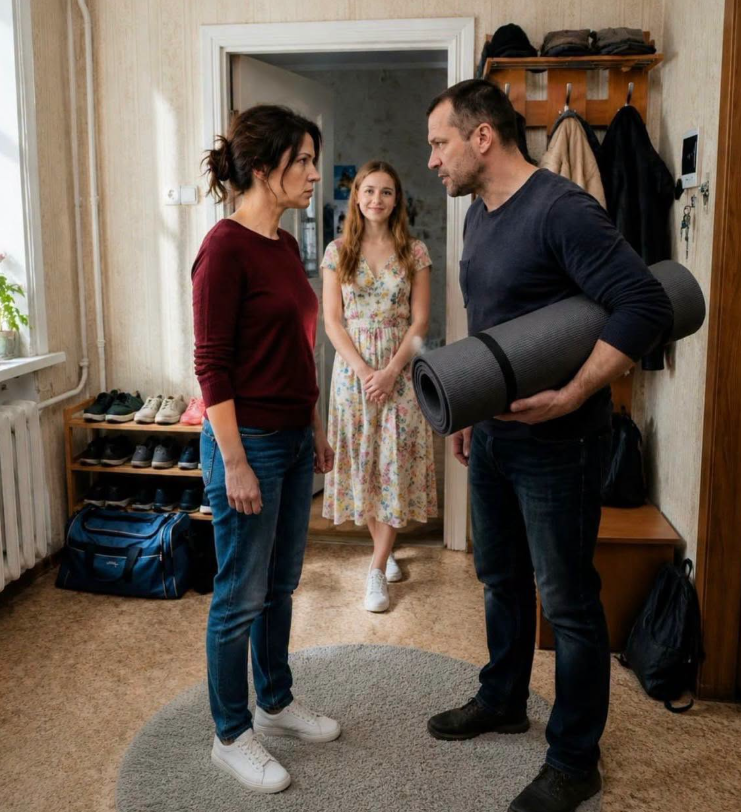
“No,” I said calmly. “Sonia sleeps in her own room.”
The air tightened.
Sergei’s voice hardened.
“Family helps family.”
“Family doesn’t mean pushing one child out for another.”
Artyom stayed silent. It was obvious he hadn’t decided anything — he had simply been brought here.
Larisa started rearranging the room as if it were already settled. Sonia’s bed was being claimed, her things pushed aside.
“Enough,” I said.
But no one listened.
Sergei took out his phone and put his mother on speaker.
“In a normal family, children don’t argue like this,” my mother-in-law’s sharp voice cut through the room.
That was when I understood it wasn’t about a room. It was about control — about who gets to decide whose needs matter.
Sonia stood still, gripping her pencil as if it were the only thing holding her up.
And I made my decision.
The night was heavy. Sergei kept insisting “everything will calm down tomorrow,” but he didn’t undo a single choice. Eventually, Sonia came to me and lay down beside me in silence.
In the morning, I woke up early.
I quietly packed Sergei’s things — shirts, tools, chargers, shoes. Everything that belonged to his life in this apartment. I carried the bags downstairs and left them by the bench outside.
When I returned, he was standing in the hallway.
“What the hell have you done?”
“I restored order.”
He didn’t believe me yet.
“You’ve lost your mind?”
“No. I’ve just stopped agreeing.”
I showed him the documents. The apartment deed was in my name. It had always been.
For the first time, I saw uncertainty in his face.
Larisa shouted that I was destroying the family. His mother demanded “common sense” over the phone. But their voices no longer reached me the way they used to.
Artyom stood up.
“I’m not staying,” he said quietly. “Not like this.”
And he was the first to break the illusion.
Sergei left that same day. No shouting, no dramatic exit. Just a man who suddenly realized there was no space left for him to take.
A few days later, Sonia sat at her desk again. Her books were back in place, her lamp was on, her world restored.
“Do you think he’ll come back?” she asked.
“Maybe for his things,” I said. “But not for your place.”
She nodded and returned to her work.
And for the first time in a long while, the apartment felt like a home where no one had to shrink themselves to fit someone else’s demand.