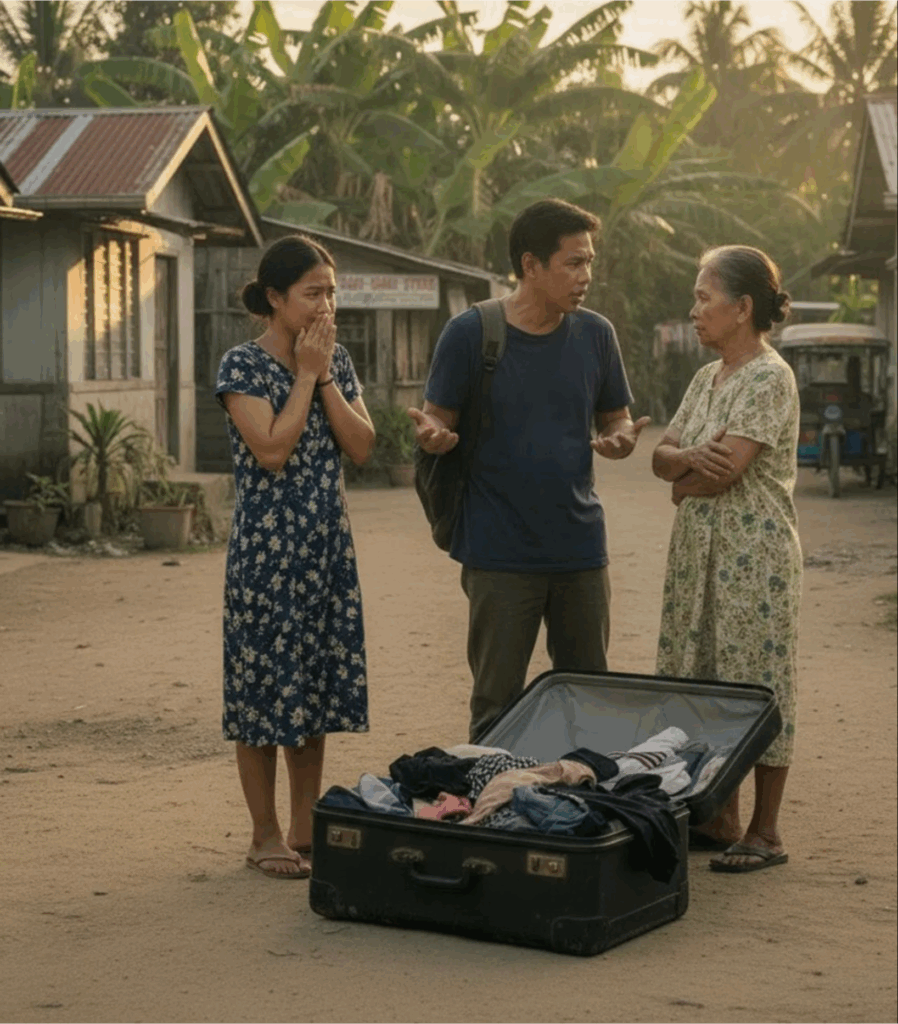
When my husband said that sentence to me—calmly, almost casually during dinner while he was still serving me a second portion of borscht—I didn’t even immediately understand that he was serious.
His voice was relaxed, almost kind.
— Mung bean. I spoke with my mother. And with Irka as well. We came to the conclusion that it would only be fair if we transferred shares of the apartment to them. One quarter for my mother, one quarter for my sister.
My ladle froze in mid-air.
For a moment, thick red drops of borscht fell back into the pot, then onto the table, as if even gravity had hesitated.
The kitchen was warm, familiar. The smell of beetroot, garlic, and bay leaf filled the air. Everything felt normal. Too normal.
— Sergei… what are you even talking about?
He looked at me as if I were slow to understand.
— About the apartment. Your apartment. Our apartment—he emphasized “our” with slight, almost offended patience. My mother practically has nowhere to live, the old Khrushchyovka is about to fall apart. Irka lives with two children in that place, that’s no life. And we have a hundred and ten square meters in the southwest. We live like kings. It’s only fair to give them something.
“Like kings.”
I almost laughed. Not from amusement. From disbelief.
Because his mother, on our wedding day eight years ago, had said in front of everyone:
“Well, at least he married a woman of simple origins. Almost no apartment. Our Seryozha will make up for that.”
“Almost no apartment” meant the small one-room flat in Biryulyovo that I had inherited after my grandmother’s death. A place where I had learned to be alone.
And the “three-room apartment in the southwest” he was now talking about, as if it were a joint purchase from IKEA, had a very different story.
I slowly put the ladle down, took a cloth, and wiped the table, even though the stain would have stayed anyway.
— Sergei. When was the last time you looked at the documents?
He waved his hand dismissively.
— What documents? We’re married, Masha. Everything that is yours is mine too. That’s the law.
He said it with such confidence it was almost insulting.
Then he added, as if doing me a favor:
— I’m not asking you. I’m just suggesting it, humanely. Give them a share. They are family.
“Family.”
That word suddenly hung heavy between us.
— And who am I to you then? — I asked quietly. — A roommate?
He flinched as if I had struck him.
For a moment there was silence. Then his voice hardened.
— I’m giving you until tomorrow. If you don’t agree, I’ll divorce you. Then everything will be split in half by law. And I will use my share to help my mother and Irka. Think about it.
He stood up, took his plate, and walked into the living room as if the conversation was over.
As if everything had already been decided.
I stayed alone in the kitchen.
The borscht was still steaming. The clock was ticking. And suddenly everything was quieter than before.
Eight years of marriage.
And in all those years, he had never once looked at the documents that decided this apartment.
I exhaled slowly.
My name is Maria Viktorovna. Thirty-six years old. I work as an editor at a publishing house. Nothing glamorous, nothing high-paying. But stable.
The apartment, however—a hundred and ten square meters in the southwest of the city—was not shared property.
It was inheritance.
From my aunt Vera Viktorovna, my mother’s sister. A woman who had worked her whole life in a ministry, disciplined, reserved, without her own family. She had paid it off over decades, maintained it, preserved it—and left it to me.
Two years before I married Sergei.
Inheritance before marriage. Personal property. Clearly defined under Article 36 of the Family Code.
Not divisible.
Not negotiable.
Not something to be “fairly redistributed.”
Sergei knew that. I had told him in the beginning. Back then he had laughed, taken my hand, and said:
“Masha, I don’t care whose apartment it is. I love you.”
I had believed him.
Maybe that was the mistake.
I picked up my phone and called my notary.
— Anna Lvovna, sorry for the late call. My husband has developed an interesting idea. I’d like to come tomorrow, with all the documents.
Her voice was calm and familiar.
— Of course, Masha. One o’clock works.
Then I called my brother.
Andrey.
Lawyer. Family law. Twenty years of experience. And a man who never wasted words.
— Sergei is demanding that I transfer shares of the apartment to his mother and sister. Or he’ll divorce me.
Silence on the other end.
Then a dry laugh.
— So he still hasn’t understood who the apartment belongs to.
— Apparently not.
— I’ll be there at seven tomorrow.
The next morning, Sergei was in unusually good spirits.
He hummed while making coffee.
— So? Have you thought about it?
I looked at him.
— We’ll talk tonight. At seven.
He smiled confidently.
He was sure I would give in.
As if he had never doubted being right.
In the afternoon, I went to Anna Lvovna. She reviewed the documents calmly, precisely, without emotion.
Then she closed the folder.
— It’s very simple, Masha. The apartment belongs solely to you. No one else has any rights to it. Not your husband, not his family.
She looked at me directly.
— If he leaves, that is his decision. But the property remains untouched.
I nodded.
For the first time that day, I felt something like calm.
A complete, official truth on paper.
Not a weapon.
A boundary.
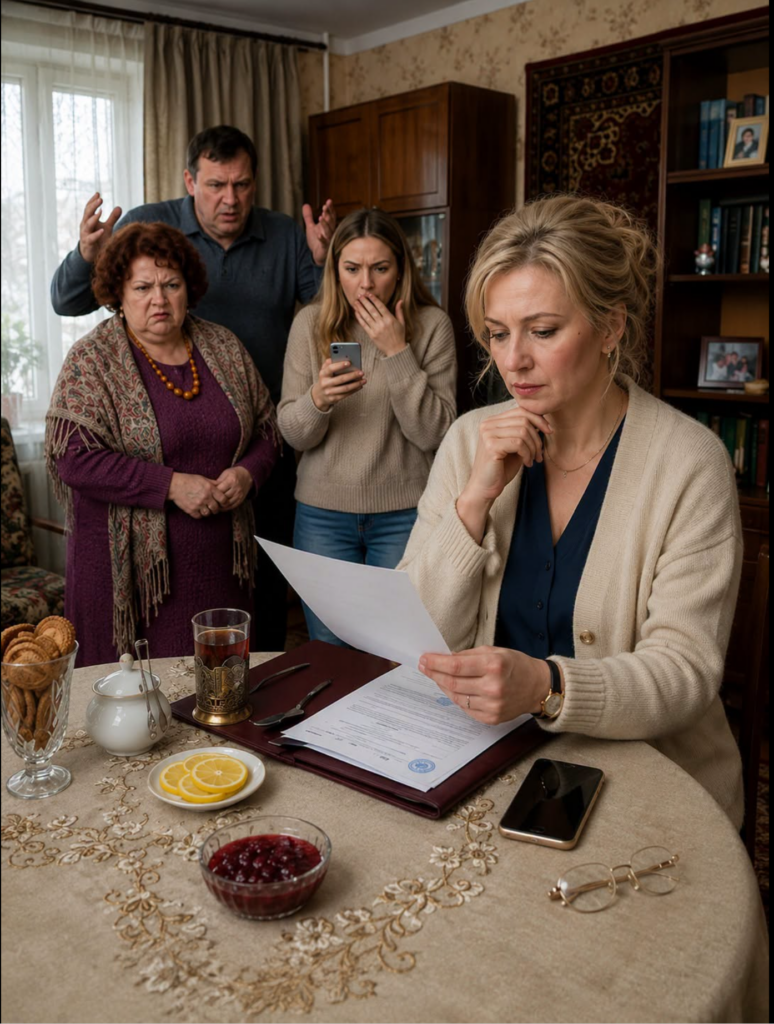
Exactly at seven, Sergei was sitting in the living room.
Next to him were his mother, Zinaida Arkadyevna, and his sister, Irina. Both dressed as if this were not a conversation, but a ceremony.
A family council.
The atmosphere was tense, but confident.
Then the doorbell rang.
— Who is that? — Sergei asked.
— My brother.
Andrey entered.
Calm. Dressed in black. Briefcase in hand. No unnecessary greetings, no extra words.
He sat down.
Opened the folder.
— Good evening. I am the legal representative of my sister in property matters.
Silence.
— Inheritance certificate. Issued two years before marriage.
Zinaida frowned.
— What is this supposed to mean?
Andrey ignored her.
— Property registry extract. Sole ownership. No encumbrances.
Sergei went pale.
Irina laughed nervously.
— It’s just paper…
Andrey looked up.
— Paper determines ownership.
Then he placed the third document on the table.
— Notarial statement. No third-party claims. No division possible. End of discussion.
Silence.
A heavy, suffocating silence that could not be undone.
Then Irina exploded:
— That’s not fair! We thought this was shared!
Andrey looked at her calmly.
— You thought. But you never asked.
Sergei said nothing for a long time.
His gaze moved between the documents, me, his brother, his mother.
For the first time, he didn’t look angry.
Just small.
— You never told me it was like this… — he muttered.
I answered quietly:
— I did. You just didn’t listen.
And in that moment, I understood something simple.
It was never about the apartment.
It was about his belief that everything could be negotiated.
Even me.