The Mysterious Visitor
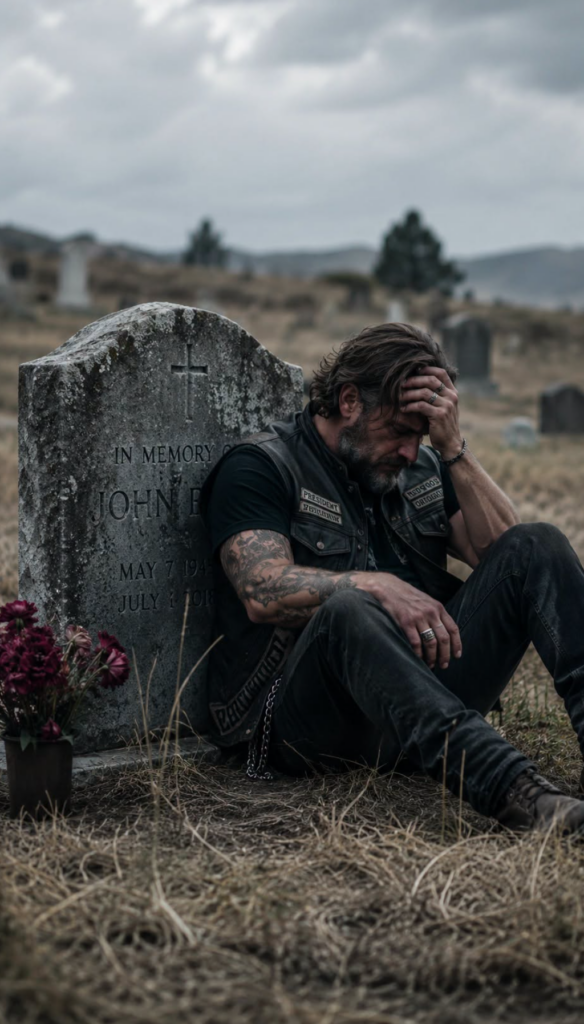
Every Saturday, at exactly two o’clock in the afternoon, a man arrived at the cemetery on a motorcycle and headed straight to my wife’s grave.
At first, I thought it was a coincidence. Perhaps he was mourning someone else nearby. But weeks turned into months, and he kept returning. The same day. The same time. The same ritual.
He never brought flowers. He never said a word. He carried only silence with him.
He would sit beside the headstone, legs crossed, head bowed, his hands resting quietly in the grass. He stayed there for exactly one hour. Then he would gently place his palm against the stone, stand up, and leave.
I watched him from my car, hidden behind the old pine trees at the edge of the cemetery. His presence unsettled me. Who was this man? Why did he come to her grave every week?
Sarah had died fourteen months earlier. Breast cancer took her at the age of forty-three. We had spent twenty years together — a simple, quiet life filled with children, everyday struggles, and the work she loved so deeply: she was a pediatric nurse.
She was one of the most extraordinary people I had ever known. The kind of woman who could still see goodness in others, even in the midst of pain.
And yet, nothing in her life seemed connected to a leather-jacketed biker with tattooed arms and a hardened expression.
Still, there he was. Every Saturday. Mourning her as if he had lost the most important person in his world.
The Conversation
Three months passed before I finally approached him.
The day was clear and almost perfectly still. He was sitting in his usual place when I walked up to him. My chest was tight with anxiety and anger.
“Excuse me,” I said. My voice sounded harsher than I intended. “I’m Sarah’s husband. Who are you?”
He didn’t flinch. He didn’t become defensive. He slowly stood up.
Up close, he was larger than I had imagined — tall, broad-shouldered, a man whose life had clearly not been easy. But his eyes were red from crying.
“I’m sorry,” he said quietly. “I never meant to intrude. I only came to say thank you.”
“Thank you?” I asked. “For what?”
He looked at the grave, and his voice trembled.
“Because your wife saved my daughter’s life.”
A Story I Never Knew
The man’s name was Mike. He told me he was a mechanic and a single father.
Several years earlier, his daughter, Kaylee, had been diagnosed with leukemia. She was nine years old.
Their insurance covered only part of the treatment. Mike worked two jobs, sold his house, and organized fundraisers with his motorcycle club. Even then, they were still forty thousand dollars short.
“I was broken,” he said. “I thought I was going to lose her.”
One day, he collapsed in a hospital hallway.
Sarah — who did not even work in his department — saw him sitting on the floor.
“She asked if I was okay,” Mike said. “And I told her everything. That my little girl was dying and I had no way to save her.”
Sarah was exactly the person she had always been.
She listened quietly. She did not judge him. She did not offer empty words of comfort. She simply listened — with that calm, deep compassion that made everyone around her feel safe.
Then she said:
“Sometimes miracles happen. Don’t lose hope.”
Two days later, Mike received a call from the hospital. The missing forty thousand dollars had been paid in full by an anonymous donor.
“I tried to find out who it was,” Mike said. “But they wouldn’t tell me. They only said the donor wanted to remain anonymous.”
Kaylee received her treatment.
She survived.
She grew up.
For years, Mike searched for the person who had saved his daughter. Only six months earlier, while reviewing old hospital records, he finally discovered the name:
Sarah Patterson.
“My wife…” I whispered.
Mike nodded.
“I found her picture online. I recognized her immediately. I wrote to thank her, but she never answered. Then I found her obituary.”
He fell silent, swallowing his tears.
“That’s why I come here every Saturday. To tell her that Kaylee is alive. To tell her that what she did gave my daughter a life.”
A Memory That Suddenly Made Sense
As he spoke, my own memories began to fall into place.
Fifteen years earlier, Sarah and I had saved forty thousand dollars to renovate our kitchen.
One morning she told me she had spent the money on “something important.”
I was furious.
Very furious.
We argued for days.
I remember her quietly saying:
“One day, you’ll understand.”
And now I did.
She had not taken a kitchen away from me.
She had saved a life.
She had kept a family together.
Tears blurred my vision.
“Please keep coming,” I finally said. “Please… come whenever you want. Sarah would have wanted that.”
Mike nodded.
“Your wife was one of the best people I’ve ever known,” he said. “And I only spoke to her for five minutes.”
A Strange New Family
Since then, Saturdays have taken on a new meaning.
Every week, Mike and I sit together at Sarah’s grave. Sometimes we talk. Sometimes we simply sit in silence.
He tells me about Kaylee — now sixteen years old, an excellent student who volunteers at the same children’s hospital where she was once treated.
Last week, he brought her with him.
Kaylee knelt beside the grave, placed a bouquet of daisies on the stone, and quietly said:
“Thank you for saving me. I’ll live my life in a way that would make you proud.”
I could not speak.
Mike is no longer a stranger.
His family and mine have become connected. We help one another. He visits my children. His wife bakes cakes for my daughter.
We have become a strange, unexpected family — woven together by the memory of a woman who gave quietly, expecting nothing in return.
## Sarah’s Legacy
Sometimes people stop in the cemetery and look at us: a grieving husband and a biker sitting side by side.
They do not understand.
They do not know that a quiet woman once gave away all her savings to save a stranger’s child.
They do not know that love does not end with death.
Every Saturday, I sit beside her grave and whisper the same words:
“Now I understand. And I will remember for the rest of my life what you taught me: kindness never dies.”
If you’d like, I can also rewrite it in a more emotional, literary, or magazine-style English version.