The cemetery’s silence was almost oppressive on the day I stood beside my mother’s grave. The mourners slowly dispersed, leaving only the scent of fresh earth and flowers behind.
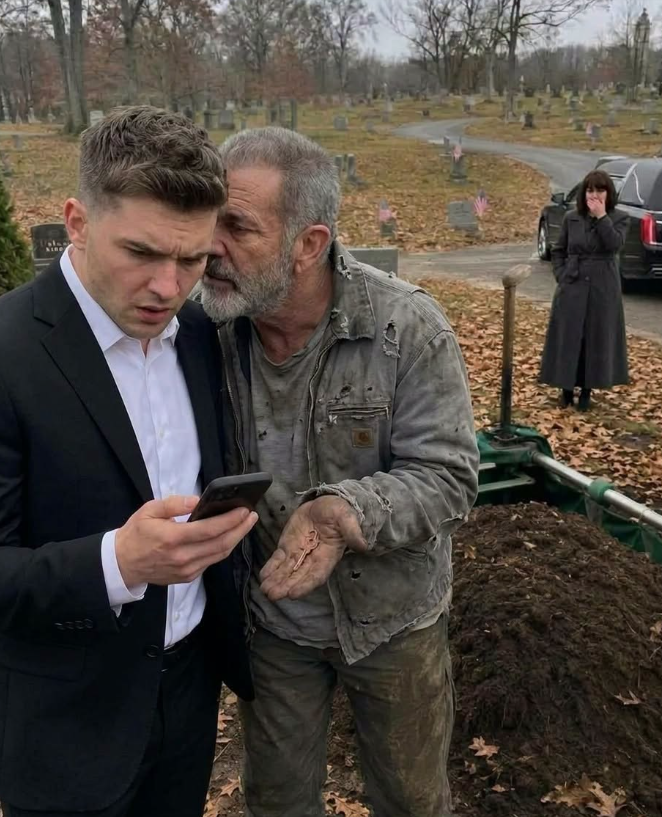
That’s when Earl, the director of the funeral home, approached me. I had known him since childhood, and he had known my mother—perhaps too well.
At first, I thought he only wanted to offer his condolences, but his face was tense.
“Miss Carter…” he whispered. “Your mother paid me to bury an empty coffin.”
The world fell silent for a moment.
“What?” I asked, trembling.
Then he slid a brass key into my hand. It was cold, heavy, with a worn tag: Unit 16.
“Don’t go home,” he said firmly. “Safelock storage. Right now.”
Before I could say anything, my phone vibrated. Sender: Mom. “Go home alone.”
My legs shook. She had been presumed dead for six days. I had seen her body, signed the papers, stood by the coffin while everyone said she was finally at peace.
And yet her name was now flashing on my screen. I didn’t think—I just went.
The Safelock storage facility stood on the outskirts, surrounded by bleak concrete and rusty fences.
Unit 16 was one of many identical metal doors. My hands were shaking so badly I dropped the key twice before I managed to unlock it.
When the shutter lifted, I froze. The unit was almost empty: a folding chair, a lamp, three large water containers, a box full of files, and my mother’s dark blue bag. Police had said it was found with her body.
On top of the bag lay an envelope: “For Emily.” My heart pounded as I opened it. “If you’re reading this, they have already lied to you.”
Then tires screeched outside. A black SUV slowed near the facility, its engine still running.
Fear flooded me. I ran inside the unit, pulled the shutter down, leaving only a thin strip of light underneath. Footsteps approached.
“Miss Carter? We just want to talk.”
The voice was calm—too calm.
“Your mother got involved in things she shouldn’t have.”
The other half of the letter trembled in my hands: “Don’t trust the police. Don’t trust Richard Hale. No one from Lawson Financial. Take the red folder and run.”
Richard Hale, my mother’s boss for nineteen years, the man who had hugged me at the funeral, was suddenly a threat.
Outside, someone scratched at the lock. The box contained files: bank records, forged contracts, traces of missing inheritances.
At the top was a red folder. When I opened it, everything came together: corporate networks, fake transfers, phantom inheritances, and a USB drive.
A sheet of plywood covered the back wall. When I moved it, I saw the wire fence had already been cut. An escape route. My mother had planned everything in advance.
Outside, the voice spoke again: “Open up, Emily. Your mother died because she refused to cooperate.”
Then I understood: this was not an accident. Someone had wanted her dead.
I ran across the grass toward a drainage ditch, then onto a service road. My phone vibrated again. “Go to Daniel Brooks. County archives. Trust no one.” Another message: “And Emily… if Hale finds you first, burn everything.”
Daniel Brooks was waiting in a dusty office. He wasn’t surprised when I walked in.
“Emily Carter,” he said, not as a question.
“Your mother sent you?” I nodded. And he handed me an envelope written three weeks before her death.
Reality began to collapse around me. Lawson Financial was running an entire financial network built on fake inheritances and missing money.
My mother had discovered it by accident. When she confronted Richard Hale, they framed her and began threatening her.
And she made the impossible choice: she staged her own death. The empty coffin wasn’t a mistake—it was part of the plan.
“She’s alive?” I whispered.
Daniel nodded. She had called four days earlier from a disposable phone.
The grief I had carried suddenly split open—but so did anger. Because she had let me cry over an empty coffin.
Later, everything was handed over to federal investigators. Two days later, Richard Hale was arrested, followed by the rest of the network.
Nine days later, my phone rang: it was my mother. She was alive. In Arizona, in a protected location, exhausted—but alive.
When she returned months later, we sat in silence in the kitchen. I told her everything: the funeral, the emptiness, the weight of the lie.
She listened without defending herself. Then she simply said, “I would do it again. But I’m sorry for what I put you through.”
I nodded. “I know.” And I truly did.
The brass key still sits on my bedside table. Sometimes I hold it, remembering the day my grief was only the beginning of a much larger secret.