The doctors suspected signs of autism in the newborn… but years later, when his mother opened an old hospital envelope, she realized she had been lied to her entire life.
Liam was born on a cool, rainy dawn.
The hospital corridors glowed beneath pale fluorescent lights, while raindrops slowly traced paths down the windows. In the newborn ward, nurses found themselves stopping unusually often beside the same crib. Not because the baby was crying or ill.
Quite the opposite.
The little boy was perfectly calm.
He had almost no hair, but his face carried a strange sense of peace. Sometimes a smile appeared while he slept—a smile so warm that even the most exhausted nurse couldn’t help but smile back.
“Look at him,” one nurse whispered. “There’s something special about that little boy.”
His mother named him Liam.
During the first few days, everyone said the same thing.
“What a quiet baby…”
Everyone except one person.
One of the pediatric doctors spent long periods watching the infant. He rarely spoke. He simply stood beside the crib, studying Liam’s face, his eye movements, his reactions, then writing notes into his medical chart.
On the third day, he asked Liam’s mother to join him in a private room.
She sat down nervously.
“Your son is showing unusual behavioral patterns,” the doctor said in a flat, professional voice. “It’s possible that he may later be diagnosed with autism spectrum disorder.”
The mother stared at him in disbelief.
“But he’s only a newborn.”
The doctor closed the folder.
“There are things we notice long before parents do.”
The sentence burned itself into her memory.
Years passed.
Liam really was different from other children.
He disliked loud noises. He avoided crowded places. He rarely looked people directly in the eyes and could spend long stretches focused on a single object.
While other children ran around playgrounds, Liam often sat near a window, tracing his fingers along the glass.
As if he were counting.
As if he were following some invisible pattern.
School wasn’t easy.
The other children thought he was strange.
Some mocked him.
Teachers looked at him with sympathy.
“Poor boy,” they often said.
But Liam’s mother saw something entirely different.
She noticed that Liam never did anything without a reason.
Every movement seemed deliberate.
Every drawing was filled with repeating patterns.
Every silence seemed to conceal a thought nobody else could hear.
One autumn afternoon, while cleaning old boxes in the attic, she discovered a dusty toy chest. As she sorted through forgotten belongings, she noticed a yellowed envelope buried at the bottom.
The hospital’s name was printed across the front.
Curious, she turned it over.
On the back was a handwritten note:
“Open only if the child continues to display unusual behavior after the age of ten.”
Her heart immediately began to race.
At the bottom was the signature of the same doctor who had warned her years ago.
With trembling hands, she opened the envelope.
Inside was only a single photograph.
It showed Liam as a newborn lying in a hospital bed.
On the back of the picture was a short sentence:
“He will remember what we saw.”
The mother froze.
She didn’t understand.
Why would a newborn remember anything?
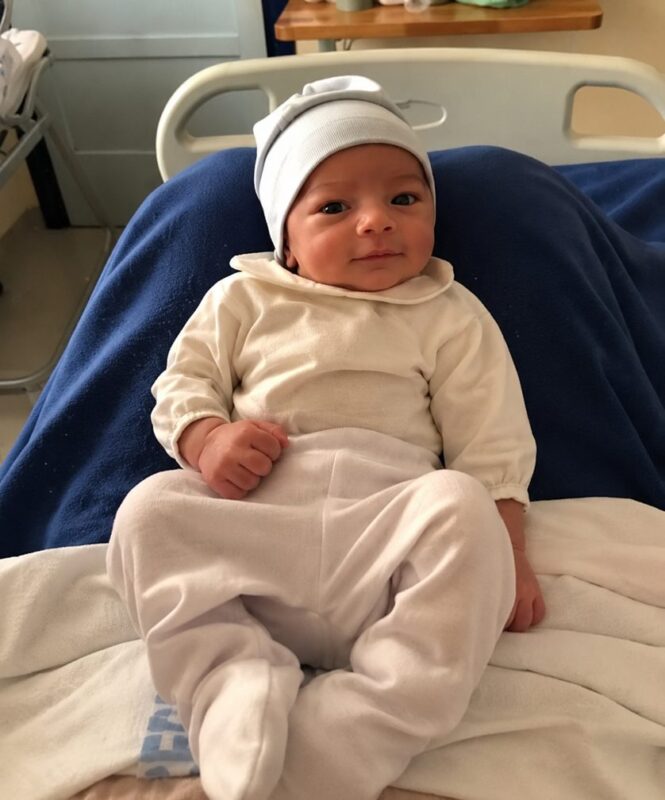
And what did “what we saw” even mean?
That night she barely slept.
The following morning, she went straight to Liam’s school.
He was sitting alone in an empty classroom.
A drawing lay on the desk before him.
The moment she saw it, her blood ran cold.
The picture showed the same doctor.
His face was unmistakable.
“Liam…” she whispered. “How do you know this man?”
The boy slowly lifted his head.
This time he didn’t look away.
“He came into my room when I was very little,” he said quietly.
His mother turned pale.
“What do you remember?”
“He said I wouldn’t remember.”
Her hands began to shake.
A terrible feeling settled over her.
That same day, she contacted the authorities.
The old hospital records were reopened.
The investigation lasted for weeks.
Officials tracked down families whose children had been born during the same period.
Slowly, a shocking picture emerged.
Liam wasn’t the only case.
Several children had been included in a secret observation program.
They had been part of a study involving infants who displayed unusual neurological responses. The children had been monitored for years without their parents receiving full information.
But the greatest surprise came afterward.
The doctor wasn’t dead, despite what people had been told.
He had assumed a new identity.
He had disappeared from public view.
When investigators finally located him at a remote private clinic, he asked only one question during questioning:
“Does the boy still draw the blue room?”
Liam’s mother nearly collapsed.
Because her son had spent years drawing the exact same room.
A room with blue walls.
The same window.
The same door.
The same cold light.
And he had never been able to explain how he knew it.
At that moment, she thought she finally understood.
Her son wasn’t quiet because he failed to experience the world.
He was quiet because he carried things inside him that nobody understood.
People had mistaken his silence for weakness.
Yet perhaps he had been seeing and feeling more than anyone around him all along.
From that day forward, his mother stopped searching for what was “wrong” with him.
Instead, she tried to understand him.
To protect him.
And to accept him exactly as he was.
Years later, Liam stood as a witness in a crowded courtroom.
Journalists filled the benches.
Lawyers sat surrounded by stacks of documents.
Families watched from every corner of the room.
Everyone was looking at him.
For several seconds, he remained silent.
Then he spoke.
“They wrote notes about us before we even had names.”
The room fell completely still.
And for the first time in his life, everyone listened to the boy they had once believed would never be able to tell his own story.