— Go on then, call your “village woman,” let’s entertain the crowd! — Éleonóra Genrikhovna hissed, slowly adjusting the diamond brooch on her jacket as if even the jewelry shared her sense of superiority.
Her voice was soft, almost pleasant, but every word cut like glass. — At my anniversary banquet, there will be the city’s most respected people. We need contrast. Let them see what kind of hopeless countryside my son dragged his wife out of.
I stood in the spacious marble hallway, holding the guest list, feeling my throat tighten. The air in the house was always like this—cold, polished, expensive, and completely without warmth.
My husband, as always, chose the safest position: his phone. He stared at it as if it had suddenly become the most fascinating object in the world. He never intervened when his mother struck. Silence was his shield.
My own mother lived two hundred kilometers away from the city. She had worked the land her entire life, raised me alone, and never once complained. Her hands were rough, cracked from years of labor, but they held more warmth than anything in this house of glass and marble.
And now they wanted to turn her into a spectacle.
At first, I wanted to refuse. To find an excuse. To protect her from this humiliation.
But something inside me hardened instead.
Fine. Let’s see who ends up laughing.
The phone call was difficult. When I mentioned a luxury restaurant, she fell silent for a long moment.
— Daughter… I don’t belong in places like that. Everyone will be dressed in silk, and I’ll come in my old wool suit. They’ll laugh at me.
— No one will laugh at you, — I said firmly. — You are my most honored guest. I can’t even breathe properly there without you.
She finally agreed, though I could still hear hesitation in her voice. She insisted on bringing something “homemade, at least a little taste of home.”
On the day of the banquet, the hall looked like a frozen dream of wealth—crystal chandeliers, gold trim, soft music, and people who carried themselves as though even their gestures were rehearsed. The food on the tables was miniature, artistic, and completely lifeless.
And then my mother arrived.
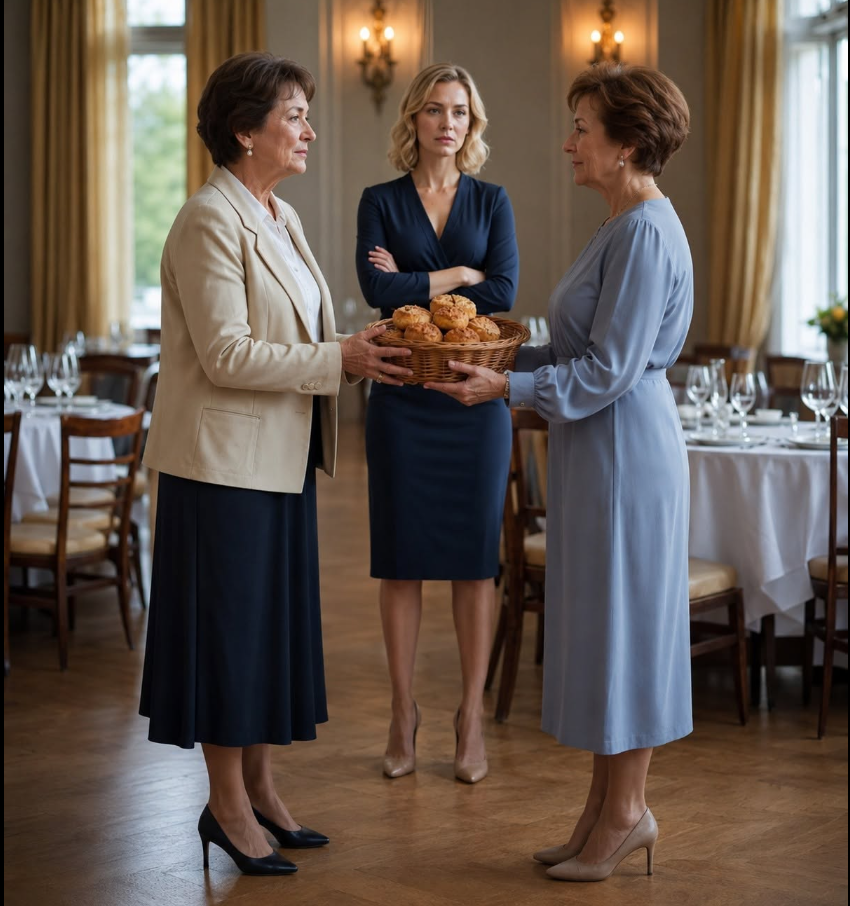
She entered quietly, neatly dressed, her expression modest but steady. In her hands was a large woven basket covered with a white embroidered cloth.
Éleonóra noticed her immediately.
Her eyes sharpened with delight.
— Oh, look who’s here! The countryside guest! — she announced loudly, gathering her circle of guests around her. — Let’s see what she’s brought!
With a dramatic motion, she pulled the cloth away.
And the entire room changed.
The smell hit first—hot, rich, unmistakably real. Meat and mushroom pies, fresh from the oven. The aroma spread through the hall, overpowering perfume, wine, and expensive cuisine in seconds.
— These are pies, — my mother said calmly. — If you’d like, please try them.
Éleonóra gave a sharp laugh.
— Darling, this isn’t a village fair. This is a high-class event. Who brings *pies* to a banquet?
But it was already too late.
A retired general was the first to reach out. He took a piece, bit into it, and froze mid-motion.
— My God… — he muttered. — This tastes like my mother’s kitchen…
That was the moment everything broke open.
People gathered around the basket. At first cautiously, then with growing urgency. The delicate gourmet plates were forgotten, left untouched, while warm slices of pie disappeared within minutes. The room filled with laughter, surprised exclamations, and memories people hadn’t spoken of in years.
Something simple had defeated something expensive.
Something real had replaced something empty.
Éleonóra’s face darkened as she stood apart from the crowd, her control slipping, her voice drowned out by the sudden life in the room.
Then the chef appeared.
Dressed in white, composed and serious, he approached the basket. He took a piece, tasted it—and did not speak for several long seconds.
— Who made this? — he asked finally, loud enough for the whole room to hear.
My mother slowly stood.
— I did.
The chef nodded with deep respect.
— This is not just food. This is memory. This is life. You could teach this in any professional kitchen. Do you use a homemade fermentation starter in the dough?
The room erupted into applause.
The general slapped the table, laughing. Guests smiled openly, genuinely, as if something heavy had lifted from them. My mother stood there, slightly embarrassed, but now carrying herself differently—no longer as a guest, but as someone being recognized.
Éleonóra was gone.
She didn’t leave dramatically. She simply vanished from the center of attention, slipping away in silence.
Later, I heard her in the restroom, crying behind a locked stall—quiet, broken sounds of humiliation she could no longer control.
When she returned, her face was pale, her pride drained.
— The pies… are they gone? — she asked hoarsely.
— Every last one, — someone replied.
Then the chef returned, holding an envelope.
— The restaurant owner would like to purchase the recipe.
My mother shook her head.
— The recipe is not for sale. It’s not just food. It’s heritage. It can only be passed on.
Then she turned to me and placed a set of keys on the table.
— I sold the house in the village yesterday. The money is in the account. We’re going tomorrow to look for a place for you. A proper home. And I will teach you how to bake—so you never have to live under anyone’s shadow again.
My husband choked on his mineral water.
And Éleonóra Genrikhovna, for the first time in her life, had no words left at all—only the empty basket, and the realization that everything she tried to control had slipped quietly out of her hands.