The baby’s cry was the first thing I heard when I stepped out of the elevator.
Not the television.
Not the sound of running water.
Not Oksana’s voice, which usually greeted me at the door with at least a tired, “You’re home already?” no matter how exhausted she was.
Just my son crying.
The sound cut through the hallway and reached me before I even got to the apartment door. It was sharp, hoarse, desperate. The kind of cry that instantly makes every parent’s stomach drop.
I stopped for a second.
Something was wrong.
Over the past two weeks since we had brought him home from the hospital, I had learned to recognize every kind of cry he had.
There was the hungry cry—impatient and demanding.
There was the uncomfortable cry when his diaper needed changing.
There was the painful cry that came with stomach cramps, when Oksana would spend hours pacing the apartment with him in her arms, whispering the same comforting words over and over while barely able to keep her own eyes open.
But this cry was different.
There was something raw in it.
Something frightening.
It sounded like the cry of someone who had been calling for help for far too long and had finally begun to believe that nobody was coming.
My hand went into my pocket for my keys.
They slipped from my fingers and clattered onto the floor.
I cursed under my breath and bent to pick them up.
My hands were shaking.
The crying continued from inside the apartment, uninterrupted and relentless.
When I finally unlocked the door and stepped inside, a wave of smells hit me immediately.
Burned porridge.
Spilled milk that had begun to sour.
The heavy scent of broth that had boiled over from a large pot on the stove.
The air felt warm, stale, and neglected.
The kitchen light was on even though daylight still streamed through the windows.
Its yellow glow reflected off wet wipes scattered across the counter, a baby bottle lying on its side near the sink, and a transparent plastic folder sitting half-open on the table.
I recognized it instantly.
Oksana’s hospital documents.
For some reason, that folder remains crystal clear in my memory.
Not because I understood its importance at the time.
But because I remembered watching her organize every paper inside it the night before she was discharged.
The medical reports.
The prescriptions.
The insurance documents.
The doctor’s instructions.
Even a small piece of paper with our family physician’s phone number carefully written on it.
That was who Oksana was.
Even when she was exhausted, hurting, and barely sleeping, she still found the energy to keep our lives organized.
People often called her overly sensitive.
What they never understood was that she was the person quietly holding everything together.
I moved toward the living room.
The first thing I saw was the bassinet.
My son lay inside it, his tiny face red from crying. Tears and saliva had soaked the collar of his onesie. His fists opened and closed repeatedly as though he were desperately searching for someone to hold on to.
Beside the bassinet, a basket filled with diapers had been knocked over.
Several diapers were scattered across the floor.
A small handmade doll Oksana had placed on a nearby shelf only days earlier had fallen face-down onto the rug.
Then I saw her.
Oksana was lying on the couch.
For a moment, I couldn’t move.
Her skin looked pale.
Not tired pale.
Not exhausted pale.
Gray.
One arm hung limply over the edge of the couch.
Her fingers were completely relaxed in a way that felt deeply wrong.
Her hair clung to her forehead.
Her lips were dry and colorless.
Only the faint rise and fall of her chest told me she was still breathing.
Even then, each breath seemed uncertain, as though her body had to struggle for every single one.
A cold wave spread through my chest.
My heart began hammering so hard I could hear it in my ears.
And then I noticed my mother.
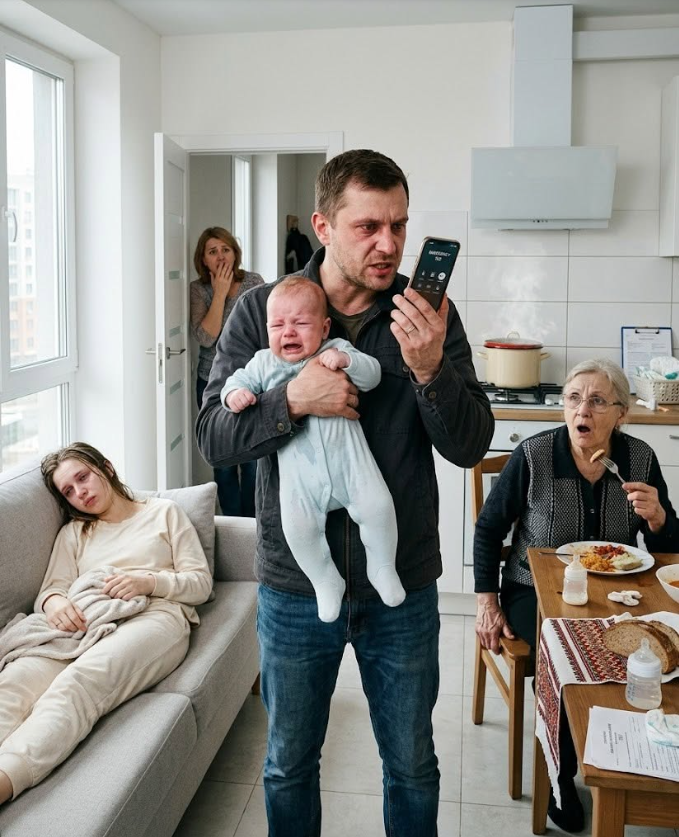
Larisa Petrovna Kovalchuk sat at the kitchen table.
Eating dinner.
Calmly.
Comfortably.
As though she were sitting in a restaurant waiting for the next course.
As though she weren’t just a few feet away from an unconscious woman and a screaming newborn.
A plate of chicken, buckwheat, and vegetables sat in front of her.
Beside it was a loaf of bread resting on the embroidered tablecloth that Oksana only brought out for special guests.
The lid on the pot clicked softly against the stove.
A fork tapped against porcelain.
The sounds seemed unnaturally loud in the silence surrounding everything else.
My mother slowly lifted her eyes.
She looked at me.
Then at Oksana.
And with complete indifference, she said:
“Drama queen.”
The world seemed to stop.
Not because of the words themselves.
But because of how casually she said them.
There was no concern.
No alarm.
No confusion.
No guilt.
Only irritation.
As if the woman lying unconscious on the couch was nothing more than an inconvenience.
As if the mother of her grandchild was somehow bothering her.
For a moment, I felt absolutely nothing.
No anger.
No rage.
No urge to scream.
Just silence.
A deep, terrifying silence.
People often imagine that love disappears slowly.
That disappointment arrives one small piece at a time.
But sometimes it doesn’t.
Sometimes there is a single moment when the love you’ve carried for someone your entire life simply stops protecting them.
And that was mine.
I didn’t yell.
I didn’t lunge across the room.
I didn’t flip the table over, though for one brief second I could picture it perfectly.
The plate crashing onto the floor.
The food scattering across the tiles.
The bread sliding from the table.
My mother finally falling silent.
But I didn’t do any of it.
Instead, I walked to the bassinet.
I picked up my son.
The moment he felt my arms around him, his tiny fingers grabbed the front of my shirt.
His desperate cries broke into exhausted sobs.
He buried his face against my neck and held on as though he was afraid I might disappear too.
I wrapped both arms around him and pulled him close.
Then I looked at Oksana again.
And in that moment, I knew with absolute certainty that whatever happened next, whatever explanation waited for me, whatever consequences followed, one thing was already beyond doubt.
Nothing would ever be the same again.