By that evening, Rájsza Savcsuk already felt that asking for help would be a source of shame, yet hunger proved stronger within her than the pride she had tried to hold together all her life.
Above the town hung a heavy, cold rain—not pouring, but dissolving into the air like fine, persistent dust.
It clung to people’s clothes, to hair, even to thoughts, as if it wanted not only to soak the body, but slowly dissolve patience itself.
Rájsza’s headscarf had long been soaked through, water ran down the collar of her coat, and with every step she felt as if the pavement itself was deliberately trying to hold her back.
She walked slowly. Very slowly. With a cane that was now more of a support than an aid.
On her shoulder hung an old canvas bag, containing a few small things that a person keeps even when there is almost nothing left to carry.
In her pocket, three coins clinked—too loudly for a life in which everything else had already fallen silent.
At home, an empty grain box was waiting. A half-used blood pressure pill. A dried-out piece of bread she had not thrown away only because “it might still be useful.” And a pot that no longer held food, only memories.
Rájsza did not like to complain.
When her husband died, she had no time to collapse. The house remained, the bills remained, everyday life remained.
And she remained with them. She paid the electricity, counted her money at the shop, and every spring planted onions under the window with her own hands, as if order in the world could be maintained that way.
She carried water until her hands grew heavy and her joints began to signal every morning, as if warning her: time does not ask permission.
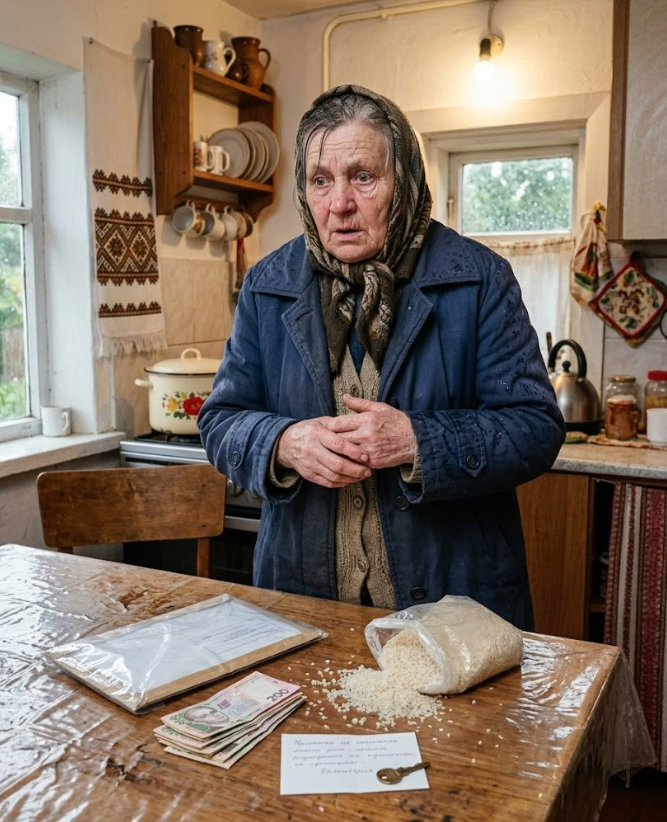
To the neighbors she always said she was managing. That there were no problems. Sometimes she brewed tea twice from the same tea leaves, convincing herself that the taste was stronger that way, “more economical.”
Her son, Antón, lived on the other side of the city. Behind a tall fence, in an orderly world where the lights around the gate were already on even during the day.
He had a shop by the main road, a warehouse with metal gates, employees, deliveries, and a car Rájsza would never have dared to touch, as if even that might break some invisible order.
She was not jealous of him.
She was proud of him.
She remembered him as a child: running home in wet shoes, his coat always too thin for winter, clutching his bag tightly to his chest, shouting from the doorway that he had gotten an A in mathematics.
Back then, Rájsza would quickly place something warm in front of him—vareniki, potatoes, whatever there was—and she herself would eat the leftovers, yet still feel that her life was complete.
A mother does not count how much she gives—until she realizes one day that she has nothing left to give, and asking becomes even harder.
That evening, Rájsza went to Antón’s house.
She stopped at the gate. Her fingers trembled on the cold metal of the doorbell when she pressed it. Once. Then again, as if the second attempt might make the first braver.
Behind the fence, warm light filtered out. The wet flowerbeds glistened, as if coated in oil.
On the veranda stood neatly arranged potted plants, and from the house’s windows came kitchen light, in which another life was unfolding: warm, safe, closed.
Rájsza suddenly felt very чужда—completely out of place.
She imagined herself stepping inside, taking off her wet coat, sitting on the edge of a chair, and quietly saying what she had rehearsed all the way:
that she only needed a little help until the next pension. Not much. Just enough not to sit in an empty kitchen.
She did not want pity.
She just did not want to go to bed hungry.
The gate opened with a soft electronic beep.
And Marina appeared.
Her daughter-in-law wore light home clothes, her hair neatly tied back, her face one of those that quickly shifted from patience into tired irritation whenever Rájsza’s name came up.
— What are you doing here? — she asked.
The words fell coldly on Rájsza. Not “you,” not “aunt,” but that distance in which there is no longer family—only rules.
— I came to see Antón, my dear, — she said softly.
Marina looked her over: the wet clothes, the old shoes, the hand leaning on the cane that could no longer hide its trembling.
— It’s late.
— I won’t stay long.
Rájsza took out her handkerchief but did not wipe her face. She could not tell where the rain ended and humiliation began.
— I have no food at home, — she finally said. — I just wanted to ask my son for a little money. Until the pension.
Marina did not answer. For a moment she simply watched, as if weighing how well this scene fit into her orderly evening. Then she turned and went back into the house.
She left the door half open. It was enough for Rájsza to see the clean hallway, the dry carpet, the warmth that was not meant for her.
A minute later, Antón appeared.
He still had his phone in his hand, as if the conversation on the other end mattered more than the wet, exhausted figure standing in the yard.
— Mom, what happened? I’m busy.
Rájsza felt shame rise in her again, slowly, familiarly. But for the first time, she did not step back. She just stood in the cold rain, trying to find a voice that did not tremble as much as her hands.