Rafael Moreira never imagined that the cruelest sound of his life wouldn’t be the screeching brakes on Marginal Pinheiros that afternoon, but the silence that followed. A heavy, suffocating quiet that seeped into every corner of his São Paulo mansion, resting on the sofas, hiding behind the curtains, filling every room with the weight of absence.
Since Helena’s death, the house had become a mausoleum disguised as a home: immaculate on the outside, fractured within. Every morning, Rafael woke at five, without an alarm, trapped in a loop of the same nightmare—an out-of-control truck, the impact, the screams… and then nothing.
For two fleeting seconds, he would convince himself it was only a dream. Then his eyes would fall on the empty side of the bed where Helena once lay, and reality would slam into him like a wall.
He rose because there was no choice. His daughter, Sofia, was all that remained of that crash. She had been eleven months old. The doctors spoke of spinal damage, nerve trauma—words Rafael refused to hear. Only one sentence carved itself into his soul:
“She may never walk.”The mansion filled with medical equipment, adapted chairs, toys that no longer sparked joy. Before the accident, Sofia had kicked her tiny legs, twisted to grab her feet, giggled when Helena kissed her belly.
Afterward, those legs seemed alien, belonging to someone else. Rafael held her close; though she weighed almost nothing, she felt as heavy as the world.
Months blurred into baby bottles and board meetings, diapers and contracts. Rafael existed as two men: the tech executive who couldn’t pause his empire, and the father who couldn’t pause his grief. Partners urged him to take time off.
He smiled and promised to consider it, knowing the truth: work was the only thing keeping him upright. If he stopped, sorrow would consume him entirely.Then came the caregivers.The first quit after three days. The second vanished with an excuse. The third lasted a week. The fourth, two. The fifth cried as she left, whispering words that haunted Rafael:
“I can’t handle this.”Every departure felt like abandonment—not just of Sofia, but of hope itself.So when the doorbell rang that Tuesday, Rafael barely reacted. He expected a delivery. Instead, a young woman appeared, slender, dark hair pulled into a simple ponytail, faded jeans and a pristine white blouse. She looked around twenty-five, eyes steady, unafraid.
—I’m here about the job, —she said softly, a faint rural accent coloring her words. —I saw the ad.Pain had taught Rafael to distrust. One voice warned him to reject her. Another whispered there was no choice.
He let her in. He told her everything: his wife was dead, his daughter paralyzed, the care required patience, skill, and a heart capable of love. He admitted others had failed. And then, a confession barely whispered, yet heavy:
“I don’t know how much longer I can endure this.”She listened without judgment. No pity. No fear. Only calm, unwavering attention.—May I see her? —she asked.Sofia lay awake in her crib, staring at the ceiling with Helena’s brown eyes, the same eyes that always pierced Rafael’s heart. The woman approached as if the air itself were fragile.
—Hello, princess, —she whispered.And Sofia smiled.Not a reflex. Not random. A real, radiant smile.Rafael froze. Why her? What secret did this stranger carry that no one else could?“I accept the job,” she said quietly.—Tomorrow, —Rafael replied too quickly.
That night, sleep refused him. There was something about her—a mixture of calm authority and something deeper—that unsettled him. Not suspicion exactly, but fear. Fear of trusting again.At three a.m., driven by equal parts love and paranoia, he installed discreet cameras.
Six in total. For Sofia’s safety, he told himself. But deep down, he knew it was also for his own peace of mind. One in a clock, one in a fan, one hidden in décor, and the most important—inside Sofia’s closet.
When he finished, the house felt alive, watching him back.Monday morning, Camila arrived punctually.She cleaned efficiently, silently. Guilt gnawed at him—maybe he had misjudged her. Then Sofia cried.
Camila rushed to her, lifting the baby with instinctive tenderness. She checked her diaper, soothed her—everything normal. Until she did something no one else ever had.She laid Sofia face down on a colorful playmat. Rafael’s heart skipped.
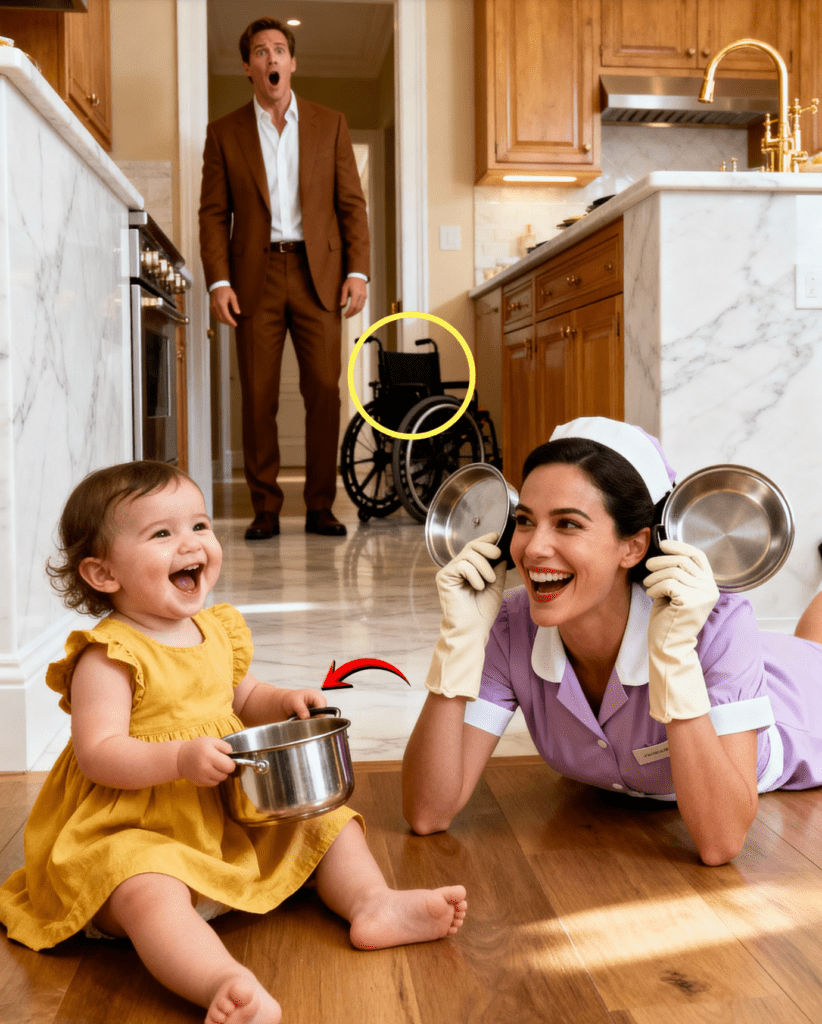
Camila positioned herself beside the baby, eye to eye.—Let’s play, princess.She placed a teddy bear just out of reach.“You can do it.”Sofia strained. Reached. Tried.Camila adjusted the distance, transforming effort into play. She gently massaged Sofia’s legs, bending her knees, singing softly.
And then, for the first time since the accident, Sofia laughed.A real laugh.Rafael stared at the screen, disbelief etched on his face. Later, Sofia lifted her arms toward Camila, asking to be held. She hadn’t done that in months.
He’d installed cameras searching for danger—and found love.Over the following days, Rafael watched obsessively. Camila’s movements were precise, professional. He researched her name: Camila Rocha. Physiotherapy student, Federal University of São Paulo, final year… three years ago. Why was she working as a cleaner?
Confronted, she told him everything: orphaned, a brother with cerebral palsy, cared for him until he died.“When I saw Sofia,” Camila said, “I knew I had to try.”From that moment, everything shifted.Sofia grew stronger, laughed, crawled. The house stopped feeling like a mausoleum.
One afternoon, Sofia cried as Camila prepared to leave.—Mom! —she sobbed.The word shattered Rafael.Love followed. Fear followed. Then betrayal—when Camila discovered the cameras. She left. Sofia collapsed. Rafael collapsed.
On the fourth day, he found her in a shelter.“I trust you,” he said, stripped of pride. “And I love you.”She loved him too.Camila returned. The cameras were destroyed. Trust replaced fear.Months passed. Sofia stood. Walked. One afternoon, she took her first steps into Rafael’s arms.
Later, he knelt before Camila. “Will you marry me?”She said yes.The house rang with footsteps, laughter, life. And one day, Camila placed Rafael’s hand on her belly.“I’m pregnant.”The past hadn’t been erased—but it no longer ruled them.
Because sometimes, even after unimaginable loss, life whispers:“You can begin again.”