I watched my father burn my life in a metal barrel when I was nineteen.
My clothes, my books, my work boots, and even the last photograph I had of my mother were thrown into the flames in the backyard of our house in Dayton, Ohio.
He stood there as if he was purifying something. “This is what happens when you disobey me,” he said. I didn’t respond.
I just watched the smoke rise into the evening sky and learned something I would never forget: silence can mean defeat, or it can mean control.
Six years later, I called him. “Check your mailbox,” I said, and hung up. Inside that envelope was a photograph of me standing in front of his house—the house I had just bought at auction.
But it wasn’t revenge. It was the result of everything I had built from nothing.
Back then, my father, Walter Hayes, didn’t see me as someone with choices. In his mind, I was meant to stay, work under him, and follow orders without question.
So when I told him I had been accepted into a trade program in Columbus, he didn’t see ambition. He saw defiance.
That night began with shouting. Then came insults. Then humiliation. And finally, destruction.
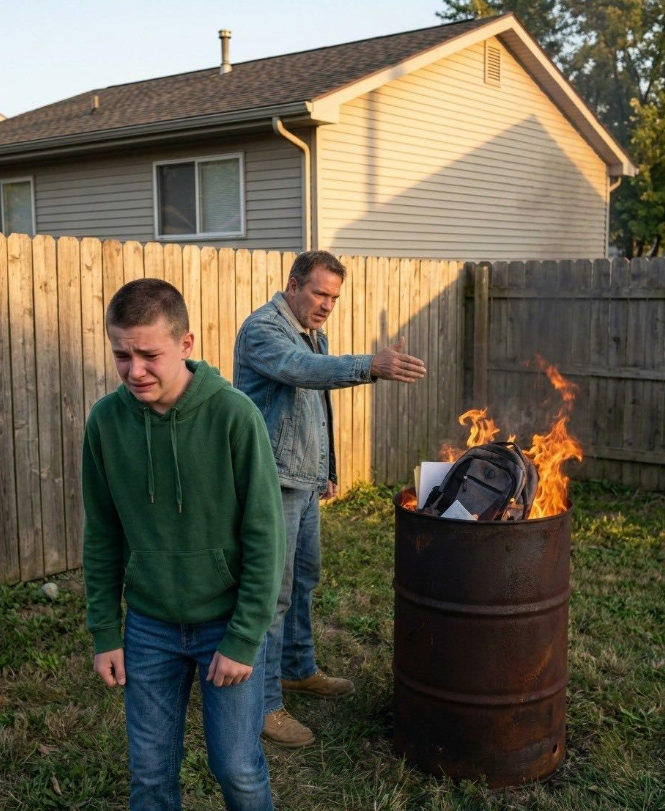
He carried everything from my room into the backyard—my notebooks, my savings, my boots, my mother’s mug—and threw it all into a metal barrel. Then he lit it.
The fire crackled as it consumed everything I owned. When it was over, he turned to me and said again, “This is what happens when you disobey me.”
But I had already made my decision long before the flames.
My important documents, my acceptance letter, and my savings were already hidden in my friend Nate’s car. So when the fire died down, I didn’t argue. I simply left.
Nate drove me to Columbus that night with nothing but a backpack and forty-three dollars. The first weeks were about survival. I slept on a couch, then in a small room above a dry cleaner.
I worked demolition jobs during the day and studied construction and project management at night.
My hands hurt constantly, and my body never really rested, but I kept going because I had no other option.
Over time, I learned everything I could about building—framing, roofing, estimating, managing crews. I learned which leaders to respect and which ones to avoid.
By twenty-two, I was running small teams. By twenty-four, I had my contractor’s license.
Soon after, I started my own company, Hayes Restoration & Build. I kept the name, not to honor him, but to redefine it.
I began taking on properties that others avoided—damaged homes, neglected buildings, places on the edge of collapse. I rebuilt them one by one. Slowly, my life began to change.
I never heard from my father directly again, but I heard enough through neighbors and records. At first, he said I had failed. Then that I had disappeared.
Eventually, he stopped mentioning me altogether. Meanwhile, his house deteriorated under financial strain—missed taxes, unpaid loans, and repairs left undone.
Years later, an auction notice appeared online: the property address I knew too well. I stared at it for a long time. I didn’t feel anger. I didn’t feel joy. I felt something quieter—finality.
The auction was held in a plain county room. I signed the papers like any other bidder. No drama. No announcement. Just a decision.
When I drove back to Dayton, the street felt smaller than I remembered. The house stood there worn down, leaning slightly, time having done what fire once could not finish.
I stood in the yard and took a single photo of myself in front of it. Not a statement. Not a performance. Just proof that I was no longer the person who had once stood powerless there.
I called him from my truck. “Check your mailbox,” I said. Then I hung up.
I didn’t go there to destroy him or to become him. I went there to close a chapter properly. Everything that followed was handled legally, carefully, and without cruelty.
When I finally spoke to him again, I let him say everything he needed to say.
When he finished, I told him, “You showed me what power looks like when it’s used to hurt people. I chose not to repeat it.” Then I ended the call.
The house was eventually repaired, restored, and sold to a young family who filled it with new life.
The profit didn’t go toward revenge or indulgence—it went into helping young people aging out of foster care find safe housing.
What I learned over those years was simple. The point was never to win against my past. It was to build something strong enough that my past no longer controlled me.
I didn’t escape what happened to me. I built over it, until it became the foundation of something better.