# The Blind Baby Elephant Refused to Let Anyone Near Him—Until a Grieving Black Dog Entered His Room and Changed Everything
By five o’clock, the afternoon heat had settled over Cedar Hollow Wildlife Refuge like a heavy blanket. The gravel roads shimmered beneath the sun, and the smell of limestone dust drifted through the Ozark hills. Somewhere in the adult elephant pasture, a deep rumble echoed across the grounds.
Inside the quarantine barn, however, there was no comfort, no excitement, and almost no movement.
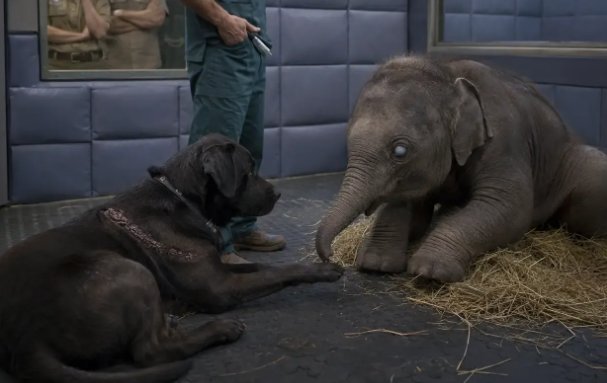
Dr. Daniel Mercer stood outside a padded recovery room, watching a tiny elephant calf curled helplessly in the corner.
The veterinarian had spent twenty-three years treating injured and abandoned animals. He had rescued horses, treated wild bison, and cared for creatures that other people had already given up on. He knew how to recognize suffering, and he knew when an animal was approaching the end of its life.
But this time, he wasn’t ready to accept what he was seeing.
The calf, whom the staff had named Finn, was barely three weeks old. His body was dangerously thin, his ribs visible beneath his gray skin, and his legs were too weak to support him for long.
An untreated infection had destroyed his eyesight. His swollen eyelids concealed eyes that would never see the world again.
Yet his blindness wasn’t the greatest problem.
Finn was terrified of everything.
He refused to approach the people trying to help him. He wouldn’t accept milk from a bottle, and even the gentlest touch made him tremble. Whenever someone entered the room, he pushed himself into the corner, tucked his trunk beneath his chin, and waited for the frightening experience to end.
Senior elephant keeper Erin Walsh had spent five exhausting days trying to earn his trust.
She approached him quietly, prepared his formula, and spoke to him in a gentle voice. Miguel Alvarez, another experienced elephant caretaker, tried different feeding methods and even added a little banana to the milk.
Nothing worked.
Finn was slowly starving himself.
His mother had died shortly after rescuers removed them from an abusive roadside animal attraction near the Alabama-Florida border. The place had advertised exotic animal encounters, but behind its colorful signs were filthy enclosures, inadequate food, and animals suffering from years of neglect.
Finn’s mother had been found severely malnourished, with infected feet and a body weakened beyond recovery.
She survived long enough to hear her baby calling for her.
By the following morning, she was gone.
Since that day, Finn had withdrawn from everything around him. He ignored the other elephants, refused food, and seemed unable to understand that the people surrounding him were trying to save his life.
When Daniel examined his latest bloodwork, the situation became even more frightening. Finn’s kidneys were deteriorating, and the fluids keeping him alive were no longer enough.
During an emergency meeting, refuge director Laura Bennett confronted Daniel with the difficult reality.
“We can’t keep putting him through procedures if all we’re doing is extending his suffering,” she said quietly.
Erin looked down at her untouched coffee. Miguel stood silently beside the counter.
Daniel understood what Laura was suggesting. They might soon have to consider euthanasia.
But he wasn’t convinced Finn wanted to die.
“His heart is weak because he’s starving,” Daniel explained. “But he’s still responding to sounds. He’s still aware of what’s happening around him. He’s frightened, not finished.”
Laura looked at him carefully.
“Then what do you suggest?”
“Give me fourteen days. I want to find something he can trust.”
After a long silence, Laura agreed, but with one condition: if Finn’s condition became critical, Daniel would have to make the decision to end his suffering.
Daniel accepted.
He just needed one chance.
That evening, unable to stop thinking about Finn, Daniel walked to the neighboring county animal shelter. The two facilities regularly helped each other with emergency treatments and rescued animals.
There, he met Grace Nolan, the shelter coordinator.
After hearing about Finn’s condition, Grace told him she had recently taken in a dog who might interest him.
She led Daniel to the last kennel in the quarantine wing.
Inside lay a large black Labrador mix named Boone.
The dog had a shiny black coat, powerful shoulders, and a long healing scar running from his left shoulder toward his ribs. He didn’t bark when Daniel approached. Instead, he slowly lifted his head and looked at him with exhausted eyes.
“He’s only been here four days,” Grace explained.
Boone had belonged to a wilderness guide named Luke Hanley, who lived and worked in the mountains of western Montana.
One day, Luke and Boone had been searching for a missing mule when they encountered a grizzly bear near a carcass.
Boone attacked the bear, giving his owner a chance to escape. But the encounter ended tragically.
Search-and-rescue workers discovered Luke the following morning. Boone was lying across his owner’s body, injured, exhausted, and refusing to let anyone approach.
He had lost the person who had been his entire world.
Luke’s sister had tried to take him home, but the dog couldn’t adjust to apartment life. He missed the mountains, the trails, the truck rides, and the man who had always been beside him.
Eventually, Boone stopped eating.
“He doesn’t know what to do without Luke,” Grace admitted. “Sometimes he just lies there and stares at the door.”
Daniel looked at the grieving dog and thought about Finn.
One had lost his mother. The other had lost his owner. Both had become disconnected from the world after experiencing something they couldn’t understand.
An unusual idea began forming in his mind.
“What if Boone met Finn?”
Grace stared at him.
“A dog and an elephant?”
“Just one supervised meeting. No forced contact. No expectations.”
Daniel knew the risks. A frightened elephant calf could seriously injure a dog without intending to. But Boone seemed unusually calm, and Daniel believed the two animals might recognize something familiar in each other’s sadness.
The following morning, he presented the idea to Laura, Erin, and Miguel.
Laura immediately objected.
“A dog? You’re suggesting we bring a predator into the room with a vulnerable elephant calf?”
Daniel explained that Boone was a trained, low-reactivity working dog who showed no obvious signs of aggression.
Erin remained worried.
“Finn panics when a person moves too quickly. Imagine what might happen when he smells a dog.”
Daniel agreed that the situation was dangerous. He proposed using the padded recovery room, removing all hard objects, and keeping an emergency sedative nearby.
Boone would remain on a lead initially. If either animal showed signs of distress, the meeting would end immediately.
After considering the proposal, Laura reluctantly agreed to one session.
The room was prepared carefully.
Finn was carried inside in a soft canvas sling and placed on fresh hay. Miguel left, while Daniel remained nearby. Erin monitored the calf’s breathing through a camera, and Laura watched from behind the observation window.
Grace arrived with Boone.
The black dog walked quietly beside her, his scarred shoulder moving a little stiffly.
When Daniel opened the recovery-room door, Finn immediately sensed something unfamiliar.
His ears flattened. His trunk tightened against his chest, and his breathing became rapid.
Boone entered slowly.
He stopped several feet inside the room, sniffed the air, and briefly looked toward the calf.
Then he did something nobody expected.
He yawned.
He turned sideways, shook his body gently, and lowered himself onto the rubber floor. He placed his head on his paws and deliberately looked away from Finn.
He wasn’t approaching.
He wasn’t demanding attention.
He was simply there.
For twenty minutes, the animals remained still.
Gradually, Finn’s breathing slowed. His trunk loosened, and his ears moved slightly forward.
Then Boone began making a quiet humming sound, a low vibration coming from deep in his chest.
Finn lifted his head.
His trunk slowly extended toward the sound, searching the air.
Boone remained still, his body relaxed and his head turned away.
Eventually, the calf’s trunk reached the dog’s outstretched paw.
Finn touched the black fur and immediately pulled back.
He waited.
Nothing happened.
Boone didn’t move or make any sudden sound.
After a minute, Finn reached out again. This time, his trunk rested gently across Boone’s paw.
The dog flexed his toes slightly, offering the smallest possible response.
Behind the observation window, Erin covered her mouth. Grace quietly wiped away a tear.
Daniel felt the tension leave his shoulders.
For the first time since arriving at Cedar Hollow, Finn had willingly touched another living creature.
And that creature hadn’t frightened him.
The first meeting lasted just over an hour. Daniel ended it carefully, even though nobody wanted the moment to stop.
Boone returned the following morning.
And the morning after that.
Soon, Finn began reaching toward the door whenever he heard the familiar sound of Boone’s paws.
But there was still one enormous problem.
Finn wasn’t eating.
On Thursday, Daniel decided to try feeding him again while Boone was present.
Miguel brought a bottle of warm formula into the room and placed it inside a plastic bucket near the doorway.
Finn immediately became tense when he smelled the familiar human presence.
Boone, however, noticed the formula.
His Labrador instincts took over. He stood, approached the bucket, and sat beside it, wagging his tail.
Then he let out an excited little whine.
Finn recognized the sound.
The calf struggled to stand. His legs trembled, but he slowly moved toward Boone, following the familiar noise.
His trunk touched the dog’s shoulder, traveled down his front leg, and eventually discovered the bucket.
Boone whined again.
Finn explored the container until his trunk found the rubber nipple of the bottle.
Miguel carefully lifted it.
For several seconds, the calf hesitated.
Then Finn began drinking.
He drank urgently, as though his body had finally remembered how desperately it needed food.
Nobody in the room moved.
Erin began crying silently behind the glass. Laura covered her mouth, and Miguel held the bottle with both hands, afraid even the smallest movement might interrupt the moment.
When the bottle was empty, Finn searched for more.
He received another bottle and then part of a third, with Daniel carefully monitoring how much his weakened stomach could tolerate.
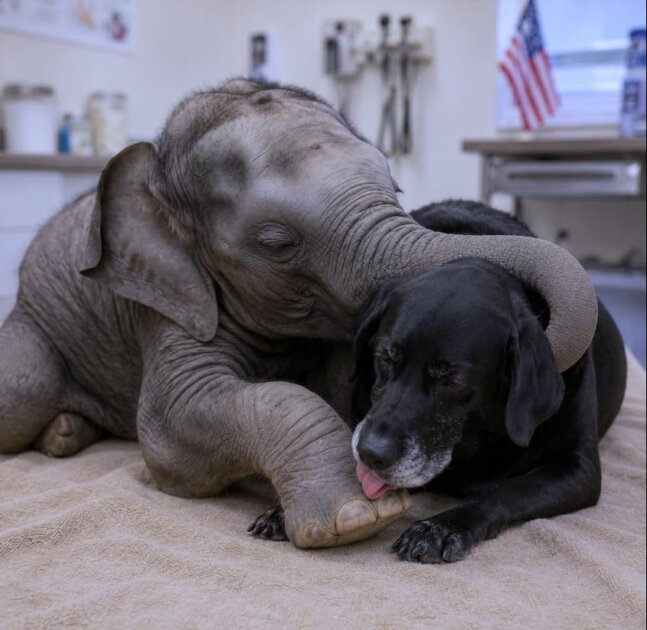
Afterward, the exhausted calf leaned against Boone and rested.
The impossible had happened.
Finn had finally chosen to eat.
From that day forward, Boone became part of his daily feeding routine. Sometimes he sat beside the bucket; other times, he rested next to Finn while Miguel offered the bottle.
Whenever the calf became frightened, Boone stayed close.
When thunder frightened Finn one afternoon, the dog pressed his body gently against the calf until the panic passed.
Their relationship was no longer simply an experiment. It had become a source of security for both animals.
By the end of June, Finn had gained twelve pounds. His breathing improved, his strength returned, and his movements became more confident.
Although he would never regain his eyesight, he began exploring his surroundings.
Boone helped him navigate.
Erin added three brass tags to the dog’s collar. Their jingling sound became a familiar signal that Finn could follow.
When Boone walked, Finn followed the tags. When Boone stopped, the calf stopped too.
The refuge eventually built Finn a special three-acre enclosure with smooth pathways, deep sand boundaries, a water station, and familiar sounds that helped him recognize different areas.
Boone learned the layout first and guided Finn through it.
Their story might have remained private if Laura Bennett hadn’t recorded a short video for a conservation grant application.
The footage showed Boone walking along a stone pathway while Finn followed, occasionally resting his trunk against the dog’s back.
Someone shared the video online.
Within days, it spread across social media. Television stations, documentary producers, and animal-welfare organizations began contacting Cedar Hollow.
Donations arrived from across the country, helping the refuge pay for food, veterinary care, fencing, and additional staff.
Laura refused public visits and protected the animals from crowds and cameras. She also allowed researchers to observe them from a distance.
Their study documented something remarkable: Boone’s predictable movements, familiar sounds, and calm presence helped Finn feel secure. Their companionship demonstrated how social connections could support animals recovering from severe trauma.
But the most extraordinary part of their story was still ahead.
Years passed.
Finn grew into a powerful bull elephant, eventually living in an expanded twenty-acre pasture. His body became strong, his trunk powerful, and his movements confident.
His blindness remained, but he had learned to recognize every pathway, tree, water station, and shelter.
Boone grew older too.
His muzzle gradually turned white. His eyesight deteriorated, and his hearing began to fade. His once-energetic movements became slower, and the dog who had once guided Finn through unfamiliar spaces started needing help himself.
One morning, Boone became confused in the middle of the pasture and couldn’t locate the water station.
Finn noticed.
The enormous elephant walked toward the trough, filled his trunk with water, and splashed it against the stacked stones.
The sound echoed across the enclosure.
Boone stopped, lifted his ears, and slowly followed the noise.
Finn waited until his old friend reached the water.
From that moment, their roles began to change.
The dog who had once guided the blind calf was now being guided by him.
Finn learned to make familiar sounds wherever Boone needed help. He splashed water near the trough, touched the wind chimes with his trunk near the barn, and dragged his foot along the stone pathway to help the old dog recognize the route.
He also adjusted his enormous steps to match Boone’s slower pace.
Sometimes, he lowered his trunk gently over the dog’s back, making sure he was still nearby.
The staff watched this transformation with amazement.
Erin Walsh, who had once feared Finn might not survive another week, now watched him protect the dog who had helped save his life.
One cool morning, more than ten years after their first meeting, Daniel Mercer arrived at Cedar Hollow before sunrise.
He walked toward the pasture and stopped at the sight before him.
Boone was sleeping between Finn’s massive front legs beneath an old oak tree. His muzzle was almost completely white, and his breathing was slow and uneven.
Finn stood perfectly still above him, carefully shifting his weight so he wouldn’t disturb the sleeping dog.
Daniel remembered the frightened baby elephant who had refused every human hand. He remembered the grieving black dog who had stopped eating after losing Luke Hanley.
He remembered the first meeting, the trembling trunk touching Boone’s paw, and the bottle of formula that had finally given Finn a reason to live.
Now, the little calf had become a giant, and the dog who had once saved him was growing old.
Finn gently lowered his trunk and touched Boone’s back.
The dog stirred and pressed closer against the elephant’s leg.
A deep rumble traveled through the quiet morning air.
Daniel stood watching, realizing that their story had come full circle.
Boone had once given a blind, frightened baby elephant the courage to trust again.
Now Finn was giving his aging friend the same comfort, protection, and security that the dog had once offered him.
Neither animal could understand the words people used to describe their friendship.
They didn’t need to.
They had found each other when both had lost everything.
And for more than a decade, they had shown the people at Cedar Hollow Wildlife Refuge that love doesn’t always need to look familiar.
Sometimes, it arrives on four black paws, lies quietly beside a frightened elephant, and changes two lives forever.