# “Galya, I’m Going to the Garage. Don’t Wait for Me for Lunch!” — He Said Every Saturday. His Wife Had Secretly Sold the Garage Two Years Earlier.
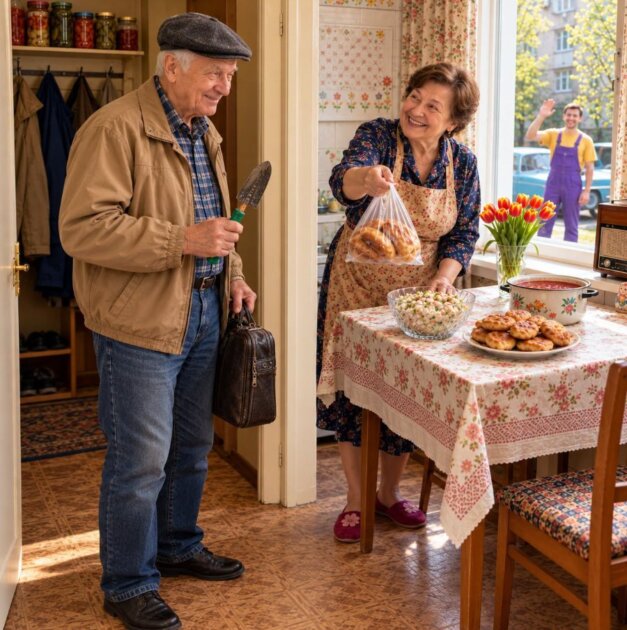
“Galya, I’m going down to the garage. Don’t wait for me for lunch!”
My father said this every Saturday morning as he stood in the doorway, already dressed to go out.
There was always the same familiar confidence in his voice, as though he were setting off on some urgent, manly mission rather than disappearing into a garage for a few hours.
He stood there in his worn-out shoes, wearing his old cap and carrying the same imitation-leather bag I had known practically my entire life. The bag had served him for at least forty years. Its edges were worn, the material had cracked in several places, and if anyone had looked inside, they probably would have discovered something worthy of an archaeological excavation.
The door closed. The elevator hummed as it descended.
My mother stood beside the stove, stirring the borscht even though it had been ready for quite some time. She moved the ladle around a few more times, then turned off the gas, wiped her hands on her apron, and sat down opposite me.
She lowered herself into the chair so carefully that she looked as though she were sitting in a doctor’s office, waiting for a serious diagnosis.
“Olga, the garage is gone.”
I had just taken a bite of a cabbage pie. The mouthful stopped halfway to my throat.
“What do you mean, gone? Did they demolish it?”
“I sold it.”
“When?”
“Two years ago. In April.”
“And Dad?”
My mother glanced toward the window, through which we had watched my father disappear just a few minutes earlier.
“Your father doesn’t know.”
Then her voice broke.
“Every Saturday, he takes his bag, I pack his pies, and he goes to the garage. He comes home around five in the afternoon, his hands covered in grease, looking perfectly satisfied. Two years, Olga. More than a hundred Saturdays.”
My mother, Galina Fyodorovna, had worked as an accountant at a bakery for thirty-eight years. She was the kind of woman who counted everything: medication, electricity bills, the number of pots the neighbor accidentally dropped, and even how many times the upstairs neighbor turned on the water during the night.
If she said more than a hundred times, there were probably already more than a hundred tiny checkmarks on the calendars stuck to her refrigerator.
“Mom, then where does he go?”
My mother finally started crying.
“That’s exactly what I want to find out.”
The garage had never actually belonged to my father. Everyone in the family knew that except him. Or, more precisely, he knew it too, but somehow had never considered it particularly important.
My maternal grandfather, Fyodor Kuzmich, had received the garage from his factory in 1974. When he died in 1995, the property passed to my mother as an inheritance.
But my father, Anatoly Stepanovich, a retired mechanical engineer, had treated that little concrete building as his own kingdom for almost fifty years.
It contained his workbench, with an old Okean radio that only picked up Mayak Radio, and even then only when turned toward the wall. There was a small cellar filled with my mother’s homemade preserves, a battered armchair from an old Soviet furniture set, a chipped mug, and a 1998 calendar featuring an unfamiliar beauty posing on a beach.
My mother had pretended not to notice that calendar for nearly thirty years.
My father had sold his old Lada in 2015, when his eyesight began deteriorating. But he continued visiting the garage regularly. Every man needs a place where he can tinker with something, where nobody asks why he spends hours sitting in the same chair.
My father repaired the neighbors’ irons and toasters. Once, he even managed to save an electric foot massager. For an entire week afterward, he walked around as though he had personally built a spaceship.
“Mom, you really shouldn’t have done this without telling him,” I said carefully. “Why did you sell it?”
My mother stood up, went into the bedroom, and returned carrying an old shoebox that had once contained winter boots.
She kept all her important documents inside it: birth certificates, my father’s medals, and my hospital records.
She took out two documents and placed them in front of me.
The first was a sales contract.
Garage No. 114, Motor Garage Cooperative. Sale price: 380,000 rubles. Seller: Galina Fyodorovna Sidorova. Buyer: Timur Rinatovich Khasanov.
The second was an invoice from a private ophthalmology clinic.
Cataract surgery on both eyes, including intraocular lens implants. Total: 168,000 rubles.
I stared at the two documents for a long time.
“Mom, but Dad had his surgery through the public healthcare system.”
“Yes,” she nodded. “That’s what I told him.”
Suddenly, I remembered everything.
Two years earlier, my father’s eyesight had become so poor that he confused five-thousand-ruble notes with five-hundred-ruble ones. Once, he nearly stepped in front of a minibus because he mistook it for the bus stop.
My mother had been standing beside him and grabbed his coat just in time. One of the pockets even tore.
At the clinic, they had told them that the surgery was free, but the waiting list was long. Perhaps he would get his turn the following year. As for the artificial lens, he would receive whichever model happened to be available.
“I was standing right beside him, Olga,” my mother said quietly. “If I had reached for him one second later, that minibus would have hit him. I didn’t sleep a single minute that night. I kept thinking about what would happen if one day I couldn’t pull him back in time.”
“Why didn’t you call me? Gena and I would have helped.”
“You were paying for Dasha’s university at the time, and Gena’s workplace was going through layoffs. I know you, Olga. You would have taken out a loan immediately.”
My mother shrugged.
“The garage was just sitting there. He didn’t even have a car anymore, and in winter he would sit in that freezing building for hours, with high blood pressure and aching knees. I thought I’d sell it, arrange the surgery, and tell him afterward. At first, I planned to tell him after the operation. Then after Christmas. Then I watched him getting ready every Saturday, packing his pies into that bag and whistling to himself. I simply couldn’t bring myself to do it.”
“And his belongings?”
“I left everything there. Timur promised he wouldn’t throw anything away. I couldn’t have had your father’s workbench thrown out. It’s practically a member of the family.”
“What about the money left over?”
“Two hundred and twelve thousand rubles. I put it in the bank. For your father.”
“What do you mean?”
My mother pressed her lips together.
“For his funeral,” she whispered. “When the time comes.”
Then she looked at me.
“Don’t tell him about that either.”
For several seconds, I just sat there, trying to process everything.
My mother had secretly sold the garage, paid for my father’s eye surgery, put money aside for his funeral, and my father, completely unaware of all this, had continued going somewhere every Saturday that had not belonged to him for two years.
“But Mom, how could you sell it without his consent? You’re married!”
“I inherited it from my father. It wasn’t marital property. I asked the notary.”
Later, my old classmate Lenka, who had since become a notary herself, confirmed it.
“If she inherited it from her father, it’s her separate property. She didn’t need her husband’s permission. If the ownership was properly registered, the sale was legal.”
So legally, everything was perfectly fine.
Emotionally, however, there were more than a hundred little checkmarks sitting on the refrigerator.
“Mom, then where does he go every Saturday?” I asked.
My mother thought for a moment and raised one finger.
“There are three possibilities.”
She looked as though she had been preparing for this conversation for days.
“First: dementia. He’s forgotten that he no longer has a garage. He goes there, sees the new padlock, and wanders around all afternoon.”
“Mom, for two whole years? Every week?”
“Why not? Nina Savelyevna’s husband went to the factory every morning for three months, even though he’d retired in 2000. He took the bus to his old workplace and then came home.”
“What’s the second possibility?”
My mother lowered her voice.
“Another woman.”
“Mom! Dad is seventy-eight!”
“And Mikhailich from our apartment building is eighty-one, yet last year he married the saleswoman from Magnit. She’s thirty years younger than him!”
My mother leaned closer.
“Besides, your father has been taking two pies with him lately. He used to take only one.”
I didn’t know what to say.
“And the third possibility?”
My mother stood up, went into the hallway, and returned carrying my father’s spare bag. She opened it and pulled out a small folding military shovel with a green handle.
“Look at this!”
“It’s a shovel.”
“I can see that. But why does he need it? He even took it with him in January!”
“Maybe he shovels snow.”
“Where? He doesn’t have a garage anymore!”
Her voice rose so much that she startled herself.
“He’s burying something. Or digging something up.”
“Maybe he’s looking for buried treasure,” I joked.
“Or burying a body,” my mother replied grimly.
We both started laughing. Nervously and uncontrollably, until tears were running down our faces. My mother wiped her cheeks with her apron and kept repeating:
“A body… Tolya… with a shovel…”
Then she suddenly fell silent.
“Olga, do you know what I’m really afraid of? If I find out where he goes, I’ll have to tell him about the garage. And if I don’t find out, I’ll spend every Saturday wondering whether he’s developed dementia or has a mistress.”
She looked straight into my eyes.
“Follow him! You’re still young.”
I’m forty-eight, but in my mother’s eyes, I’m naturally still a child.
That evening, I told Gena everything.
Gena had been driving a bus for twenty-six years. He was generally such a calm man that even the end of the world would probably remind him of nothing more than a particularly long traffic jam.
He listened to the entire story, then slowly put down his teacup.
“Wait a minute. Your mother-in-law sold the garage, and your father-in-law has been visiting a garage that doesn’t even exist anymore for two years?”
“Exactly.”
“With a shovel?”
“Yes.”
“And two pies?”
“Gena!”
He raised his hands.
“I didn’t say anything. I’m just thinking that we’ve been married for twenty-five years, and I’ve never encountered family secrets on this level.”
“Will you come with me on Saturday?”
“Surveillance? Absolutely! I’ll bring the Logan. It’s gray. Nobody notices it. Not even traffic police.”
On Saturday at half past nine, we were already parked outside my parents’ apartment building in our gray Logan, hiding behind the garbage containers.
I was wearing Gena’s cap and dark sunglasses, even though the sky was overcast.
Meanwhile, Gena was munching on a sandwich and narrating the events as if he were commentating on a football match.
“Target has exited the building. Cap on his head. Bag over his shoulder. Walking confidently toward the sidewalk… Wait! He’s stopped at the bakery!”
A few minutes later, my father emerged carrying a paper bag.
Even through the paper, I could tell there were two pies inside.
“Two,” I said.
“Two,” Gena confirmed approvingly.
My father boarded bus number 37. We followed in the car.
Gena maintained such a serious and disciplined distance that, for a moment, I worried he might instinctively stop at every bus stop.
My father got off near the old industrial district. He crossed an empty lot, passed some abandoned warehouses, a tire repair shop, and a place with a sign reading “Kebab 24” that I had assumed had been closed since 2010.
Then he walked through the gates of the Motor Garage Cooperative.
“See?” I whispered. “Mom was right. He’s probably developed dementia. He’s coming to his old garage.”
“Let’s wait and see what happens,” Gena replied.
We parked, and I walked along the rusty rows of garages.
Some doors were blue, others green or gray, while several were completely covered in rust. Someone had painted a huge warning on one of them:
“DON’T PARK HERE OR I’LL SLASH YOUR TIRES!”
A typical garage cooperative warning. Friendly, but clear.
Garage No. 114 was in the fourth row.
I peeked around the corner.
My father was standing in front of our old garage.
The doors had been repainted dark green. The padlock was shiny and new.
My father knocked three times, then twice more.
The door opened from the inside, and a dark-haired man in his mid-thirties stepped out, wearing greasy work clothes.
“Stepanych! I thought you weren’t coming today! The carburetor has arrived!”
“I told you we’d find one in Tver,” my father replied proudly.
Then he handed the man the paper bag.
“Here. Yours is cabbage. Mine is potato.”
The two men went inside together, and the garage door closed behind them.
I stood behind the wall, wearing Gena’s cap, with absolutely no idea what to think.
The saleswoman from Magnit would have fitted the story. Dementia would have fitted too. But a young man and a carburetor?
That was an entirely different story.
I waited for forty minutes. Gena called me twice, but I rejected both calls.
From inside the garage, I occasionally heard tools clattering, followed by my father’s voice.
“Not like that! Who holds it that way? This isn’t some foreign computer-controlled car!”
Later, the old Okean radio started playing. Mayak Radio was broadcasting Alla Pugacheva’s song “Arlekino.”
So Timur hadn’t thrown the radio away either.
A few minutes later, the garage door opened again. Timur came out carrying a box and walked toward the corner, probably heading to the cooperative’s communal restroom.
Meanwhile, my father crouched beside the garage door, took out the little green-handled shovel, and carefully loosened the soil.
There was a small flower bed in front of the garage, bordered with pieces of brick.
I had completely forgotten about it.
That was where the tulips my father had planted in the spring of 1977 grew, just a few years after he and my mother had married.
They were dark red, with a thin golden-yellow stripe along the edges of their petals.
My mother always called them “my tulips.”
Every May, my father picked her a bouquet. They were the only flowers he gave her every year, without needing a special occasion.
The tulips were already budding. Their green buds stood tightly on their stems, like tiny clenched fists.
I stepped out from behind the corner.
My father looked up and saw me wearing Gena’s cap and sunglasses on a gloomy November morning.
He stared at me for a long moment, then said:
“Take those glasses off! You look like a plumber on television.”
When Timur returned, he understood from a single glance that something was wrong.
“Stepanych, I’m going to the shop,” he said quickly. “For cigarettes.”
“But you don’t smoke!”
“I might start,” Timur replied, disappearing around the corner.
My father and I were alone.
He sat down in the old armchair, and I settled onto an overturned crate.
Inside, the garage looked both completely different and exactly the same as it had years ago.
The walls had been whitewashed, and the lighting was modern LED. In the middle stood an old light-blue Moskvich, raised on blocks, without wheels.
But the workbench was still my father’s. So was the chipped mug. The Okean radio was there too, still facing the wall.
And the old 1998 calendar was still hanging on the wall, next to a newer one featuring Timur’s cars.
“Dad, you know, don’t you?” I asked.
My father took out his thermos, poured himself some tea, blew on it, and took a slow sip.
“I know.”
“How long have you known?”
“Since last May. A month after the surgery, I came here. My key wouldn’t fit the lock. I thought some hooligan had changed it. I was just about to force it open when this Timur came out and asked what I wanted with his padlock.”
My father smiled.
“I told him, what do you mean, his padlock? This is my garage! Then he showed me the contract. Your mother’s signature was right there, with that little curly flourish she always puts at the end.”
“And what did you do?”
“I sat down on that crate. For a while. Then I went home. Your mother was making borscht. I ate dinner.”
“And you didn’t say anything to her?”
My father looked at me as though I had asked something incredibly foolish.
“Olga, I’m not an idiot.”
Then he turned toward the window.
“The contract was dated one week before my eye surgery. Your mother arranged that so-called public healthcare appointment exactly one week earlier. Petrovich from the third floor has been promised surgery for a year and a half, and he’s still wearing thick glasses. Meanwhile, I got an appointment in one week at a clinic with a coffee machine and ladies in pink uniforms smiling at everyone. Do you really think I didn’t figure it out?”
He tapped his temple.
“I worked as an engineer for thirty years. I can still do the math.”
I said nothing.
My father looked at the Moskvich.
“At first, of course, I was terribly hurt. I didn’t sleep all night. I just lay there thinking that after all these years, she had still made such a big decision behind my back. She sold my garage, my workbench, everything.”
He fell silent for a moment.
“Then, early in the morning, I got up to drink a glass of water and looked out the window. I saw a car’s license plate across the street.”
His voice trembled.
“Olga, I hadn’t been able to read license plates properly for ten years. At your birthday celebration, I could only see a yellow blur when you were standing in front of me. But that morning, I could see that license plate perfectly, every single number. And I thought to myself: how could I possibly be angry with her?”
“But why do you still come here?”
My father looked surprised.
“Because she expects me to leave.”
“Mom?”
“Of course. If I suddenly stayed home on a Saturday, she’d immediately realize I knew everything. Then she’d start apologizing. For days, weeks, perhaps years. You know your mother. She’d torment herself until she made herself sick.”
Then he added quietly:
“Why would I do that to her? Because she saved my eyesight?”
“Dad, Mom thinks you have dementia.”
My father nearly choked on his tea.
“What?!”
“Or that you have someone else. Because of the two pies.”
He put his mug down with an indignant bang.
“The second one is for Timur! Poor boy. His wife is at home with the twins, and he barely has time to eat properly. He’s always grabbing something in a hurry.”
Then he thought for a moment and suddenly started laughing.
“Dementia… Oh, Galya! Better she thinks I’m losing my mind than that I have a guilty conscience.”
While Timur was supposedly out buying cigarettes, my father explained how the garage had ended up with its new owner.
Timur restored and sold old cars. Moskviches, Pobedas, old Ladas, and once he had even managed to get hold of a Volga 21.
Wealthier collectors were willing to pay good money for such cars nowadays, especially those who wanted something resembling the family car they had grown up with.
Timur was an excellent bodywork specialist, but he knew absolutely nothing about old Soviet engines and carburetors.
“He spent six months trying to put this Moskvich back together,” my father said with professional disdain. “Then I told him to give me a few Saturdays, and I’d have it running within a year. He said he’d pay me. I told him I didn’t want money. I just wanted somewhere to sit.”
“And he really doesn’t pay you?”
“I don’t accept money.”
My father looked at me for a moment.
“Sometimes his wife sends me pilaf. That’s not money.”
“And the shovel?”
“What about it? In winter, I clear the snow in front of the garage because Timur doesn’t always have time. And now I’m looking after the tulips.”
He smiled.
“When he first moved in, he almost dug up the entire flower bed. He wanted to pave it over. I stood in front of those flowers and told him he’d have to go through my dead body first. So your mother was almost right. There was a body involved, but it was mine, and not literally.”
Just then, Timur returned. Instead of cigarettes, he had brought three cups of coffee from the “Kebab 24” place, which, it turned out, was still very much open.
“Olga Anatolyevna, here you are,” he said seriously, handing me a cup.
Then he added:
“I once saw your mother at the notary’s office. She told me never, under any circumstances, to touch the flowers in front of the garage. I forgot. Stepanych has been reminding me every week ever since.”
So my mother had even taken care of the tulips.
My father stood up, brushed the dust off his trousers, and looked at me.
“Olga, don’t tell your mother!”
“Dad…”
“Please. Let her believe she succeeded. Let her think she saved me and that I know nothing about it. She’s spent her entire life thinking about everyone else. Us, the family, the children. Almost never herself. Let this be her secret, at least.”
On the way home, Gena and I sat quietly for a while.
Finally, at a red light near the market, he spoke.
“I’d still like to know.”
“Know what?”
“If you sold my garage, I’d want to know.”
“You don’t even have a garage.”
“In theory.”
“In theory, I wouldn’t tell you,” I replied.
Gena thought about it.
“You’d go to a pub every Saturday and tell me you were at the garage.”
“Exactly.”
“Fair enough,” he said.
But that wasn’t the end of the argument. We continued discussing it for another week.
Gena believed it was still a lie. Two people who had lived together for fifty years shouldn’t keep secrets from each other like that.
I said it had been done out of love.
Gena replied:
“Love is when you cook someone a good soup. When you sell his garage and keep quiet about it for two years, that’s a covert operation.”
I reminded him that he had once kept quiet for three years about the fact that two of his teeth hadn’t been paid for by insurance but by the money we’d saved for our vacation.
He went silent.
A few minutes later, however, he started arguing again.
My friend Svetka, whom I naturally told everything, had a simple solution.
“Tell both of them! Let them decide. Why do you have to play babysitter? They’re nearly eighty, not children!”
My daughter, Dasha, saw things very differently.
“Mom, this is the most beautiful story I’ve ever heard! Don’t you dare tell them! It’s just like *The Gift of the Magi*.”
“But the truth came out in the end.”
“So what? That doesn’t make it any less beautiful!”
In the end, I was left to make the decision alone.
The worst part was that my mother started calling more and more frequently. Saturday evening, Sunday morning, then Sunday evening again.
I didn’t answer.
On Monday, she called Gena, who naturally handed the phone straight to me.
“Well?” my mother asked without any introduction. “Does he have someone?”
I had rehearsed this conversation a hundred times. I imagined telling her the truth, pretending I hadn’t seen anything, or inventing some believable story about my father going to the library.
The problem was that my father hadn’t been to a library since 1980, when they refused to lend him a book by his favorite author, Valentin Pikul.
Finally, I answered slowly and carefully.
“Mom, there is no other woman. Dad is fine. He goes somewhere he feels comfortable. I can’t tell you exactly where.”
There was such silence on the other end that I could almost hear the kitchen cuckoo clock ticking.
The cuckoo, incidentally, hadn’t worked since 1993.
“What do you mean, you can’t tell me?”
“I simply can’t.”
“Olga, is that why I sent you there?”
“You sent me to find out whether he was sick or seeing someone. Neither is true. Dad is fine, and he’s not cheating on you.”
“And the shovel?”
“He’s using it to do something good.”
“Are you taking his side now?”
“Mom, I’m on both your sides.”
A long silence followed.
Then my mother spoke in a completely different voice.
“Olga… Does he know?”
At that moment, I understood that my mother, the former bakery accountant, suspected far more than she let on.
I couldn’t lie to her, but I couldn’t tell her the truth either.
“Mom, how about I come over on Saturday? I’ll bring some pies.”
“I don’t need any pies,” she said, and hung up.
She was hurt. Seriously hurt.
Over the following days, whenever I called, she only said, “Everything is fine,” or “I’m busy kneading dough right now.”
She talked about the weather, her blood pressure, and the neighbors, but barely asked me anything about myself.
Three times in one week, she told me I was “just like your father, a real partisan.”
It hurt, but somehow I felt that this time she hadn’t meant it entirely as an insult.
May 16 was my parents’ golden wedding anniversary.
They had been married for fifty years.
They didn’t want to rent a restaurant. According to my mother, restaurants were a waste of money, and besides, strangers would be watching them eat.
They celebrated at home, with close family. Gena and me, Dasha and her husband, my mother’s sister Aunt Lyuda, and Nina Savelyevna, the neighbor whose husband had once spent months visiting his old workplace.
The Saturday before the celebration, I went to the Motor Garage Cooperative again.
This time, I went alone, without sunglasses or disguises.
My father and Timur were installing the Moskvich’s wheels. The car was finally standing on its own tires. It hadn’t been painted yet, and one headlight was still missing, but it was clear that it would soon be back on the road.
“Dad, are the tulips blooming yet?”
My father straightened up and looked toward the flower bed.
The buds were already turning red, and that familiar yellow stripe was beginning to appear along the edges of the petals.
There were exactly twelve stems, as always.
My father had never transplanted them in fifty years. He had only occasionally added new bulbs to the soil.
“They’ll open just in time for May 16,” he said.
“That’s Mom’s anniversary.”
“I know.”
“Take them to her. Like you used to.”
My father looked at me for a long time. He had the expression of someone examining a complicated technical drawing, making sure every little detail was in the right place.
“Then she’ll figure it out.”
“Dad, you’ve been married for fifty years. Maybe it’s time.”
He didn’t answer.
He turned back toward the Moskvich and began tightening a nut that was already perfectly tight.
Timur tactfully disappeared, saying he was going to buy cigarettes.
I had no idea what my father would do. That was his decision.
I had given the truth back to him. What he chose to do with it was up to him.
On May 16, my mother had been setting the table since early morning.
She prepared as though she were expecting an entire regiment rather than seven people.
There was homemade meat aspic, herring and beet salad, Olivier salad in the special crystal bowl she only used for major celebrations, and, naturally, cabbage pie.
My mother wore an elegant blue dress with an old brooch pinned to her chest. She had even gone to the hairdresser.
She still barely spoke to me, though. All I heard was, “I don’t have time right now. I’m making dough.”
My father was nowhere to be seen.
“He’s gone to the garage,” my mother said when Aunt Lyuda asked where the guest of honor was.
Her voice was perfectly calm, but she placed the herring dish on the table so firmly that everyone fell silent.
“To the garage? Today?” Aunt Lyuda asked in surprise.
“Yes. He always goes on Saturdays. And today he even left wearing a suit!”
Gena looked at me.
I suddenly became very interested in studying my plate.
My father arrived around half past one.
He was wearing a suit and holding a beautiful bouquet of dark red tulips.
Twelve stems. Every single petal had that golden-yellow stripe along its edge.
When he entered the room, everyone fell silent.
Even Nina Savelyevna, who was normally capable of talking nonstop for hours.
My mother was holding a large salad spoon.
She looked at the flowers.
I watched her recognize them. The way someone recognizes a face in an old photograph. First, they cannot believe their eyes. Then they find themselves unable to look away.
A long silence followed.
Aunt Lyuda was about to reach for the herring, but Gena gently placed his hand on her wrist.
“You brought them from the garage?” my mother asked, almost in a whisper.
“From there, Galya,” my father replied.
My mother slowly put down the salad spoon.
“And how is everything there?”
My father smiled.
“Everything’s fine. We’ve almost finished the Moskvich. We’re still looking for one headlight. Timur sends his regards. He said he hasn’t touched the flowers.”
My mother sat down. Her eyes filled with tears.
“Tolya… But I sold that garage.”
“I know.”
“Since when?”
“Since last May.”
“Two years?!” My mother covered her mouth with her hand. “You’ve known for two years, and you’ve still been going there?”
My father stepped closer.
“And you’ve known for two years that I leave every Saturday, and you’ve still been packing my pies.”
“I thought you didn’t know!”
“And I thought you didn’t know that I knew.”
Nina Savelyevna let out a quiet sigh.
Aunt Lyuda simply said:
“I don’t understand any of this.”
Gena leaned toward her.
“None of us does, Aunt Lyuda. Have some aspic instead!”
My father approached my mother and placed the bouquet of tulips in her lap.
Then, quietly but clearly enough for everyone to hear, he said:
“Thank you for my eyesight, Galya. I can see you now. All of you. I can even see this tiny wrinkle here on your face.”
My mother immediately touched her cheek.
“What wrinkle? I don’t have any wrinkles!”
“You do. Right here. And it’s beautiful.”
My mother started crying. Then she laughed, and then she did both at once, exactly as she had that afternoon in the kitchen.
She held the tulips tightly against her chest.
Then something suddenly occurred to her.
“Tolya, I still have two hundred and twelve thousand rubles left in the bank.”
“For what?”
My mother glanced toward the guests, then said very quietly, although everyone could still hear her:
“For your funeral.”
My father thought for a few seconds.
Then he announced with a perfectly serious expression:
“Then the funeral is canceled. We need a headlight and a spare carburetor now.”
Gena was the first to burst out laughing.
Then Aunt Lyuda, even though she still didn’t understand half the story. Dasha followed, and soon everyone was laughing.
My mother wiped away her tears, still clutching the tulips, and looked at my father in such a way that I urgently had to go into the kitchen to check on the pie.
Even though I knew perfectly well it had been ready for hours.
My mother made peace with me that same evening.
After the guests had gone home, she caught the sleeve of my coat in the hallway.
“You knew, didn’t you?”
“Yes, Mom.”
“You knew for three weeks, and you didn’t say a single word!”
“Mom, it wasn’t my secret to tell. It wasn’t my place to reveal it.”
She looked at me for a long time.
Then she straightened my collar, exactly as she used to when I was in first grade.
“Partisan,” she said. “You’re exactly like your father.”
And this time, she didn’t mean it as an insult at all.
Nina Savelyevna’s neurologist, incidentally, turned out to be a very good doctor.
My mother eventually took my father to see him anyway, “just to be safe,” because she liked to have everything in order.
The elderly, exceptionally calm doctor examined my father for about twenty minutes. Then, out in the hallway, he told my mother:
“Galina Fyodorovna, if a person can find his way around independently, calculate his change correctly, and keep a secret from his wife for two years, that’s not dementia. That’s simply a matter of character.”
My mother naturally took it as a compliment.
About herself, of course.
In the end, she decided to use 112,000 of the 212,000 rubles and leave the remaining 100,000 in the bank “for the sake of order.”
With that money, my father and Timur bought the missing headlight, a spare carburetor, chrome hubcaps, and the exact original factory light-blue paint.
In September, the Moskvich finally started running again.
Timur refused to sell it.
He said it was Stepanych’s first Moskvich, and cars like that simply weren’t for sale.
Apparently, Timur’s wife was quite angry at first, but after he took her and the twins for a ride in it, she stopped objecting.
They eventually named the car Galya.
My mother was offended at first, but then asked my father to drive her to the market.
My father immediately agreed, naturally.
My mother sat in the passenger seat wearing an elegant hat, holding her handbag on her lap, and giving him instructions the entire way.
“Tolya, don’t drive so fast! There’s a pothole! Why are you turning here? Watch out for that pedestrian!”
My father, meanwhile, was beaming as though he had just received a brand-new car.
These days, my mother visits the Motor Garage Cooperative once a month.
She says she’s just going to have a look around, but in reality, she brings Timur’s family stuffed cabbage rolls, checks on the flower bed, and gives the 1998 calendar a stern inspection.
For now, that calendar is still hanging on the wall.
I suspect it will still be there thirty years from now.
Last Saturday morning, I visited my parents again.
My father was already standing in the hallway, wearing his old cap and carrying his worn imitation-leather bag over his shoulder.
My mother came out of the kitchen carrying a large package.
“Here. Yours are potato pies, Timur’s are cabbage. Give this one to his wife. It’s a cottage cheese pie. But don’t give any to the twins. It has raisins in it.”
“Galya, I’m going to the garage, not a restaurant,” my father said.
“Then get going! The carburetor is waiting!”
My father leaned over and kissed my mother on the cheek, right beside that particular wrinkle that supposedly didn’t exist.
Then he stepped outside.
The front door closed, and the elevator hummed as it descended.
My mother walked over to the window and watched for a long time as my father crossed the courtyard and headed toward the bus stop for route 37.
He walked slowly, wearing his old cap, carrying the worn bag that still contained the little folding shovel with the green handle.
Now everyone knows why he takes it with him, even in October.
Tulip bulbs have to be planted in autumn.
Last time, my mother bought him ten new ones herself. Dark red, of course, with yellow edges.
“He’s gone to the garage,” my mother said softly.
“Yes, Mom. To the garage,” I replied.
Then we sat down to have tea.
And when I glanced at the refrigerator, I noticed that my mother was still marking every Saturday on the calendar.
Only now, beside each checkmark, she draws a tiny flower.