
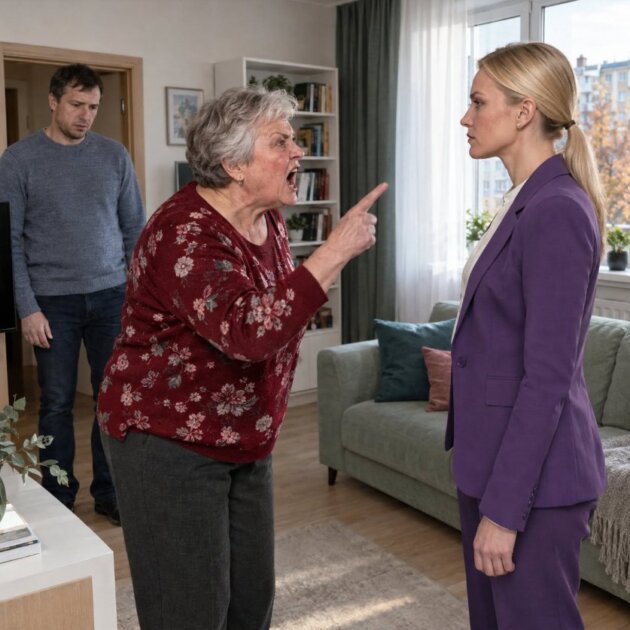
“Pack your things and get out! Do you hear me? My daughter needs this apartment, not you, sitting around here doing nothing!”
Galina Petrovna stood in the middle of the living room with her hands on her hips and her chin held high. She looked around as though she had already rearranged the furniture in her mind and was simply waiting for the current occupant to disappear.
The autumn light filtering through the window cast a yellowish glow over her dyed hair and emphasized the wrinkles around her mouth.
Anna slowly raised her eyes from her book.
She said nothing.
Her mother-in-law was waiting for precisely this moment. She wanted a scene. She wanted Anna to lose her temper, start shouting, perhaps even burst into tears. Then Galina could turn to her beloved son and say with that familiar, triumphant expression:
“See, Vitya? I told you she was unstable. I told you she was impossible to live with!”
Anna knew this script by heart. After three years, she could practically recite every line.
“Did you hear what I said?” Galina demanded, turning toward her son.
Vitya stood beside the wall, looking like a man who desperately wanted the floor to swallow him, except that the floor was unfortunately solid.
“Mom, well…”
“What do you mean, ‘Mom’? Are you a man or aren’t you? Tell your wife to vacate the apartment!”
Anna closed her book, stood up, and walked into the kitchen.
Behind her, Galina continued muttering insults about freeloaders and people who tried to live off other people’s property. But the words no longer reached Anna.
She switched on the kettle, took out a mug, and made herself some tea.
Her hands weren’t shaking at all.
Sometimes, a person is at their calmest when the decision has already been made inside them. They simply haven’t said it aloud yet.
The apartment belonged to Anna.
She had bought it four years earlier, before the wedding. Her parents had helped her with the down payment, and Anna had taken on the mortgage herself. She had committed to eight years of repayments, three of which she had already spent living with Vitya.
Galina Petrovna knew all of this perfectly well. She couldn’t possibly pretend otherwise. The property documents were clear.
But facts had never been an obstacle for her.
After all, Vitya was her son. Her precious Vitushka, her sunshine, the poor little boy who had supposedly always been cold and never received enough food at school.
Vitya was thirty-seven, yet his mother still brought him homemade meatballs in plastic containers and could spend half an hour explaining how Anna ought to chop an onion.
Naturally, Anna did that wrong, too.
From the kitchen, Anna could hear Vitya trying to calm his mother.
“Mom, don’t get yourself worked up…”
“I’m not worked up! I’m simply explaining the situation!”
Galina had been explaining the situation for twenty minutes already. Her voice rose and fell like that of someone accustomed to wearing other people down until they finally surrendered just to make the noise stop.
“Annie!” she shouted from the living room. “Have you gone deaf?”
There was so much venom in that little nickname that even a stranger would have understood it had nothing to do with affection.
Anna set down her mug.
September had left the city suspended in a strange, uncertain state. Summer was over, but autumn hadn’t quite arrived. The trees were reluctant to surrender their leaves, letting them go one at a time.
Every morning on her way to work, Anna watched them through the bus window. Sometimes she thought she was much the same. Still holding on, still trying to remain green, but already beginning to let go of something deep inside.
At work, everything was fine. Anna was an administrator at a private medical clinic. She scheduled appointments, handled insurance paperwork, and occasionally dealt with angry patients at the reception desk.
Those confrontations no longer frightened her. After three years with Galina Petrovna, even the most difficult patients seemed almost pleasant.
Once, her colleague Svetlana asked her a question without any malicious intent.
“Anya, have you ever thought about getting divorced?”
Anna remained silent for a long moment.
“Yes,” she finally answered.
She added nothing else.
Svetlana didn’t press her.
That evening, Galina finally left in her old Opel. She slammed the door so hard that the coat rack in the hallway trembled.
Vitya came into the kitchen, sat down at the table, and stared at the tablecloth for a long time.
“You have to understand that Mom is only worried about Nadya,” he eventually said.
Nadya was Vitya’s younger sister. She was thirty-two, had been through two divorces, and rented a small apartment in the suburbs.
In Galina Petrovna’s eyes, Nadya was a helpless victim of cruel circumstances. Everyone else, however, saw someone who somehow managed to escape responsibility for every decision she made.
“Vitya,” Anna said calmly, “this is my apartment.”
“Our apartment.”
“Mine. The mortgage is in my name. My parents provided the down payment. The purchase agreement is in my name, too.”
Vitya grimaced as though she had reminded him of something unpleasant they had silently agreed never to discuss.
“So what happens now? Mom is right. Nadya needs somewhere to live. She’s raising a child on her own…”
“Then your mother can help her find a place.”
“Mom doesn’t have any money!”
“Neither did I,” Anna replied. “But I figured it out. I worked for it.”
That was the end of the conversation.
Vitya stood up, went into the bedroom, lay down on the sofa, and switched on his phone.
That was always his solution when responsibility came knocking. He simply withdrew from the situation and escaped to a place where nobody expected him to make a decision.
Anna washed the mugs, wiped the table, and glanced at the clock.
Then she opened the storage cupboard.
Over the past three years, Galina Petrovna had left just enough belongings in the apartment to give herself an excuse to visit whenever she pleased.
There was an old blanket for “cold evenings,” even though the apartment was always comfortably warm. Several jars of preserves occupied the top shelf. A bag of yarn and balls of wool sat beside them, despite the fact that Galina hadn’t knitted anything in twenty years. There was also an umbrella, a pair of size-eleven rubber boots, and a box of medicines she kept because they “might come in handy someday.”
Anna packed everything carefully.
She placed the blanket in a bag, arranged the jars in a box, and packed the yarn, umbrella, boots, and medicines together.
Then she carried everything into the shared entrance hall.
Fortunately, the neighbors had gone to their country house and wouldn’t return until Sunday. Anna placed Galina’s belongings beside their door, went back inside, and locked the apartment.
She stood motionless in the hallway.
Silence.
Vitya’s phone murmured faintly through the wall. Somewhere downstairs, the building’s entrance door slammed shut. Outside, autumn continued its unhurried work: falling leaves, gathering dusk, and the smell of wet asphalt.
Anna thought that this was only the beginning.
And, strangely enough, the thought made her feel a little better.
The following morning, Galina Petrovna called at eight o’clock, just as Anna stepped out of the shower.
Vitya grabbed the phone before Anna could reach it. He went into the bedroom and closed the door behind him.
Only fragments of the conversation reached her.
“Mom, just wait…”
“I told you…”
“She didn’t do it on purpose…”
Not on purpose.
Anna wrapped a towel around her hair and went into the kitchen.
She always made breakfast herself. Vitya claimed he couldn’t eat in the mornings, then wondered why he had a headache by lunchtime.
Fried eggs, bread, tomatoes. Nothing complicated, nothing unnecessary.
Outside, the sky was gray, and a single raindrop slowly slid down the windowpane. It wasn’t really raining. The city was simply wrapped in that damp September air that made everything look a little colorless.
Vitya entered the kitchen holding his phone, guilt written all over his face.
“Mom is upset.”
“I heard.”
“Anya, why did you have to move her things?”
Anna placed a plate in front of him.
“Eat.”
“I’m serious!”
“So am I,” she replied. “Your mother asked me to clear out the apartment. I started with her belongings. Seems perfectly logical to me.”
Vitya opened his mouth, then closed it again. He looked down at his eggs.
“This isn’t funny.”
“I’m not laughing,” Anna agreed.
She walked to work that morning. It took about twenty minutes through the park, where the paths were already covered with the first fallen leaves.
The leaves were wet and dark, sticking to the soles of her shoes.
As she walked, Anna realized that, for the first time in a long while, she wasn’t thinking about Vitya or Galina Petrovna.
She was thinking about the park.
For three years, she had passed it every morning on the bus. She had always been in a hurry, staring at her phone, mentally already at work.
Now, suddenly, she noticed the trees.
They stood tall and peaceful, utterly indifferent to other people’s family dramas.
At the clinic, Svetlana gave her a quick, understanding glance but asked no questions.
Anna was grateful.
She didn’t want to talk. She wanted to work. She wanted to answer calls, organize patient files, and solve problems that had clear questions and clear answers.
At lunchtime, Nadya unexpectedly called her.
Nadya had never contacted Anna directly before. At the occasional family gatherings, they exchanged polite greetings and little else.
Nadya had a low, slightly husky voice and a way of speaking as though every sentence were an important announcement that demanded serious attention.
“Anna, we need to talk.”
“I’m listening.”
“Not over the phone. Let’s meet.”
Anna paused for a moment.
Surprisingly, she felt neither anxious nor irritated.
She was curious.
“All right. After six? Do you know the café on Beregovaya Street?”
Nadya did.
They sat at a table beside the window. Streetlights flickered on outside, and pedestrians hurried home with their collars turned up against the chill.
Nadya had arrived before Anna. That was unexpected, too, since she had always been late in the past.
Now she sat upright, her hands resting on the table. She wasn’t clutching her handbag in her lap.
Something about her had changed.
She didn’t look tense or defensive, as Anna had expected. Instead, she looked like someone who had been carrying a heavy burden for too long and had finally decided to put it down.
“Mom hasn’t told you the truth,” Nadya began without any introduction.
Anna lifted her cup.
“I’m used to that by now.”
Nadya gave a faint smile, but it quickly disappeared.
“I never asked you for the apartment. Not once. This was Mom’s idea. She decided I would agree, you would leave, and Vitya would end up alone. Then she could take control of everything again.”
Anna listened without interrupting.
“I rent an apartment,” Nadya continued. “Yes, it’s small. Yes, it’s in the suburbs. But it’s mine in the sense that I pay for it and decide how to live in it. It took me three years to put my life back together after my second divorce. I don’t need someone else’s home.”
Anna studied her face.
At that moment, a woman walked past the window with a tiny dachshund wearing a ridiculous yellow raincoat.
For a few seconds, neither woman spoke.
“Why are you telling me this?” Anna finally asked.
Nadya looked straight at her.
“Because Mom will break you and Vitya apart. She’s good at that. She’s already done it to me twice. I’m not saying your marriage is happy. I love Vitya because he’s my brother, but you know he’s weak. I just want you to understand that if your marriage ends, it should end because you choose it. Not because Mom has written the script.”
Anna slowly set down her cup.
In three years, she couldn’t remember a single truly honest conversation.
Not with Vitya. Not with Galina Petrovna. Not with the aunts at family gatherings, who always seemed to know exactly how everyone else ought to live.
And now Nadya, a woman Anna barely knew, was sitting across from her and saying what nobody else had dared to say.
“Does your mother know we’re meeting?” Anna asked.
“No. And she won’t find out. I have my own unfinished business with her.”
Nadya took out her wallet.
“I’ll pay for the coffee. Not because we’re suddenly best friends. I invited you.”
Anna nodded.
They left the café without saying much. They didn’t hug, make solemn promises, or pretend they had always been close.
They simply walked away in opposite directions.
As Anna headed toward the bus stop, she thought about how strange life could be. Sometimes, the person you least expect turns out to be the one who tells you the truth.
Not necessarily because they’re especially kind.
Sometimes, they have simply had enough of the lies.
At home, Vitya was watching television. He didn’t ask where she’d been.
Anna took off her shoes, went into the bedroom, and sat on the edge of the bed.
One sentence kept repeating in her mind, the words Nadya had spoken:
“If it ends, let it be your decision.”
Anna still didn’t know exactly what she was going to do.
But something inside her had begun to fall into place, slowly and steadily, like a puzzle whose missing corner piece had finally been found.
The next morning, she woke before her alarm.
Vitya was asleep beside her, lying on his back with his mouth slightly open. He looked completely peaceful, as though nothing in the world could ever happen that might require him to take responsibility.
Anna watched him for a few seconds.
She felt no anger. But she felt no tenderness, either.
She simply looked at him the way someone looks at something they’ve known for a long time needs to change but have continually put off dealing with.
She got dressed, went into the kitchen, made coffee, and opened her laptop.
She didn’t browse social media or read the news.
Instead, she visited legal advice websites.
Methodically, she worked her way through one page after another, reading about marital property, mortgaged apartments, separate property, and assets acquired during marriage.
The legal language was dry and precise. That was exactly what she needed.
Not emotions. Not promises. Not another person explaining why she should be patient just a little longer.
Facts.
And this time, the facts were on her side.
On Saturday, Galina Petrovna arrived without calling ahead.
She simply rang the doorbell.
Vitya hurried to open the door, looking like a man who had been expecting the visit and dreading it at the same time.
Anna sat in her armchair with a book in her hands.
She didn’t get up.
Galina entered the living room and surveyed it. Her gaze moved over the furniture, the shelves, and the windows, as though she were taking inventory of someone else’s life.
Then she turned to Anna.
“Where are my things?”
“In the hallway,” Anna replied. “Just as I said.”
“Just as you said?” Galina repeated, as though the statement itself were an outrageous insult. “Vitya, do you hear what your wife is saying?”
Vitya stood in the doorway with his hands in his pockets and his shoulders hunched forward.
He looked exactly like someone who wished he were in another city.
“Mom, please, let’s not start this again…”
“Not start what?!” Galina’s voice shot upward. “I come into my own son’s home, and his wife throws out my belongings!”
“I didn’t throw them out,” Anna corrected her. “I packed them carefully. And this isn’t your son’s apartment.”
Galina’s face tightened.
“Silence! Who do you think you are? This is Vitya’s apartment!”
Anna closed her book and looked directly at her mother-in-law.
“No. It’s my apartment. If you’d like, the documents are in the top drawer of the desk.”
The silence that followed was so complete that Anna could clearly hear cars passing outside.
Vitya stared at the floor.
Galina Petrovna stayed for another full hour.
She paced around the apartment, speaking loudly and repeating herself, throwing one accusation after another at Anna.
She claimed Anna had stolen her son from her.
She insisted that decent people didn’t behave this way.
She spoke about poor Nadya, who supposedly had nowhere to live.
She declared that she had sacrificed her entire life for her children, only to be rewarded with such ingratitude.
Anna listened.
She no longer pretended to read her book, because that would have been unnecessarily provocative. But she didn’t answer, either.
She simply waited for Galina to run out of words.
Meanwhile, Vitya drank tea in the kitchen and occasionally called out:
“Mom, that’s enough…”
But he said it in the same tone he might have used as a child when asking his mother to let him sleep for another five minutes.
There was no strength behind it. No genuine intention to change anything.
Only habit.
When Galina finally left, slamming the door hard enough to rattle the walls, Vitya emerged from the kitchen with guilt written across his face.
“You could have just talked to her normally.”
Anna looked up at him.
“Vitya, I want a divorce.”
The words came out without warning.
She hadn’t prepared them, practiced them in front of a mirror, or waited for the perfect moment.
And yet they sounded as though they had always been there, waiting for her to finally say them aloud.
Vitya froze. The cup in his hand tilted slightly.
“What?”
“I want a divorce,” Anna repeated, just as calmly. “I’ve booked a consultation with a lawyer for next week. You can find legal representation of your own.”
Vitya stared at her in confusion.
“You… are you serious?”
“Completely.”
“Because of my mother?”
Anna was silent for a few seconds.
“No. Because of us. Your mother has simply made it impossible for me to keep ignoring what I should have understood a long time ago.”
The following days passed strangely.
Vitya didn’t move out, but he didn’t approach Anna, either. He wandered around the apartment as though he’d suddenly found himself in a stranger’s home, afraid that every movement might cause something to break.
Sometimes Anna caught him looking at her.
He seemed confused, almost pleading.
And she realized that, perhaps for the first time in a long while, she was truly seeing him.
Not as her husband.
Not as a stranger.
Simply as a man who was weak, too dependent on his mother, and who had somehow forgotten to grow up along the way.
He wasn’t evil.
He simply wasn’t the person Anna wanted to spend her life with.
On Wednesday, Galina called again. Vitya took the phone out onto the balcony and spoke quietly for a long time.
Anna didn’t eavesdrop.
She was busy organizing the bookshelf, separating her books from his.
Not out of anger.
She was simply beginning to separate the things that had become tangled together over three years.
On Thursday, Nadya called.
“I heard,” she said briefly.
“From your mother?”
“From Vitya. He called her to complain.” Nadya paused. “Are you okay?”
Anna thought about it for a moment.
“Yes. Surprisingly, I am.”
“There’s nothing surprising about that,” Nadya replied. “It just means you can finally breathe.”
They fell silent for a while.
But the silence was no longer uncomfortable. Instead, it felt as though something between them had quietly shifted into place.
“If you need a decent lawyer, I can recommend someone,” Nadya added. “She’s good. She doesn’t waste time talking in circles.”
“Thank you.”
The consultation took place on Friday in a small office just a three-minute walk from the clinic.
The lawyer was a woman of about forty-five, with tired but attentive eyes. She examined Anna’s documents, asked several precise questions, and then explained what Anna had already suspected but needed to hear from an independent professional.
Based on the documents Anna had provided, there was no immediate reason to believe she would have to surrender ownership of the apartment. The precise legal position would, of course, depend on the applicable law and the complete documentation, but the initial assessment was reassuring.
Anna stepped outside and stopped for a moment.
September was drawing to a close.
The trees had finally turned properly golden. The lime trees along the pavement glowed in the autumn light, as though they wanted one last chance to show how beautiful they could be before shedding every leaf.
There was something almost indecently optimistic about it.
Anna lifted her face and closed her eyes for a moment.
Behind her lay the apartment, the dismantled bookshelf, Vitya’s guilty expression, and Galina Petrovna’s carefully written script.
Ahead of her, there was nothing concrete yet.
Only space.
Silence.
And a life that could finally belong to her again.
She took out her phone and sent Nadya a message.
“Thank you for recommending the lawyer. Everything is fine.”
Nadya replied almost immediately with a smiling emoji.
No long message.
No elaborate words.
It was enough.
Anna put her phone away and headed to work.
Her steps felt light. She was surprised by that herself.
Leaves rustled beneath her shoes, the sky stretched high and clear above the city, and the autumn that had begun with someone else’s outburst in her living room was ending in an entirely different way.
The way she had chosen.
The divorce was finalized in November.
It was handled quietly, without unnecessary arguments or a drawn-out court battle. Vitya eventually signed all the necessary papers without putting up a fight.
According to Nadya, Galina Petrovna spent an entire week shut away in her room. She took the news as though it were her own marriage that had ended rather than her son’s.
Anna heard about it from Nadya.
Since then, the two women had met occasionally. They went out for coffee and sometimes had lunch together.
There were no dramatic reconciliations, no solemn promises, and no attempts to rewrite the past.
They had simply become two people who unexpectedly discovered they had things to talk about.
The apartment felt different without Vitya.
Not necessarily better or worse.
Just quieter.
Anna rearranged the furniture. Not because the room looked prettier that way, but because she felt like changing it.
She removed Vitya’s mug from the shelf. It bore the words “World’s Best Husband” and, naturally, had been a gift from Galina Petrovna.
In its place, Anna put a small potted geranium.
The plant took root almost immediately.
It didn’t throw tantrums, demand special treatment, or try to dictate how Anna should arrange her own home.
Sometimes, looking at it, she found herself smiling.
Nothing changed at work. The same patient files, the same insurance documents, the same difficult people complaining at the reception desk.
One day, Svetlana asked her again, without any hidden agenda:
“So, how are you doing now?”
Anna thought about it.
“Fine,” she replied. “Actually, surprisingly well.”
Svetlana nodded as though she’d expected exactly that answer.
Galina Petrovna called one more time in December.
It was late in the evening.
Anna saw her mother-in-law’s name on the screen and let the phone ring until it stopped.
She didn’t call back.
Not because she wanted revenge. Not because she hated Galina.
She simply no longer felt obligated to answer every call, endure every insult, and smooth over every new family crisis.
There was something final about that small gesture.
Not anger.
A boundary.
According to what Anna heard, Vitya had moved back in with his mother.
Anna wasn’t surprised.
One evening, she stood by the window with a mug of tea in her hands, watching the city lights. The rooftops, the illuminated windows, the small, silent fragments of strangers’ lives.
She thought about how she had spent three years waiting for something.
Waiting for things to get better.
Waiting for Vitya to change.
Waiting for Galina Petrovna to calm down.
Waiting for the next argument to finally be the last one.
Waiting to wake up one morning and discover that everything had somehow sorted itself out.
But nothing had ever resolved itself.
The problems hadn’t disappeared. They had simply returned again and again, wrapped in different words and different excuses, always leading to the same result.
Anna finally understood that sometimes the hardest thing isn’t watching something end.
It’s admitting that it ended a long time ago and that you’ve been too afraid to say it aloud.
Now she no longer had to wait.
She didn’t have to prove that she was a good wife, a patient daughter-in-law, or an endlessly understanding person.
She didn’t have to ask permission to feel at home in her own apartment.
Outside, the city carried on. Behind other windows, people were eating dinner, arguing, laughing, making plans, and perhaps waiting for something just as she had once done.
Anna took a sip of tea.
The apartment was quiet.
The geranium on the shelf had grown a new leaf.
And for the first time in a long while, Anna didn’t ask herself what might happen tomorrow.
Instead, she asked herself what she wanted to do with it.
Because tomorrow no longer belonged to Galina Petrovna’s plans, Vitya’s excuses, or anyone else’s expectations.
It belonged to her.
And this time, nobody had to give her permission to live her own life.
Anna simply began.

