# A Millionaire Stopped in Front of a Homeless Woman and Whispered, “You’re My Mother!” — But the DNA Results Revealed a Truth That Left Her Speechless
For thirty-two years, Daniel Foster had lived with a question that money could never answer.
Who was his real mother?
He had everything most people could only dream of: a billion-dollar technology company, a mansion overlooking the ocean, a fleet of luxury cars, a private yacht, and a jet that could take him anywhere in the world.
Yet there was one place he had never been able to reach.
The beginning of his own story.
Daniel had been adopted as a baby. His adoptive parents had raised him in luxury, sent him to the finest schools, and given him every opportunity imaginable. But whenever he asked about his biological mother, the conversation ended the same way.
“She gave you away because she didn’t want you,” his adoptive father would say coldly. “You have a family now. Stop digging up the past.”
As a child, Daniel had believed him.
As a teenager, he had tried to forget.
But as he grew older, the questions became impossible to silence.
Why would a mother give away her newborn child? Had she been young and frightened? Had she been poor? Had she ever regretted her decision?
And most painfully of all, had she ever thought about him?
On his thirty-second birthday, Daniel stood alone in the enormous bathroom of his penthouse, staring at his reflection. He had his adoptive father’s sharp jawline and confident smile, but his eyes had always seemed strangely unfamiliar.
Sometimes, he imagined another face looking back at him from the mirror.
A face he had never seen.
A face that might hold the answer to everything.
He didn’t know that the truth was waiting for him in an old envelope, hidden behind a row of dusty books in his late adoptive father’s private study.
And when Daniel finally discovered it, his entire world began to crumble.
## The Secret Hidden for Thirty-Two Years
Three months after his adoptive father’s funeral, Daniel decided to renovate the old study.
The room had remained untouched since the funeral. His father’s leather chair still stood beside the window, and the faint smell of tobacco lingered in the curtains. Daniel had avoided the room for weeks because every corner reminded him of the man who had raised him—and the questions that man had refused to answer.
While moving a heavy bookcase, Daniel noticed a loose wooden panel behind it.
Something had been hidden there.
He pulled the panel away and discovered a small metal box covered in dust.
Inside lay several legal documents, a yellowed photograph, and a sealed envelope bearing his full name.
Daniel’s fingers trembled as he opened it.
The first document was an adoption record dated 1992. The second contained the name of his biological mother.
**Amara Foster.**
Beneath it was a photograph of a young Black woman holding a newborn baby wrapped in a white blanket.
She looked exhausted. Her cheeks were hollow, her clothes were worn, and her smile seemed painfully forced. Yet her arms held the baby with unmistakable tenderness.
Daniel stared at the photograph.
Something about her eyes made his heart pound.
They were his eyes.
He turned the photograph over. A handwritten note had been added beneath the official stamp.
*Amara Foster, biological mother of Daniel Foster. Husband deceased in aviation accident. Financial hardship. Full legal adoption approved.*
Daniel read the words once.
Then again.
His father had always said that his birth mother had abandoned him because she didn’t love him.
But the documents told a different story.
Amara had lost her husband in an aviation accident shortly before Daniel’s birth. Left alone with a newborn and no reliable income, she had struggled to survive. The adoption papers indicated that she had been pressured into surrendering her parental rights during a period of extreme vulnerability.
There was also a letter bearing his adoptive father’s signature.
Its language was cold and final.
*The biological mother has consented to permanent adoption. No future contact is required. All relevant records are to remain confidential.*
Daniel felt sick.
Had his father deliberately kept his mother away from him?
Had someone made sure she could never find him?
He sank into the leather chair and pressed the photograph against his chest.
For thirty-two years, he had imagined a woman who had forgotten him.
Now he was beginning to understand that she might have spent those same thirty-two years remembering him every single day.
And he had no idea whether she was alive.
## The Search That Led Nowhere
Daniel immediately hired a team of private investigators.
They searched adoption agencies, old hospital records, municipal archives, and every address connected to Amara’s name. They contacted former neighbors and traced the limited information available about her late husband.
At first, the search seemed promising.
Amara had lived in a modest neighborhood before the adoption. A few old records placed her in a nearby city several years later.
Then the trail disappeared.
No recent employment records. No current address. No reliable phone number.
One investigator suggested that she might have changed her name. Another believed she could have moved abroad.
Weeks passed.
Daniel canceled meetings, ignored calls, and spent sleepless nights studying the same photograph.
His company’s executives worried that he was losing focus. His assistant repeatedly reminded him of important appointments.
He barely listened.
For the first time in his life, money could not buy him the answer he needed.
He could purchase buildings, launch satellites, and negotiate deals worth hundreds of millions of dollars. Yet he couldn’t find the woman who had given him life.
Then, on a cool autumn afternoon, something happened that no investigator could have predicted.
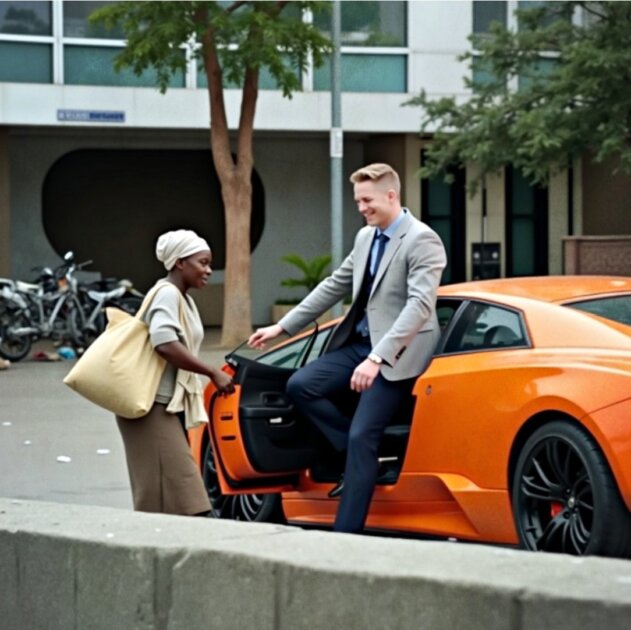
Daniel was returning from a corporate lunch in the older part of the city. His bright orange supercar moved slowly through congested streets while sunlight glinted off its polished hood.
He wasn’t really paying attention to the traffic.
His mind had returned to the photograph.
*Where are you, Mom?*
*Are you still alive?*
*Do you ever wonder what happened to me?*
The cars ahead suddenly slowed near a busy intersection.
Daniel glanced toward the pavement.
And then he saw her.
An elderly Black woman stood beside a wall, carrying an enormous cloth sack over one shoulder. Her dress was faded and torn. Her feet were bare, and her thin arms trembled beneath the weight of her belongings.
Her hair had turned almost completely gray. Her shoulders were bent, and every step seemed to cost her an extraordinary amount of effort.
A small cardboard cup sat beside her.
People passed without looking at her.
Some avoided her eyes. Others hurried around her as though she were part of the pavement.
Daniel would have driven past her like everyone else if she hadn’t lifted her head.
For one brief moment, their eyes met.
Daniel’s blood seemed to turn to ice.
He looked at her nose, the shape of her face, and the deep, tired eyes he had studied in the photograph hundreds of times.
He remembered the handwritten name on the back.
Amara Foster.
His heart began to hammer.
It couldn’t be.
After thirty-two years of searching, after every dead end and every unanswered question, was this really the woman he had been looking for?
Daniel slammed on the brakes.
The car stopped so abruptly that the driver behind him blasted his horn. Another car swerved around him, and someone shouted angrily through an open window.
Daniel didn’t hear any of it.
He threw open the door and ran into the street.
## “Please Look at Me. I Think You’re My Mother.”
The elderly woman recoiled when the elegantly dressed stranger rushed toward her.
“Sir?” she asked nervously, clutching the sack against her chest. “Have I done something wrong?”
Daniel stopped a few feet away.
He had rehearsed this moment in his imagination a thousand times. He had imagined embracing her, asking her why she had left, telling her how much he had missed her.
But now that she stood before him, he could barely breathe.
His lips parted, but no words came.
Finally, he whispered, “Amara?”
The woman went still.
Her eyes narrowed with confusion.
“Who are you? How do you know my name?”
Daniel’s hands shook as he reached inside his jacket and pulled out the old photograph.
“I’ve been looking for you,” he said, his voice breaking. “I’ve been looking for you my entire life.”
He held the photograph toward her.
“Please. Just look at this.”
Amara stared at the picture.
At first, she seemed unable to understand what she was seeing. Then her gaze settled on the young woman in the photograph, and her fingers began to tremble.
She took one uncertain step forward.
“No,” she whispered.
Daniel’s eyes filled with tears.
“That’s you, isn’t it?”
Amara raised a hand to her mouth.
The sack slipped from her shoulder and landed on the pavement.
“No,” she repeated, more urgently this time. “Where did you get that photograph?”
Daniel swallowed hard.
“From my father’s study. I found my adoption papers. They said your name was Amara Foster.”
The old woman’s knees nearly gave way.
She stared at him, searching his face as though she were trying to see through thirty-two years of separation.
“Your name,” she whispered. “Tell me your name.”
“Daniel.”
The sound that escaped her throat was neither quite a sob nor quite a cry.
She reached for his face with trembling hands, touching his cheek as if she were afraid he might disappear.
“Daniel?” she repeated. “My little Daniel?”
He nodded, tears streaming down his face.
“I’m your son.”
Amara collapsed against him.
For a moment, Daniel feared she had fainted, but then he felt her arms tighten around his waist. She buried her face against his chest and began to sob with a grief so deep that strangers stopped to watch.
“My baby,” she cried. “My baby. I thought you were gone forever!”
Daniel dropped to his knees on the dirty pavement and held her as tightly as he could.
“I found you, Mom,” he whispered. “I finally found you.”
She pulled back just enough to look at him.
“You’re alive,” she said, touching his face again. “You’re alive, and you’re standing here in front of me.”
“Yes.”
“But why? How?”
“I found the papers. I know about Dad’s accident. I know you were alone. I know you didn’t simply decide to forget me.”
Amara closed her eyes.
For thirty-two years, she had carried a secret sorrow that she had never been able to explain to anyone.
Now, the child she had once held in her arms was kneeling before her, a grown man in an expensive suit, crying like the little boy she had lost.
“I never stopped loving you,” she whispered. “Not for one day.”
Daniel pressed his forehead against hers.
“Then why didn’t you find me?”
Amara’s face crumpled.
“I tried.”
Those two words silenced him.
She took a shaky breath and began to tell him the story that had haunted her for decades.
## The Truth About the Mother He Thought Had Abandoned Him
Amara had been twenty-three when Daniel was born.
Her husband, Michael, had worked as an aviation mechanic. He wasn’t wealthy, but he was kind, hardworking, and deeply devoted to his family. When Amara discovered she was pregnant, he had spent evenings talking to her stomach and promising their unborn child that he would teach him everything he knew.
Then came the accident.
Michael died before he could meet his son.
Amara was devastated. Overnight, she became a grieving widow with a newborn baby, unpaid bills, and no steady income. She worked wherever she could, cleaning offices and washing clothes for families in the neighborhood.
But the money was never enough.
Her landlord threatened eviction. The electricity was disconnected. Some nights, she went without food so that Daniel could have milk.
Then a social worker introduced her to an adoption agency.
“They told me you would have everything,” Amara explained through tears. “A safe home. Good food. A proper education. They said you would never have to know hunger or fear.”
She had resisted at first.
Daniel was the only thing she had left of Michael. Giving him up felt like losing her husband all over again.
But the people handling the adoption assured her that the arrangement would protect the baby. The paperwork moved quickly, and she was overwhelmed by grief, exhaustion, and fear.
“They said it was temporary at first,” she whispered. “They told me there would be people who could help us. Then they said the adoption was the only way to guarantee your future.”
She signed the documents.
And then they took him away.
Amara remembered the weight of Daniel in her arms, the warmth of his tiny body, and the way his fingers had curled around hers.
She remembered promising him that she loved him.
She remembered begging to hold him for just one more minute.
Afterward, she returned to an empty room.
For years, she tried to find out where he had gone. But the adoption records were sealed, and she had neither the money nor the legal assistance to challenge the decision.
Whenever she asked for information, she was told that the adoption was permanent and that she had no right to interfere with the family’s privacy.
Then came more hardship.
Without her husband’s income, Amara struggled to keep a roof over her head. She worked in kitchens, cleaned houses, and took temporary jobs wherever she could find them.
Eventually, illness and financial setbacks cost her the little stability she had managed to rebuild. She lost her rented room and spent time moving between shelters and temporary accommodation.
The years passed.
Her clothes grew older. Her body weakened. Friends who might once have helped her moved away or lost contact with her.
Eventually, she found herself begging on the streets.
But she never stopped wondering about Daniel.
Every time she saw a young man walking with his mother, she imagined what her own son might look like.
Every birthday, she whispered his name.
Every Christmas, she wondered whether he was warm, whether he was healthy, and whether he had anyone who loved him.
“I used to pray that you would be happy,” she told him. “I thought that if I couldn’t be your mother, at least you might have a better life without me.”
Daniel listened in silence.
The more she spoke, the more his anger dissolved into heartbreak.
All those years, he had believed his mother had rejected him.
Instead, she had spent her life believing that losing him was the price she had paid for his survival.
He wrapped his arms around her again.
“You didn’t fail me,” he whispered. “You were left alone when you needed help. You were told there was no other way.”
Amara clung to him.
“I should have fought harder.”
Daniel shook his head.
“You were twenty-three. You had lost your husband, you had no money, and you were trying to keep a baby alive. You deserved help, not punishment.”
For the first time in decades, Amara allowed herself to believe that perhaps she wasn’t the terrible mother she had always imagined herself to be.
But Daniel had one more question.
A question he had been afraid to ask since finding the envelope.
“Mom,” he said gently, “did you ever know what happened to me after the adoption?”
Amara shook her head.
“Nothing. I never knew if you were happy. I never knew if you were sick. I didn’t even know whether you remembered me.”
Daniel wiped his eyes.
“I remembered you before I even knew your name.”
## The DNA Test That Changed Everything
Daniel knew that emotion alone could not establish the biological relationship beyond doubt. He wanted the truth documented, not because he doubted the woman standing before him, but because he intended to make sure no one could ever separate them again.
That evening, he brought Amara to his home.
She hesitated at the entrance to the mansion, staring at the marble floors, the towering windows, and the elegant staircase.
“Daniel, I can’t stay here,” she said quietly. “People like me don’t belong in places like this.”
Daniel turned toward her.
“People like you?”
She looked down at her worn clothes.
“Look at me. I’m old. I’m poor. I’ve spent years on the streets. You have a company to run, people who depend on you, and a life I could never understand.”
He gently took her hand.
“This is my home. And you’re my mother. You don’t have to earn a place here.”
He led her inside.
A housekeeper prepared a warm meal while Daniel arranged for a doctor to examine her. Amara ate slowly, almost cautiously, as though she still expected someone to take the food away.
Daniel watched her with a tightness in his chest.
How many nights had she gone hungry?
How many times had she wished she could feed the child she had lost?
Later that evening, Daniel arranged for a DNA test.
The samples were collected, and the laboratory explained that the results would take several days.
Those days felt longer than the thirty-two years that had come before them.
Daniel continued working, but his mind was elsewhere. Every time his phone rang, he wondered whether the laboratory was calling.
Amara, meanwhile, barely slept.
She sat in the guest bedroom, staring at a framed photograph of Daniel as a child that he had found among his adoptive family’s belongings. She studied his face, tracing his features with her eyes.
She had missed his first steps.
His first words.
His first day of school.
His birthdays, his achievements, his disappointments, and every ordinary moment that makes up a child’s life.
Now she was sitting beneath the same roof as the man he had become, and she was terrified that someone would tell her it had all been a mistake.
On the morning the results arrived, Daniel asked Amara to join him in his study.
She entered slowly.
He stood beside the desk, holding a sealed laboratory envelope.
“Is something wrong?” she asked.
Daniel shook his head, but his eyes were shining.
“No. I just want us to read this together.”
He opened the envelope.
For several seconds, he stared at the page without speaking.
Then he looked up at her.
“The test confirms it,” he whispered. “We’re biologically related. You’re my mother.”
Amara’s hand flew to her mouth.
“It’s true?”
Daniel nodded.
“It’s true, Mom.”
She sank into a chair, trembling.
A strange expression crossed her face—relief, disbelief, and a sorrow so old that even happiness could not erase it.
Then she began to cry.
Not the desperate crying of a woman begging on a street corner.
Not the frightened crying of someone who believed she had lost everything.
These were the tears of a mother who had spent thirty-two years wondering whether she would ever know what had become of her child.
Daniel knelt beside her and took her hands.
“I know a piece of paper can’t give us back the years we’ve lost,” he said. “But from today on, nobody will ever tell us that we don’t belong to each other.”
Amara held the DNA report against her chest.
“I don’t need your money, Daniel,” she whispered. “I only wanted to know that you were alive.”
He smiled through his tears.
“Then let me give you the one thing you should never have had to live without.”
“What is that?”
“A family.”
## The Millionaire’s Greatest Gift
In the weeks that followed, Daniel made sure Amara received the medical care she needed. Doctors examined her, treated her health problems, and helped her regain her strength. She was given comfortable clothes, nourishing meals, and a room overlooking the garden.
But the greatest change wasn’t physical.
It was the way she began to smile.
At first, Amara moved through the mansion like a visitor afraid of disturbing something. She apologized whenever she needed anything and insisted on doing small chores herself.
Daniel gently reminded her that she didn’t have to ask permission to live in her own home.
Gradually, she began to relax.
She sat with him during breakfast. She asked about his business. She laughed when he told her stories about his school days, and she cried when he admitted how often he had wondered whether his biological mother would have loved him.
“I would have loved every minute of you,” she told him. “Even the difficult ones.”
Daniel laughed.
“You don’t know how difficult I was.”
“I changed your diapers,” she replied, smiling through her tears. “I know exactly how difficult you could have been.”
For the first time, Daniel heard his mother laugh.
He would later say that the sound was worth more to him than every successful business deal he had ever made.
Still, happiness did not erase the past.
Some nights, Amara woke from dreams in which she was once again standing in a hospital corridor, begging strangers not to take her baby. Other nights, Daniel woke thinking about the years they had lost.
They learned to talk about those memories together.
Daniel also began examining the circumstances surrounding his adoption. He wanted to understand why his adoptive father had concealed the truth and whether anyone had deliberately obstructed Amara’s attempts to find him. He knew that documents could reveal only part of the story, and he was determined to separate what he could prove from what he had merely feared.
Whatever the investigation uncovered, one thing had already changed forever.
He no longer had to wonder whether his mother had loved him.
He could see it in every glance, every trembling touch, and every time she called him her son.
One evening, several months after their reunion, Daniel returned home earlier than usual.
He found Amara sitting beside the fireplace, holding the old photograph of herself with her newborn baby.
She looked up as he entered.
“Do you ever wonder what our lives would have been like if things had been different?” she asked.
Daniel sat beside her.
“Sometimes.”
“I would have held you every night,” she said. “I would have watched you grow up. I would have been there when you were sick. I would have told you stories about your father.”
Daniel took the photograph from her hands and studied it.
“Maybe our lives would have been different,” he said. “But we can’t change what happened.”
Amara lowered her eyes.
“I lost so much time with you.”
He reached for her hand.
“And I lost so much time with you. But we still have today.”
She looked at him, tears gathering in her eyes.
“Do you truly forgive me?”
Daniel’s expression softened.
“Mom, there was never anything to forgive. You didn’t stop loving me. You never chose to forget me. You were a young woman trying to survive a terrible loss, and you were made to believe that giving me up was the only way to protect me.”
He squeezed her hand.
“You spent thirty-two years thinking you had lost your son forever. I spent thirty-two years believing I wasn’t wanted. We both suffered because we didn’t know the truth.”
Amara leaned against his shoulder.
For a long time, neither spoke.
Outside, the evening light faded over the garden. Inside, the fire crackled softly, filling the room with warmth.
Daniel had once believed that success meant acquiring everything the world could offer.
Now he understood how little those things mattered when the person you longed for most was missing.
He could buy another mansion. He could replace every car in his garage. He could build another company and earn another billion.
But he could never purchase the moment he had just received: his mother resting peacefully beside him, her hand wrapped around his, knowing she would not have to face the world alone again.
The next morning, Daniel took Amara to visit a quiet garden overlooking the city.
They walked slowly along the path, stopping beneath a tree whose branches were beginning to turn gold.
Amara looked at the people passing by—parents holding their children’s hands, elderly couples walking together, families laughing in the sunlight.
Then she turned to Daniel.
“Do you think your father would have wanted us to find each other?”
Daniel considered the question.
“I don’t know what he would have wanted,” he answered honestly. “But I know what I want.”
He wrapped an arm around her shoulders.
“I want to know you. I want to hear every story you can remember. I want to learn about the father I never met. And I want us to have a future that belongs to us, not to the people who made decisions for us thirty-two years ago.”
Amara rested her head against him.
For years, she had believed that her life had ended the day she surrendered her baby. She had carried guilt through hunger, homelessness, and old age, convinced that she had failed the person she loved most.
Now she understood that her story was not over.
The little boy she had once held in a hospital room had grown into a man who had crossed a lifetime of distance to find her.
And despite everything they had lost, he had come back.
Not to accuse her.
Not to demand explanations.
But to take her hand and bring her home.
Daniel Foster was one of the wealthiest men in the country, but the greatest discovery of his life had not been hidden in a bank account, a business contract, or a secret inheritance.
It had been standing on a crowded sidewalk, wearing torn clothes and carrying everything she owned in a sack.
A woman the world had overlooked.
A mother who had never stopped loving him.
And a truth that no amount of money could ever replace:
Sometimes, the person you spend your whole life searching for has been carrying your memory in their heart every single day.