
Dmitry drove Ira to his parents’ apartment for Sunday lunch at exactly two o’clock.
They had been married for eight months, and during that time, Sunday lunches at his parents’ home had become an unpleasant ritual. Ira always did the same thing: smiled politely, brought something as a gift, helped in the kitchen, and tried not to say more than necessary.
According to Dmitry, that was the easiest way to keep the peace.
“An hour and a half,” he promised as he turned off the engine. “Then we’ll go home. Don’t worry.”
Ira glanced at the bouquet of burgundy chrysanthemums resting on her lap and then at the cake box by her feet.
It was a lemon cake from a famous pastry shop on Pokrovka. Her father-in-law’s favorite.
Maybe that would soften the tension.
Maybe.
The apartment door opened almost immediately.
Tamara Viktorovna was standing behind it as though she had been waiting there specifically for them.
“Finally!” she announced instead of saying hello. “I was beginning to think you’d forgotten where your parents lived. It’s almost three!”
“Mom, we’re exactly on time,” Dmitry said, trying to smile.
He kissed his mother on the cheek and handed her the flowers.
Tamara Viktorovna inspected the bouquet without smiling.
“Put those in a vase.”
Then she looked at Ira.
“And wash your hands. You can help me in the kitchen.”
Ira said nothing.
She took off her boots, went into the bathroom, and stared at herself in the mirror while washing her hands.
She looked exhausted.
Her shoulders were tense. Her jaw was clenched.
She already knew what was coming.
Her husband would sit with his father and watch football while she stayed in the kitchen listening to another lecture about how she should cook, dress, speak, and generally live her life.
When she returned, Tamara Viktorovna was already standing beside the cutting board.
“Slice the cucumbers. But don’t make them as tiny as last time. We’re not making baby food.”
Ira picked up the knife.
“All right.”
Less than a minute later—
“Not like that!”
Ira flinched.
“I told you to make them bigger! What are you doing?”
“Okay.”
“And another thing,” her mother-in-law continued. “It’s time you learned how to cook properly. What does my son even eat at your place? Yogurt and cereal?”
Ira slowly put the knife down.
“Dmitry likes my cooking. We both prefer lighter food.”
“Of course he doesn’t complain! He’s just like his father. He’d rather starve than create an argument. Look at how much weight he’s lost!”
At that moment Dmitry appeared in the kitchen doorway.
“Mom, my weight is perfectly fine. And Ira cooks wonderfully.”
Tamara Viktorovna fell silent.
But Dmitry returned to the living room a few seconds later.
As soon as the door closed behind him, his mother’s expression changed again.
“Don’t think he’ll always defend you.”
Ira took a deep breath.
“I don’t want to argue.”
“Neither do I. I’m just trying to teach you.”
“I’m an adult.”
Tamara Viktorovna narrowed her eyes.
“Are you talking back to me?”
“No.”
“Then look at me when I’m speaking to you!”
Ira raised her eyes.
“I am.”
“No, you’re not! You keep looking away!”
Her mother-in-law suddenly stepped closer.
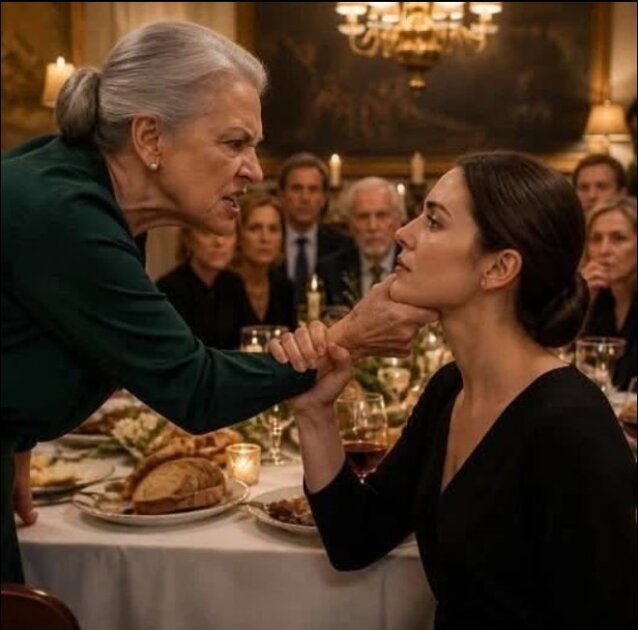
Before Ira could understand what was happening, Tamara Viktorovna grabbed her by the chin.
Her fingernails dug into Ira’s skin.
Ira froze.
“Look at me!” the older woman hissed. “When I’m talking to you, you look me in the eyes!”
“Let go of me.”
“What?”
“I said, let go of my face.”
Tamara Viktorovna squeezed harder.
“I’m trying to teach you. You married into this family, so you need to understand who’s in charge.”
Ira stopped being afraid.
Instead, an unexpected calm came over her.
She didn’t shout.
She didn’t cry.
She simply took her mother-in-law’s wrist.
Then, slowly and firmly, she removed the woman’s hand from her face.
“I did not give you permission to touch me.”
Tamara Viktorovna stared at her.
“What?”
“Never touch me again.”
For a moment, the older woman looked stunned.
Then she exploded.
“How dare you!”
She began shouting that Ira had attacked her, twisted her wrist, and assaulted her.
The noise brought Dmitry and his father rushing into the kitchen.
Dmitry looked at his mother first.
Then at his wife.
Red marks from fingernails were clearly visible on Ira’s chin.
“What happened?” he asked.
“Your wife attacked me!” Tamara Viktorovna cried. “She twisted my wrist!”
Dmitry looked at his mother’s wrist.
There wasn’t a single mark.
Then he looked at Ira’s face.
“Mom…”
“I only wanted her to look at me!”
“You grabbed her face?”
Silence.
“Yes,” the woman finally admitted. “But only for a moment.”
Dmitry’s expression hardened.
“Then we’re going home.”
“What did you say?”
“We’re going home.”
“You’re choosing her over me?”
Dmitry stared at his mother for several long seconds.
“I’m not choosing anyone. I’m finally realizing that what you called normal wasn’t normal.”
That was the first time Ira truly felt that her husband was standing beside her.
A week later, Tamara Viktorovna called Dmitry.
She said she wanted to make peace.
But the meeting wasn’t at her apartment.
It was at Aunt Galya’s birthday party.
The entire extended family would be there.
Ira immediately knew it was a trap.
“I don’t want to go.”
“Neither do I,” Dmitry admitted. “But if we don’t, they’ll say we’re the ones destroying the family.”
Ira thought for a long time.
“All right. But I have one condition.”
“What?”
“If anyone starts shouting, insulting me, or touches me, we leave immediately.”
“I promise.”
The following afternoon, they arrived at an apartment packed with relatives.
Almost the entire family was there.
Tamara Viktorovna sat at the head of the table.
She looked like a queen who had already decided how the trial would end.
The first half hour was relatively peaceful.
Then Aunt Galya raised her voice.
“Mitya, is it true that your wife attacked Tamara?”
Ira froze.
Dmitry put down his glass.
“No.”
“But Tamara says…”
“My mother grabbed Ira’s face.”
“Liar!” Tamara Viktorovna shouted. “I only wanted her to look at me!”
Then Sergei, Dmitry’s large and intimidating cousin, leaned forward.
“Mitya, I think you need to keep your wife under control.”
Dmitry stood.
“Sit down, Sergei.”
“Why? I’m right.”
“Sit down.”
Sergei grinned and got to his feet.
“Or what?”
Dmitry stepped in front of his wife.
Ira knew there was no turning back now.
She stood.
“Enough.”
Everyone fell silent.
“I don’t want to separate anyone from anyone. But I will not allow anyone to humiliate me or touch me.”
Tamara Viktorovna laughed.
“And what are you going to do? Call the police?”
Ira took out her phone.
“If necessary.”
“Oh, please!” Aunt Galya laughed. “Nobody is going to take you seriously.”
Ira looked around the table.
“Then perhaps everyone should stop now.”
Sergei moved toward her again.
“What happens if we don’t?”
Ira looked directly at him.
“Then I’ll file a report tomorrow.”
“On what grounds?”
“Threatening me.”
The room suddenly became silent.
Ira’s phone wasn’t actually recording anything.
But nobody knew that.
Dmitry immediately backed her up.
“I heard everything,” he said. “If anyone threatens my wife again, we’re going straight to the police.”
Tamara Viktorovna stared at her son.
“You’re against me too?”
“I’m not against you, Mom. I’m protecting my family.”
Ira took Dmitry’s hand.
“Let’s go.”
And this time, nobody tried to stop them.
—
Two months later, the letter arrived.
Registered mail.
Ira knew something was wrong the moment she saw the envelope.
When she opened it, her breath caught.
Tamara Viktorovna was demanding financial support from her son.
She claimed that her pension was insufficient, that her medication was expensive, and that her husband barely earned anything.
She was demanding one-third of Dmitry’s monthly income.
“This is war,” Dmitry said after reading it.
Ira nodded.
“Then we prepare for it.”
They hired a lawyer.
A family-law attorney named Kruglov studied the documents carefully.
“Adult children can, under certain circumstances, be legally required to support parents who are unable to work and genuinely in need,” he explained. “But the claimant has to establish that need.”
“And what if she’s lying?” Ira asked.
“Then the documents will show it.”
And they did.
In court, it emerged that Tamara Viktorovna had more than just her pension.
Her husband was still working.
They owned a garage that they rented out.
And there were other sources of income she had conveniently failed to mention in her claim.
Then the old messages were discovered.
Dozens of them.
Insults.
Threats.
Demands.
The lawyer read one aloud.
“If you don’t leave Mitya, I’ll make your life so miserable that you’ll regret it.”
The courtroom went silent.
Tamara Viktorovna turned pale.
“That’s taken out of context!”
But Dmitry stood.
“No, Mom. That’s you.”
His voice wasn’t loud.
For the first time, it didn’t tremble.
“I love you. But being my mother doesn’t give you the right to control my life. It doesn’t give you the right to hurt my wife. And it doesn’t give you the right to punish me financially because I finally said no to you.”
Tamara Viktorovna said nothing.
—
Three weeks later, the court delivered its decision.
Tamara Viktorovna’s claim was rejected.
She jumped to her feet.
“This is unfair!”
The judge warned her to remain calm.
But Tamara Viktorovna could no longer maintain the image of the helpless, abandoned woman.
“I’ll appeal! I’ll take this all the way to the Supreme Court!”
Then she saw Dmitry.
“You’ll regret this.”
Dmitry slowly walked toward her.
“I didn’t come here to argue.”
“Then why did you come?”
“To say goodbye.”
Tamara Viktorovna’s anger disappeared from her face.
“What are you talking about?”
“I can’t live like this anymore. I don’t want to spend the rest of my life wondering what will make you angry. I don’t want my wife to be afraid of you. I don’t want to think about you before making every decision in my own life.”
The woman’s lips trembled.
“I gave birth to you.”
Dmitry’s eyes filled with tears.
“Yes. And I will never forget that.”
He paused.
“But giving birth to me doesn’t mean you own me.”
Tamara Viktorovna stared at him.
Dmitry turned and walked away.
He didn’t look back.
Ira was waiting for him outside the courthouse.
When she saw him, she didn’t ask any questions.
She simply took his hand.
—
That evening, they sat quietly in their kitchen.
The court decision lay on the table.
Ira looked at her husband.
“I thought I would feel happy.”
“So did I.”
“But I’m just exhausted.”
“Me too.”
After a moment, Dmitry smiled faintly.
“But there’s something else I feel.”
“What?”
“Free.”
Ira squeezed his hand.
“Was it worth it?”
Dmitry thought for a long time.
“That wasn’t really the question. The question was how long we were going to keep living as if other people had the right to decide what happens inside our own home.”
Ira lowered her eyes.
“So now it’s finally our life.”
“Yes.”
Outside, the cold March wind swept through the streets.
The city lights slowly came on.
Inside, two people sat beside each other, finally free from the fear of the next phone call, the next attack, the next family confrontation.
They weren’t winners.
And they weren’t losers.
They were simply free.
And that was when Ira finally understood something:
A home doesn’t become safe because the door is thick.
It becomes safe when the people inside learn how to protect each other.

