
“Just don’t turn this into a tragedy,” Ruslan said, carefully placing his coffee cup on the napkin. “We’re adults. The feelings are gone. It happens. I’ve decided we should get divorced.”
I stood beside the kitchen table, a dish towel in my hands, staring at the thin stream of steam rising from his cup.
Outside, a cold October rain was falling. A branch from the rowan tree tapped against the window, and the apartment smelled of fresh coffee and cinnamon. Half an hour earlier, I had been baking his favorite cookies.
Now my husband was telling me he wanted a divorce.
“A divorce?” I repeated.
My own voice sounded strange, distant, almost as if I were speaking underwater.
“Yes. What’s the point of dragging it out? We’ve been together for fourteen years. For the last two, we’ve practically been living like roommates. Tomorrow I’ll file the paperwork. It’s all quick online if we don’t argue over anything.”
“And when are you moving out?”
Ruslan looked up at me, genuinely surprised.
“Moving out? Where?”
“To a rented apartment. Or your mother’s. You’re the one who wants the divorce.”
He actually laughed.
“Polina, are you serious? Why would I pay thirty or forty thousand rubles a month to some stranger when we already have an apartment? There are two rooms. I’ll take the larger one, you stay in the bedroom. We’ll split the utilities. Until we sort out the property, I’m staying here. This is my home too.”
I almost laughed myself.
The apartment was mine.
My grandmother had left it to me years before I ever met Ruslan.
Five years earlier, Ruslan had contributed to renovating the kitchen and balcony. Just enough, apparently, to start calling it “our family nest” and threatening to take me to court for compensation for his “irreplaceable improvements.”
“Ruslan, this is ridiculous,” I said, feeling a pulse begin to throb in my temple. “People live together after a breakup when they have nowhere else to go. You have somewhere else to go. And besides, how exactly do you imagine this working?”
“Very easily.”
He stood up, took two cookies from the plate, covered them with a napkin, and headed toward the living room.
“And remember, we’re strangers now, Polina. I’m not obligated to support you, entertain you, or adjust my life around you. We each have our own life. You live however you want, and I’ll live however I want.”
He disappeared into the living room.
A minute later, I heard the television turn on.
A football match.
I remained in the kitchen alone.
The coffee was getting cold.
So were the cookies.
And somewhere inside me, something else had gone cold too.
—
For the first three days, I moved through the apartment like a ghost.
Fourteen years of a shared life cannot simply disappear because someone says a few sentences over coffee.
Every morning, I still woke up at six-thirty.
I made breakfast.
I prepared sandwiches.
I ironed Ruslan’s shirts.
He would come out of the living room freshly showered, sit down, eat, drink his coffee, put on the shirt I had prepared, and leave for work.
In the evening, he came home, took off his shoes, walked into the kitchen where dinner was waiting, ate silently, put his plate in the sink, and disappeared back into his room.
When we crossed paths in the hallway, he nodded politely.
Like a tenant passing another tenant in a communal apartment.
Only one of those tenants was still taking care of the other.
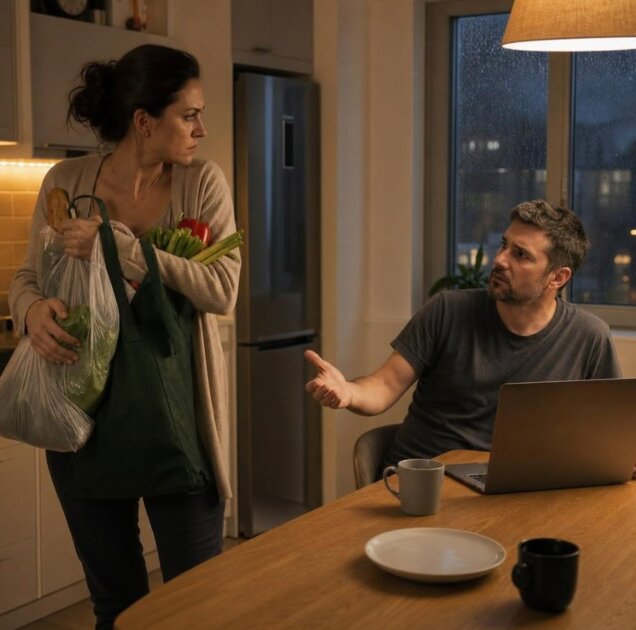
On the fourth day, I got home late.
A report had taken longer than expected. Then there had been an enormous line at the grocery store. By the time I reached the apartment, rain was pouring so heavily that my shoes were soaked through.
I carried several heavy grocery bags into the kitchen.
Ruslan was sitting at the table with his laptop.
He looked at the clock.
“You’re late,” he remarked casually. “What’s for dinner? I checked the fridge. There’s only yesterday’s soup left, and there’s no meat in it.”
I froze.
“Yesterday’s soup?”
“Yes. You could make some meatballs. Or fish. Oh, and I have an important meeting tomorrow. Can you iron my blue shirt? It’s in the laundry basket. There’s a stain on the collar.”
I stared at him.
Four days earlier, this man had told me we were strangers.
Now he was calmly giving me instructions about dinner and laundry.
“Ruslan…”
“What?”
“Don’t you think you’re confused about something?”
“About what?”
“You said we were getting divorced. You said we were strangers.”
“Yes. So?”
“Strangers don’t cook dinner for each other. Strangers don’t remove stains from each other’s shirts. And strangers don’t expect someone to make sure they have a hot meal waiting when they come home.”
His expression hardened.
“Polina, don’t start this again. We’re adults. We’re still living in the same apartment. The household is still shared. Or do you expect me to cook?”
“Exactly.”
He laughed shortly.
“You can’t be serious.”
He pulled a two-thousand-ruble note from his pocket and put it on the table.
“Here. My half of last month’s utilities. As for groceries, you’re shopping anyway. You cook for yourself too.”
I looked at the money.
The utility bill had been seven thousand five hundred rubles.
The grocery receipt in my coat pocket was for four thousand.
Meat. Vegetables. Dairy. Cleaning supplies.
Nothing luxurious.
“You don’t think we should split the grocery bill?”
“Why complicate things? If you’re buying a kilo of minced meat anyway, I can eat some too.”
Something clicked inside me.
Not anger.
Not even hurt.
Clarity.
Ruslan thought divorce meant only one thing: his obligations toward me disappeared.
My obligations toward him, however, remained.
Because to him, they had never been favors.
They had simply been expected.
I picked up the two-thousand-ruble note, placed it on the hallway cabinet, and walked back into the kitchen.
“Fine,” I said.
And from that moment on, the rules changed.
—
The next morning, I woke up at seven.
Not six-thirty.
Not because of an alarm.
I was simply rested.
At seven-thirty, Ruslan appeared in the kitchen.
He was wearing trousers but no shirt. His hair was still wet.
“Polina! Where’s my blue shirt?”
“In the laundry basket.”
“What?”
“You put it there yesterday.”
“But I told you I needed it!”
“I heard you.”
“Then why didn’t you wash it?”
I calmly lifted my tea.
“Because I’m not responsible for washing clothes for a man who says we’re strangers.”
Ruslan’s face turned red.
“I’m your husband!”
“You said we were strangers.”
“That’s ridiculous!”
“I agree. But you were the one who came up with the rule.”
He stormed toward the refrigerator and opened it.
Then he froze.
My groceries were neatly arranged on the upper shelves.
Cheese.
Vegetables.
Yogurt.
Soup.
Meat.
Each shelf had a small note:
“Polina — personal property.”
On the bottom shelf sat half a jar of mustard, a piece of stale bread, and some margarine.
“Where’s the food?!”
“My food is right there.”
“There were groceries here yesterday!”
“My groceries. I paid for them.”
“Polina, this is petty!”
“No. This is our new arrangement.”
“What am I supposed to eat?”
“There’s a grocery store across the street. It opens at eight.”
Ruslan stared at me.
“Are you seriously expecting me to cook?”
“I’m not expecting anything. You wanted a divorce.”
He stood there in disbelief.
For the first time, I saw something in his expression that I had never seen before.
Fear.
He had spent fourteen years believing that clean clothes, stocked refrigerators, hot meals, and tidy rooms simply happened.
Now the invisible person responsible for all of it had stopped working.
He grabbed an old shirt, attempted to iron it himself, and twenty minutes later left the apartment with a wrinkled collar.
I finished my tea.
And for the first time in fourteen years, I felt strangely light.
—
That evening, I came home at seven.
The apartment smelled like burnt food.
The kitchen looked as though a small hurricane had passed through it.
There was a frying pan on the stove filled with blackened remains.
The sink was overflowing with dirty dishes.
Crumbs covered the table.
Food wrappers were scattered everywhere.
Ruslan was sitting in the living room watching television.
“Clean up the kitchen,” he said without looking at me. “It smells awful.”
I stopped.
Then I picked up his dirty dishes, his frying pan, his cups, and his plates.
I put everything into a large plastic basin.
Then I carried the basin to his bedroom door.
“What is this?!”
“Your dishes.”
“Why aren’t you washing them?”
“Because they’re yours.”
“This is a shared apartment!”
“Then we should keep it clean. You made the mess. You clean it.”
“You’re my wife!”
I smiled.
“You said we were strangers.”
He stared at me.
For once, he had no answer.
—
That night, his mother arrived.
Galina Stepanovna stormed through the door as if she were responding to an emergency.
“Polina! What are you doing to my son?”
“Good evening.”
“Ruslan says he’s starving! You don’t iron his clothes, you don’t cook for him, you don’t even wash his dishes!”
“Your son wants a divorce.”
She stopped.
“What?”
“He said we’re strangers. He said he no longer has any obligations toward me. I simply accepted his decision.”
Galina slowly turned toward the living room.
“Ruslan!”
Her son appeared in the doorway.
“Mom, I…”
“You’re forty-one years old,” she interrupted. “And you called me because your wife didn’t iron your shirt?”
“Mom, that’s not the point…”
“She didn’t cook for you either?”
Ruslan said nothing.
“She didn’t wash your clothes?”
He lowered his eyes.
Galina stared at him for several seconds.
Then she spoke quietly.
“So let me understand this. You wanted to divorce your wife, but you still expected her to provide all the services you received as a husband?”
“Mom…”
“Tomorrow you’re coming home with me.”
“What?”
“You heard me. You can sleep in your old room. And you can wash your own clothes.”
“Mom!”
“I’m not your maid either!”
She turned to me.
“Polina… I’m sorry. I honestly thought you two had some serious problem. Instead, my son apparently wanted freedom while keeping all the comforts of married life.”
“Thank you,” I whispered.
—
Ruslan still didn’t move out immediately.
Pride kept him from going back to his mother.
So he tried something else.
A cold war.
For several days, he ordered food.
Breakfast.
Lunch.
Dinner.
Then he discovered that freedom was expensive.
His food expenses skyrocketed.
So he bought frozen dumplings.
He forgot about the pot on the stove.
The water boiled away, leaving behind a single blackened mass.
Then he tried doing laundry.
He threw a white shirt, black socks, and a red sports top into the washing machine together.
At ninety degrees.
The result was a strange pinkish garment that had shrunk two sizes.
But the real breaking point came the following Saturday.
Ruslan burst out of the bathroom wearing nothing but a towel.
“Polina! Where’s the toilet paper?!”
“In my room.”
“And the shower gel?”
“Also in my room.”
“You’re hiding toilet paper from me?!”
“No. I bought it with my money.”
He stared at me.
“That’s ridiculous.”
“What’s ridiculous is a forty-one-year-old man with a good salary running around the apartment looking for toilet paper because he never bothered to notice how household supplies actually appear.”
For the first time, his anger disappeared.
There was something else in his eyes.
Confusion.
Then embarrassment.
Maybe, for the first time, he understood that the life he had taken for granted had required constant work.
Someone had done the shopping.
Someone had cooked.
Someone had washed the clothes.
Someone had noticed when the detergent was running out.
Someone had remembered everything.
That someone had been me.
“Polina…” he said quietly. “Can we talk?”
“About what?”
“I think… maybe I went too far.”
“You wanted a divorce.”
“I just wanted freedom.”
“No,” I said softly. “You wanted freedom without responsibility.”
He looked at the floor.
“You wanted to look single to everyone else while keeping the comfort of married life at home. You wanted me to remain your housekeeper while you went looking for a new life.”
He was silent.
“I didn’t want to lose you,” he whispered.
I looked at him.
For the first time, I didn’t feel angry.
I didn’t feel sorry for him either.
I simply felt tired.
“You didn’t lose me today, Ruslan. You lost me the day you decided I was a service instead of a person.”
He said nothing.
“The divorce is happening,” I added. “And tomorrow, you’re moving to your mother’s.”
Three days later, Ruslan left.
He packed his clothes into large black garbage bags.
I didn’t give him the suitcases.
Those had been mine before we were married.
At the front door, he stopped.
“I’ll leave the keys here,” he said.
“Okay.”
“I’m not going to ask for money for the renovation.”
“Thank you.”
He looked at me as though he wanted to say something else.
But finally, all he managed was:
“Take care of yourself.”
“You too.”
The door closed quietly behind him.
I stood there for several seconds.
Then I walked into the kitchen.
Opened the window.
Cool autumn air filled the apartment.
For the first time in days, the sun was shining.
I made myself a fresh cup of tea.
Then I took a slice of apple pie from the refrigerator—the one I had baked only for myself.
I sat beside the window.
And smiled.
Housework is not just cooking, washing dishes, or ironing shirts.
It is invisible labor.
It is hundreds of small things someone does every day to make another person’s life easier.
Ruslan had believed those things happened naturally.
Until they stopped.
Clean shirts don’t magically appear in closets.
Food doesn’t refill the refrigerator by itself.
Dinner doesn’t materialize on the table.
And love doesn’t come automatically with a marriage certificate.
Respect has to be given every day.
Care has to be appreciated.
And if someone decides that their spouse has become a stranger, they shouldn’t be surprised when that stranger eventually starts acting like one.
Sometimes the most powerful way to teach a grown man about independence is surprisingly simple:
Let him wash his own shirt.
And buy his own toilet paper.

