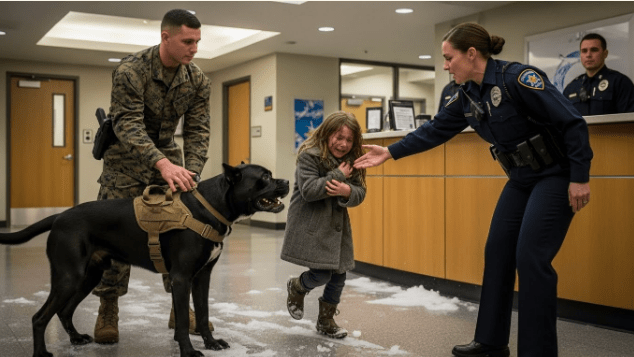
For three months, Leah Morgan had lived inside the pediatric ICU beside her six-month-old son, Caleb.
She knew every sound in that hospital. She knew the rhythm of the ventilator pushing air into Caleb’s tiny lungs. She knew the alarm that meant his oxygen had dropped and the softer beep that meant he was stable enough for her to breathe again. She knew which nurses whispered when they entered the room and which doctors avoided eye contact when they carried bad news.
Most of all, she knew her son.
Caleb had once been a cheerful baby who grabbed Leah’s fingers and smiled whenever someone spoke to him. Now he lay beneath a blanket covered in blue whales, surrounded by tubes and machines. His little body had been fighting a terrible infection for weeks, but instead of getting better, he was becoming weaker.
One morning, Dr. Aaron Pierce sat beside Leah and finally said what she had been terrified to hear.
“We’ve tried everything available to us,” he told her. “His body is exhausted. We can continue supporting him, but I don’t want to give you false hope.”
Leah stared at Caleb.
“So you’re saying there’s nothing left?”
Dr. Pierce hesitated.
“We can keep him comfortable.”
Leah understood.
Hospice. Comfort care. The words sounded like a door closing.
She looked at her son and desperately searched for something else she could give him.
Then she remembered Ranger.
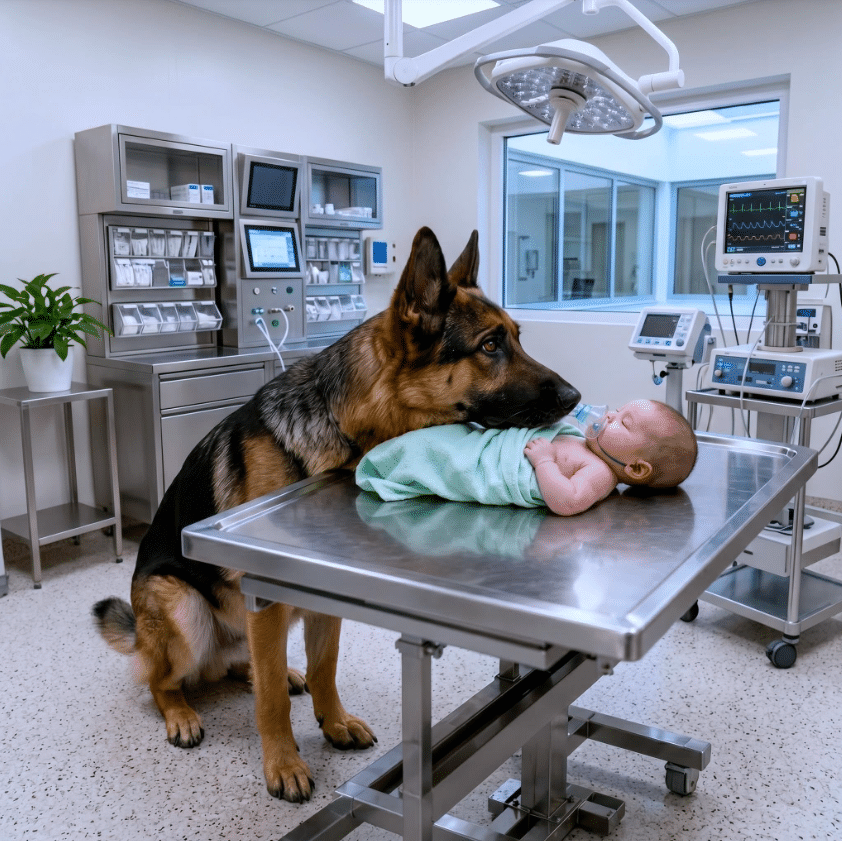
Ranger was a large German shepherd from the hospital’s therapy dog program. Caleb had loved him from the first day they met. Whenever Ranger came into the room, Caleb’s heart rate seemed to settle. Even when he was exhausted, he would open his eyes and reach toward the dog.
Leah turned to Dr. Pierce.
“Please let Ranger come.”
The doctor understood immediately.
But there was a problem.
The hospital had suspended its therapy animal program.
Dr. Miriam Vale, the hospital’s chief administrative officer, had ordered the program stopped because of infection-control concerns. Leah begged her to make an exception for Caleb, but Dr. Vale refused.
When Leah asked why one short visit was so dangerous, Dr. Vale gave her the real reason.
The Whitmore Family Foundation was coming for an important donor visit. The foundation, led by wealthy philanthropist Celeste Whitmore, was expected to provide major funding for the hospital.
“We cannot risk an incident,” Dr. Vale explained.
Leah stared at her in disbelief.
“My baby is dying,” she said. “And you’re worried about what a donor might think?”
Dr. Vale remained cold.
“Grief does not exempt anyone from hospital policy.”
Leah returned to Caleb’s room devastated.
But nurse Denise quietly told her that she knew Ranger’s handler.
His name was Jack Callahan, a retired firefighter and former search-and-rescue specialist.
Denise could not officially give Leah his number.
But she made sure Leah found it anyway.
Leah called Jack from a hospital restroom and explained everything.
She expected him to tell her there was nothing he could do.
Instead, Jack asked one question.
“Where can I meet you?”
The next day, Leah met him outside the hospital.
Jack listened as she explained how much Ranger meant to Caleb. Then he looked at a photograph of the baby reaching toward the German shepherd.
“I remember him,” Jack said. “Ranger remembered him too.”
Jack agreed to bring Ranger to Caleb.
But they needed help getting inside.
That was when nurse Natalie Cruz stepped forward.
Natalie had cared for Caleb since his admission. She knew how much Ranger had helped him, and she knew the hospital’s strict rules were being enforced partly because of the upcoming donor visit.
She offered to help them bring Ranger into the ICU.
It was a huge risk.
Natalie could lose her job and possibly her nursing license.
Jack warned her.
Natalie simply answered, “I know what I could lose. I also know what that baby loses if everyone keeps hiding behind policy.”
The plan was set.
The next evening, Jack brought Ranger through a service entrance.
Leah waited nervously in the corridor.
When she saw the German shepherd, tears filled her eyes.
“Hi, boy,” she whispered.
Ranger briefly pressed his nose against her sleeve before returning to Jack’s side.
They moved through the hospital quietly until they reached Caleb’s room.
Leah approached the crib.
“Look who came,” she whispered.
She expected Ranger to immediately rest his head beside Caleb.
But he didn’t.
Instead, the dog suddenly became tense.
His ears lifted.
His nose began working rapidly.
He sniffed the air around Caleb’s medical equipment, then moved toward a nutrition cart.
Jack tightened his grip on the leash.
“Ranger,” he whispered.
The dog ignored him.
Ranger began sniffing around the cabinet beneath the cart. Then he pawed at it.
Natalie looked frightened.
Ranger suddenly turned toward the wall behind Caleb’s crib.
His hackles rose.
A deep growl came from his chest.
Jack’s expression changed.
“That isn’t therapy behavior,” he said.
Leah looked at him.
“Is he reacting because Caleb is dying?”
Jack shook his head.
“No. I’ve seen dogs react to grief. This isn’t grief. He’s alerting.”
Before anyone could investigate further, the door flew open.
Dr. Miriam Vale stood there.
“What is that animal doing in my ICU?”
She ordered them to remove Ranger immediately.
But the dog barked again, this time directly toward the nutrition cart and the wall.
Jack refused to ignore it.
“He’s trained for hazard detection,” he explained. “He’s picking up something.”
Dr. Vale dismissed him.
But Ranger kept warning them.
Then Jack said something that changed everything.
“I know that alert.”
He had spent years working with search-and-rescue dogs and knew the difference between an animal seeking comfort and an animal detecting danger.
Something was wrong.
Natalie began reviewing Caleb’s records.
She discovered that Caleb’s condition had started deteriorating around six weeks earlier.
That was also when Fairview Regional had introduced a special nutritional formula connected to the Whitmore Foundation.
Natalie noticed something else.
Other fragile infants who had received the same formula showed troubling patterns in their medical records.
She couldn’t prove the formula was responsible.
But the timing frightened her.
Then she discovered that the hospital’s nutrition storage system had experienced repeated refrigeration problems.
There were temperature warnings.
Storage failures.
Unresolved maintenance reports.
And suddenly Ranger’s behavior made sense.
The hospital wasn’t dealing with one problem.
It might have been dealing with several.
Jack also checked Ranger’s official training records.
They showed that Ranger had been trained not only as a therapy dog but also in biological contamination recognition and hazard detection.
His alert in Caleb’s room was not random.
Meanwhile, Dr. Vale discovered that Natalie was investigating.
She threatened her career.
Natalie refused to stop.
Then, during the donor tour, the hospital lights flickered.
Ranger suddenly became alert again.
He pulled Jack toward the wall.
Jack grabbed a thermal reader from a maintenance cart and pointed it at the panel.
His face changed.
“Call a Code Red,” he said.
Dr. Vale refused to believe him.
Then the lights went out.
The ICU plunged into darkness.
A moment later, emergency lights came on.
Smoke began leaking from the wall.
The electrical panel was overheating.
The pediatric ICU had to be evacuated.
Nurses rushed to move critically ill infants.
Respiratory therapists grabbed portable oxygen.
Dr. Pierce helped move Caleb.
Leah stayed beside her son as the unit filled with alarms, smoke, and emergency personnel.
Ranger had warned them before the panel failed.
The hospital’s own maintenance records later showed that staff had reported problems with the same electrical panel months earlier.
But the warnings had not been properly resolved.
Caleb was transferred to Children’s Hospital.
There, for the first time, doctors were willing to question the original diagnosis instead of assuming every worsening symptom came from his infection.
The new team stopped the questionable formula and began an independent investigation.
Caleb’s condition did not magically improve overnight.
But something changed.
His numbers began to stabilize.
His gray coloring improved.
His body was no longer deteriorating as rapidly as before.
Dr. Hannah Kim, one of the doctors at Children’s, eventually gave Leah the news.
“We found evidence consistent with nutritional contamination or breakdown,” she explained. “We need more testing to identify the exact cause, but removing the previous formula appears to be helping.”
Leah’s heart broke.
The thing that was supposed to nourish her son may have been contributing to his decline.
And all those weeks, she had been told that there was nothing more medicine could do.
Fairview tried to protect itself.
Dr. Vale accused Leah of causing a disturbance.
The hospital even contacted Child Protective Services, claiming Leah had endangered her son by bringing Ranger into the ICU.
But Leah had recorded the evacuation.
Jack had evidence of Ranger’s training.
Natalie had copies of the medical and laboratory information.
And Fairview employee Mike Alvarez came forward with maintenance records proving that the hospital had known about electrical and storage problems.
The truth began spreading.
Leah eventually posted her own account online.
She didn’t make wild accusations.
She showed what she could prove.
She explained that Ranger was trained for hazard detection. She showed the hospital’s maintenance warnings. She described the evacuation and Caleb’s transfer.
The video spread rapidly.
Parents shared it.
Nurses shared it.
Firefighters shared it.
Former Fairview employees began speaking publicly about safety concerns.
The state health department launched an investigation.
The fire marshal confirmed the electrical danger.
Independent testing confirmed that improperly stored nutritional supplies had degraded and become unsafe for extremely fragile infants.
The Whitmore Foundation denied knowing about the storage problems.
Fairview’s administration blamed failures in communication and management.
Dr. Miriam Vale eventually resigned while investigations continued.
But Leah’s fight was no longer only about Caleb.
She wanted to make sure another mother would not have to break hospital rules simply to be heard.
Meanwhile, Caleb slowly began recovering.
He still had a long road ahead.
But his ventilator was eventually removed.
His breathing became stronger.
His cheeks slowly filled out.
One morning, Leah watched him grab a stuffed elephant with one tiny hand and refuse to let go.
For the first time in months, she saw something that looked like her old son.
Ranger was eventually allowed to visit Caleb again under strict hospital procedures.
This time, there were no alarms.
No barking.
No danger.
Ranger simply walked to the crib and rested his chin beside Caleb.
Caleb opened his eyes.
Then he reached out and touched Ranger’s ear.
Leah covered her mouth as tears filled her eyes.
Jack stood beside her silently.
The dog had come to Caleb as a source of comfort.
But he had ended up doing something far greater.
He had noticed what everyone else had overlooked.
By the time Caleb was ready to leave the hospital, major changes had already begun at Fairview.
Natalie Cruz accepted a new patient-safety leadership role.
The problematic nutrition partnership was terminated.
The hospital agreed to strengthen its safety systems.
A new family safety council was created, giving parents a real voice in pediatric policies.
Leah was invited to join it.
She agreed, but she had one condition.
“Ranger gets access.”
The new hospital leadership agreed.
On the day Caleb finally went home, Leah carried him through the hospital doors.
Jack walked beside her.
Ranger walked on the other side.
For months, Leah had dreamed about this moment but had been too afraid to believe it would happen.
There were no cameras.
No donors.
No administrators.
No alarms.
Just autumn air, her son in her arms, Jack beside her, and Ranger quietly keeping watch.
Caleb was alive.
He was going home.
And the mother who had once been told that nothing more could be done had proven that sometimes, the person who refuses to stop asking questions is the one who finally discovers what everyone else missed.