
# Every Saturday, a new bouquet appeared on my wife’s grave, even though no one in our family was bringing the flowers. In the end, I hid a small camera near the grave to find out who it was. When I watched the recording, I was left completely shocked. 😨
My wife’s name was Laura. She died almost two years ago after a long and difficult illness.
We had been married for seven years. Like any couple, we had arguments, hard times, and financial problems, but I never doubted that Laura was the closest person in my life.
After her death, I couldn’t get used to the silence in our home.
For months, I would walk into our bedroom in the evening and, for a split second, forget that she was gone. Then reality would hit me all over again.
With time, things became a little easier.
I returned to work, started meeting friends again, and slowly learned how to sleep peacefully.
But one thing never changed.
Every Saturday, I went to the cemetery.
And that was where I noticed something strange.
One morning, I found a small bouquet of white lilies lying in front of Laura’s headstone.
I assumed her sister had brought them and even sent her a message to thank her.
Her reply surprised me.
She said she hadn’t visited the cemetery for several weeks.
At first, I thought perhaps one of Laura’s friends had come.
But the following Saturday, another bouquet appeared.
This time, it was red roses.
A week later, someone left daisies.
I began asking everyone who might have visited her grave.
No one knew anything.
Yet the flowers kept appearing.
Every single Saturday.
Always early in the morning.
Always before I arrived.
One week, I deliberately came at seven o’clock.
The flowers were already there.
The next week, I arrived even earlier.
Still, I was too late.
It felt as though someone knew exactly when I would come.
By then, my curiosity had turned into something else.
Fear.
Who was visiting my wife’s grave every week?
Why were they doing it?
And why did they want to remain hidden?
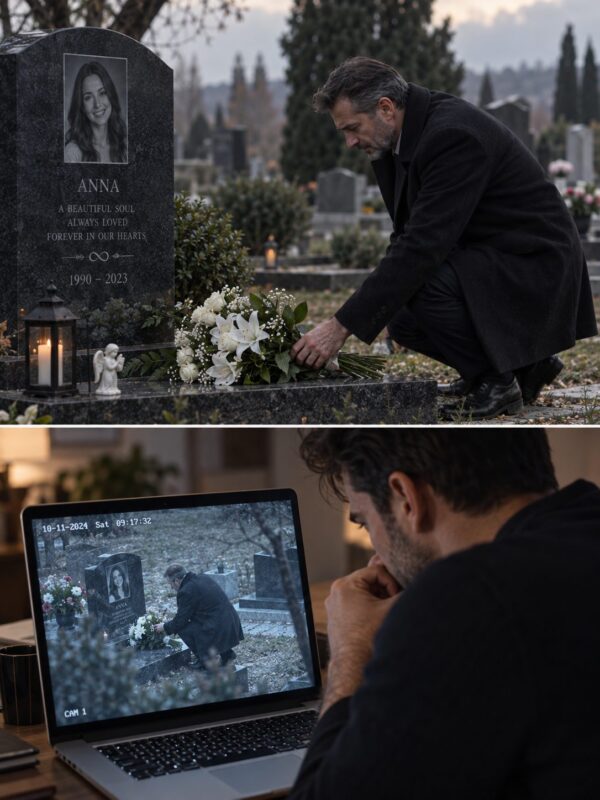
One evening, I bought a small camera.
Late at night, I returned to the cemetery and hid it in a thick bush opposite Laura’s grave.
I felt a little ashamed of what I was doing.
But the uncertainty had been tormenting me for months.
The next week passed unbearably slowly.
That Saturday, I intentionally stayed home and waited until evening.
Then I opened the recording.
For several hours, nothing unusual happened.
People walked along the paths.
An elderly woman stopped beside a nearby grave.
A cemetery worker swept away dry leaves.
Then I noticed the time stamp on the screen:
7:43 AM.
A dark-colored car pulled up near Laura’s grave.
The door opened.
A man stepped out.
And when I saw who he was, I froze in horror. 🫣😨
The man looked to be about fifty-five years old.
He wore a gray coat and carried a bouquet of white peonies.
He walked to the grave, placed the flowers down…
But he didn’t leave.
He sat beside the grave.
For nearly twenty minutes.
Sometimes he spoke softly, but the camera was too far away for me to hear his words.
Before leaving, he gently touched Laura’s photograph on the headstone and lowered his head.
The pain on his face was impossible to ignore.
I watched the recording several times.
His face seemed familiar.
But I couldn’t remember where I had seen him before.
Until late that evening.
Then it suddenly came to me.
It was Dr. Mark Wilson.
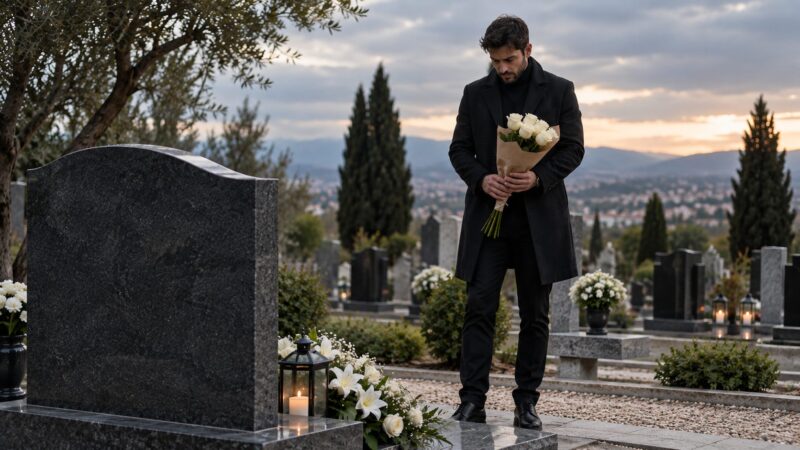
The doctor who had treated Laura during her final months in the hospital.
The following Saturday, I arrived at the cemetery before sunrise and waited in my car nearby.
Around nine o’clock, the same dark car appeared.
The doctor stepped out, carrying flowers once again.
I waited until he reached the grave.
Then I walked toward him.
The moment he saw me, he turned pale.
“Do you remember me?” I asked.
He didn’t answer.
“Why do you bring flowers to my wife’s grave every week?”
The doctor looked at the headstone for a long moment.
Then, in a quiet voice, he said:
“I hoped I would never have to explain this to you.”
My heart tightened.
“Then tell me the truth,” I demanded.
After a long silence, he finally spoke.
When Laura was first admitted to the hospital, one of her tests showed signs of a dangerous complication.
Additional examinations and changes to her treatment should have been made immediately.
But the doctor misjudged the results.
He believed the condition was not serious and allowed Laura to return home.
A week later, she was brought back to the hospital.
By then, it was too late.
After Laura’s death, an internal review was conducted.
The official documents listed complications of her illness as the cause of death.
The doctor’s mistake was never revealed to our family.
He confessed that he himself had insisted that some details remain hidden.
He was afraid.
Afraid of losing his job.
Afraid of losing his medical license.
Afraid of destroying his own life.
But after that, he could no longer live in peace.
He thought about Laura constantly.
During her treatment, she had once told him that white peonies were her favorite flowers.
A few months after her death, he visited the cemetery and brought a bouquet.
Then he came back the following week.
And the week after that.
Eventually, it became a ritual.
Every Saturday, he returned with flowers, sat quietly beside her grave, and asked forgiveness from the woman he could never save.
And standing there, I realized that behind this long and mysterious story was not a stranger—
But a man who would carry the weight of a single mistake for the rest of his life.

