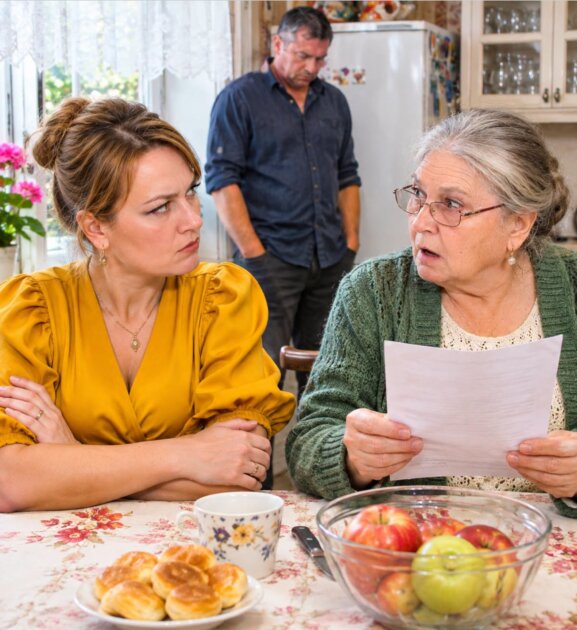
“Starting on the first of next month, you will pay me fifteen thousand rubles a month!” my mother-in-law declared, sliding a sheet of squared notebook paper across the table toward me. “I’ve calculated everything down to the last detail.”
I was peeling potatoes for dinner. The knife froze in my hand.
On the paper, written in her neat, carefully rounded, schoolteacher-style handwriting, was a list of expenses: electricity, gas, water, and then one particularly interesting item: “House depreciation.” At the very bottom, underlined twice, was the following: “Inna – monthly contribution.” Beside it was the amount.
“Rimma Arkadyevna, am I understanding this correctly? Are you actually asking me to pay rent for living in my own house?”
“Why? Do you expect me to support you for free?” she asked, sitting down opposite me and adjusting her glasses. “I believe in making things clear. For three years, you’ve had everything handed to you. You came to my son with nothing but a suitcase, and now you’re living in a grand house with a veranda. It’s time you finally understood your place!”
She had been living with us for six weeks. She arrived from Rybinsk in mid-September, claiming she wanted to spend a week relaxing at our place. Then she rented out her own two-room apartment to tenants and somehow forgot to go home.
She was seventy-one and had spent most of her working life as a deputy school principal. She spoke to everyone as if they were late students about to receive a disciplinary lecture.
I put down the knife and wiped my hands.
I was forty-four, worked as a dental technician, and had grown up in this very house.
Everyone in Uglich knew our old family home. It had a stone ground floor, a wooden upper story, carved window frames, and a huge veranda overlooking the street that led toward the river.
My father had been a carpenter and restoration specialist. In the 1990s, he bought the building, which was practically uninhabitable at the time, for the price of a second-hand Zhiguli. He spent twelve years restoring it with his own hands, paying attention to every beam and every plank.
He died five years ago.
Gleb and I had found each other later in life. We had both already been through divorces. He moved in with me with two travel bags and a toolbox. Since then, he had replaced the house’s electrical wiring and helped with various minor repairs.
His mother visited us twice a year. She was always polite but distant. She complimented the garden, asked about the weather, but never showed the slightest interest in me.
“Why do you think I’ve been handed everything?”
“Just because someone grows up in a house doesn’t automatically make it theirs,” she said, tapping the paper with her fingernail. “If it weren’t for Gleb, this entire mansion would have fallen into strangers’ hands long ago. My son bought it back. He’s the master of this house, and you’re simply living here with him. If we’re going to call things by their proper names, you’re financially dependent on him.”
At first, I wasn’t even angry. I almost felt like laughing.
“Who told you Gleb bought my house?”
“My son did. His word is enough for me.”
“Then your son forgot to mention one little detail. This house was never sold, and nobody ever bought it back. My father gave it to me seven years before our wedding. There’s a notarized deed. The documents are upstairs. Shall I bring them down?”
“These days, anyone can print a few documents!” She folded her arms. “Don’t take me for a fool, Inna!”
Just then, the front door slammed.
Gleb had come home from his shift. He worked as an elevator mechanic and always carried the distinctive smell of machine oil with him. He was forty-six, but when he saw us, he pulled his head down into his shoulders like a schoolboy caught doing something wrong.
“Gleb, come here!” I pushed the paper toward him. “Explain to your mother who owns this house!”
He looked at the sheet, then at his mother, and finally at me.
“Inna, not now, please! I’ve just got home from work.”
“But we need to talk now.”
“Come outside with me for a minute!”
We sat in his car in the yard. There was no way to have a quiet conversation inside because my mother-in-law’s hearing seemed to be better than both of ours combined.
Gleb gripped the steering wheel with both hands, even though the engine wasn’t running. A yellow maple leaf with brown edges lay on the windshield.
“Did you tell your mother that you bought my house?”
“Yes.”
“When?”
“Before our wedding.”
He rubbed his face and let out a long sigh.
“Try to understand me! After my divorce, I was living in a factory dormitory. I left the apartment to my ex-wife. For months, my mother kept telling me I’d made nothing of my life. Then I met you and saw this enormous house. I was afraid she’d think I’d simply moved in with you and was living off you. So I told her your father had wanted to sell the house and that I’d bought it. At least that made it look as if I had rescued you.”
“Gleb, we’ve been married for three years.”
“But my mother has barely been here! She came twice a year, for two days at a time. Why did I need to turn it into such a big issue?”
“Because today, in my own kitchen, she handed me a bill for living in my own house!”
Gleb fell silent.
Now I understood why his mother had never been interested in my work, what I liked, or what this house meant to me. She had been given her own version of the story years ago. In that version, I was simply a lucky woman whom her son had taken in.
“She became ill in September,” Gleb finally said. “She had an episode on the bus. Since then, she’s been afraid to stay alone. She has a cardiologist’s appointment in two weeks, on Monday. Please, don’t blow everything up before then! After the examination, I’ll tell her everything myself. If she finds out now, she might completely fall apart.”
Two weeks.
An elderly woman with a weak heart, whom her own son had kept in the dark for years. And me, being called financially dependent in my own home.
Who was I supposed to feel more sorry for?
“Fine. But I have three conditions. I won’t pay a single ruble. She gets rid of that paper today. And on that Monday evening, you tell her everything, in front of me.”
“I promise.”
By dinner, the paper had disappeared from the table. My mother-in-law ate in silence and conspicuously avoided looking at me.
But the following morning, another surprise awaited me.
I stepped onto the veranda and immediately noticed that I couldn’t hear the familiar chime.
The brass bell was gone.
My father had brought it back from Valdai and hung it above the door himself. When I was a child, it would ring whenever I came home from school, and he would know I had arrived.
Now, all that remained was a loop of wire.
Where had my father’s old bell gone?
“It was too loud,” my mother-in-law said, standing by the veranda window with a measuring tape in her hand. “It kept ringing all the time. It gave me a headache. I took it down.”
“Where is it?”
“Somewhere in a drawer. I didn’t throw it away, so don’t worry!”
I was already late for work, so I didn’t start searching.
I regret that now.
On Wednesday, I came home to find that I barely recognized the veranda.
My father’s wicker armchair was gone. So was the table where I used to make the wax patterns needed for my work. Two folding beds stood against the wall, neatly covered with our guest blankets.
“Zhanna and her son are moving in for the winter,” my mother-in-law announced, running her hand proudly over one of the blankets. “She can no longer afford her one-room rental. But this warm veranda is just sitting empty. And at fifteen, a boy needs a little space of his own.”
Zhanna was my mother-in-law’s younger daughter, my sister-in-law. She was forty-one and worked in a shop selling curtains.
Naturally, everyone knew about this moving arrangement except me.
My father had insulated the veranda during the last winter of his life. He installed double-glazed windows, connected a radiator, and made the carved larch windowsill himself.
He used to say that one day he would sit there and spend hours watching the Volga.
He only got to enjoy one spring there.
“Where are the armchair and the table?” I asked.
“In the shed. They were junk, Inna. Don’t act as if they were priceless treasures! Besides, you had completely cluttered up the veranda with them.”
I sat down on one of the folding beds. Its springs creaked in protest.
“Rimma Arkadyevna, let’s try to reach a reasonable agreement at last. The veranda will be restored to its original condition. Zhanna is welcome to visit us, of course, but she is not moving in. And we need to discuss the groceries, too. Since you arrived, I’ve been spending an extra nineteen thousand rubles a month. Market-bought cottage cheese, fish, Sunday dinners… I’m paying for everything. You proudly told me that you’re renting out your apartment for twenty-eight thousand rubles a month. Yet you haven’t contributed a single ruble toward our shared expenses. At the very least, let’s split the costs!”
“You even keep track of how I spend my own money?” She straightened up indignantly. “I put the rent from my apartment aside, and it’s none of your business what I do with it! In this house, the person who invested in it makes the decisions. What did you bring here? One suitcase!”
“Then am I right in understanding that you’re refusing to reach an agreement?”
“People who are equals make agreements, dear.”
That evening, I called Gleb.
He was working on an urgent repair.
“Your mother wants to move Zhanna and her son onto the veranda.”
“Inna, please, not now! I’m in an elevator shaft!”
“Who brought those folding beds into the house?”
There was silence on the other end. I could only hear a metallic humming sound.
“My mother asked me to,” he finally said. “Inna, please wait until Monday! We’ll sort everything out then.”
I ended the call.
So he had brought the beds in himself. During the day, while I was at work. The very man who had told me to stay calm and give him another week had personally carried strangers’ beds into my house.
That night, I couldn’t sleep for a long time.
Eventually, I logged into the government services portal and requested an updated property ownership certificate for the house. Of course, I still had the original gift agreement, but now I needed a document with a recent date. I no longer wanted to argue about which papers were genuine and which weren’t.
I took care of everything on my phone while sitting on the stairs.
Then I went downstairs to the kitchen for a glass of water.
I found the bell among the screwdrivers and electrical tape. Someone had wrapped its clapper in a paper napkin so that it wouldn’t make a sound even by accident.
I held it in my hands for a long time before putting it back in the drawer.
If I had rehung it in the middle of the night, I would have declared war a week earlier than planned.
A small lamp was still burning on the veranda.
My mother-in-law was sitting on a folding bed, a shawl draped over her shoulders. A disassembled blood pressure monitor lay on her lap.
“I can’t sleep,” she said before I could ask. “Don’t think I’m dying! It’s just a habit.”
I stopped in the doorway.
“I can’t sleep at home either,” she continued, staring at the dark window. “His slippers are still standing in the hallway. I’ve been walking around them for two years, but I can’t bring myself to put them away. I even told the tenants not to touch them. Imagine that. Strangers are living in my apartment, but his slippers are still in exactly the same place.”
Her voice broke.
She took off her glasses and began wiping them with the edge of her shawl. In the dim light, she could barely see what she was doing, yet she kept rubbing the lenses over and over again.
“At least there are sounds here. Gleb walks around, you put dishes away. If Zhanna and her son moved in too, the family would finally be together again. I didn’t do it out of bad intentions, Inna.”
I brought her a glass of water.
She drank half of it, then moved her tongue around her mouth.
“By the way, your dental work turned out very well. It doesn’t hurt at all. They couldn’t have made something like that for me in Rybinsk, not even for money.”
I had made her dentures as a birthday present the previous year.
Back then, she had only said thank you. She hadn’t mentioned them once since.
“Try to get some rest, Rimma Arkadyevna!”
“But think about the contribution, at least!” she called after me, already back in her familiar commanding tone. “Fifteen thousand rubles is hardly an unreasonable amount.”
I went upstairs and lay down without even changing my clothes.
I felt sorry for her and hated the situation at the same time. Neither feeling could push the other aside.
On Sunday, she was expecting guests again.
For the third week in a row.
What was my sister-in-law talking about when she mentioned four hundred thousand rubles?
Zhanna arrived from Rybinsk by bus for lunch with her son, along with one of my mother-in-law’s acquaintances from the veterans’ choir. The woman wore a shiny green lizard-shaped brooch on her coat, with one eye missing.
I had spent the entire morning cooking. Out of spite, this time I made only one salad instead of three, but apparently nobody noticed the difference.
When everyone sat down at the table, my mother-in-law introduced me with a broad smile.
“This is Inna, Gleb’s wife. Technically, she’s just someone we tolerate here, but we haven’t thrown her out. She’s a little dependent, you know, though in a good way. Inna, cut some more bread!”
Her friend laughed, then quickly reached for her glass. My nephew stared at his phone. Gleb sliced the meat as if he had nothing else to do in the entire world.
I had heard that word from my mother-in-law before, but only in private. Now she had called me financially dependent at my own table, over my own tablecloth, in front of a stranger.
I put down the bread knife.
“Rimma Arkadyevna, I think it’s time I explained to our guests what rights everyone actually has in this house.”
Under the table, Gleb squeezed my knee.
“Inna, please! Not now!”
“Go ahead, tell them!” my mother-in-law encouraged me, smiling proudly at her friend. “There’s certainly no shortage of strong personalities in our family!”
I stood up and went into the kitchen.
If I stayed at that table for another minute, I would reveal every secret.
I stood by the sink, holding my hands under cold running water until my fingers went numb.
Zhanna came in after me, carrying the empty salad bowl.
“Oh, come on, Inna! Why do you make such a big deal out of everything?” she asked, closing the door behind her. “You just have to put up with Mom a little. After all, she invested four hundred thousand rubles in this house! After putting that much money in, she’s entitled to have some say in things.”
I turned off the tap.
“What four hundred thousand rubles?”
Zhanna put down the salad bowl. She did it very carefully, as if she were afraid it might break.
“Didn’t Gleb tell you?”
“What was he supposed to tell me?”
“I thought he hadn’t mentioned it. Ask him!”
“Zhanna, do you know this house belongs to me? That my father gave it to me and nobody ever bought it back?”
“Of course I know,” she replied, lowering her eyes. “Gleb asked me to keep quiet. It’s easier for Mom to believe her money is tied up in these walls rather than where it actually went.”
“And knowing all that, you still wanted to move in here?”
“I can’t afford my rent anymore,” she said simply. Then she picked up the empty salad bowl and walked out.
The guests went home on the evening bus.
I barely remember how the rest of lunch passed or who washed the dishes afterward. Most likely, it was me again.
I waited for Gleb upstairs in our bedroom.
He came in but remained standing by the door.
“Zhanna told you?” he asked.
“Why don’t you tell me yourself?”
He sat on the edge of the bed, his back to me.
“Before our wedding, my mother gave me all their savings. She and my father had been putting money aside because they wanted to buy a different car. I told her I needed the money to purchase the house and that I was still short of the full amount.”
He paused, then continued.
“In reality, I used it to pay off an old loan from my tire repair business. The debt I told you about during my first marriage. The debt collectors were already waiting for me outside the factory gates.”
“You told me about the loan. You never told me that you had paid it off with your mother’s savings while claiming you were buying my house.”
“I thought I’d pay her back eventually. I didn’t want her to find out.”
“And how much have you paid back so far?”
He didn’t answer.
I looked at his back. I had ironed that shirt for him on Friday.
It’s strange what insignificant things come to mind when your husband admits that he has spent years using lies to conceal his debts.
That night, I spent a long time doing the calculations.
She had been living with us for a month and a half. During that time, my monthly grocery expenses had increased by almost exactly the amount she received from the tenants in her own apartment.
Every Sunday, I cooked for her guests. I did the shopping, set the table, and washed the dishes.
They had taken over my veranda, carried my father’s furniture into the shed, and eventually even demanded that I pay rent.
Then I tried to look at the situation from her perspective.
An elderly woman had given her son everything she and her husband had spent decades saving. She believed she was investing in a house. In her mind, these walls held the memory of her savings.
She wasn’t simply behaving outrageously. She had arrived at our home as someone who had been deceived, believing she had every right to demand an explanation about what had happened to her money.
And the episode on the bus hadn’t been made up, either.
Was I being cruel?
Should I simply give her the fifteen thousand rubles she had demanded? Wait until the cardiology appointment and let Gleb tell her everything himself?
It wasn’t as if that money would ruin me.
I got up and walked to the window.
The little lamp on the veranda was still burning. My mother-in-law was probably sitting awake again with her blood pressure monitor on her lap, believing she was protecting her own money.
Should I go downstairs?
Should I tell her everything without Gleb?
What if she became ill? What if she collapsed and I was the only one there? Me, the very woman she called financially dependent and demanded money from in her own home?
By morning, I had almost convinced myself that I should wait.
On Monday, I left for work earlier than usual.
At the end of our street, beside the garbage bins, I spotted something.
It was my father’s wicker armchair.
A piece of soggy cardboard lay on the seat. One of the legs was crooked, and mud stains covered the woven backrest.
I stopped.
My bag slipped down my shoulder to my elbow, but I didn’t even try to adjust it.
I walked over, picked up the armchair, and carried it home. I hauled it into the shed by myself and locked the door.
My mother-in-law was watching from the porch.
“Gleb took it out. I asked him to,” she said. “It’s practically falling apart, Inna. Why do you keep holding on to all that old junk?”
I didn’t answer.
I went to work.
At the laboratory, I opened the government services website. The property certificate had arrived on Thursday. I printed it, then found a standard room rental agreement online within a few minutes.
The printer left streaks across the paper, so I had to print it twice.
There was still one week until the medical appointment.
But I no longer wanted to wait.
The Agreement That Changed Everything
That evening, both of them were in the kitchen.
My mother-in-law was peeling apples for jam. The peel hung from her knife in one long ribbon. Gleb was repairing the electrical outlet beside the refrigerator.
I placed the property certificate in front of them.
“Rimma Arkadyevna, please read this!”
“More paperwork!” she sighed.
“This time, there’s no need to guess. I downloaded it from the government portal. It has today’s date and a verification code. You can even check it on your tablet.”
She wiped her hands, put on her glasses, and began reading. Her lips moved silently as she followed the lines.
“I am the owner of this house,” I said. “The basis for my ownership is my father’s gift agreement, signed seven years before our wedding. Gleb never bought this property. He didn’t pay a single ruble for it. He lives here because he’s my husband.”
My mother-in-law slowly looked up.
Then she turned toward her son.
The screwdriver stopped in Gleb’s hand.
“Gleb?”
“Mom, please, not now!”
“Gleb, is this true?”
She placed the paper on the table.
“And what about my four hundred thousand rubles? Where did they go?”
My husband crouched down beside the wall.
“I used them to pay off the debts from the tire repair shop. If I hadn’t, the debt collectors might have cost me my job at the factory, too. I intended to pay you back, Mom. I swear!”
“Your father and I saved that money for eleven years…”
She stopped halfway through the sentence.
She took off her glasses and placed them on the table with the lenses facing down. She had never put them down like that before.
The cooling stove clicked softly. The long strip of apple peel curled up on the table.
“I have always been an honest person,” my mother-in-law murmured, but she couldn’t finish the sentence.
This was where I should have stopped.
I could see that she was devastated. I knew she didn’t need another blow right now.
But I was exhausted, too.
I placed a second sheet of paper beside the first.
“Now let’s talk about that squared notebook paper on which you calculated my rent. Since you believe everyone should pay for their accommodation, I’ve prepared an offer of my own.”
My mother-in-law stared at me in confusion.
“The upstairs bedroom costs twenty-eight thousand rubles a month. Exactly what you charge the tenants in your own apartment. The agreement takes effect on the first of next month. If you don’t accept it, you must vacate the room by Sunday. And the veranda will be restored to its original condition today. Zhanna will not be moving in.”
“Are you asking me to pay you money? A seventy-one-year-old woman? Just so I have somewhere to sleep?”
“You wanted to charge me money for living in my own house.”
“I thought this was my son’s house!”
“And for a month and a half, I listened to you telling me I was merely a tolerated guest in my own home. You even said it in front of your guests.”
“Inna!” Gleb stood up. “We had an agreement! There’s still a week left! Mom has to see the doctor!”
“Yes, we had an agreement. But this morning, you took my father’s armchair and left it beside the garbage bins. That was the end of the week I promised you.”
My mother-in-law slowly stood up, gripping the back of her chair.
For a while, she simply stood there. Then she headed toward the stairs.
The railing creaked beneath her hand with every step.
The agreement remained on the table.
I expected her to call me ungrateful. Or declare that she would never set foot in my house again.
But she said nothing.
The door upstairs closed behind her. She didn’t slam it.
Gleb stared at me for a long time.
“You could have told her the truth about the house. Just the house. Why did you have to charge her rent, too?”
“So she wouldn’t forget what it feels like when someone makes you feel like a stranger in your own home.”
“She won’t forget,” he nodded. “For the rest of her life, she’ll remember that her daughter-in-law charged her for a place to sleep.”
Then he went upstairs to see his mother.
I put the apples in the refrigerator because they were already beginning to turn brown.
I sat down at the table.
My legs ached, even though I’d spent the entire day doing sedentary work.
That Monday, when my mother-in-law was supposed to have her cardiology appointment, I was alone in the house.
She never signed the agreement.
On Saturday, Gleb packed his mother’s belongings and drove her to Rybinsk, to Zhanna’s rented one-room apartment. His mother’s own apartment was still occupied by tenants until May.
He took her to the doctor from there.
All I received was a single message:
“The doctor says she needs regular checkups and must avoid stress.”
They left in the morning.
My mother-in-law came downstairs wearing her buttoned-up coat. Every button was fastened carefully. She passed me in the hallway, then stopped at the threshold.
I thought she was going to say something.
Perhaps apologize. Perhaps accuse me of something.
Instead, she stepped over to the coat rack and straightened my scarf, which was hanging crookedly.
Then she walked out without a word.
She had left the upstairs room tidy. The bed was made, and the bedside table was empty. Only a forgotten teaspoon remained in a glass.
Gleb also stayed in Rybinsk, at Zhanna’s place. He was sleeping on an inflatable mattress on the floor. He took his winter coat and his drill with him. He had put his car up for sale so he could repay at least part of what he owed his mother.
As for our marriage, all he said was:
“We’ll talk about it later.”
I didn’t ask when that particular later would come.
I folded the beds and put them in the shed. I carried my father’s armchair back to the veranda and put the table in its proper place.
Now I cook for only one person. The borscht lasts four days in the refrigerator because there’s nobody to help me finish it.
The neighbor across the fence no longer says hello. She saw my mother-in-law leaving with her bags and getting into the car.
I searched for the squared notebook paper on which my mother-in-law had so carefully calculated my rent. I wanted to keep it as a souvenir, but I couldn’t find it anywhere.
Yesterday, Zhanna called.
“What exactly did my mother ever do to you?!” she shouted. “Her own son has practically robbed her of every last penny, and you went and put a price tag on her, as if she were some random tenant!”
I didn’t argue with her.
I switched off my phone and went outside to wash the veranda windows, even though I had already cleaned them in September.
Then I took the brass bell out of the drawer full of screwdrivers. I peeled off the paper napkin and hung it back on the old nail where my father had once placed it.
The bell rang softly.
I stood beneath it for a long time.
Only now, there’s nobody left to walk in through the veranda.
And no matter how loudly the bell rings, nobody will call from inside:
“Inna, you’re home!”
What would you have done in my place? Would you have given your husband one last week to tell his mother the truth after her medical examination, or would you have put the property certificate and the rental agreement on the table as soon as she demanded rent for the first time?