When My Neighbor Accused My 81-Year-Old Father of Banging on Her Wall Every Night, I Began to Doubt Him Too. But One Weekend Revealed a Truth Neither of Us Had Expected.
“If your father bangs on my wall one more time after ten o’clock at night, I’m calling the police! And I don’t care how old he is!”
Mrs. Vaso stood outside my door, clutching her phone as if she were holding evidence in a criminal investigation.
It was Tuesday afternoon, a little after six. I had just returned from work, still carrying my grocery bags.
“What happened this time?” I asked.
“The same thing that’s been happening every night for three weeks! Knocking. Every single night. Three knocks, then a pause, then two more. As if he’s trying to send me some kind of signal!”
“Are you sure it’s my father?”
“Who else could it be? My living room wall is right next to his apartment!”
I took a deep breath.
My father was eighty-one years old.
He lived alone on the third floor of an old apartment building in Kalamaria, Thessaloniki. I lived about fifteen minutes away, in Toumba.
Over the past few years, he had started forgetting little things more often. Sometimes he couldn’t remember where he had left his glasses, whether he had watered his plants, or which day he had arranged for the plumber to come.
Still, he cooked for himself, visited the bakery nearby, and read his newspaper every morning.
He wasn’t the kind of man who would deliberately disturb his neighbors.
“I’ll talk to him,” I promised.
Vaso pressed her lips together.
“You said that last week, too.”
“And I did talk to him.”
“Then he clearly isn’t listening.”
She walked away without saying goodbye.
With a heavy heart, I went upstairs to my father’s apartment.
I found him in the kitchen, trimming green beans.
He was wearing his old checked cardigan, and the radio was playing softly in the background, tuned to a station featuring classic Greek songs.
“Well, look who’s here! My little girl!” he said cheerfully. “Are you staying for dinner?”
I sat down opposite him.
“Dad, I need to ask you something.”
He looked at me over his glasses.
“What have I done now?”
That question hurt more than I expected.
“Mrs. Vaso says she hears knocking on her wall every night.”
My father stopped preparing the beans.
“What does that have to do with me?”
“She thinks you’re doing it.”
He looked at me as if I had just accused him of stealing someone’s bicycle.
“Me? Eleni, I’m asleep on the sofa by nine o’clock. I’m not knocking on anyone’s wall.”
I nodded.
But as I was leaving that evening, I noticed something.
His old wooden walking stick was standing beside his armchair. He used it whenever his knee hurt. The rubber tip at the bottom was badly worn.
I wondered whether he might be leaning it against the wall or using it to help himself stand up, causing the strange noises.
The next day, I bought him a new rubber tip.
“This should stop it from making so much noise when you use it,” I explained.
My father looked at me.
“So you think I’m the one doing it.”
I didn’t know what to say.
“I just want to make sure we’re not disturbing anyone.”
He lowered his eyes.
“I see.”
That single sentence stayed with me all the way home.
My name is Eleni Papadopoulos. I’m forty-six years old, and I work as an accountant for a shipping company.
I’m married to Giorgos, and we have a seventeen-year-old son named Marios.
My mother passed away six years ago.
Since then, my father, whom everyone in the neighborhood calls Mr. Thanasis, has lived alone.
He spent his working life as an electrician at a large factory in western Thessaloniki. He repaired machines, cables, and electrical control panels.
Even now, he can’t walk past a faulty switch or a dripping tap without wanting to fix it.
His balcony has a small workbench covered with tools, screws, and old radios he tries to bring back to life.
Every Sunday, we have lunch together at his apartment.
He usually makes lemon chicken or pastitsio, and he always insists that we have another helping.
But over the past year, I’ve become increasingly worried about him.
Not because he had developed a serious illness, but because I had begun noticing small changes.
Once, he forgot that we had a doctor’s appointment.
Another time, he bought the same newspaper twice.
We spoke to his family doctor, who suggested keeping an eye on these changes and arranging more detailed examinations if the difficulties continued.
I tried to be careful.
I didn’t want to take away his independence, but I also didn’t want to overlook something important.
Vaso was sixty-nine.
She had moved into the neighboring apartment two years earlier, after her sister passed away.
At first, she and my father had a good relationship.
My father often helped her carry her groceries upstairs, and she sometimes left a plate of stuffed vegetables outside his door.
But over the past month, things had changed.
First, Vaso claimed that my father moved furniture around at night.
Then she complained that he played his radio too loudly.
Finally, the mysterious knocking began.
One Friday evening, at a quarter past ten, she called me.
“Listen to this!”
She held her phone against the wall.
A dull, muffled sound came through the speaker.
Three knocks.
A short pause.
Then two more.
“Do you hear it?”
I did.
But I couldn’t tell where it was coming from.
“Maybe it’s the pipes,” I suggested.
“Don’t take me for a fool, Eleni! I know the difference between a pipe making noise and someone deliberately hitting the wall!”
She hung up angrily.
The next morning, I went to see my father.
I checked his armchair, his walking stick, and his radio.
I found nothing unusual.
My father was sitting at the table, his hands folded.
“Should I move out of my own apartment?” he asked suddenly.
“What?”
“If I’m causing so much trouble, I can go and live in some village.”
“Dad, don’t be ridiculous!”
“Then why do you keep coming here looking for something I’ve done wrong?”
I fell silent.
He wasn’t entirely wrong.
I suggested that he spend the weekend at our house. I thought he could relax and enjoy some time with his grandson.
But, if I’m honest, I also wanted to find out what was happening while he wasn’t in his apartment.
I wanted to know whether the knocking would continue without him there.
On Friday afternoon, I brought him home.
We had dinner together, watched an old Greek movie, and Marios showed his grandfather photographs from his school trip to Ioannina.
My father slept in the guest room.
On Saturday morning, the doorbell rang.
Vaso was standing outside.
This time, she didn’t have her usual stern expression.
She looked pale.
She was holding a small bag and her phone.
“Eleni, we need to talk,” she said.
“What happened?”
She looked over my shoulder into the apartment.
“Is your father here?”
“Yes. He’s been staying with us since yesterday.”
Vaso swallowed.
“Then we have a problem.”
“What do you mean?”
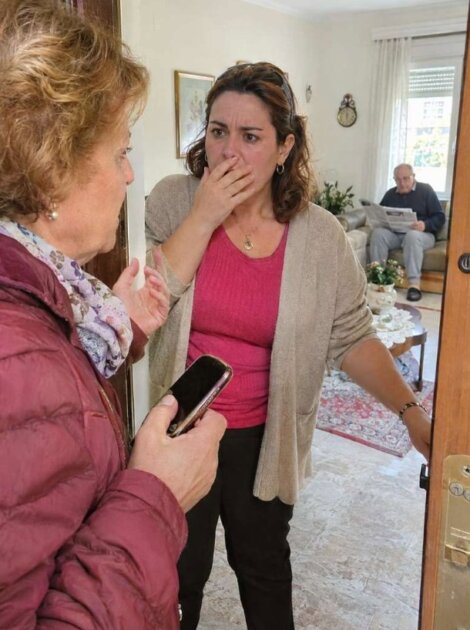
She took out her phone and played a recording.
I heard the same five knocks.
Three.
A pause.
Two.
“This happened last night at 11:12,” she said.
A chill ran down my spine.
At that exact time, my father had been asleep at our house.
Vaso continued.
“But something else happened yesterday. Something I hadn’t noticed before.”
She leaned closer.
“After the knocking, I heard a sound like someone moving a metal door. But the noise wasn’t coming from your father’s apartment.”
So who was making the knocking sounds while Thanasis was nowhere near his apartment? And what was hidden behind the wall?
I invited Vaso into the kitchen.
A few minutes later, my father appeared.
He was wearing his slippers and holding his newspaper.
When he saw Vaso, he stopped.
“Have you come here to complain again?” he asked.
Vaso blushed.
“No, Mr. Thanasis.”
“Then why are you here?”
She looked him straight in the eyes.
“To apologize. I heard the knocking again last night. And I know you weren’t home.”
My father said nothing.
After a moment, he replied:
“I told you.”
He lowered his newspaper.
“Eleni, I told you.”
I felt so ashamed that I could barely look him in the eyes.
Vaso took a sheet of paper from her bag.
She had written down dates and times.
The knocking usually happened between ten and eleven at night, although she had also heard it early in the morning on a few occasions.
I noticed that several of the incidents had occurred on particularly rainy days.
“Could there be something wrong with the heating pipes?” I asked.
My father took the paper and studied it carefully.
Then he asked:
“Vaso, which wall exactly do you hear it coming from?”
“ The wall behind my bookshelf.”
“Is it the inner wall or the one facing the balcony?”
“The inner wall.”
My father frowned.
“Then the apartments aren’t positioned next to each other in quite the way you think.”
I looked at him.
“What do you mean?”
“There’s a narrow service shaft between the two living rooms. Old heating pipes and some electrical cables run through it.”
Vaso shook her head.
“But that shaft is sealed.”
“Exactly. But sound can travel through it.”
My father put the paper down.
“We need to take a look.”
That afternoon, we returned to the apartment building.
We also invited Mr. Leonidas, the building manager, who was a retired civil engineer.
He listened carefully to our explanation.
“The building was constructed in 1978,” he explained. “It has old pipework, and several alterations have been made over the years without everyone being informed.”
We went up to Vaso’s apartment.
Her living room was small but carefully furnished. A large bookshelf stood against the wall, filled with novels and family photographs.
My father gently tapped the wall with his fingers.
It sounded hollow.
“This is exactly where it’s coming from,” he said.
Leonidas stepped closer.
“The service shaft is behind this wall. We can access it from the staircase, but we’ll have to open the metal door.”
We went down to the third-floor corridor.
At the end of it, behind an old fire extinguisher, there really was a narrow metal door.
It had been painted the same color as the wall.
The building manager took a small key from his pocket.
When he opened it, the metal hinges creaked.
Inside were pipes, cables, and an old manual valve.
My father bent down as far as his aching knee allowed.
“This pipe didn’t look like this before,” he remarked.
Leonidas shone his flashlight inside.
One of the metal brackets had come loose, and the pipe was almost touching a vertical metal support.
“It could be hitting against it whenever water flows through,” he said.
“Possibly,” my father replied. “But why does it happen at almost exactly the same time every night?”
None of us had an answer.
The building manager promised to call a plumber.
The next day, a technician named Manolis arrived. He had carried out several repairs in the building before.
He carefully inspected the pipes.
One of the metal brackets really was loose.
But something else caught his attention.
“This valve is being used quite frequently,” he said.
Leonidas looked at him.
“Who would be using it?”
“I don’t know. But there are fresh tool marks on it.”
My father stepped closer.
“This originally supplied water to the shared room on the ground floor.”
There was a small storage room downstairs that had once been used by the building caretaker.
In recent years, the building manager had taken it over, and it was used to store cleaning products and tools.
At least, that’s what we thought.
Manolis suggested checking the connection as well.
When we went downstairs, Leonidas seemed slightly uneasy.
“There’s nothing unusual in there,” he said.
“Then it won’t take long to check,” the plumber replied.
He opened the door.
The room was about ten square meters.
There were shelves, boxes, and two old radiators.
But at the far end of the room, we found something none of us had expected.
A brand-new, compact water heater.
A water connection ran underneath it.
Manolis stepped closer.
“When was this installed?”
The building manager didn’t answer immediately.
“A few months ago.”
“Why?”
“To provide hot water when the entrance is being cleaned.”
The plumber raised an eyebrow.
“But this is connected through an old pipe that hasn’t been properly secured. Every time the water heater switches on, it can cause a sudden change in pressure in the system.”
My father looked at the pipe.
“So that’s what’s causing the knocking.”
Vaso folded her arms.
“Then why does it happen every night at eleven?”
The building manager looked embarrassed.
“There’s a timer.”
“Why?”
“To save electricity.”
Manolis shook his head.
“The timer itself isn’t the problem. The real issue is that the connection was installed incorrectly.”
Silence fell over the room.
Eventually, Leonidas admitted that he had arranged for the water heater to be installed to help a woman who cleaned the building.
She didn’t have easy access to hot water at home, so he had allowed her to use the storage room at certain times.
However, he hadn’t informed the other residents.
“I was only trying to help,” he said.
“But shared plumbing must not be altered without permission and proper technical inspection,” Manolis replied.
My father nodded in agreement.
“Good intentions don’t make an improperly installed pipe safe.”
The building manager lowered his eyes.
“You’re right.”
The plumber switched off the water heater until the necessary inspections could be completed and a proper solution could be found.
That evening, not a single knock was heard.
Nor the following night.
On Tuesday, Vaso called me.
“Eleni, for the first time in weeks, I slept peacefully through the night.”
“I’m glad.”
She was quiet for a moment.
“There is something else I want to say.”
“Go ahead.”
“I feel terrible.”
I didn’t answer.
“I accused your father without having any proof. And the worst part is that when he told me he wasn’t responsible, I assumed he had simply forgotten.”
My heart tightened.
Because I had thought exactly the same thing.
The following Sunday, Vaso knocked on my father’s door.
She was carrying a small baking dish of spinach pie.
“Mr. Thanasis, I’ve come to apologize.”
My father looked at her over his glasses.
“Because of the knocking?”
“Yes.”
“I told you it wasn’t me.”
“I know.”
“But you didn’t believe me.”
Vaso lowered her head.
“No, I didn’t.”
My father remained silent for a few seconds.
Then he stepped aside.
“Come in. I’ve made coffee.”
Vaso smiled uncertainly.
They sat in the kitchen and had coffee together.
I don’t know exactly what they talked about.
But when I arrived that afternoon, the baking dish was almost empty.
My father was sitting in his armchair, reading the newspaper.
“Vaso came by,” he said.
“I know.”
“She brought pie.”
“I saw.”
He took off his glasses.
“Eleni, there’s something I want to tell you.”
I sat beside him.
“What is it, Dad?”
“What hurt me most wasn’t that Vaso thought I was knocking on her wall.”
He paused.
“It was that you started believing her, too.”
Tears filled my eyes.
“Dad…”
“I know I sometimes forget things. I notice it myself. But that doesn’t mean everything I say is wrong.”
I took his hand.
“You’re right. I’m sorry.”
He smiled sadly.
“You don’t have to apologize every time you worry about me. I just want you to listen before deciding I’m the one at fault.”
I hugged him.
At that moment, I realized how easily my concern had turned into distrust.
Over the following weeks, we made a few changes.
Not to restrict my father, but to help him without making him feel as though someone was monitoring his every move.
We arranged the medical examinations we had discussed earlier.
We prepared a simple calendar for his appointments.
And we agreed that whenever a problem arose, we would talk to him first and look for a solution afterward.
Leonidas also accepted responsibility for the improperly installed connection.
The residents decided to have the shared pipes and old water connections inspected.
The water heater remained switched off until a safe and appropriate solution could be found.
The cleaning woman wasn’t left without help, either.
The residents agreed to make sure she had the facilities she needed for her work, but there would be no more unauthorized or unsafe alterations to the building’s shared equipment.
And Vaso stopped complaining about every little noise.
In fact, some mornings she and my father began having coffee together.
She brought him pastries, and he told her stories about old radios.
One day, she called me, laughing.
“Eleni, your father is impossible!”
I immediately became concerned.
“What happened now?”
“For half an hour, he’s been trying to explain why my old clock runs five minutes slow. And he won’t even let me tell him I simply want to replace it!”
I burst out laughing.
That was my father, exactly as I had always known him.
Stubborn.
Precise.
And always ready to fix something other people had already given up on.
But the biggest surprise came a month later.
It was Saturday afternoon.
I went to visit him and bring him some food.
I found him in the kitchen, bent over a small wooden box.
Inside were old parts, screws, and a tiny metal hammer.
“What are you making?” I asked.
“Something for Vaso.”
I raised an eyebrow.
“For Vaso?”
He smiled.
“Yes. She told me that ever since the knocking stopped, her apartment has become too quiet.”
I looked at him in surprise.
“So now you’re planning to start knocking on her wall on purpose?”
He burst out laughing.
“Of course not, my girl!”
He showed me an old table clock.
It was one of those traditional clocks with a small pendulum that chimed softly every hour.
He had found it in storage and was restoring it.
“Vaso told me her mother had a clock just like this when she was a child. She said she missed the sound.”
I looked at the old object.
Its wooden casing was scratched, and the glass was slightly cloudy, but the pendulum moved steadily.
“You’re giving it to her?”
“Yes.”
I smiled.
“Aren’t you afraid she’ll complain about the noise again?”
My father looked at me seriously.
“Eleni, there’s a big difference between a sound that bothers us and one that reminds us of someone we loved.”
I fell silent.
I never expected such simple words to move me so deeply.
The next morning, we went to Vaso’s apartment together.
My father carefully carried a small paper bag containing the clock.
When he handed it to her, she stared at it for a long time.
“Where on earth did you find this?”
“I’ve had it for years. I repaired it.”
Vaso ran her fingers over the wooden frame.
“My mother had one almost exactly like this.”
“I know. You told me.”
Tears filled Vaso’s eyes.
“Mr. Thanasis, I don’t even know what to say.”
My father smiled.
“Just tell me whether it keeps time properly.”
Vaso laughed through her tears.
She placed the clock on her bookshelf.
Then we heard its soft, steady ticking.
It wasn’t loud.
It didn’t disturb anyone.
It was simply a small sound in an apartment that had been far too quiet for far too long.
“It’s beautiful,” Vaso whispered.
My father nodded.
“Enjoy it.”
As we were leaving, Vaso stopped me at the door.
“Eleni, there’s something I’d like to tell you.”
“I’m listening.”
“When the knocking first started, I wasn’t angry only because I couldn’t sleep.”
I looked at her.
“Why else?”
“After my sister died, every evening became difficult. The apartment felt empty. And those noises kept reminding me how alone I was.”
She lowered her head.
“Perhaps that’s why I became so irritable. I was looking for someone to blame for something I couldn’t really change.”
I didn’t know what to say.
I took her hand.
“At least now we know the truth.”
She smiled.
“Yes. And sometimes the truth is much simpler than the stories we create in our minds.”
Several months have passed since then.
My father still lives in his own apartment.
He still forgets where he puts his glasses.
He still buys more oranges than he needs.
And he still insists that nobody makes better Greek coffee than he does.
But I learned something very important.
When someone grows old, they don’t lose the right to speak in their own voice.
They don’t suddenly stop knowing what they’re doing.
And we shouldn’t treat everything they say with suspicion simply because the years have passed.
Sometimes, a strange knocking behind a wall isn’t caused by bad intentions at all.
Sometimes, it’s just a faulty pipe, an old installation, and people who have forgotten how to trust one another.
And when the truth finally comes out, it isn’t only a technical problem that can be fixed.
A relationship can be rebuilt, too.
That evening, just before I left, my father called out to me from the kitchen.
“Eleni!”
“Yes, Dad?”
“Take some pastitsio home for Giorgos and Marios. I made far too much.”
I took the food container and kissed his cheek.
As I closed the door behind me, I heard the gentle chime of Vaso’s clock.
One clear, quiet note.
I smiled.
Because once, every unexplained knock had frightened us.
Now we had learned to listen first.
And only then decide what it really meant.