
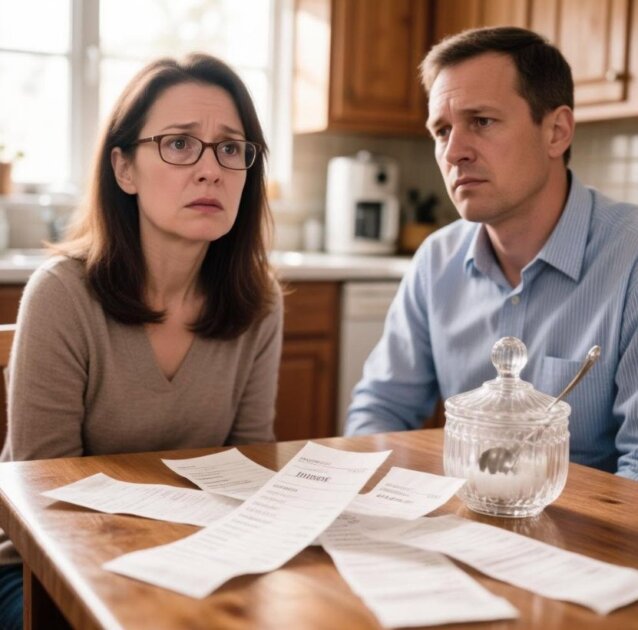
On Sunday morning, just as I had done every week for the past thirty years, I sat at the kitchen table surrounded by cash register receipts and my calculator. Oleg had been making fun of this habit for twenty years. According to him, there was no point in checking the numbers by hand when the stores had computerized systems that calculated everything automatically. But every Saturday evening, I collected the receipt rolls from all three of our stores, brought them home in a buckwheat bag, and spent Sunday morning checking every figure over a cup of coffee.
It was a habit I had developed back in the 1990s, when Oleg and I sold nails, plaster, and other building materials from a single shipping container at a construction market. In those days, I recorded every last kopeck in a thick ledger with a green cover. I still have that old book tucked away in my wardrobe, between our wedding photo album and the folder containing Denis’s certificates from school.
“Galya,” Oleg said, appearing in the kitchen doorway.
He was already dressed, and not in his usual clothes for staying at home. He wore new jeans and a light blue shirt with thin stripes. It was made of good-quality cotton, and I certainly hadn’t bought it for him.
For a moment, I wondered where it had come from, but then I returned to my calculations. The figures from our second store were off again, this time by 312 rubles.
“Galya, we need to talk.”
“Go ahead. I’m listening.”
“Put those papers away for a minute!”
I set the receipts aside and took off my glasses.
Oleg sat opposite me on the little stool where our cat, Accountant, usually liked to nap. The ginger tomcat had earned his name because he loved sleeping on the cash register receipts. Now he jumped down indignantly and disappeared into the hallway.
Oleg wasn’t looking at me. His attention was fixed on the old crystal sugar bowl in the middle of the table. It had belonged to his mother.
“I’m going to tell you something, but please don’t start shouting. We’re adults.”
“When have I ever shouted?”
“Never. And I don’t want you to start now.”
He fell silent, nervously turning the sugar bowl around.
“There’s someone else in my life. A woman. We’ve… well, things have become serious. It isn’t just a fling, Galya. Do you understand?”
I watched his hands. His wedding ring was still on his finger. After thirty years, his fingers had grown so thick that the ring seemed almost embedded in his skin. There was a greenish mark on his wrist where he had cut himself on a piece of sheet metal a week earlier while helping unload a truck.
“So you’ve fallen in love with someone else,” I said.
I wasn’t asking a question. I was stating a fact.
“Yes, I’ve fallen in love with another woman,” Oleg admitted.
Then he hurried on, as though afraid I might interrupt him.
“But we’re not getting divorced. You understand that, don’t you? There’s the business. Three stores, the warehouse, loans, suppliers. If we start dividing everything now, the whole thing will collapse. Denis is involved in the business, too. Why should he suffer? No, I’ve thought everything through. We’ll keep living as we always have. The house stays as it is. You’ll continue managing the stores. I’ll just spend the weekends somewhere else. Maybe some weekdays, too. You’re an intelligent woman, Galya. You understand.”
I said nothing.
The kettle began to boil softly on the stove. A radio was playing in the apartment next door, and the weather forecast announced that temperatures would drop to minus three degrees on Wednesday.
For some strange reason, that detail stayed with me.
Minus three on Wednesday.
“How old is she?” I finally asked.
Oleg grimaced.
“What difference does that make?”
“It makes a difference to me.”
“She’s thirty-four.”
“What’s her name?”
“Galya, why do you need to know that?”
“What’s her name, Oleg?”
“Kristina.”
I mentally went through every Kristina I knew. Kristina, the saleswoman at our third store, was only twenty. Kristina, my cousin’s daughter, lived in St. Petersburg.
Then I remembered the third Kristina.
“She’s an interior designer,” Oleg added, as if he could read my thoughts. “Remember that project we did for the tile department in the summer? The display stands and lighting? She designed them.”
Of course I remembered her.
She was tall and blonde, always wearing loose trousers and carrying a folder of drawings under her arm. Back then, she had praised the coffee we made in the staff room and remarked on what a warm, family-like atmosphere we had at the company.
“I see,” I said.
“Galya, don’t think I’m abandoning you! I’m not. I respect you. You’re like… like family to me. We’ve been through so much together. But I’m alive, too, Galya. I’m fifty-four, and I want to live a little.”
The kettle began to whistle.
I stood up and switched it off. Then I poured boiling water into my cup, only to realize that I had forgotten to add the tea leaves.
“What if I want a divorce?” I asked without turning around.
Oleg sighed heavily, the way someone sighs when a child asks a foolish question.
“Galya, think about it! We spent thirty years building all this. If we divide everything, there’ll be lawsuits, frozen bank accounts, suppliers running away, and the bank could call in its loan. You could lose everything. So could I. And Denis, too. Who would benefit from that? Kristina? She doesn’t even want the business. She earns her own money.”
He stood up, came over to me, and placed his hand on my shoulder. It was heavy, warm, and familiar.
“Let’s not do anything stupid, all right? Everything will stay the same. Just… a little different.”
He left at eleven.
I heard his car start in the courtyard, then the engine noise gradually faded into the distance.
I remained standing by the stove, holding my cup of boiling water, and didn’t move until it had gone completely cold.
***
That evening, my friend Tamara came over.
We had been best friends since childhood. We sat at the same desk from fifth through tenth grade, then life pulled us in different directions. We became close again when our sons were born just a month apart.
Tamara had worked as a notary’s secretary for twenty years. When her employer retired, she stayed at the same office under his successor. She knew so much about other people’s family affairs that she could have written an entire series of books about them.
She brought a Bird’s Milk cake, a popular Russian chocolate-covered soufflé cake, and placed a bottle of cognac on the table with a firm thud.
“All right. Tell me everything.”
I told her the whole story, word for word. The striped shirt, Kristina, the business, and Oleg’s generous proposal that we remain married while he lived his life somewhere else.
Tamara listened without interrupting. She snorted only once, when I repeated Oleg’s claim that he respected me.
When I finished, she cut herself a slice of cake, ate it slowly, and then asked a question.
“Galya, whose name is your company registered under?”
“What do you mean?”
“Exactly what I asked. The three stores belong to you. It’s a limited liability company, right? Who owns it?”
I thought for a moment.
To be honest, I hadn’t thought about it in years. Oleg handled the paperwork, banking, and tax authorities. I dealt with inventory, the cash registers, and the sales staff. That was how things had worked since the days of our little market container.
“I suppose Oleg. He’s the director.”
“Being a director is a position,” Tamara explained patiently. “The director runs the company. The owner owns it. Those are two different things. You can be a director without owning a single share. And you can own one hundred percent of a company without ever setting foot in the office.”
“Wait a minute,” I said slowly.
Suddenly, I remembered something.
Fourteen years earlier, in 2012, Oleg had a business partner named Sergei Tikhonov. Together, they opened our second store. Then Tikhonov disappeared, leaving behind a mountain of debt. Some people began pressuring Oleg and threatening to take legal action against him.
One evening, Oleg came home looking as though he had seen a ghost. He was pale, and his hands were shaking.
“Galya, we need to transfer the company into your name immediately. If I have nothing in my name, they won’t have anything to take from me. It’s just a formality. You don’t have to do anything. Just sign the papers.”
And I had signed them.
At the very notary’s office where Tamara worked.
“Tamara…” I stared at her in disbelief. “The company is in my name!”
She put down her fork.
“What?”
“In 2012, Oleg transferred the entire company to me. One hundred percent of the shares. Remember? You were on vacation at the time, and I told you about it afterward.”
“And he never transferred it back?”
“I don’t know. I never asked. He said it was just a formality. Then the problems were resolved, and we simply forgot about it.”
Tamara studied me for a long moment.
“Maybe you forgot about it, Galya. But I’m not sure he did.”
She pulled out her phone and opened the tax authority’s website.
“This is easy to check. We can request an official company extract. It’s free and takes only a few minutes. It tells us who the director is, who owns the company, and what percentage they hold.”
We entered the company’s name: StroyDvor LLC.
A minute later, I was staring at the document on the screen.
General Director: Oleg Viktorovich Somov.
Owner: Galina Petrovna Somova.
Ownership stake: 100 percent.
Tamara leaned back in her chair and burst into laughter. There was nothing cheerful about it.
“Well, well, Oleg Viktorovich! ‘We can’t get divorced because of the business.’ Of course you don’t want a divorce! Your wife might remember who actually owns the company.”
“But we’re married,” I protested. “Everything acquired during the marriage is joint property. If we divorce, won’t he get half?”
“He might claim half the value of the ownership stake through the courts,” Tamara admitted. “But that would be a lengthy process involving valuations and expert assessments. Until then, you’re the sole owner. You decide who runs the company. You can even remove him with a single resolution. There’s no need for a vote because you’re the only member. A notary needs to certify the decision, but it can be done.”
I stared at my name on the phone screen. My name, beside the number one hundred percent.
“I don’t want to destroy him,” I whispered. “He’s spent thirty years building this business. He knows the suppliers, the banks, the whole market. I don’t want to take his life away from him.”
Tamara remained silent for a while before speaking.
“Galya, you’re a good person. But first, find out what he’s been doing behind your back. Don’t make any moves yet, and don’t tell him anything. Go to the stores. Look through the paperwork, contracts, and payments. You’ve been keeping accounts for decades.”
Her eyes shifted to the cash register receipts lying on the table.
“Well, my friend, it’s time to add up the numbers again.”
***
On Monday evening, I began investigating in earnest.
I still had access to the accounting system. My username and password were written on a scrap of paper in my wallet, exactly where I had put them years earlier.
In recent years, however, I had stopped using the system. Oleg always said that an outside company handled the accounting, that the software was complicated, and that I didn’t need to burden myself with it.
That evening, when everyone had left the office above our first store, I sat down at the accounting computer.
Our actual accountant, Ludmila Ivanovna—not our cat, Accountant—worked on Tuesdays and Thursdays.
I opened the bank statements for the previous six months.
At first, everything looked ordinary. Payments to suppliers for tiles, paint, and plumbing fixtures. Warehouse rent. Salaries. Taxes. Loan repayments.
Then I saw something that made my blood run cold.
June: Kristina A. Vetrova, sole proprietor — design project fee: 380,000 rubles.
July: Kristina A. Vetrova, sole proprietor — design project, second stage: 420,000 rubles.
August: Kristina A. Vetrova, sole proprietor — design supervision: 290,000 rubles.
September: Kristina A. Vetrova, sole proprietor — new store concept development: 650,000 rubles.
October: Kristina A. Vetrova, sole proprietor — advance payment: 500,000 rubles.
I stared at the screen.
I took Ludmila Ivanovna’s old calculator, the one with the large buttons, and added the amounts.
Two million, two hundred and forty thousand rubles.
Two million, two hundred and forty thousand.
That was how much we had paid in five months to the woman my husband claimed to be in love with.
Design projects? Display stands for the tile department?
I had seen those stands. Three illuminated display units and two plasterboard partitions. They looked nice, I admitted that. But we sold building materials ourselves. I knew exactly how much plasterboard, metal framing, and lighting cost.
And most importantly, we had never opened a new store.
There had been no plans for one. Nobody had even mentioned expansion to me.
I photographed the screen with my phone, closed the program, shut down the computer, and turned off the lights.
For a long time, I sat in the dark office. I listened to the quiet hum of the drinks refrigerator downstairs and tried to understand how, after thirty years of building a business together, my husband had decided not only to replace me with another woman but also to strip me of the very business we had created.
***
On Tuesday, I arrived at the office early.
Oleg usually showed up around ten. I was there by eight. I told our security guard, Mikhalych, that I had forgotten my glasses at home and needed to come back.
I went upstairs.
The door to Oleg’s office was slightly open.
I could hear his voice coming from inside.
He was already there, earlier than I was. Perhaps he hadn’t even slept at home. Lately, I had stopped asking where he spent his nights.
I stopped in the hallway.
I hadn’t intended to eavesdrop. At least, that was what I told myself at first. I simply couldn’t make my legs carry me any farther.
“Kristina, please be patient!” Oleg said in a gentle voice I hadn’t heard him use in at least fifteen years. “Don’t act like a child. I told you, you have to wait until spring.”
There was a short pause.
Then he spoke again.
“No, we can’t do it earlier. I still need to pull out the working capital, understand? If I file for divorce now, she’ll start digging around, and then she’ll discover that everything is in her name.”
My stomach tightened.
“Yes, hers. I told you that already. I transferred everything to her in 2012. I was an idiot back then. But she doesn’t remember anything. All she cares about are those damn cash register receipts.”
I leaned against the wall.
“In the spring, we’ll run a few more ‘projects’ through your business, then I’ll transfer the warehouse to my brother’s company. After that, I’ll divorce her, and she’ll be left with three stores with empty shelves and a pile of debt. She can fight over the liabilities in court. Don’t worry, I’ll leave her an apartment. My mother’s one-room flat.”
That apartment.
The one where his mother had lived for forty years, and which had been sitting empty for five years because the ceiling leaked and the bathroom tiles were falling off.
Oleg continued speaking as calmly as if he were planning a holiday.
“All right, kisses. I’ll come over tonight. Buy that wine you liked so much!”
I quietly turned around and headed for the stairs.
When I reached the ground floor, Mikhalych looked up from his security booth.
“Galina Petrovna, did you find your glasses?”
“I did,” I replied.
Then I stopped in front of him.
“Mikhalych, how long have you worked for us?”
“About twelve years now.”
“Twelve years…” I nodded. “Thank you.”
He looked at me strangely but asked no questions.
I stepped outside. It was cold, and the air carried the unmistakable smell of winter. A thin layer of ice glittered on the puddles near the entrance.
I thought it was Wednesday, the day the forecast had promised temperatures of minus three.
Then I realized it was only Tuesday.
But it no longer mattered.
Something inside me had changed forever.
I got into my car and called Tamara.
“Tamara, you were right. I need your notary contact. And a good lawyer who understands divorce and corporate law. Urgently.”
My friend was silent for a moment.
“Come at noon. I’ll arrange everything.”
***
The notary’s name was Alexei Borisovich. He was around forty, wore rimless glasses, and had a remarkably calm manner. Tamara also brought along an old acquaintance of hers, Nina Arkadyevna, a lawyer. She was a petite woman wearing an enormous knitted cardigan, with the firm voice of an experienced elementary school teacher.
I laid everything out in front of them.
The company extract, the photographs of the payments, and a detailed account of what I had overheard in Oleg’s office that morning.
Nina Arkadyevna took notes, occasionally nodding. When I finished, she put down her pen.
“Let’s look at what we can do. I’ll explain everything in simple terms, without legal jargon. First, you are the sole owner of the company. That means you can decide to replace the director. You can do it today. Alexei Borisovich will certify the resolution, and within a few days the changes will be entered into the official register. From that point on, your husband will no longer be able to sign documents on behalf of the company or authorize payments.”
“What about the bank account?”
“We’ll notify the bank immediately. The new director, whether that’s you or someone you appoint, will receive new signing authority, access credentials, and security keys.”
Nina Arkadyevna pointed to the photographs of the payments.
“Second, there’s this amount of more than two million rubles transferred to the business of your husband’s… acquaintance. If the services were fictitious, this may constitute an improper diversion of company funds. The company can demand repayment. A director who acts against the company’s interests can also be held personally liable.”
“And what happens when we divorce?”
The lawyer didn’t try to give me false hope.
“Your husband may claim half the value of the ownership stake because the company interest was acquired during your marriage. I won’t hide that from you. But the court may also consider the money he withdrew from the company and how he spent your shared assets. If he used the money for purposes unrelated to the family, particularly to benefit another woman, that could be a significant argument during the property division. So his plan to leave you his mother’s crumbling one-room apartment probably won’t work out as easily as he imagines.”
I looked out the window.
The first snow had begun to fall. Tiny, dry flakes swirled through the air, as though winter itself hadn’t yet decided whether it was truly time to arrive.
“Galina Petrovna,” Alexei Borisovich said gently, “you don’t have to do everything today. You can take some time to think.”
I looked at him.
“No,” I said. “I’ve spent thirty years thinking. I’ve had enough.”
***
That evening was the hardest part.
Oleg came home at seven, which was unusual. On weekdays, he generally explained his late arrivals by saying he had been busy at the warehouse.
He walked in, took off his shoes, and sniffed the air.
“Meat patties?”
“Yes.”
“With mashed potatoes?”
“Yes.”
He sat down and began eating the way he always had, quickly, leaning over his plate and tearing off large pieces of bread.
I had watched him eat for thirty years.
I knew he would finish the patty first, then the mashed potatoes, and finally use his bread to mop up the gravy before declaring with satisfaction:
“Galya, you’re an amazing cook!”
He did exactly that.
He cleaned his plate with bread.
Then he said the same words.
And suddenly I understood something strange about habit. Sometimes, even after someone has betrayed you, you still prepare the same dinner, pour the tea the same way, and wash the same plate. You continue the routine even when the person sitting across from you has long since betrayed everything you built together.
Oleg looked into his teacup and casually asked:
“Were you at the office yesterday?”
“Why?”
“Mikhalych said you stopped by.”
Mikhalych. Twelve years working for us, and apparently reporting to Oleg whenever I showed up at my own workplace.
“Yes,” I said evenly. “I wanted to check the accounts for the second store. We were short by another three hundred rubles. I thought I’d see which receipt was missing.”
“And did you figure it out?”
“Forget it! I couldn’t understand that software. All those English labels and tiny buttons. I gave up and came home.”
Oleg watched me over the rim of his cup.
He studied me for a long time, as though trying to determine whether I really was as clueless as he believed.
I calmly drank my tea and thought about buying bread the next day and getting more food for Accountant.
Finally, he nodded.
“Good. Don’t bother with that system. Ludmila Ivanovna handles the accounting. You don’t need to burden yourself with it.”
“No, of course not,” I agreed.
Oleg went into the living room to watch football.
I washed his plate. Under the hot water, my hands somehow felt ice-cold.
He had known me for thirty years. For thirty years, he had watched me record every payment, check every invoice, and account for every last kopeck.
And yet he believed he could dismiss me with a single sentence.
He had told me I didn’t understand computers.
And I had let him believe it.
A week earlier, he might actually have gotten away with it.
That night, Oleg slept at home. He lay on his left side and snored as usual.
I stared at the ceiling, watching the shadow of a poplar branch move in the light from the streetlamp.
I wasn’t counting sheep.
I was counting the payments.
Three hundred and eighty.
Four hundred and twenty.
Two hundred and ninety.
Six hundred and fifty.
Five hundred.
And one question kept running through my mind: how many more would I find if I dug deeper?
***
I decided to take over as director myself.
Tamara suggested hiring an experienced manager, but I refused.
I had stood beside that market container when our business was born. I had carried stock, kept the books, negotiated with suppliers, and worked through the years when we didn’t even know where we would find the money for the next shipment.
I knew our suppliers, our warehouse staff, and our salespeople. I knew who had children, who could be trusted, and who always kept their word.
I refused to believe that after everything I had done, I was incapable of running my own company.
On Wednesday, the resolution was certified. By Friday, the updated company extract had arrived. That same day, I went to the bank, where they changed the signing authorities and gave me new access credentials.
Oleg found out on Monday.
The bank had sent him a text message informing him that his account access had been revoked. He called the bank, and they politely explained that he was no longer authorized to act on behalf of the company.
At two that afternoon, he stormed into the house.
I was sitting at the kitchen table checking the cash register receipts.
“What have you done?!” he shouted from the doorway. His face was red, and he was breathing heavily. He was still wearing that light blue striped shirt. “Have you lost your mind? Do you understand what you’ve done? I have a supplier payment due on Wednesday! I have…”
“You no longer have the right to control the company’s money, Oleg,” I said calmly. “You’re no longer the director.”
“You have no right to do this!”
“Yes, I do. I’m the sole owner. You transferred the company to me yourself in 2012. Remember? You told me it was just a formality and all I had to do was sign.”
He fell silent.
He stared at me as if he were seeing me for the first time.
“You… how do you know about that? You didn’t even remember!”
“There are many things I didn’t remember,” I replied, taking off my glasses. “For example, what you said about my cash register receipts. That I don’t remember anything except my receipts. Isn’t that what you told Kristina?”
Oleg’s face first turned red, then drained of color.
“You were eavesdropping?”
“You were speaking very loudly in an empty office at eight in the morning. Next time, close the door.”
He sank onto the same stool where he had sat a week earlier, explaining his love for another woman and his reasons for keeping our marriage intact.
Accountant, who had been dozing nearby, jumped down indignantly and disappeared into the hallway.
“Galya, please…” Oleg’s voice suddenly changed. He was no longer giving orders. He was begging. “Don’t do this. People sometimes say things they don’t mean. I was just trying to keep Kristina calm. I never intended to…”
“Two million, two hundred and forty thousand rubles,” I interrupted. “Was that a misunderstanding, too?”
He didn’t answer.
“You transferred that money to Vetrova’s business over five months. You paid for the design of a store we never intended to open. And I checked the numbers, Oleg. Just like you always mocked me for doing. By hand, using my old-fashioned methods. It turns out they weren’t so useless after all.”
“I’ll pay it back!” he blurted out. “Galya, I’ll return everything! I made a mistake. Kristina wanted it, too. I didn’t…”
“You will pay it back. You can be certain of that. Nina Arkadyevna, my lawyer, will explain what it means to be held legally responsible for money taken from the company. You can be held personally liable. Your car, for example, or your boat. And the garage you transferred to your brother last year will also be investigated. If it was purchased with marital funds, we may be able to challenge that transfer.”
Oleg stared at me, unable to say a word.
“Now, please pack your things,” I continued.
I stood up and looked him straight in the eye.
“I’m divorcing you, Oleg. Denis is an adult. If you agree, we can file the necessary papers together and have our marriage dissolved through the appropriate process. If you refuse, we’ll go to court. Nina Arkadyevna is already preparing the case. The property division will go through the courts anyway. Exactly what you were so desperate to avoid.”
***
On Tuesday, for the first time in many years, I went to the office not to check the accounts but to work.
Mikhalych stood up from his security booth when he saw me. It was obvious that he had already heard the news.
“Good morning, Galina Petrovna!”
“Good morning, Mikhalych!”
I stopped by the entrance gate.
“I want to ask you something honestly. Did Oleg Viktorovich ask you to tell him whenever I came to the office?”
The man turned red and lowered his eyes.
“Yes,” he admitted quietly. “He said you’d been getting nervous lately and that I should keep an eye on you. I thought… Galina Petrovna, I didn’t mean any harm!”
“I know. You’ve worked for us for twelve years, and I know you’re a decent man. But from now on, you report to me. Understood?”
“Yes, absolutely!”
Then he unexpectedly smiled.
“Don’t worry, Galina Petrovna. Everyone here is on your side.”
Ludmila Ivanovna arrived at ten. I had asked her to come in on a day when she normally didn’t work.
She sat across from me with a thick folder and remained silent for a long time.
“Ludmila Ivanovna, did you know about these payments to Vetrova?”
“I did,” she replied dryly. “In fact, I told Oleg Viktorovich twice that something was wrong. The completion certificates were blank, and the work was worth only a few thousand rubles at most. He told me my job was to process the payments, not to question them.”
She paused before adding:
“I work part-time in retirement. My pension is small, and I have grandchildren to support. I was afraid of losing my job.”
“I don’t blame you,” I said. “But I need your help now. Show me everything suspicious from the past two years. I want to understand exactly what I’m dealing with.”
We spent the entire day going through the records.
Ludmila Ivanovna became increasingly animated. She clicked through the files, pulled up statements, and kept exclaiming:
“Look at this, Galina Petrovna! This is interesting, too!”
We discovered that we had been paying two suppliers for plumbing fixtures at prices one-third higher than the market rate. Both suppliers turned out to be Oleg’s old fishing buddies.
We also found a contract showing that we had paid six months of warehouse rent in advance to a company belonging to his brother, Vitya. There was no reasonable explanation for why we needed to do that.
By six o’clock, my head and back were aching, but I felt something strange inside me.
It wasn’t happiness.
It was clarity.
It was as though I had spent years wearing glasses with someone else’s prescription, and I had finally taken them off.
Ludmila Ivanovna gathered the files and headed toward the door.
Then she turned around.
“Galina Petrovna, may I tell you something? Not about work.”
“Of course.”
“Whenever you sat down to check the cash register, you always made sure not a single kopeck went missing. I noticed that in the very first year. Oleg Viktorovich used to laugh at you, but I always thought you were the real owner of this business. You just hadn’t realized it yourself.”
For a long moment, I couldn’t think of anything to say.
Perhaps because, for the first time in my life, someone else had said aloud what I should have understood long ago.
***
The hardest part wasn’t confronting Oleg.
It was facing my son.
Denis arrived that evening. He was twenty-eight, had worked in our business since he was twenty, and managed the warehouse. He had grown into a tall, broad-shouldered man who resembled his father in almost every movement. He walked the same way and rubbed his forehead whenever he was nervous.
“Mom, what’s going on?” he asked, sitting at the table without taking off his jacket.
“Dad called me. He said you fired him from the company and kicked him out of the house. He says you’ve lost your mind.”
I poured him some tea. This time, I remembered the tea leaves.
“Denis, do you know Kristina?”
He looked away.
And in that moment, I understood everything.
“You do know her,” I said quietly.
“Mom…” He rubbed his forehead, exactly as his father did. “I saw her a few times. She came to the warehouse about the display stands. Dad said it was business-related. I didn’t want to get involved. I thought it was between you two.”
“Between us,” I repeated.
Then I took out the documents.
“Denis, did you know your father planned to transfer the warehouse to your Uncle Vitya’s company in the spring? The warehouse you manage?”
My son raised his head.
“What? Why would he do that?”
I showed him the bank statements and payment records, then told him what I had overheard in the office.
Denis read the documents slowly.
First came disbelief, then confusion, and finally a deeper, heavier pain—the kind of adult disappointment I had never seen on his face before.
“Dad told me we were expanding in the spring,” he said at last. “He said we’d have a bigger warehouse, and I’d be put in charge of it. I was so happy…”
“You’re not a fool, son. You’re his son. Children want to believe their fathers.”
He remained silent for a long time.
Then he took off his jacket and hung it over the back of the chair.
“Mom, what will happen to the warehouse now?”
“Nothing will happen to it. It will remain ours, just as it always has. And you’ll continue managing it. But I need your help, son. I can’t run three stores alone. I need someone I can trust.”
Denis looked at me. His eyes were wet, just as they had been when he was a little boy who fell off his bicycle and tried to hide how badly his knee hurt.
“I’ll help you, Mom.”
And for the first time, I felt that perhaps I hadn’t lost everything after all.
***
Kristina called me herself a week later.
I have no idea where she got my number. Probably from Oleg’s phone.
“Galina Petrovna?” she asked in a young, bright voice that trembled slightly. “This is Kristina Vetrova. I suppose you know who I am.”
“I do.”
“I just wanted to explain that your lawyer sent me a letter. She’s demanding that I repay the two million, two hundred and forty thousand rubles.”
She fell silent for a moment.
“Galina Petrovna, I honestly didn’t know what was happening. Oleg told me the company belonged to him. He said you’d been living like roommates for years and that you didn’t care what he did. He suggested those contracts himself. He said it would reduce the taxes. I thought everything was legitimate…”
“Kristina,” I interrupted, “you’re thirty-four years old. You’re an adult woman with your own business. Did you really believe it was perfectly normal to receive two million rubles for three illuminated display stands?”
Silence.
“The money must be returned,” I continued calmly. “Not to me, but to the company. If you don’t repay it voluntarily, we’ll take the matter to court. Nina Arkadyevna will explain everything to you.”
“And if I pay it back…” She swallowed nervously. “Will you stop pursuing me? I mean, will you leave me alone after that?”
“I’m not interested in your life, Kristina. I don’t want to take anything from you. I want my money back.”
In the end, she repaid the money, although not all at once. She paid it in installments over two months.
Later, Denis told me that Oleg had moved out of Kristina’s apartment by then. Or, more accurately, she had thrown him out after learning that he was no longer the director, that his car was at risk of being seized, and that the upcoming property division would probably leave him with far less than he had expected.
“That’s what she told him,” Denis said, lowering his eyes. “She said she thought she’d fallen in love with a successful businessman, but he was just a man pretending to be rich with his wealthy wife’s money.”
Oleg was now staying with his brother, Vitya. Apparently, he was sleeping in the garage.
I didn’t say anything.
Instead, I remembered the day thirty years earlier when Oleg and I had stood together beside our little container at the construction market. We wore identical winter jackets and shared a thermos of tea and a single sausage sandwich.
Back then, Oleg had put his arm around me and said:
“Galya, just you wait. One day, we’ll show everyone what we can do!”
And we had shown them.
Somewhere along the way, however, Oleg had decided that he had accomplished everything alone.
In his eyes, I had merely stood beside him, holding the thermos.
***
Six months passed.
The property division was still going through the courts. Nina Arkadyevna said we would need at least another two months to finish everything, but it was already clear that Oleg wouldn’t get what he had originally expected.
The money he had taken from the company was being considered in the property division. The garage transferred to his brother was also under investigation.
All three stores continued operating.
I reorganized much of the business and dismissed two suppliers who, as it turned out, had been receiving kickbacks in secret arrangements with Oleg. I found new suppliers who offered better prices and more reliable service.
Denis managed the warehouse and purchasing. Surprisingly, he had inherited his father’s business instincts.
He was simply more honest.
Last Sunday morning, I was sitting at the kitchen table again, checking the cash register receipts, when the doorbell rang.
I opened the door.
Oleg was standing there.
He had lost weight, his face was unshaven, and he wore an old jacket. In his hands was a shopping bag containing a box of Bird’s Milk cake, my favorite.
“Galya,” he said quietly. “Can I come in for a little while? I won’t stay long.”
I stepped aside and let him in.
I wasn’t even sure why. Perhaps it was because Accountant had already run into the hallway and was rubbing against Oleg’s legs as though nothing had happened.
Oleg sat down on his familiar stool and looked around.
“You haven’t changed anything,” he remarked.
“Why would I?”
He remained silent for a while, nervously turning the cake box in his hands.
“Galya, I made a terrible mistake. I understand that now. I thought I had built everything myself. That this was my business, my stores, my life. And you were simply there beside me. Like a piece of furniture that never moved.”
He looked up at me.
“Then I realized that without you, none of it would have existed. Not the stores. Not even the man I became.”
I said nothing.
“I’m not asking you to forgive me,” he continued. “I just want to know if I could come by sometimes. Have a cup of tea. Sit with Accountant for a while. I have nowhere else to go now, Galya.”
I looked at him for a long time.
The man I had spent thirty years of my life with. The man who had secretly siphoned money from our shared business for five months so that he could eventually leave me with three stores full of empty shelves and a crumbling one-room apartment.
And now he was sitting in front of me on his old stool, thinner and broken, holding a cake he knew I loved.
Once, I had imagined growing old with him. I pictured us sitting at this very table in retirement, drinking coffee on Sunday mornings and laughing about the old days.
But life doesn’t always turn out the way we plan.
Oleg had betrayed me—not only by falling in love with another woman, but by betraying everything we had spent thirty years building together.
And yet, as I looked at him, I felt no triumph.
Only exhaustion. Sadness. And a strange sense of relief, because at last I no longer had to lie to myself about the man sitting across from me.
“I’ll make you some tea,” I finally said. “Today, at least. But what happens after that, I don’t know, Oleg. Honestly, I don’t know.”
I stood up and put the kettle on.
Oleg sat quietly at the kitchen table while Accountant jumped onto the chair beside him.
The cash register receipts lay in front of me.
The calculator was where it had always been.
And for the first time in a long while, I felt that perhaps everything in my life could finally fall into place.
I didn’t know what the next Sunday would bring.
But I knew one thing for certain: I would never again let anyone else decide how much I was worth.

