
When the dispatcher announced the address, I forgot to breathe for a moment.
12 Kertész Street.
I hadn’t been inside that house for eighteen years. Not because it was far away, but because my father had stood in the doorway all those years ago and told me never to dare set foot inside again. At the time, I was clutching my five-year-old daughter and carrying a single suitcase as I walked out into the night.
Now, I was heading back there as a paramedic.
“Male, seventy-six years old, sudden speech impairment, barely able to move his right arm,” the dispatcher reported. “A family member called the ambulance.”
“That’s my father,” I told my colleague, Ilya, who was sitting beside me.
He glanced at me for a moment, then turned his attention back to the road.
“If you want, I can talk to the family.”
“Thank you. Let’s see the patient first.”
I had been working as a paramedic for twelve years. During that time, I had treated neighbors, former teachers, old classmates, and even people I had chatted with in the grocery store the day before. But it had never occurred to me that one day I would be called to my father’s house.
To the man I hadn’t spoken to in eighteen years.
After my mother suffered a stroke, I cared for her for nearly two years. I fed her, dressed her, helped her wash, and arranged her medical appointments. All the while, I was raising my daughter, Kata, on my own. Her father and I had gone our separate ways, we barely had enough money to get by, and eventually I felt as though I was slowly falling apart myself.
Then I was offered a job in a nearby city. I didn’t want to leave my mother without help, so I suggested to my father that we hire a caregiver for her. I would pay for the initial visits, and I would come home on weekends.
But my father saw it as betrayal.
“You would put your own mother in the hands of strangers?” he snapped. “What kind of person have you become?”
I tried to explain that I wasn’t trying to run away. I simply wanted to start working, earn money, and build a life for Kata in which she wouldn’t have to worry every day about how we were going to pay the next bill.
He wouldn’t listen.
When I finally moved out with my daughter, he shouted after us that a daughter like me didn’t deserve to ever come home again.
Eight months later, my mother died.
At her funeral, my father walked past me as if I were a stranger. He didn’t even look at me.
And now, eighteen years later, I was the one who had to save his life.
I spotted Kata by the gate. She was wearing my old, faded sweater, its sleeves pushed up to her elbows. When she saw me, she went so pale that she looked as though she had seen a ghost.
“Mom?”
Her voice was barely more than a whisper.
“I didn’t know you were coming.”
I didn’t ask what she was doing there. I didn’t ask how long she had been visiting him. My job left no room for personal grievances just then.
“Where’s your grandfather? When did the symptoms start?”
Kata pulled herself together.
“In the kitchen. At eleven twenty, he dropped his cup. Then he tried to stand up, but he couldn’t move his right arm properly. I called the ambulance immediately.”
In the kitchen, my father was sitting on the floor, leaning against a cabinet. A broken cup lay beside him. When he saw me, he tried to say something, but only incomprehensible sounds came out of his mouth.
Fear filled his eyes.
For the first time in my life, I saw him truly helpless.
Ilya and I examined him quickly. We checked his vital signs, blood sugar, speech, and movement. The right side of his face was visibly drooping compared with the left.
“András Péter, you’ve probably had a stroke. We’re taking you to the hospital right now,” I told him calmly.
Inside the ambulance, we alerted the hospital in advance and then handed him over to the emergency team. A few minutes later, we were already on our way to another call.
I left Kata in the emergency department.
But she ran after me as I headed for the exit.
“Mom, wait! There’s something I need to tell you.”
I stopped.
“I’ve been visiting Grandpa since spring. Almost every Saturday.”
Her words hit me as though the ground had suddenly disappeared beneath my feet.
I thought of all those weekends when she had told me she was going to visit a friend. The breakfasts I had eaten alone. The short phone calls after which she always hurried to hang up.
“We’ll talk about it tonight,” I said, because the ambulance driver was already signaling impatiently for me to hurry.
But Kata still had something else to say.
“There’s more. I’m not going to the restoration workshop. I’m turning down the internship.”
At first, I thought I had misheard her.
Kata had spent almost a year preparing for that four-month internship. Every spare moment, she had been repairing old picture frames, practicing gilding techniques, and talking about everything she would learn from the master craftsmen.
“Why would you do that?” I asked.
“Because Grandpa is going to need me. He won’t manage on his own.”
“We don’t know yet how much help he’ll need.”
“I know I can’t leave him alone.”
Then she looked at me. There was no anger in her eyes, no hatred either. Something much worse: she looked at me as though she had already passed judgment.
“I don’t want to behave the way you behaved toward Grandma.”
I couldn’t answer.
I climbed into the ambulance, and only then did I notice that I was trying to unscrew the cap of the water bottle in my hand for the second time.
Ilya didn’t ask any questions. I was grateful to him for that.
I didn’t get home until after seven that evening. Kata was sitting at the kitchen table, an untouched cup of tea in front of her. Her backpack lay beside her chair, as if she were ready to leave at any moment.
“How’s your grandfather?” I asked.
“They examined him. They said he had a cerebrovascular event, and he’s being treated in the appropriate department now. They can’t say anything definite yet.”
I was glad she was taking the information from the hospital staff seriously. Then it struck me that she had spent the entire day alone in the emergency department at the age of twenty-three.
“Have you eaten anything?”
“A pastry. Mom, please, let’s not talk about food right now.”
Even so, I took yesterday’s meat patties out of the refrigerator and began heating them. I didn’t know what to say, so I kept my hands busy instead.
“Why did you hide the fact that you were visiting him?”
Kata was silent for a long time.
“Because whenever you talked about him, it sounded as though you were talking about someone who had ruined your life. I was afraid that if you found out I was seeing him, you’d be angry with me too.”
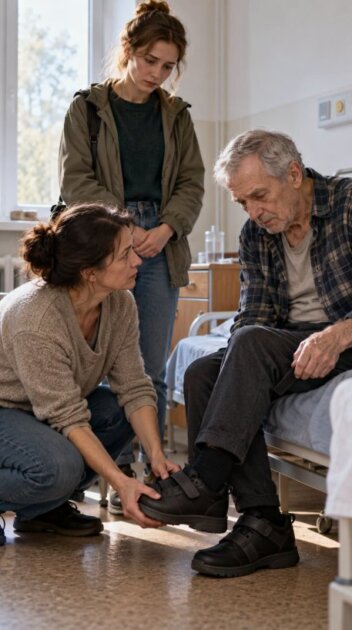
“How did you meet?”
“In the spring, outside the grocery store. His apples had spilled out of his bag, and he couldn’t pick them all up by himself. I recognized him from the old photograph. At first, we only talked at the gate. Then he invited me in for tea. Sometimes I did his shopping. Other times, I cooked something for him.”
Kata smiled.
“You know what’s strangest? He argues with the television constantly. Just like he used to.”
A laugh escaped me unexpectedly. My father really could argue with an entire news broadcast, even when nobody was listening to his replies.
For the first time in eighteen years, I had heard something about him that didn’t leave me feeling bitter.
“Did he talk about me?”
Kata’s expression grew serious again.
“He said you abandoned Grandma when she could barely walk. I argued with him. I told him you must have had your reasons. Then he asked me how I knew that. And I realized I didn’t really know anything at all.”
She raised her eyes to mine.
“Why didn’t you ever tell me about all this?”
“I thought I was protecting you.”
“From what? The truth? Or the fact that you didn’t always make the right decisions either?”
The meat patties began sizzling in the pan. I turned down the heat.
It was easier to save strangers’ lives than to explain to my own daughter why I had made the decisions that were now causing her pain.
I sat down opposite her.
“I was thirty-one when we left. Your grandmother had already been living with the effects of her stroke for two years. She understood everything, but she struggled to speak, could barely move her right leg, and even getting dressed on her own was difficult. I helped her wash, eat, and take her medication. At the same time, I was raising you and trying to earn money from home.
“Was Grandpa working?” Kata asked.
“He left for the workshop at dawn and came home after eight in the evening. He thought that meant he had fulfilled his duty.”
He hadn’t always been like that. On Sundays, he used to roast potatoes in the oven, carve wooden whistles for you, and bring your grandmother cherries even when she had asked for apples. But whenever the subject of hiring a caregiver came up, he always said the same thing:
“We don’t entrust our own family to strangers.”
One evening, I saw you beside the trash bin. You had thrown away a drawing of three people holding hands beneath a huge red sun. You had shown it to me that morning, but I had simply waved it aside because I was busy changing your grandmother’s bedding.
You thought you had drawn it badly.
But I was the one who hadn’t paid attention to you.
That evening, I started looking for work in the neighboring city. A friend offered me a room, and I told your father I would pay for a caregiver’s first few visits. I planned to find a job first and then take you with me.
But your father immediately declared that you would stay.
“My granddaughter’s home is here!” he said. “You can leave if your job is so important to you.”
“And who will look after her while you’re at the workshop?” I asked. “Who will take care of your mother?”
“I’ll figure something out.”
He said it exactly the way he used to promise to fix the leaking faucet. Confidently, firmly, and without a plan.
I didn’t have a perfect plan either. I was simply hoping that within a few weeks, I would find an apartment where you could be safe.
But you overheard our conversation.
That evening, you came to me holding your pajamas.
“Mom, if you move away, who will I belong to?”
My heart broke. I promised you we would leave together. And that’s what we did.
A few days later, we were living in a tiny room. It had a pull-out sofa, a small desk, and a landlady who didn’t tolerate children making noise.
Before we left, I arranged for a neighbor to help your grandmother. I left her money to cover the first few visits.
Your father took it in silence.
Then he told me that traitors had no place in his house.
A week later, I went back to visit your grandmother. Your father didn’t open the door, even though I could hear his footsteps in the hallway.
The neighbor told me he regularly came over to help with lunch and washing. I could have tried to return when your father wasn’t home, but I was afraid another argument would break out in front of my mother.
To this day, I don’t know whether I was truly trying to spare her or simply protecting myself from more pain.
“And Grandma?” Kata asked.
“Eight months later, she suffered another stroke. She died in the hospital. I went home for her funeral. Your father still wouldn’t speak to me.”
I couldn’t say how my mother’s life might have turned out if I had stayed beside her. But I knew how much she had loved those evenings when the three of us drank tea together and you made her laugh.
When I left, I took those evenings away from her too.
“For a long time, I kept telling myself that we hadn’t abandoned anyone,” I continued. “It was easy to say that. I truly couldn’t go on living the way I had been. But your grandmother had less help without me. And I never found out whether she had forgiven me.”
Kata stared at the tablecloth.
“Did you really want to leave me here?”
“Only for a few weeks. But the fact that I discussed it in front of you as if you were just another suitcase is something I’m still ashamed of. I didn’t think about how you might feel.”
“I remember the pajamas,” she said quietly. “I also remember checking every morning for a long time to make sure you hadn’t left without me.”
I hadn’t known that.
After we moved into the new apartment, she often followed me from one room to another. I had thought she was simply stubborn and couldn’t play by herself.
“I’m sorry, sweetheart.”
Kata didn’t answer immediately.
“I don’t know what to do with all this, Mom. I understand you better now. But I still feel sorry for Grandma.”
I turned off the stove.
Neither of us ate.
A month after his stroke, my father was able to get out of bed independently and walk slowly across the room while holding on to something for support. But he was still a long way from a full recovery. He tired after short conversations, struggled to get dressed, and couldn’t shower safely on his own.
We worked with the hospital team to prepare for his return home.
We had grab bars installed, removed dangerous thresholds, and rearranged the kitchen. My father learned to use his phone with one hand, heat up prepared meals, and call for help when he needed it.
Before discharging him, the specialists checked whether he could safely get out of bed, reach the bathroom, sit down, stand up, and return to bed.
Washing and cooking were still difficult for him. We discussed with the caregiver how she could assist him safely and arranged his ongoing rehabilitation sessions.
We also spoke honestly about the costs. My father’s pension and savings would cover daily care for about six months. After that, we would have to reassess how much help he needed and how we could afford it.
I paid for the grab bars to be installed and promised to take him to his appointments on my days off.
When he saw the bill, my father frowned.
“That’s… quite a lot of money.”
“It isn’t free for me to take care of you either,” I replied.
To my surprise, he laughed.
It was a short, raspy laugh, but Kata heard it from the hallway and hurried over. When she saw us both smiling, she smiled too.
The day before his discharge, my father asked me to stay a little longer.
We were sitting in a small visitors’ room. For a long time, he twisted a handkerchief in his hands as though he couldn’t find the right words.
“I… what I said to you back then…”
He fell silent.
“You don’t have to rush,” I told him.
With great difficulty, he continued.
“I told you that you weren’t my daughter. But you were. I was afraid I would be left alone with your mother. I didn’t know how I was going to cope. And I took my fear out on you.”
I looked at his right hand, resting motionless on his knee.
For the first time in eighteen years, he had spoken about my mother without blaming me.
“I said cruel things to you too, Dad,” I replied. “And it took me far too long to understand how frightened I had made Kata. But if I could start over, I would still move away with her. I would just make much firmer arrangements for Mom’s care.”
My father slowly nodded.
That nod seemed harder for him than the apology.
“Will you… come and visit sometimes?”
“Yes. We’ll arrange a time. But I’m not going to move back here.”
“I’m not asking you to.”
We didn’t hug.
The scent of the same soap my mother used to wash the collars of his shirts in the evenings still lingered around him. I wanted to tell him about my mother’s final eight months, the days I had missed, and the evenings we would never get back.
But I knew he wouldn’t be able to handle such a long conversation just yet.
I promised him we would return to the subject another time.
He nodded.
On the day Kata left, the two of us drove her to the station.
My father still couldn’t stand for long, so he stayed in the car. I got out and helped Kata with her luggage.
My daughter leaned down toward the open window.
“I’ll call you as soon as I arrive, Grandpa.”
“Just don’t call after midnight. I’m an old man. I need my sleep.”
Kata burst out laughing.
“Your alarm goes off at six in the morning even when you have absolutely nothing to do!”
My father raised his left hand as though he wanted to argue, but in the end, he simply waved goodbye.
As we drove home, he remained silent for a long time. Then he asked which days I worked.
I told him my schedule. He took a folded piece of paper from his pocket. Kata had written the caregiver’s arrival times on it in large letters.
My father compared the dates with my days off.
“We could have lunch together on Sunday,” he finally said. “If you feel like it.”
“I’ll think about it.”
“Just don’t oversalt the potatoes,” he added.
“I wasn’t planning to cook potatoes.”
“Then I’ll have to learn how to do it myself.”
The following Sunday, I showed up at his house with a bag of potatoes after all.
My father was sitting at the kitchen table. He had spread a damp dishcloth beneath the cutting board to keep it from slipping. A vegetable peeler lay in front of him.
When he saw me, he nodded toward the bowl.
“Put one here.”
I washed a potato, placed it in front of him, and sat down opposite him.
My father slowly took the peeler in his left hand, awkwardly gripping its handle.
We didn’t hurry.
Sunlight streamed through the window, and the kitchen was filled with a kind of silence I hadn’t experienced in that house since childhood.
We hadn’t yet talked about my mother’s final months. We hadn’t resolved eighteen years of hurt in a single Sunday afternoon. We hadn’t suddenly become the kind of family I had once imagined we would be.
But my father hadn’t sent me away.
And I hadn’t run away.
I watched him slowly peel the potato. Sometimes he had to stop because his hand grew tired. When that happened, I didn’t take the peeler away from him. I simply waited until he was ready to try again.
Perhaps for the first time, I truly understood that forgiveness doesn’t mean pretending nothing ever happened.
Nor does it mean that we have to move back into the place we once had to leave.
Sometimes, forgiveness simply means sitting across from someone, allowing them to do with their own hands whatever they are still capable of doing, and not expecting them to make up for the entire past in a single day.
At last, my father put down the peeler and looked at me.
“Will you come again next Sunday?”
Outside the window, a neighbor’s child rode past the fence on a bicycle. The old green gate, its paint still peeling, stood open.
“If you don’t oversalt the potatoes,” I said.
My father smiled.
And this time, it hadn’t taken an ambulance, an emergency department, or a life-threatening illness for us to finally speak to each other again.
All it had taken was a Sunday.
And a single potato that we peeled together.

