
CHAPTER 2 – “IF I STOP PAYING YOUR BILLS, DO I NO LONGER BELONG TO THIS FAMILY?”
“If you’re not going to help us anymore, then don’t expect us to visit you! And don’t think you’ll be welcome in our home after this!” Khloe snapped.
For several seconds, I sat motionless, the phone pressed against my ear. Those words came from the very woman whose children I had helped raise for years. I had shopped for groceries, cooked meals, done laundry, driven my grandchildren to school, and dipped into my savings whenever they needed money.
Yet she hadn’t asked how I was feeling. She didn’t care that my knees hurt or that I had postponed some of my medical treatments because I couldn’t afford to keep putting everyone else’s needs ahead of my own.
All that mattered was that I no longer wanted to solve every problem in her household.
“Tell me something, Khloe,” I asked quietly. “Do you really believe I have to pay your bills and watch your children to earn a place in this family?”
“Here you go again, twisting my words!” she shouted. “I’m simply saying I’m tired of you interfering in everything!”
“Then I’ll respect your wishes. I won’t visit unless I’m invited, and I won’t organize my life around your family’s needs anymore.”
Before she could respond, she hung up.
I remained in the kitchen, staring at my phone. I was heartbroken. Of course I was. But for the first time, I didn’t call her back to apologize for something I hadn’t done. I didn’t offer another favor just to restore the peace.
That evening, something inside me finally changed.
I realized that if I continued living the way I had been, one day there might be nothing left of my own life.
Ten days later, I made a decision that would change everything: I was going to sell my house in Maple Oak.
It wasn’t an easy choice. That was the home Sebastian, my husband, and I had built together. He had planted the roses that bloomed every spring, and we’d chosen the curtains together, room by room. Our son, Theo, had grown up within those walls.
Every corner held a memory.
But memories couldn’t pay the bills, and they couldn’t ease the pain I felt when I struggled to climb the stairs alone in the evening.
I was sixty-eight years old. I had osteoporosis and persistent joint pain. My doctor had warned me months earlier that I needed to rest more and stop carrying heavy things.
Yet I continued spending my days solving other people’s problems while pushing my own aside.
Now, finally, I wanted to take care of myself.
I called Peter, the real estate agent who had helped one of my neighbors sell her home.
“Are you sure about this, Camila?” he asked after I explained what I wanted to do.
I appreciated that he didn’t dismiss my decision simply because I was an older widow. He took it seriously without trying to talk me out of it.
We reviewed the property’s condition, discussed a reasonable asking price, and calculated how much money I would have left after moving expenses.
Several prospective buyers came to view the house. Then Daniel and Emily, a young married couple, arrived.
Emily was an elementary school teacher, and Daniel worked as a technician. When they saw the garden, Emily immediately walked over to the window.
“I can imagine how beautiful this must look in the spring,” she said.
I told her that Sebastian had planted the flowers himself.
“Then we’ll take good care of them,” she promised.
Something stirred inside me. It was comforting to imagine the garden being loved rather than neglected, and someone else finding joy in the place where Sebastian and I had shared so many years.
The couple made a fair offer, and the terms of the sale were straightforward. After carefully reviewing the documents, I accepted.
For the first time in years, I made an important decision without asking myself how it would benefit Theo and Khloe.
Instead, I asked myself a different question.
What would be best for me?
Meanwhile, Khloe began posting messages on social media about protecting her peace and keeping toxic people out of her life.
I didn’t respond.
I had no intention of engaging in a public argument or trying to convince anyone of what kind of person I was. People who truly knew me didn’t need an explanation. And those who had already decided I was the villain wouldn’t be satisfied no matter what I said.
Theo called me four times in a single weekend.
Each time, I let the call go to voicemail.
By the fourth message, he no longer sounded angry. He sounded frightened.
“Mom, where are you? What’s happening? Please call me back!”
I listened to his message, but I wasn’t ready to speak to him.
For years, I had lived as though every ringing phone demanded an immediate response. It didn’t matter whether I was cooking, heading to a doctor’s appointment, or finally sitting down to rest. If Theo called, I went. If Khloe asked for something, I found a way to make it happen.
Now I needed time. Time when nobody could persuade me that putting my own needs first was selfish.
When the sale was finalized, I handed the keys to Daniel and Emily.
Before leaving, I took one last look around the empty living room. I remembered Theo as a little boy, sitting at the dining table and begging Sebastian for another helping of dessert.
The tears came before I could stop them.
But I understood something now: just because a decision hurts doesn’t mean it’s the wrong decision.
I packed a few photographs of Sebastian, my old nursing notebook, my medical records, and the clothes I needed. Then I left Maple Oak and headed for Newport, Oregon, where my older sister, Nora, was waiting for me.
When she saw me, she opened her arms.
“You finally made it,” she whispered.
I collapsed against her shoulder and cried like a child who had spent far too long pretending to be strong.
Behind Nora’s house stood a small guesthouse with cedar shingles and a porch overlooking the marshland. She helped carry my suitcase inside before smiling at me.
“What would you like first? Something to eat, or would you rather rest?”
It was such a simple question, yet I nearly burst into tears again.
It had been so long since anyone had asked what I wanted.
That evening, we went to a casual restaurant near the coast and ordered shrimp. For the first time in ages, I could sit through an entire meal without getting up to clear plates, prepare lunches for the next day, or check Cheyenne’s dance schedule.
After a while, Nora looked at me.
“Do you regret leaving?”
I thought carefully before answering.
“I miss them,” I admitted. “I miss Theo, Hugo, and Cheyenne. But I don’t regret trying to build a life of my own.”
And I had no idea that the hardest conversation was still ahead of me.
CHAPTER 3 – “I SOLD MY HOUSE, NOT MY LOVE”
The first few days in Newport were peaceful. At first, the quiet felt almost unnatural.
Nora took me to a farmers’ market, where we bought fresh tomatoes, basil, and honey. There was no need to hurry. I didn’t have to remember who needed picking up from school or which bill I had forgotten to pay on someone else’s behalf.
At first, I almost felt guilty for enjoying myself.
Then, little by little, I began to understand that peace was not a sin.
One afternoon, while sitting on the porch, I turned my phone back on. Notifications and missed calls immediately filled the screen.
Theo called again almost at once.
“Mom, I went to your house,” he began. “There are strangers living there. What happened? Where are you?”
“I sold the house, Theo. I’m in Newport, staying with Nora.”
There was a long silence.
“You sold it? Without even telling me?”
“Yes.”
“But… I always thought I’d get that house someday.”
His words hit me as though someone had suddenly poured a bucket of ice water over my head.
So Theo had been thinking of my house as though it already belonged to him. As though I were merely living there temporarily, with an obligation to preserve it for him throughout the remainder of my life.
“Theo, your father and I bought that house together,” I replied. “I never promised it to you. And don’t forget something: I’m still alive. I need money, security, and the ability to take care of myself.”
Before he could answer, Khloe took the phone.
“That house represented our family’s future!” she exclaimed. “Don’t you care about what happens to Theo?”
I closed my eyes for a moment.
“And who is thinking about what happens to me?”
I reminded her of the roof replacement, Cheyenne’s dance lessons, the telephone bills, the groceries, and all the other expenses I had covered over the years.
Then I told her that I had even postponed my own treatments because I had spent my medical savings helping them.
Theo’s voice changed immediately.
“Mom, why didn’t you tell me your knees were hurting that badly?”
“Because I didn’t want to become another problem for you,” I admitted. “But even now, all you’ve asked about is the house and the money. Neither of you has asked whether I arrived safely.”
Silence settled over the conversation.
Finally, Theo asked me to come home so we could discuss everything in person.
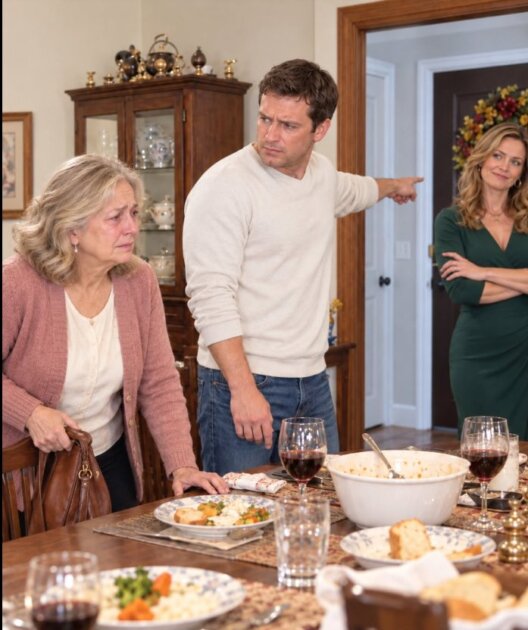
“I’m not coming back,” I said. “Right now, I need to focus on my health and my own life. That doesn’t mean I don’t love my children and grandchildren. But from now on, you need to take responsibility for your own household.”
I wasn’t shutting them out of my life. I was simply making it clear that love did not mean being available without limits.
Over the following weeks, I attended my medical appointments regularly and finally followed the instructions I had spent months ignoring.
Nora also enrolled me in a watercolor class.
My first painting looked more like a landscape drowning in water than a sunset over the ocean. Nora laughed so hard that I eventually joined her.
For the first time in years, I no longer felt that every minute of my day had to be productive.
We visited exhibitions, joined a reading group, and met new people. I met many women who had spent their entire lives caring for others. Some had been teachers, nurses, or homemakers. Others were grandmothers who had almost entirely abandoned their own plans for the sake of their families.
Little by little, I realized I wasn’t alone.
Meanwhile, Pamela, one of Theo’s cousins, occasionally called to tell me how things were going at home.
Without me, the mornings had become much more difficult. Theo now had to take the children to school before going to work. Khloe had to reorganize their extracurricular activities, meals, and shopping. They were also arguing more frequently about money because I had previously covered so many expenses without discussing them.
I wasn’t happy about their difficulties. Hugo and Cheyenne deserved to grow up in a peaceful, loving home.
But eventually, Pamela began reporting positive changes. Theo adjusted his work schedule, Khloe reorganized the children’s activities, and the couple started dividing household responsibilities more fairly.
One day, Pamela told me that Khloe had been sitting on the patio, overwhelmed as she tried to organize a single afternoon.
I remembered how many afternoons I had arranged for them while postponing my own medical appointments.
I didn’t feel any satisfaction at their struggle.
I felt relieved.
They were finally learning that running a household wasn’t one person’s responsibility.
And over the course of nearly six months, I learned something even more important: loving my family did not require me to abandon myself.
CHAPTER 4 – “MOM, PLEASE FORGIVE ME!”
Almost six months had passed when Theo called me one afternoon.
Nora and I were sitting on the porch, drinking tea. When I saw my son’s name on the screen, my stomach tightened.
Was he going to ask for something again?
Did he need money? Was he expecting me to return home and resume my old role as though nothing had happened?
I answered.
“Hi, Mom,” he said hesitantly.
“Hello, Theo.”
For several seconds, neither of us spoke.
Then he asked a question I had been waiting months to hear.
“How are you?”
My eyes filled with tears.
“I’m doing well,” I replied. “My treatments are helping, and I’m finally getting enough rest.”
“I’m glad,” he said. Then he took a deep breath. “Mom, I know I should have asked you that a long time ago. I’m sorry about what happened that night.”
I didn’t interrupt him.
“I shouldn’t have forced you to choose between apologizing to Khloe and being part of our family. And I shouldn’t have spoken to you that way in front of the children.”
I remained silent for a moment.
Then I told him what I had been carrying inside for months.
“You know, Theo, what hurt me most wasn’t how much I worked for you. It wasn’t even how much money I spent. It was that when I needed a little understanding, my own son looked at me as though I had no value unless I did everything he wanted.”
Theo didn’t try to defend himself.
“You’re right, Mom. I became so used to you always being there that I stopped noticing everything you did for us. When I had to get the children ready for school myself, when we had to organize everything and pay all the bills, I finally understood how much you had been taking off our shoulders.”
“And why didn’t you notice that I was in pain?” I asked.
“Because I wasn’t paying enough attention. But I should have been.”
That sentence meant more to me than any lengthy explanation could have.
I told him I wasn’t moving back and wouldn’t return to my old role.
“I’m not asking you to,” he said quickly. “I just want you to know that I’m sorry, and I hope you can forgive me someday.”
We spoke at length about Hugo and Cheyenne. They had been asking about their grandmother and missed the time we used to spend together.
I told Theo that I loved all of them, and that I wished Khloe no harm. But from now on, I wanted a relationship in which I mattered because they loved me, not simply because they needed something from me.
When I ended the call, I felt cautiously hopeful.
I knew one apology couldn’t erase years of behavior. Real change would have to show itself in everyday life.
A few weeks later, Theo sent me the details of their summer family trip. They were planning to visit Newport.
They booked their own accommodation. They didn’t ask me for money or assume they would stay with me while I organized everything.
It might have seemed like a small thing, but it meant a great deal to me.
For the first time, they were preparing to visit me the way grown children visit their mother, rather than behaving as though they were assigning me another set of responsibilities.
When they arrived, I was waiting by the road.
Hugo and Cheyenne recognized me immediately and ran straight into my arms.
“Grandma! We missed you so much!” Cheyenne cried.
Hugo enthusiastically told me about school, while Cheyenne was already planning which cake we should bake together.
I hugged them as tightly as my knees allowed before Theo wrapped his arms around me, too.
“Thank you for letting us come, Mom,” he whispered.
We spent the following days together. We walked along the beach, ate at restaurants, and sat on Nora’s porch in the afternoons.
One day, Cheyenne insisted that we bake something. When we finished, Theo and Khloe helped clean up without being asked. The next day, Theo set the table while Khloe put away the dishes.
They weren’t grand gestures.
That was precisely why they mattered.
Change doesn’t always appear in dramatic promises. Sometimes it shows up when someone finally notices another person’s work and willingly does what they had always left for someone else.
One afternoon, while the children were playing outside, Khloe approached me.
“Camila, I want to apologize,” she said.
I looked up at her.
“For the way I spoke to you. And for acting as though your time and energy were unlimited. I didn’t take your pain seriously. I always assumed you’d find a way to manage everything.”
I didn’t answer immediately.
“I should have explained my limitations sooner, too,” I admitted. “But just because I didn’t establish my boundaries earlier doesn’t mean you weren’t responsible for respecting them.”
Khloe nodded.
“I don’t want you to feel that we only need you when we’re asking you for something.”
I heard sincerity in her voice. I wanted to believe her, but I also knew that trust couldn’t be rebuilt through a single conversation.
It would take time.
Before they left, Theo told me they hoped to visit every few months.
“We’ll organize the trips ourselves, Mom. You won’t have to arrange anything for us.”
“I’ll be happy to see you whenever my health allows,” I replied. “But if I need to rest, I’ll tell you.”
Theo nodded without trying to negotiate.
After they left, Nora and I sat on the porch again. The sun was slowly sinking over the marsh, and the air carried the salty scent of the ocean.
I still missed my family. I always would.
But I no longer interpreted silence as proof that I had been abandoned. Nor did I feel compelled to make myself useful every moment just to give people a reason to love me.
At sixty-eight, I finally understood something I should perhaps have learned much earlier.
I could love my children unconditionally. I could always be a loving grandmother to Hugo and Cheyenne. I could help my family when they genuinely needed me and treasure every moment we spent together.
But I didn’t have to sacrifice my health, my savings, or my future to prove that I deserved a place in their lives.
Because love is not a bill that I must keep paying over and over again.
And home is not a place where I am welcome only as long as I do everything for everyone else.
A true home begins where people love you even when you finally sit down to rest.
Where you don’t have to earn your place at the table.
And where you never forget again that your life is worth just as much as the lives of the people you love.

