
“WE’RE SELLING YOUR SUMMER HOUSE! SVETA NEEDS AN APARTMENT MORE THAN YOU DO!” MY MOTHER-IN-LAW DECLARED. BUT I HAD A VERY DIFFERENT SURPRISE IN STORE FOR HER…
“You’ve destroyed this family! You ungrateful, selfish woman!” Nina Pavlovna screamed so loudly that the windows seemed to tremble. The massive glass beads around her neck rattled furiously as she slammed her hand against the table.
I didn’t say a word. I calmly lifted my cup and took another sip of my now-cold chamomile tea.
A bundle of crumpled banknotes lay in the middle of the table. Fifty thousand rubles. Beside it stood Mikhail, our neighbor, staring at my mother-in-law as though he had only just discovered what kind of person he was dealing with. Just minutes earlier, he had believed he was making the deal of a lifetime. Now he wasn’t even sure how to demand his money back without calling the police.
Anton stood beside me, his jaw clenched and his hands curled into fists. I knew that expression. My husband rarely lost his temper, but this time, even he couldn’t remain silent about what his own mother had done.
Yet Nina Pavlovna still couldn’t understand why nobody was taking her side.
“She needs an apartment, and you begrudge her even that!” she shrieked, pointing an accusing finger at me. “Sveta needs a home of her own! You already have your place in the city! Why are you so obsessed with that summer house?”
I slowly placed my cup on the table.
“Before anyone starts shouting again, perhaps we should first establish how someone got the idea that they could sell my property without my permission.”
My mother-in-law’s face suddenly went pale.
But to understand how we ended up in that kitchen, surrounded by crumpled banknotes and accusations, we need to go back five years.
I bought the summer house before I married Anton. Back then, the property consisted of nothing more than an overgrown plot of land and a dilapidated shed. The roof leaked, sections of the fence had collapsed, and weeds had swallowed nearly the entire garden.
But Anton and I saw its potential.
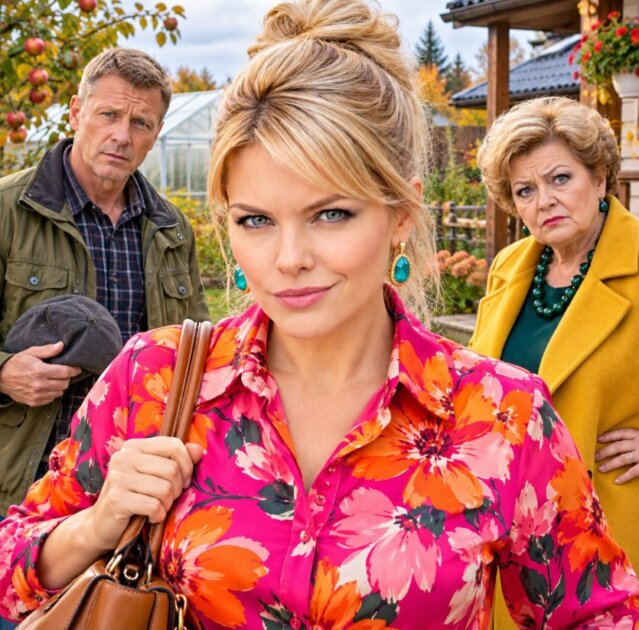
My husband built a new roof, repaired the fence, and replaced the old electrical wiring. I planted flowers, set up a greenhouse, and gradually filled the garden with fruit trees. We spent our weekends working from morning until night. In the evenings, we would sit on the veranda, exhausted but happy, discussing what we wanted to improve next.
We weren’t wealthy. I worked as a pharmacist, while Anton earned his living as an electrician. Every plank of wood, every bag of cement, and every seedling came out of our own pockets.
That summer house wasn’t just a piece of real estate. It was our sanctuary, the one place where we could finally breathe.
But Nina Pavlovna had always treated it as though it belonged to the entire family. She became especially interested in it whenever her daughter, Sveta, was involved.
My forty-three-year-old sister-in-law had expensive tastes. Designer handbags, the latest phones, and spontaneous vacations were her weaknesses. Saving money, on the other hand, never seemed to make it onto her list of priorities.
By the end of most months, she had practically nothing left. Yet Nina Pavlovna spoke about her as though every difficulty in her daughter’s life were proof that the world had treated her unfairly.
One Tuesday evening, my mother-in-law arrived at our apartment. She didn’t even take off her coat before announcing her grand plan.
“I’ve solved Sveta’s housing problem! You’re going to sell your summer house and give her the money for a down payment!”
Anton stared at her in disbelief.
“What?”
“You heard me! I’ve already found a buyer. Sveta needs a place of her own, and you have your apartment in the city.”
“Mother, that property belongs to Vera,” Anton said, his voice rising.
“And so what? We’re family!”
I calmly put down my plate.
“The summer house isn’t for sale.”
Nina Pavlovna stared at me as though I had slapped her across the face.
“We’ll see about that! I’ll find a buyer, and that’s final!”
I assumed she was merely threatening us. I was wrong.
Two weeks later, Anton called to tell me that his mother had arranged a meeting at the summer house for Saturday. She had asked him to come alone because, apparently, she needed to show something to an acquaintance.
I immediately became suspicious.
I opened a classified advertising website, and within minutes, I found exactly what I feared.
Our summer house was listed for sale.
The photographs had been taken by Nina Pavlovna herself, and the asking price was so low that it was practically an invitation for someone to snap up the property immediately.
She hadn’t waited for our permission. She had simply decided that she had the right to dispose of something we had spent years building.
The following day, I obtained an updated copy of the property ownership documents. Then, on Saturday morning, Anton and I drove to the summer house together.
Nina Pavlovna was waiting on the veranda with an unfamiliar man.
When she saw me, she froze.
“What are you doing here? I thought Anton was coming alone!”
The man, Mikhail, greeted us politely and explained that he wanted to buy a plot for his son. He had already handed my mother-in-law a fifty-thousand-ruble deposit.
I took out the documents.
“Please, Mikhail, have a look at these.”
He examined the ownership record, then looked up in confusion.
“But Vera Nikolayevna’s name is on the document! Nina Pavlovna told me you had authorized the sale.”
“I haven’t authorized anyone to sell anything,” I replied. “The property is not for sale.”
Mikhail slowly turned toward my mother-in-law.
“You were trying to sell me someone else’s house?”
Nina Pavlovna lost control.
“This is family property! Sveta needs an apartment! I thought they would eventually agree! And once I had accepted the deposit, they would have had no choice!”
Anton went pale with anger.
“You used our keys without permission, advertised Vera’s property, and accepted money for it. I will never forgive you for this.”
Mikhail stepped forward.
“Give me my fifty thousand rubles back, or I’m calling the police!”
With trembling hands, Nina Pavlovna pulled the money from her handbag and threw it onto the table.
“There! Happy now? You’ve destroyed this family!”
I simply reached for my cup.
“Count the money, Mikhail. We don’t want any misunderstandings later.”
After our neighbor left, Anton demanded that his mother return the keys. Nina Pavlovna cried and begged, but my husband refused to give in.
“You are no longer welcome here unless we invite you,” I told her, opening the door.
Five months later, on a sunny day in March, I ran into Mikhail again. He told me that Sveta had eventually bought an apartment with a mortgage, but she was already struggling with the monthly payments and renovation costs. Nina Pavlovna had even pawned her gold jewelry to help her daughter keep up.
I felt no satisfaction at their difficulties. I simply thought that everyone must take responsibility for their own decisions.
On my way home, I bought a fresh, crusty loaf of bread and walked through the sunshine, tearing off a piece as I went.
Our summer house was still ours. That spring, we expanded the veranda and planted new seedlings in the greenhouse.
And I finally understood something that I would never forget: being family does not give anyone the right to treat another person’s hard work, property, or life as their own.
My home’s door remains open to the people I genuinely want in my life. But from now on, no one else gets to decide who is allowed to cross my threshold.

