
“Just as you were a nobody back then, you’re still a nobody now!” my ex-husband laughed at the class reunion. Then the host announced the name of the evening’s guest of honor…
Alexandra spotted Pavel from the car and almost asked the driver to keep going.
Her ex-husband was standing at the restaurant entrance with three former classmates, swinging his car key fob as though the reunion organizers were about to award a prize to whoever could identify the brand first.
“No, originally I wanted the previous model,” he was explaining to Sergey Krilov. “Then I thought, why bother? You only live once! So I bought this one. Almost the highest trim level.”
Alexandra paused beside the car for a few seconds, adjusted the strap of her small handbag, and finally headed toward the entrance.
She hadn’t avoided class reunions for fifteen years just to turn back because of Pavel.
Besides, this evening wasn’t entirely ordinary for her. The school was celebrating its sixtieth anniversary, and the invitations had gone out not only to her graduating class but also to former students from other years and the teachers. A few months earlier, the principal had personally called Alexandra and asked her to make sure she attended.
She had promised she would.
What nobody had mentioned was that Pavel would be there, too.
“Sasha!”
Pavel noticed her first.
He was still speaking so loudly that people at neighboring tables turned to look, even when he was addressing only one person.
“Well, would you look at that! You haven’t changed at all!”
Naturally, that wasn’t true.
Over the past fifteen years, Alexandra had moved between two apartments, buried her father, survived several serious business setbacks, learned to dismiss employees she had become personally attached to, and learned to say no to contracts that looked profitable only in presentations.
At forty-eight, she was certainly a different person from the woman she had been at thirty-three.
But explaining all that to Pavel beside the cloakroom seemed like an unnecessarily lengthy undertaking.
“You can’t complain, either,” she replied.
“Work keeps you young.”
Pavel immediately announced that he now managed the sales department of a large car dealership.
Then, for some reason, he added:
“Thank God, the salary isn’t bad, either. I recently changed cars.”
“I noticed.”
Sergey turned away to hide his smile.
Pavel didn’t notice a thing.
He was examining Alexandra from head to toe.
A simple dark dress. Only a few pieces of jewelry. A small handbag. Nothing that, in Pavel’s eyes, signaled success.
“And what about you?” he asked. “Still working on projects?”
“Yes.”
“At the same company?”
Alexandra paused for a moment.
Technically, the answer was entirely accurate.
“At the same place.”
Pavel nodded knowingly.
Alexandra recognized that nod, too.
Fifteen years earlier, he had nodded exactly the same way when he was convinced she was making the biggest mistake of her life.
Back then, Alexandra had managed the project department of a major construction company. She had a good salary, health insurance, bonuses, business trips, and an office in the city center.
Despite all that, every Sunday afternoon, as Monday approached, she found it increasingly difficult to bear the thought of going back to work the next morning.
Not because she disliked her job.
Quite the opposite.
She loved planning. She loved the moment when dozens of calculations, blueprints, and technical requirements gradually came together to form a facility that would eventually be built in the real world.
What she disliked was something entirely different.
Three approvals were required to purchase a single piece of software. Five meetings were held to discuss an issue that could have been resolved with one email. Managers who hadn’t looked at the project materials for a week would suddenly decide, twenty minutes before a client meeting, that half the proposed solutions needed to be redesigned.
That year, two engineering colleagues, Andrey Sokolov and Roman Lebedev, suggested establishing their own design firm.
The three of them wanted to take the plunge.
Without investors.
Without wealthy relatives.
All they had was a rented twenty-four-square-meter office, three computers, and one client who had promised them work but didn’t sign the contract until two months later.
Pavel wasn’t impressed by the idea.
“You’re seriously going to leave a secure job for a room with three desks?”
“Four. We’ll need an accountant sometimes.”
“Well, that changes everything!”
Alexandra had laughed at the joke back then.
Six months later, she wasn’t laughing quite as much.
Payment for their first major contract was delayed. Their second client haggled over every item in the budget. Alexandra visited construction sites herself, answered phone calls late into the evening, and one day in November realized that her income for the previous month hadn’t even matched the bonus she used to receive at her former job.
Pavel simply waited.
Not necessarily for her to fail.
He was waiting for the moment when it would be proven that he had been right.
“It’s all right,” he kept telling her. “You tried your little business experiment. That’s enough. Call your old bosses before someone else takes your place!”
Alexandra didn’t call.
A year later, they divorced.
It wasn’t solely because of the company. Blaming the collapse of a five-year marriage on a single decision would have been far too convenient.
The truth was that, little by little, every other problem in their relationship had begun to surface around the business.
Pavel wanted a wife whose decisions he understood and agreed with.
Alexandra gradually realized that she no longer wanted to ask permission to live her own life.
After the divorce, the design firm remained with her, Andrey, and Roman.
Pavel, however, seemed to remember that period more vividly than anything else.
Meanwhile, the guests in the restaurant were gradually taking their seats.
Alexandra was seated at one of the long tables between Irina, a former classmate, and Sergey Krilov. Pavel took the seat opposite her.
The first half hour passed peacefully enough.
They talked about their teachers.
It turned out that Galina Mikhailovna, their former deputy principal, was still working at the school, even though she had vowed at their graduation that this particular class would send her into early retirement.
“So we rejuvenated her instead,” Sergey remarked.
“Especially you,” Irina reminded him. “Who brought firecrackers into the science lab?”
“The investigation proved nothing.”
Pavel told them that he had recently run into their former physical education teacher.
Then, almost imperceptibly, the conversation turned to work.
One classmate had become a doctor, another taught at a university, and Irina had established a small chain of flower shops.
Pavel perked up.
“Irina, you’ve done really well! Even back in school, you could tell you had a head for business.”
“What business sense?” Irina laughed. “I worked as an inventory clerk until I was thirty-eight.”
“Still, it takes character.”
Alexandra already had a feeling she knew where the conversation was heading.
She was right.
Pavel turned toward her.
“But Sasha was always a dreamer.”
“Why? Am I not allowed to dream anymore?” Alexandra asked. “I still do sometimes.”
“That’s not what I mean. Remember when you started your own company?”
“I remember.”
“I told her even then that being good with numbers wasn’t enough to succeed in business.”
Irina raised an eyebrow.
“What else does it take?”
“Character. Determination. A willingness to take risks. You also have to know how to deal with people.”
Alexandra took a sip of water.
“Pasha, how do you know so much about my character? We haven’t lived together for fifteen years.”
“People don’t fundamentally change.”
“What a convenient theory.”
The waiter approached their table with the wine list.
Pavel immediately took it from him.
“I’ll choose. You need to know what you’re doing with this stuff.”
He flipped through the pages with considerable confidence until the waiter pointed out a wine near the bottom.
“I’d recommend this dry wine. It’s an excellent choice.”
Pavel checked the price.
Then he checked it again.
“Actually, you know what?” he finally said. “We’re at a class reunion, not a wine tasting. Bring everyone mineral water! We have a workday tomorrow.”
Irina lowered her eyes to her plate.
Alexandra turned toward the window.
She didn’t want to laugh.
Especially not out loud.
Pavel, however, had already returned to the subject of cars.
“Besides, I don’t mind spending money on a good car. Comfort is either there or it isn’t. Now I can afford not to look at the price.”
Sergey cleared his throat.
“The price of the car?”
“Pretty much everything.”
Alexandra caught Irina’s eye.
Irina quickly raised a finger to her lips.
A little later, Olga Samoilova approached their table. She had sat behind Alexandra in class.
Olga worked as a chief accountant, and one thing about her hadn’t changed in twenty-five years: she could ask the question everyone else considered awkward, then sincerely wonder why the room had suddenly gone quiet.
“Sasha, you left that big company back then, didn’t you? Did you ever regret it?”
Alexandra put down her fork.
“At first…”
“Come on, what was there for her to regret?!”
Pavel burst into loud laughter before Alexandra could finish her sentence.
Several people turned toward them.
“Just as you were a nobody back then, you’re still a nobody now!” he continued. “All these years have passed, and you’re still working on the same kinds of projects. At least you used to have a decent salary!”
Silence fell over the table.
It wasn’t theatrical silence.
Sergey simply stopped chewing, Irina turned her phone facedown, and Olga frowned.
Alexandra looked at Pavel.
She was almost curious.
“Pasha, can I ask you something?”
“Of course.”
“Why are you still so interested in my professional life after fifteen years?”
Pavel shrugged.
“I’m not. I’m just telling the truth.”
“I see.”
“What’s that supposed to mean? I don’t like it when people pretend to be successful.”
“Who’s pretending to be successful?”
Pavel thought about it for a moment.
“Well, you’re sitting here acting as if…”
“As if what?”
Now even Sergey laughed.
Pavel shot him an irritated look.
“Oh, come on! Everyone knows what I mean.”
“I don’t,” Irina said. “Sasha has said about two sentences about her work all evening.”
“Exactly,” Olga added. “You invented the rest yourself.”
Pavel waved a hand dismissively.
“For heaven’s sake, we’re adults! Can’t a person make a joke anymore?”
Alexandra nodded.
“Then let’s agree it was a very successful joke.”
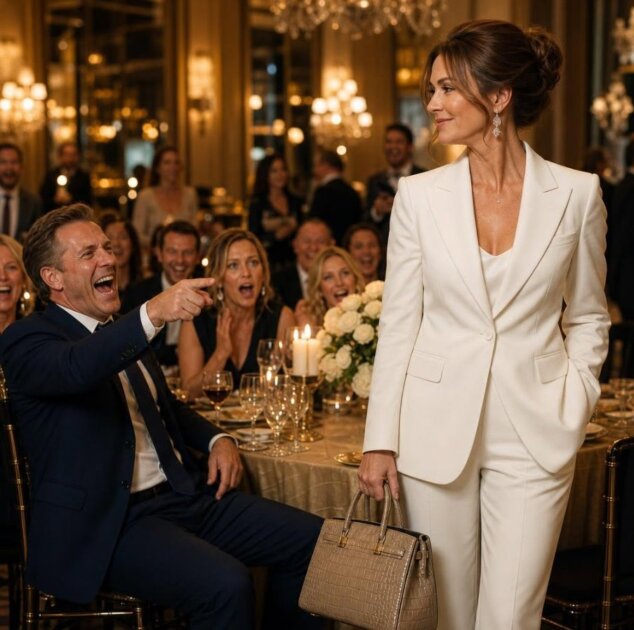
The conversation was just about to return to their school cafeteria and the mysterious meat patties nobody could identify when the host stepped onto the small stage.
“Ladies and gentlemen, please take your seats! Our anniversary program is about to begin.”
Pavel leaned back in his chair.
“Just don’t let it drag on. I couldn’t stand these formal speeches even when we were in school.”
Alexandra glanced at her watch.
She knew the official program would last about forty minutes.
The schedule had been sent to her in advance.
First, the principal, Viktor Andreyevich, took the microphone.
He didn’t speak for long. He thanked the teachers for their work, reminisced about former students, and announced that the assembly hall and two classrooms had been renovated over the past year.
Then photographs of the new engineering laboratory appeared on the screen.
Alexandra immediately noticed that the equipment on one of the tables had not been positioned according to the original design.
She made a mental note to write to the contractor the next day.
“And now,” the principal continued, “I’d like to introduce a project we’ve been waiting almost four years to see completed.”
The screen displayed the entire laboratory: workstations, computers, robotics kits, measuring instruments, and a small piece of equipment for the students’ engineering projects.
Sergey let out a low whistle.
“Wow! The most we ever had was a soldering iron.”
“And even that was shared by the entire class,” Irina added.
The principal explained that a company owned by one of the school’s former students had financed a substantial portion of the renovation and equipment.
Pavel immediately leaned toward Sergey.
“I wonder who it is. Maybe that guy who started a construction company.”
Sergey shrugged.
“We’ll find out in a minute.”
The host returned to the stage.
“We have many distinguished guests with us tonight. But I would especially like to invite onto the stage the person whose support made this project possible in the first place.”
Alexandra was already pushing her chair back.
“The chief executive officer of Meridian Project, an engineering and design company, and a former student of our school, Alexandra Melnikova!”
The smile disappeared from Pavel’s face.
The host continued speaking about the company’s projects across several regions, its workforce of nearly two hundred employees, and its collaborations with industrial enterprises.
Alexandra barely heard him.
She stood up.
“Sasha…” Irina whispered beside her.
“Later.”
Alexandra made her way between the tables toward the stage.
The principal greeted her at the steps.
“Thank you for coming.”
“I promised I would.”
They shook hands.
The applause was louder than Alexandra had expected.
She didn’t enjoy giving speeches at events like this.
Negotiations involving hundreds of millions no longer intimidated her.
What still made her uncomfortable was having to talk about her own generosity from a stage.
So she had prepared a short speech.
“I didn’t donate this laboratory to the school alone,” she began. “I also donated it to the person I used to be.”
Laughter rippled through the room.
“When we studied here, we loved taking things apart, putting them back together, and testing everything with our own hands. Although, after some of our experiments, our science teacher would probably have preferred to take a few of us apart instead.”
An elderly man at the back of the room raised his hand.
“I still remember!”
It was Nikolai Petrovich, their former physics teacher.
The audience laughed again.
He was the one who had called Alexandra a year earlier.
At first, he had simply asked whether she could help obtain laboratory equipment.
Then they started talking.
For years, the school had been trying to raise enough money for an engineering classroom. The city had provided some funding, and the school foundation had contributed, too, but they were still short of the full amount.
Alexandra reviewed the budget and offered to cover the remaining costs through Meridian Project.
It was a substantial sum, but one her company could now afford.
She had only one condition.
She didn’t want a giant advertising board with her photograph on the wall.
And she didn’t want ceremonial speeches describing her as an “outstanding benefactor.”
“Let the children get to work!” she had told the principal. “That will be the best advertisement.”
The organizers had almost respected her wishes completely.
Her photograph never made it onto the wall.
But they had invited her to be the guest of honor anyway.
When Alexandra returned to the table, she was greeted by an interesting sight.
Sergey was smiling.
Irina was smiling.
Olga was openly amused.
And Pavel was studying the menu with such concentration that he looked as though he would have to take an exam on it the next day.
For three minutes, nobody said a word.
Then Sergey couldn’t hold back any longer.
“Sasha, nearly two hundred people work for you?”
“We had 187 last week.”
“That’s still a lot. Do you know all of them?”
“No, thank goodness. Otherwise, I’d have to remember 187 birthdays.”
Irina burst out laughing.
“And where’s your office?”
“Our headquarters is here. We also have two smaller regional offices.”
“What exactly do you do?”
“Mostly industrial facilities. Engineering systems, reconstruction projects, and sometimes public buildings.”
Pavel turned another page of the menu.
Then another.
Finally, he put it down.
“Listen, Sasha…”
“Yes?”
“Why didn’t you tell us this right away?”
Alexandra genuinely didn’t understand.
“What was I supposed to tell you?”
“Well… what you’ve become.”
“You didn’t ask.”
“But I asked about your work!”
“I answered. I told you I work on projects.”
Sergey coughed into his napkin.
Pavel twisted his mouth into a grimace.
“Oh, come on. You know what I mean.”
“Not exactly.”
“You could simply have said you own a company with nearly two hundred employees.”
Alexandra looked him straight in the eye.
“Pasha, you spent forty minutes telling everyone I was a nobody. I thought it would be rude to interrupt someone who was so confident in his information.”
Irina couldn’t hold it in any longer.
Olga started laughing, too.
A second later, Sergey joined them.
Two classmates at the other end of the table, who hadn’t heard the beginning of the conversation, asked what had happened.
Pavel turned red.
“All right. All right. I was wrong.”
“It happens.”
“Besides, I always knew you were talented.”
Alexandra turned toward him.
“Now you’ve really made me curious.”
“Oh, come on. Let it go!”
“No, go on!”
“I supported the idea of your business.”
Irina quietly interrupted.
“Pasha, you’d better not.”
But Pavel had already gathered momentum.
“Maybe not at the beginning. But I knew you had potential.”
Alexandra smiled.
“You told me I’d come crawling back to an office job within six months.”
Pavel moved his lips, but no words came out.
“Then you suggested I sell my computer before it lost too much of its value.”
Sergey turned away again to hide his expression.
“All right,” Pavel said. “Fifteen years have passed. People who keep bringing up the past…”
“Exactly why I haven’t brought it up until now.”
Pavel fell silent.
This time, for a little longer.
The rest of the evening went surprisingly well.
People got up from their tables, walked around the room, took photographs with their teachers, and reminisced about graduation.
Nikolai Petrovich caught Alexandra beside the stage.
“I’ll send you photographs of the laboratory after the first student competition.”
“Better send me the list of everything else you’ll need.”
“That’s exactly what I was afraid of!”
“Too late.”
The man laughed.
“You haven’t changed at all.”
“Oh, but I have, Nikolai Petrovich. We have more money for experiments now.”
“That’s particularly frightening.”
Around eleven that evening, the guests began saying their goodbyes.
Alexandra said farewell to Irina, and they agreed to meet separately soon. She was just about to order a car when Pavel appeared beside the cloakroom again.
This time, he was alone.
He was no longer swinging his car keys.
“Sasha, could we talk for a minute?”
“Go ahead.”
He hesitated.
“I really didn’t know.”
“I noticed.”
“Sergey showed me your company’s website afterward.”
“Why?”
“Well… I got curious.”
Alexandra put on her coat.
Perhaps for the first time in his life, Pavel was standing in front of her without having already prepared his next sentence.
“Listen, I know someone who’s about to launch a major investment project. An industrial complex. They’ll need designers.”
“That happens.”
“Would you give me a business card?”
Alexandra took out her phone.
“Write down the number for our commercial department.”
Pavel looked surprised.
“And your personal number?”
“Why would he need mine?”
“Well… so he could speak to you directly.”
“Pasha, if it’s a serious investment project, our commercial department is exactly who he needs. They’ll review the requirements, the documentation, and the deadlines. If the project is right for us, we’ll take it on. If it isn’t, they’ll tell him honestly.”
Pavel wrote down the number.
“I understand.”
They were almost at the door when he spoke again.
“Sasha!”
Alexandra turned around.
“What you’ve achieved is really impressive.”
For once, there was neither mockery nor condescension in his voice.
Alexandra nodded.
“Thank you.”
“I honestly thought you wouldn’t last more than six months.”
“I know.”
“I was wrong.”
“It happens.”
Pavel smiled.
“And spectacularly wrong, too.”
Alexandra looked through the glass doors toward the parking lot.
Somewhere among the cars stood the vehicle whose price had been announced to approximately forty people over the course of the evening.
“Not entirely,” she said.
Pavel frowned.
“What was I right about?”
“That our little company really didn’t stay little for long.”
Pavel stared at her in confusion.
Alexandra opened the door.
“It outgrew its beginnings pretty quickly.”
The air outside was chilly.
A message appeared on her phone from the school principal. Nikolai Petrovich had already come up with three more things that absolutely needed to be purchased for the laboratory.
Alexandra read the list and burst out laughing.
Now, that was far more dangerous than Pavel.
After all, Nikolai Petrovich had known exactly how to persuade her to do something ever since they were in eighth grade.

