
“Divorce Me If You Want,” My Husband Declared. “I’m Staying Here Anyway.” A Week Later, His Own Mother Called and Begged Me to Take Him Back.
On Friday evening, Alena was ironing Vitya’s shirts for the coming week, five of them, one for each working day. Over the past few months, he had been staying late at work more and more often. There was always an excuse: an urgent quarterly report, a new department dumped on his shoulders, meetings that dragged on until nine at night. Alena had long since stopped asking when he would be home.
The blue shirt was already hanging over the back of a chair, and the white one lay on the ironing board when her phone rang.
“Al, are you alone?” Lena asked without even saying hello.
“Yes. Vitya’s at work. They’re supposedly drowning in that quarterly report. What’s wrong?”
Lena was silent for so long that Alena managed to turn the shirt around and start on the other sleeve. Somewhere on the other end of the line, plates clinked and music played softly.
“Listen, are you absolutely sure he’s at work tonight?”
“What do you mean, absolutely sure? He told me this morning he’d be there until late. Lena, what’s going on?”
“I went out for dinner with Ira after work. There’s this little Georgian restaurant on Sadovaya Street. And I saw your Vitya standing outside the entrance. He wasn’t alone.”
Alena gave a short, awkward laugh. Even she could hear how foolish it sounded.
She immediately started listing explanations aloud. Maybe it was someone from his department. There were plenty of young women working there. Maybe it was a client. Maybe it was Sveta from accounting, whose husband had recently left her. Vitya felt sorry for her, after all. He had always been such a compassionate person.
Lena listened without interrupting. Then she spoke quietly, in the careful tone people use when they have to deliver terrible news.
“Alena, he had his arms around her. Men don’t hug clients like that. I’m not blind. I’m sending you a picture now. Just don’t get angry with me afterward.”
A minute later, Alena’s phone pinged. She hadn’t even managed to put it down on the ironing board.
The photograph was dark, and the restaurant sign above the entrance was blurred, but she recognized Vitya’s jacket immediately. Dark blue with a rusty-red lining. She had picked it out for him at a sale last November. She recognized his leather-strapped watch, too, the one she had given him for his fortieth birthday.
Behind them, a gray car with a scratched bumper stood beside the sidewalk.
The woman wore a light-colored coat, her long hair loose around her shoulders. Vitya’s hand rested on her lower back with such easy familiarity that it looked as though it had always belonged there.
Alena enlarged the photograph with two fingers, reduced it, then enlarged it again.
A faint smell of scorching drifted up from the ironing board. A yellow stain the size of a coin had appeared on the collar of the white shirt.
She yanked the iron’s plug from the socket, sat on the edge of the sofa, and sent Lena a single word:
“Thank you.”
Then she reconsidered and added:
“Don’t call him, okay?”
Vitya came home at almost eleven that night.
Alena was sitting in the living room with the television switched off. He didn’t even notice her at first. He hung up his jacket, tossed his keys onto the console, and kicked off his shoes by stepping on their heels.
“Alenka, is there anything to eat?” he called toward the kitchen. “They kept us there until closing. Gusev has completely lost his mind over that tender!”
“I’m here,” she said.
He jumped, looked into the room, and smiled.
“Why are you sitting in the dark? You scared me.”
“Where were you after work?”
“Like I said, at work. Then the guys and I stopped somewhere to grab a bite. After that, the boss called and chewed my ear off for half an hour. I was sitting in the car talking to him.”
He spoke evenly, without a single hesitation, while unbuttoning his cuffs.
Alena realized that he was lying with astonishing ease, as if he were simply describing the weather.
“Which guys?”
“Our guys. Seryoga, Pashka. You don’t know them. What is this, an interrogation?”
“Then explain why Lena has a photograph of you standing outside a restaurant on Sadovaya with a woman, holding her like this.”
Alena turned her phone toward him.
“Is her name Pashka, too?”
Vitya fell silent for a second. One corner of his mouth twitched. Then he waved a hand dismissively and didn’t even reach for the phone.
“Your Lena is always making things up. She’s a colleague. It was her birthday, and the whole group stopped by. She’d had a little too much to drink, so I walked her to her taxi. Lena misunderstood everything!”
“Give me your phone.”
“Why?”
“Give it to me. Now!”
He smirked and shook his head as if dealing with a spoiled child. Then he pulled his smartphone from his trouser pocket and placed it on the coffee table.
“Here. Have a look if you’ve got nothing better to do. By the way, there’s no password on it.”
Then he walked into the kitchen, whistling under his breath.
Alena heard him open the refrigerator, take out a frying pan, and light the stove. He was reheating yesterday’s meat patties while she picked up his phone.
The conversation was right there at the top of the list. The contact was saved under a short name: Karina.
Vitya hadn’t deleted anything or even bothered to rename the contact.
There were photographs of the two of them together in a café. In one, his hand rested on her knee. There were messages about a hotel room for the weekend, the same weekend he had supposedly gone to his mother’s house to repair her fence.
Alena scrolled upward, but the messages seemed endless. They stretched back through June, May, and April.
“I’m outside your building. Come down.”
“I can’t today. I have to show my face at home, or they’ll start asking questions.”
“You promised tonight would be just for us.”
“Baby, don’t be upset. Tomorrow, definitely.”
He told Karina where he was, when he would be free, and why he had to go home and sleep there yet again.
Apparently, home had become his second job: somewhere he had to show up, clock in, and get some sleep.
Alena placed her own phone beside his and began photographing the screen methodically, page by page, with the same diligence she might use to collect receipts for a tax return.
In the kitchen, oil hissed and spat as the meat patties sizzled.
When she finished, she had forty-two photographs in her gallery.
Vitya returned to the room carrying a plate, already chewing as he walked. Without saying a word, Alena placed his phone on the edge of the table, screen facing up, with the conversation open.
He looked at the screen, then at her. He set his plate on the armrest of the chair and stood there for several seconds without saying anything.
He was still holding his fork.
“How long?” Alena asked.
“Al, can we not do this right now?”
“How long, Vitya?”
“Not that long. It’s nothing serious.”
“Vitya, the messages go back to April!”
He grimaced as though she had caught him arriving late to work. Then he put down his fork.
“Fine. Since spring. Sometime in April, I guess. I didn’t keep track.”
“Then why did you come home every night?” Her voice rose, and she couldn’t stop it. “If you have Karina over there, if you have your precious little ‘baby,’ why did you keep coming back here? To eat my meat patties?”
“Where else was I supposed to go?” Vitya shrugged. “I wasn’t planning to abandon my family. I hadn’t even figured out what was going on with her. Whether it was serious or just a fling. Why are you immediately screaming?”
“I’m not screaming! I’m asking you a question!”
She stood up, making the coffee table wobble.
“There’s nothing left for you to figure out, Vitya. I read everything, from the first message to the last. It’s all perfectly clear! You didn’t even bother hiding the conversation! And your phone doesn’t even have a password!”
He reached for his plate, then changed his mind.
Alena stood over him, wanting to sweep the meat patties onto the floor, straight onto the carpet they had chosen together three years earlier.
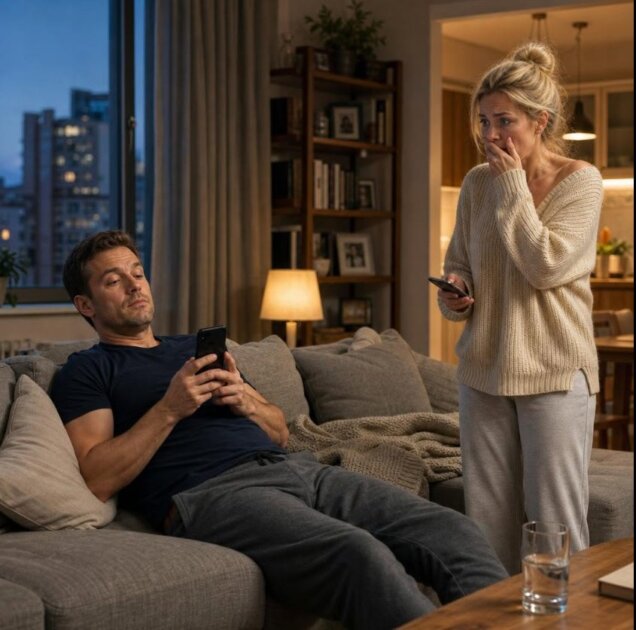
She clasped her hands behind her back and spoke slowly, determined not to let her voice break.
“You have one week. Seven days to decide what you’re taking, where you’re going, and how we’re going to arrange the divorce. If you haven’t sorted it out by then, I’ll file the papers myself.”
Vitya looked at her with complete calm.
Then he suddenly smirked, leaned back in the armchair, and crossed one leg over the other as if he were a guest in someone else’s home.
“Divorce me if you want,” he said. “I’m staying here anyway.”
Alena asked him to repeat himself because she genuinely thought she had misheard him. Perhaps he was exhausted and had misspoken. Perhaps it was another one of his stupid, badly timed jokes.
“What did you just say?”
“You heard me.”
Vitya finally picked up his plate and broke off a piece of meat patty with his fork.
“I’m not paying thirty thousand a month to rent some dump just because you feel like it. We have a three-bedroom apartment, Al. The small room is empty. There’s a perfectly good sofa in there. I’ll move in, and that’s that.”
“You’re moving into the small room? Do you hear yourself?”
“What’s the problem? The apartment is jointly owned. I’m registered here, and I own half of it. Go ahead and divorce me. I won’t stand in your way. But you’re not throwing me out onto the street. I’m telling you that right now.”
Alena felt an almost hysterical laugh rising in her throat, the same kind that had escaped her during the phone call with Lena. She forced herself to swallow it.
She walked to the window, turned around, then returned to the table, as though the room had suddenly become too small to contain her.
“Vitya, the down payment came from my apartment. Remember my grandmother’s one-bedroom place on Zavodskaya Street? I sold it, and that money went into this apartment. Then you changed jobs three times, and I paid the mortgage for two whole years. Alone. You told me you were ashamed of yourself back then.”
“That’s something you’ll have to prove,” he replied calmly, finishing his meat patty. “Money earned during marriage is shared, you know. Let the court sort it out if that’s what you want. Until then, I’m not going anywhere.”
He stood up, carried his plate into the kitchen, and turned on the water. He gave the plate a quick rinse but didn’t actually wash it.
Then he went into the bedroom. Alena heard him pull open a dresser drawer.
When he came back, he had his orthopedic pillow tucked under one arm, the one he had paid six thousand rubles for. In his other hand were his phone charger and laptop.
“You don’t need to cook dinner for me. I’m not asking you to,” he said from the doorway of the small room. “I won’t be around much in the evenings anyway. Just don’t hog the washing machine all weekend. We only have one.”
He closed the door carefully.
Alena stood motionless in the hallway for a moment. Then she walked into the living room, snatched the blue shirt from the chair, took the white one with the yellow stain from the ironing board, grabbed three more un-ironed shirts from the laundry basket, and carried the whole lot to his door.
She threw them onto the floor in one tangled heap.
The sleeves sprawled in every direction.
Three days later, everything unfolded exactly as Vitya had said it would.
He got up at seven, fried eggs in her frying pan, and ate standing by the windowsill. He held his fork in one hand and typed messages with the other.
Sometimes he smiled at his screen right in front of her. Alena simply turned toward the sink.
After breakfast, he left and returned at eleven, midnight, or sometimes even later. Once, he came home at half past one in the morning. He quietly turned the key in the lock with the casual confidence of a homeowner, as though she were the one living in his apartment.
He still didn’t bother hiding his phone.
On Tuesday, he went to take a shower and left it on the kitchen table. The screen lit up with a new message. Without touching the phone, Alena read the words that appeared.
“Vitya, I’m tired of waiting. When are you finally moving your things over? A month ago, you told me everything was settled.”
Vitya came out of the bathroom with a towel draped over his shoulders. He read the message, snorted, and immediately began typing a reply right there in the kitchen, standing with his back to her.
Alena could see the screen over his shoulder. This time, she didn’t pretend not to notice.
“Baby, it’s complicated. The apartment is jointly owned, and there’s a mortgage. She refuses to handle things reasonably. She’s being stubborn. Just be patient a little longer.”
He didn’t mention that he was the one who had refused to move out.
That evening, while he was gone, Alena opened Karina’s social media profile. She found her within two minutes using the photograph and opened a private message.
“He’s lying to you. He has no intention of moving out.”
She kept her finger hovering over the send button for a long time.
Then she deleted the message, letter by letter, closed the page, and went downstairs to take out the trash.
At home, she stopped doing everything she had done for Vitya for years.
She made no announcement and started no argument. She simply stopped.
She cooked a small pot of buckwheat with mushrooms, just enough for one plate, and ate it in the living room while watching a television series.
His socks and T-shirts piled up in the laundry basket until the lid wouldn’t close. Alena moved the basket into a corner of the small room.
She paid the electricity bill herself and threw away the receipt. Previously, she would have pinned it to the refrigerator with a magnet so Vitya would remember to transfer his share.
Apparently, he noticed nothing until Thursday.
That evening, close to eleven, he knocked on her bedroom door, opened it without waiting for an answer, and stood in the doorway holding a white shirt. The very same shirt with the yellow stain on the collar.
“Al, why don’t I have a single clean shirt? I have a meeting with a client at ten tomorrow!”
Alena was sitting on the bed with her laptop. She didn’t look up immediately. First, she finished reading the paragraph on her screen.
“Ask Karina,” she said. “This was all for her, wasn’t it? Let her do your laundry and iron your shirts.”
“Are you serious right now?” Vitya shook the shirt at her. “Is it really so difficult to throw it in the washing machine? You’re doing your own laundry anyway.”
“I wash my own clothes. I don’t wash yours,” Alena agreed, lowering her eyes to the screen again. “Close the door. There’s a draft.”
He stood there for another moment, crumpled the shirt in his fist, and walked away.
A minute later, Alena heard the washing machine start humming in the bathroom. Then came Vitya’s muffled swearing as he struggled to figure out which button to press.
On Friday, Alena took two hours off work and went to see a lawyer Lena had recommended.
Tamara Sergeyevna worked in a cramped office above a pharmacy. She wore a cardigan with little fabric pills around the elbows and listened without looking up from her notebook.
When Alena got to the part about the small room and the orthopedic pillow, the lawyer snorted and put down her pen.
“Well, this is a classic,” she said. “For some reason, they all seem to think that if they sit on the sofa long enough, the apartment will magically divide itself in half. Do you have documents?”
Alena did. She had spent the entire week gathering them in the evenings while Vitya was at Karina’s.
She pulled a shoebox from the top of the closet. Inside was the sale agreement for her grandmother’s one-bedroom apartment on Zavodskaya Street. She also found a bank statement showing that, just three days after the sale, the money had been transferred to the seller of their three-bedroom apartment.
During the two years when Vitya had been changing jobs and trying to find himself, the mortgage payments had come out of Alena’s bank account month after month. The printed statements formed a stack nearly an inch thick.
Tamara Sergeyevna leafed through the papers, holding some of the pages up to the lamp.
“Almost the entire down payment came from your separate property. That’s documented. The mortgage payments are documented, too. But don’t rely on verbal agreements or promises that you’ll sit down in the kitchen and work everything out. We’ll file for divorce and division of property through the court. We’ll also make a separate request to establish how the apartment can be used while the case is pending. Prepare yourself for this to take longer than a month.”
“I’m ready,” Alena said.
She was surprised by how easily the words came out.
That evening, she placed a plastic folder on the kitchen table and left it there.
Vitya came home shortly before midnight. He opened the refrigerator, closed it again, and then noticed the folder.
He flipped through the papers without taking off his jacket. Alena watched the smile he had worn when he entered the apartment gradually disappear.
He stopped at the statement concerning the sale of the Zavodskaya apartment and stared at it for a long time.
“You’re actually going to court?” he asked.
“I gave you a week. That week ended on Wednesday.”
“Al, you’re not like this.” Vitya closed the folder and pressed his palm against it. “Why do we have to make everything so complicated? Courts, lawyers, all that money. We can settle this like reasonable people.”
“You showed me exactly what your idea of a reasonable conversation was on Friday,” Alena replied. “I did what I promised. Don’t touch the folder. They’re copies, but I still don’t want you touching them. Understood?”
He pulled his hand away as if the folder had burned him, then retreated to the small room.
Through the wall, Alena heard him call someone. His voice was louder than usual, full of wounded indignation.
She didn’t need to guess who was on the other end.
The next day, her mother-in-law, Svetlana Petrovna, arrived around lunchtime without calling first.
She always came that way, carrying a grocery bag from Pyaterochka with a jar of homemade vegetable relish wrapped in newspaper. She always headed straight into the kitchen without even taking off both boots, leaving one on so she could put the jar down as quickly as possible.
This time, she removed both boots, set her bag by the door, and started talking before she had even left the hallway.
“Alena, I don’t understand what kind of circus is going on here! Vitya called me and said you’re trying to throw him out onto the street and have hired some lawyers. Why? You had a fight, so what? These things happen. Kolya and I argued for thirty years, and neither of us ever threw the other out of the house!”
Alena didn’t try to explain everything in the hallway.
Instead, she took out her phone, opened the gallery containing the forty-two photographs, and placed it on the table in front of her mother-in-law.
Vitya stood in the kitchen doorway wearing his house trousers, staring pointedly away from both women.
Svetlana Petrovna put on the glasses that hung from a cord around her neck and began scrolling.
At first, she moved quickly, her expression irritated, as though someone had forced her to examine a pile of someone else’s bills.
Then she began to slow down.
When she reached the photograph showing Vitya’s hand on Karina’s knee, she stopped. She enlarged the image with two fingers, just as Alena had done that Friday evening, and held it there until the screen went dark.
“Vitya,” she said without turning around. “How long has this been going on?”
“Mom, since spring. What difference does it make?”
“You’ve been seeing her since spring?”
“Yeah.” Vitya shifted from one foot to the other. “But, Mom, that doesn’t mean I should end up homeless! I paid into this apartment, too!”
Alena silently pulled the blue folder closer to her mother-in-law and opened it to the statement concerning the Zavodskaya apartment.
She pointed to the amount and the date, then turned several pages and showed her the mortgage payments, line after line, all bearing her name.
“This was my grandmother’s apartment, Svetlana Petrovna. Do you remember it? You came to our housewarming. I sold it before the wedding, and almost all the money went toward the down payment. These are the two years of mortgage payments from when Vitya kept changing jobs. You used to tell me how admirable I was for carrying everything on my own.”
Svetlana Petrovna removed her glasses and laid them on the folder.
She looked at her son the way someone might look at a guest who had spilled red wine on the tablecloth and was pretending nothing had happened.
“And after the divorce, you still intend to live here?” she asked. “In that little room? And keep going to see her?”
“What’s impossible about that?” Vitya shrugged. “Half the apartment is mine. Where else am I supposed to live? On a folding bed in your one-bedroom place?”
Svetlana Petrovna turned the glasses over in her hands, folded the arms, and said nothing to her son.
She sat for another minute, then stood up. She took the jar of relish out of the bag and placed it directly in front of Alena on the table, although she had always left it beside the stove before.
Then she went to put on her shoes.
Vitya followed her into the hallway. Alena could hear him speaking quickly and quietly, trying to explain something. His mother kept repeating the same words.
“Leave me alone, Vitya. Just leave me alone.”
A week later, Alena filed the lawsuit.
Tamara Sergeyevna had prepared the paperwork over two evenings. It included the divorce, division of the apartment, and a separate request to establish the terms of residence while the court proceedings were underway.
Alena delivered the documents herself. She waited in line at the clerk’s office, received the official filing stamp, and photographed it, just as she had photographed the messages, to be safe.
Vitya came home early that evening, around eight.
From the way he threw his keys onto the console, Alena knew someone had already called or messaged him.
The keys slid off the edge and fell to the floor. He didn’t even bend down to pick them up.
“Why do you have to make everything so complicated?” he demanded from the doorway. “We could have worked this out normally! We could have sat down and talked like adults. But you’re taking revenge on me, that’s all. You’re doing this because of Karina!”
Alena stood by the stove, stirring her buckwheat. She didn’t turn around.
“Vitya, you told me to divorce you if I wanted to. I wanted to. Why are you shouting now?”
“I didn’t mean it like that!”
“Then how did you mean it?”
He fell silent and started unzipping his jacket, but the zipper jammed halfway. He kept yanking at it until the pull broke. In the end, he had to drag the jacket over his head like a sweater.
“I have the right to live here,” he said, catching his breath. “This is my apartment, too!”
“Then the court can decide exactly what rights you have.” Alena turned off the stove. “Don’t explain it to me in the kitchen anymore. I’m not the one making that decision.”
He went back to his room, and not a sound came from it for the rest of the evening.
The next morning, as Alena was leaving for work, the door to the small room stood slightly open. Vitya was sitting on the sofa in nothing but his socks, scrolling through rental listings on his phone.
The screen faced the doorway, and Alena saw a studio apartment in Kuzminki for twenty-six thousand rubles a month. One of the photographs featured a toilet bowl in extreme close-up.
About two weeks later, on a Saturday, Vitya returned from Karina’s at six in the evening instead of late at night.
Alena was washing the hallway floor. She hadn’t even managed to move the bucket out of the way when he walked straight across the wet floor in his shoes and went into the small room.
His phone rang immediately. He answered on speakerphone, probably out of habit from talking while driving, and didn’t think to close the door.
“Karina, I’ve already explained this to you! There’s a court case, there’s a mortgage. None of this gets settled in a single day!” he shouted.
The woman’s voice sounded tired and surprisingly young.
“Vitya, I understand the mortgage. What I don’t understand is why you keep going back to her to sleep. You eat her food, wash your shirts in her washing machine, and tell me what a wonderful new life we’re going to have together. This isn’t what I want. I told you that from the beginning.”
“But she doesn’t cook anything for me!”
“I don’t care, Vitya. I really don’t care anymore.”
Alena wrung out the mop, picked up the bucket, and went into the bathroom.
When she returned, the door to the small room was closed. But across the freshly washed floor, all the way down the hallway, Vitya’s muddy footprints remained.
Ten days later, Vitya finally rented the studio apartment in Kuzminki.
He spent two evenings packing, stuffing his belongings into shopping bags from Lenta and cardboard boxes he had brought home from work, marked “A4 Paper.”
He took his orthopedic pillow first.
Alena neither helped nor interfered. She simply brought him a forgotten razor from the bedroom once and placed it on top of one of the boxes.
“I’ll come back for my winter boots,” he said from the doorway, holding a bag in each hand. “And for my drill.”
“Come whenever you want. Just text me beforehand.”
Two weeks later, on a Thursday, he showed up without warning.
He stood in the hallway without taking off his shoes, looking around for a long time as though he didn’t know where to direct his gaze.
“Where are my winter boots?” he finally asked.
“On the top shelf, in a box.”
Vitya dragged over a stool and climbed up to the storage space above the closet. From among the boxes, he called down casually, as though making an offhand remark.
“By the way, things are over with Karina. You can be happy now.”
Alena turned toward him, but he was already climbing down with a box in his hands and avoiding her eyes.
“The drill is in the storage closet,” she said. “Put the stool back where it belongs. And I’m changing the locks tomorrow.”
When he left, the apartment fell silent for the first time in two months.
It was the same kind of silence Alena remembered from when she had lived alone in her grandmother’s one-bedroom apartment on Zavodskaya Street.
She walked into the small room, opened the window, pulled Vitya’s bedsheet off the sofa, and put it in the washing machine with her own laundry.
Then she took it out again and placed it in a separate bag.
A week later, on Wednesday evening, Svetlana Petrovna called at around nine.
Alena saw her mother-in-law’s name on the screen and hesitated for a long time. The phone rang six times before she finally answered.
She was already preparing herself for the familiar words.
“Please take pity on him. He won’t survive without you.”
But that wasn’t what she heard.
“Alena, it’s me,” her mother-in-law said. Her voice was hoarse, as though she were recovering from a cold. “Please don’t hang up, okay? I want to ask you for something. Something I wouldn’t have dreamed of asking you a month ago.”
“What happened, Svetlana Petrovna?”
“Vitya is living alone in that little hole of an apartment. Things are over with that girl, as you probably know. He comes to my place every evening, sits in the kitchen until late, and keeps repeating the same things. That he wants to come home. That he made a mistake. That you’ll forgive him if I ask you to.”
Alena remained silent, scraping a dried drop of paint from the windowsill with her fingernail. It had been left there after the renovation.
“Why should I take him back, Svetlana Petrovna?” she finally asked. “After everything he’s done? After he betrayed me?”
“I know you shouldn’t,” her mother-in-law said quickly. “When I came to your place that day, I thought you were just upset. I thought, well, he cheated, he acted like a fool, it happens. Men are like that. He’ll get over it. But then I sat at your table and watched him standing there in those ridiculous house trousers, telling you there was nothing wrong with what he was doing.”
She paused.
“He wanted everything, Alena. The other woman, you, the apartment. He wanted you to keep ironing his shirts and never go anywhere. I’ve known my son for forty-three years, and somehow I never realized…”
She fell silent again. Alena could hear the television murmuring in the background of her mother-in-law’s little apartment.
“If there’s still any chance,” Svetlana Petrovna continued more quietly, “please take him back. I won’t ask you for anything else.”
Alena stepped away from the window, sat on the stool Vitya had never returned to its proper place, and stared at her slippers for a while.
“Vitya made his own choice, Svetlana Petrovna,” she said. “That evening, when he sat in my armchair eating my meat patties and told me, ‘Divorce me if you want, I’m staying here anyway.’ He wasn’t joking then. And now I’ve made my choice, too.”
She paused before continuing.
“I’m seeing the divorce through to the end. The court can divide the apartment according to the documents. But I will not let him move back in. He was using my home as a place to stay while he figured out what he wanted from that other woman. I won’t let anyone use me as a temporary shelter ever again.”
There was such a long silence on the line that Alena glanced at her screen to make sure the call hadn’t dropped.
“I understand,” her mother-in-law finally said. “I really do. Can I ask you just one more thing? Could I come over for tea sometimes? Without him. I’ll bring you some of my homemade relish. I know you like it.”
To Alena’s surprise, a short, almost nasal laugh escaped her.
“Of course you can, Svetlana Petrovna. Just call beforehand. I work until seven now.”
Four days later, on Sunday morning, Vitya sent her a long message.
It began with the words, “Al, I’ve been thinking a lot…”
He ended by asking her to meet him in a café so they could talk calmly, without his mother or the lawyers involved.
In between, he complained that the studio apartment was damp, the neighbors upstairs stomped around constantly, and there wasn’t a decent grocery store in Kuzminki.
Alena read the message while standing in the small room over the last box of his belongings.
Inside were an old pair of sneakers, a charger for some device she couldn’t identify, a bedsheet folded inside a plastic bag, and the white shirt with the yellow stain on the collar that he had never bothered to take.
She typed her reply.
“I’ll meet you only at the lawyer’s office to discuss the divorce and the apartment. Tuesday at 3 p.m. Tamara Sergeyevna will send you the address. You can collect your belongings at the same time. The box is with the neighbor. I’ve changed the locks.”
She sent the message, sealed the box with packing tape in a cross, and wrote across the top in large marker letters so it could be seen from the doorway:
“VITYA — COLLECT BY THE 15TH!”
Then she carried it into the hallway and rang the neighbor’s doorbell.

