
Raisa finally decided to say it in front of everyone.
Every Sunday, Rita woke up before the rest of the family so that there would be homemade aspic on the table by lunchtime. She had been making it from the same recipe for twenty-eight years.
And for twenty-eight years, Stas had insisted it was always too salty.
“Too much salt again,” he would mutter every Sunday as he walked into the kitchen for his coffee.
Rita never argued.
She had learned long ago that arguing with Stas was like trying to move a cabinet bolted to the wall. You pushed, strained, exhausted yourself—and the cabinet stayed exactly where it was.
And somehow, in the end, you were the one blamed for shaking it.
That Sunday morning started like all the others.
Rita had been up since six. Stas was already sitting in front of his two monitors, wearing a shirt that hung loosely over his sweatpants.
He worked from home as a programmer and often claimed that his brain “didn’t switch on until noon.”
So before noon, everyone was expected to leave him alone.
Rita did.
She quietly placed his coffee beside the computer and went back to the kitchen.
His mother, Raisa, was sitting by the window, watching.
She had moved in with them in September. Living alone in her old apartment had become difficult. Her legs weren’t what they used to be, and climbing four flights of stairs without an elevator while carrying groceries had become exhausting.
Stas had been the one to suggest it.
“Come live with us, Mom. Why stay there alone?”
So Raisa came.
She tried not to interfere. She helped around the house, kept to herself, and rarely commented on her son and daughter-in-law’s marriage.
But she watched.
For forty years, Raisa had worked as a supervisor at a sewing factory. A woman who had spent that long managing people learned to notice everything.
And what she was seeing in her son’s home bothered her more every day.
“Rita!”
“Yes?”
“Can you iron my shirt? I have a meeting with a client tomorrow.”
It wasn’t a request.
It was an order.
“Of course, Stas.”
“Rita, when’s lunch? I’m hungry.”
“Soon, sweetheart.”
Rita would wipe her hands, heat the food, serve him, and carry on.
Stas ate in front of his computer.
When he finished, he simply pushed the plate aside.
He never took it to the sink.
Raisa watched and wondered where she had gone wrong.
Because she had not raised her son to behave this way.
She had raised Stas alone.
His father died when the boy was only nine. Raisa worked two shifts, barely slept, and still found time to teach her son one simple thing:
“A man should respect women.”
If his mother was tired, he helped her.
If an elderly neighbor needed help carrying groceries, he carried them.
And saying “thank you” cost nothing.
As a boy, Stas had been polite, cheerful, and considerate.
Raisa couldn’t understand when everything had changed.
It was as if somewhere along the way, someone had taken his heart out and replaced it with a hard drive.
Then, on Friday evening, something finally broke.
Rita came home later than usual from work. Her cheeks were flushed, and there was an unfamiliar sparkle in her eyes.
She looked happy.
“Guess what?” she said as she put down her bag.
Raisa looked up.
“Vera Nikolaevna offered me the position of senior teacher starting in January.”
Rita paused, almost embarrassed by her own excitement.
“It isn’t a huge raise, but… it’s still a promotion. And I’ll be able to keep my group.”
Rita had worked in a kindergarten for twenty-six years.
For the first time, someone had noticed her.
Stas barely looked up from his food.
“Senior teacher? Do you really need that at your age?”
Rita froze.
“I… I was happy about it.”
“Why? More paperwork for a few extra dollars? Just stay where you are.”
That was all.
He went right back to eating.
Rita stood there holding the ladle.
The excitement disappeared from her face.
“Oh,” she whispered. “I guess you’re right.”
She sat down.
Raisa said nothing.
Not yet.
That evening, she decided she would talk to her son privately.
On Saturday, when Stas stepped onto the balcony for a cigarette, Raisa followed him.
“Why did you talk to Rita like that yesterday?”
Stas shrugged.
“Mom, don’t get involved. Everything is fine between us.”
“It doesn’t look fine to me.”
“She doesn’t even really want the promotion. She just doesn’t know how to say it.”
Raisa stared at him.
“She told you that?”
“I know her.”
“You know what your wife wants better than she does?”
“Mom, enough.”
He waved her off and went back inside.
Raisa remained alone on the balcony.
What hurt wasn’t only the way he treated Rita.
It was the fact that he spoke to his own mother in exactly the same tone.
As though everyone around him existed simply to serve him.
Then she thought about her grandson.
Kirill was twenty-five and came home most weekends.
He was almost a younger copy of his father.
Not just in appearance.
In behavior.
He spoke to his girlfriend, Alyona, as though she were part of the household staff.
“Mom, wash this.”
“Mom, bring me something.”
“Mom, where’s my shirt?”
And somehow, the word “thank you” always seemed to disappear.
One afternoon, Raisa watched Kirill sitting on his phone while Rita walked past carrying a huge basket of laundry.
“Grandma,” Kirill called without looking up, “tell Mom to wash this too. I’ll bring the rest during the week.”
Raisa stared at him.
And suddenly she saw the future.
Kirill would grow up.
He would get married.
And one day Alyona—or some other woman—would be standing in a kitchen with a ladle in her hand while Kirill sat on the couch giving orders.
The same behavior would continue.
From father to son.
From one household to another.
Like an inheritance nobody had asked for.
That was when Raisa decided:
Enough.
If nobody listened behind closed doors, she would speak in front of everyone.
The following Sunday gave her the opportunity.
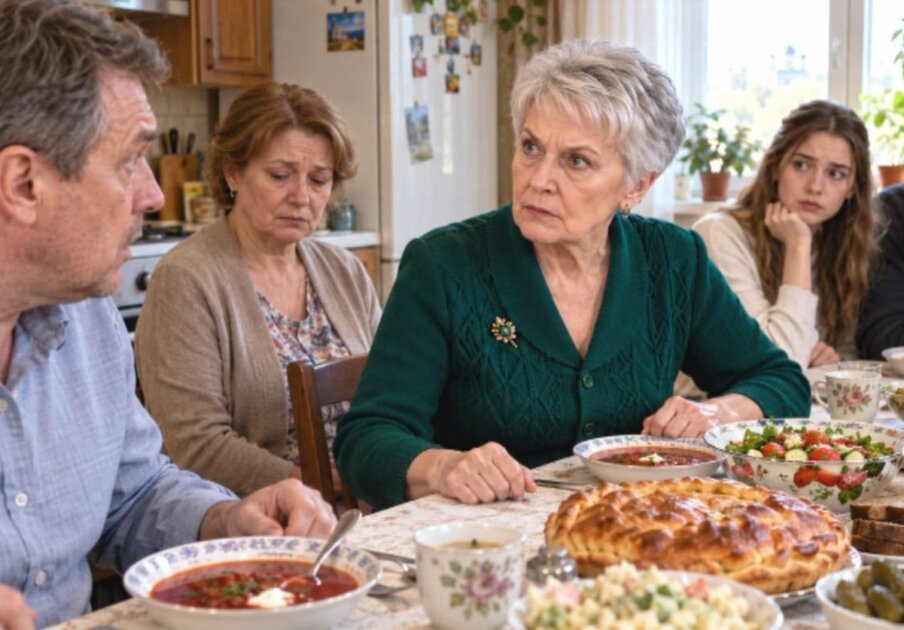
The whole family sat around the table.
Stas, Rita, Kirill, Alyona, and Raisa.
Rita had been cooking since early morning. Borscht, aspic, cabbage pie, salad—there was enough food for twice as many people.
For the first few minutes, everything felt warm and ordinary.
Then Stas tasted the borscht.
His face tightened.
“Rita, you barely put any beetroot in this again. How many times do I have to tell you? Borscht is supposed to be red. My mother always made it properly.”
Raisa slowly looked up.
Rita was already getting to her feet.
“I’ll bring some sour cream. It’ll taste better with—”
“Just sit down,” Stas snapped. “That won’t fix it. You can’t do anything properly.”
Kirill laughed.
“Grandma, he’s right. Mom’s borscht is always watery. Alyona is at least trying to learn how to cook. Mom, you should teach her what not to do.”
Alyona’s face turned bright red.
Rita remained half-standing.
And Raisa knew she couldn’t stay silent anymore.
She put down her fork.
Slowly, she placed both hands on the tablecloth.
“Stas.”
He looked up.
She rarely used his full name.
“Sit up straight and listen to your mother. Just this once, don’t interrupt me.”
Silence fell over the table.
Kirill stopped smiling.
Rita slowly sat back down.
“That woman,” Raisa said, pointing toward Rita, “has cooked for you, washed your clothes, ironed your shirts, and taken care of this house for twenty-eight years.”
Stas opened his mouth.
“Mom, we were just—”
“No. I’m talking now.”
Her voice was calm, but no one dared interrupt.
“They offered your wife a promotion, and you dismissed it with one sentence.”
Stas shifted uncomfortably.
“Do you even see Rita anymore?” Raisa asked. “Or is she just an appliance to you? Press a button, and coffee appears. Press another, and lunch is ready. Then you complain that it’s too salty or too watery.”
Stas’s face turned red.
“I didn’t raise you to be like this.”
His mother’s voice trembled.
“Your father died when you were nine. I raised you alone. I worked two shifts so you could have everything you needed. And do you remember what I always told you?”
Stas said nothing.
“I told you to respect women.”
She turned toward Rita.
“Your wife is not your servant. She isn’t your second mother. She is your partner.”
Then Raisa looked at Kirill.
“And you listen carefully, too. Because you’re already learning the same lesson your father is teaching you.”
Kirill lowered his eyes.
“I don’t want another woman standing in front of you twenty years from now while you speak to her the way your father speaks to Rita.”
Raisa looked back at her son.
“And don’t be angry with me for saying this, Stas. But what you’re doing is simply beneath you.”
The silence became almost unbearable.
A tear slipped down Rita’s cheek.
In twenty-eight years, no one had ever stood up for her like this.
No one.
Stas pushed his chair back.
“So now you’re humiliating me in front of everyone?”
“No,” Raisa replied. “I’m trying to stop you from becoming someone you won’t recognize.”
Stas said nothing.
He walked into the other room and closed the door.
The family continued eating without him.
And then something happened that Raisa had never seen before.
Kirill stood up.
He gathered the plates and carried them into the kitchen.
Without being asked.
Alyona simply stared at him.
That evening, after Kirill and Alyona left, Rita was washing dishes.
She heard footsteps behind her.
She turned.
Stas was standing in the kitchen doorway.
He didn’t say anything.
He simply walked over, picked up the dish towel, and started drying the plates.
Badly.
Leaving streaks everywhere.
But he was doing it.
He hadn’t done that in fifteen years.
Rita didn’t comment.
She was afraid that if she said anything, the fragile moment would disappear.
Then, while drying the fifth plate, Stas spoke quietly.
“Take the promotion.”
Rita stopped.
“What?”
“If you want it, take it.”
She looked at him.
“Are you serious?”
He stared at the wall.
“Yes.”
Rita smiled faintly.
“Then I will.”
“Good.”
That was Stas’s apology.
He couldn’t say the word “sorry.”
Not yet.
But for the first time, he did something instead.
The next morning, Rita got up early as usual.
When she entered the kitchen, Raisa was already sitting by the window, peeling potatoes.
“You’re up early, Mom,” Rita said with a smile.
“So are you.”
Rita poured two cups of tea and sat beside her.
Outside, the city was slowly waking up. A delivery truck was unloading bread nearby, a garbage truck rumbled somewhere in the distance, and another ordinary Monday morning was beginning.
“Mom…”
“Yes?”
“What you did yesterday… Stas is going to be angry with you.”
Raisa put down the knife.
“Let him be angry.”
Rita looked at her.
“He’s my son. I know him. He’ll get over it.”
Then Raisa reached across the table and took Rita’s hand.
“But you remember this: as long as I’m in this house, you are not alone.”
Rita lowered her eyes.
“Thank you.”
“If I have to teach him how to respect his own wife, I’ll teach him. And if he doesn’t understand on his own, I’ll stand beside you until he does.”
Rita turned toward the window.
She didn’t want Raisa to see her crying.
But these tears were different.
For the first time in twenty-eight years, she wasn’t crying because someone had hurt her.
She was crying because someone had finally stood up for her.
And Raisa continued peeling potatoes by the window.
Quietly.
Firmly.
As if she were telling the entire household one simple thing:
As long as I’m here, no one in this family will be treated like a doormat.

