Two hundred thousand hryvnias had to be delivered to the cashier at a Kyiv oncology center before four o’clock that afternoon.
If the money did not arrive in time, the surgeons supposedly would not even enter the operating room.
And according to her younger brother, their mother was already struggling to breathe.
When Viktor threw a crumpled stack of medical documents stamped with the clinic’s seal onto the dining table, Yekaterina’s legs nearly gave way.
The glass in her hand slipped from her fingers and shattered across the old linoleum.
“Two hundred thousand,” Viktor whispered. “We have to pay today. The doctors say she may have only three days.”
He covered his face with trembling hands.
“I don’t know what else to do. If we don’t pay, they won’t operate.”
Yekaterina didn’t hesitate.
It was their mother.
She pulled her gold wedding ring from her finger, emptied the emergency savings she had been keeping for her daughter’s university education in Kharkiv, and begged her husband to call everyone he knew at the auto repair shop where he worked.
Within two hours, the family’s entire savings had disappeared.
A family friend even transferred another forty thousand hryvnias from his credit card, despite the enormous interest rate he would have to pay.
Viktor gathered the cash, stuffed the banknotes into the inside pocket of his jacket, and rushed toward the door.
“I’ll send you the doctor’s name and the room number as soon as I finish the admission paperwork,” he promised.
Then he disappeared.
Yekaterina still had no reason to doubt him.
Not until forty minutes later.
The bedroom door opened.
And the woman who was supposedly dying of cancer walked into the kitchen.
She was wearing an old robe and holding a watering can.
She looked perfectly healthy.
“Why do you look so pale, sweetheart?” their mother asked.
Yekaterina froze.
She still had her phone pressed to her ear. On the other end, a bank employee was helping her arrange an emergency loan.
“Mom… how are you feeling?”
“Fine. Why?”
“But Viktor said you have cancer. He said you need surgery today.”
Her mother stared at her in confusion.
“Cancer? What are you talking about? I have some back pain from time to time. That’s all.”
Then she added casually:
“Your brother took my ID about an hour ago. He said he needed it to arrange some government assistance with my utility bills.”
Yekaterina felt the blood drain from her face.
She immediately called Viktor.
His phone was switched off.
Then her banking app sent another notification.
A transaction had just been made.
Her entire balance was gone.
Viktor had been given temporary access to her card because he claimed he needed it to buy medicine.
Now there was nothing left.
Her husband immediately began searching for him.
They soon discovered where Viktor really was.
He wasn’t at the hospital.
He was sitting in a dark, rundown gambling establishment, staring obsessively at a virtual roulette wheel.
An almost-empty glass of cheap whiskey stood beside him.
The two hundred thousand hryvnias collected for their mother’s supposed operation were nearly gone.
Yekaterina grabbed him by the jacket.
“What have you done?”
Viktor shoved her hand away.
“Leave me alone!”
“Where is the money?”
“I lost it!”
“You told us Mom had cancer!”
A strange smile appeared on his face.
“So what?”
Yekaterina stared at him in disbelief.
Then the truth finally came out.
Viktor had been drowning in debt for months.
Six months earlier, he had secretly used their mother’s apartment as collateral for a series of microloans.
He had even forged her signature.
The repayment deadline was that very day.
The entire cancer story had been carefully planned.
The fake medical documents.
The forged clinic stamps.
The emergency operation.
The demand for two hundred thousand hryvnias.
Everything.
But there was something even more horrifying.
Viktor had been secretly mixing sedative medication into his mother’s evening tea.
The drugs made her weak, nauseous, dizzy, and unusually sleepy.
He used those symptoms to convince everyone that she was seriously ill.
When Yekaterina confronted him, she could barely recognize the man standing in front of her.
“Why would you do this to Mom?”
Viktor didn’t apologize.
Instead, he blamed the entire family.
“If you had helped me years ago, I would never have gotten into debt!”
According to him, his family had forced him into desperation by refusing to give him enough money to start a new life.
In his mind, none of this was really his fault.
Two days later, the situation became even worse.
Representatives of the microfinance company arrived at their mother’s home.
They claimed they had legal rights to the apartment.
That was when the elderly woman finally learned what her own son had done.
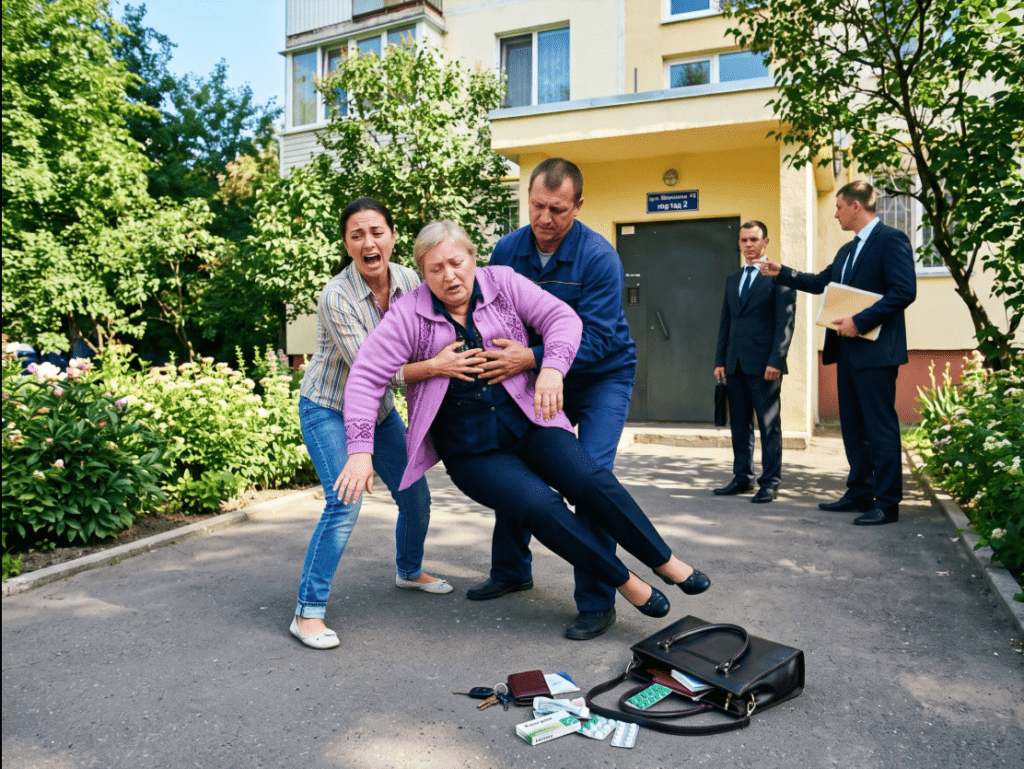
The shock was too much.
She collapsed outside the building.
This time, there was no acting.
She had suffered a real stroke.
Yekaterina suddenly had two battles to fight.
She had to save her mother’s home and protect her from the consequences of her own son’s fraud.
She sold her car.
She took out another loan.
Then she hired lawyers and filed a lawsuit seeking to invalidate the fraudulent agreement because her mother’s signature had been forged.
Viktor disappeared.
He hid at a friend’s country house near Brovary.
But even while hiding, he continued sending messages to his sister.
“You betrayed your own brother.”
“A family doesn’t send its own family member to the police.”
“You’re the reason this happened.”
Yekaterina didn’t listen.
She reported him.
And eventually, everything came crashing down in court.
Investigators presented messages and voice recordings recovered from Viktor’s phone.
They revealed that on the very day their mother was lying in the hospital after her stroke, Viktor had been sending voice messages to his friends.
He bragged about how easily he had fooled his relatives.
He laughed about the money he had taken from them.
He even called his family “greedy idiots.”
There was no remorse.
Not even in court.
Viktor sat behind the glass partition with his head held high.
“I was pushed into a corner,” he insisted.
But the court saw things differently.
He was sentenced to prison for large-scale fraud and document forgery.
The money, however, was mostly gone.
Yekaterina and her husband were left with enormous debts.
Their mother never fully recovered.
The stroke permanently affected her speech, and she struggled to express herself the way she once had.
Yet every evening, she still looked toward the window.
As if she were waiting for her beloved youngest son to come home.
As if she still believed that one day he would walk through the door and say:
“Mom, I’m sorry.”
But he never did.
And Yekaterina was left with one question she could never answer.
Had she done the right thing by reporting her own brother?
Or should she have tried to protect the family, even after such a cruel and calculated betrayal?
What would you have done in Yekaterina’s place?
Would you have reported your own brother and accepted that he might spend years in prison?
Or would you have tried to resolve everything within the family, despite the fact that he had not only stolen their money but deliberately endangered his own mother’s life?