“Mom, it’s just a tax matter. You only need to sign where the checkmarks are,” her son told her as he took his 78-year-old mother to the notary.
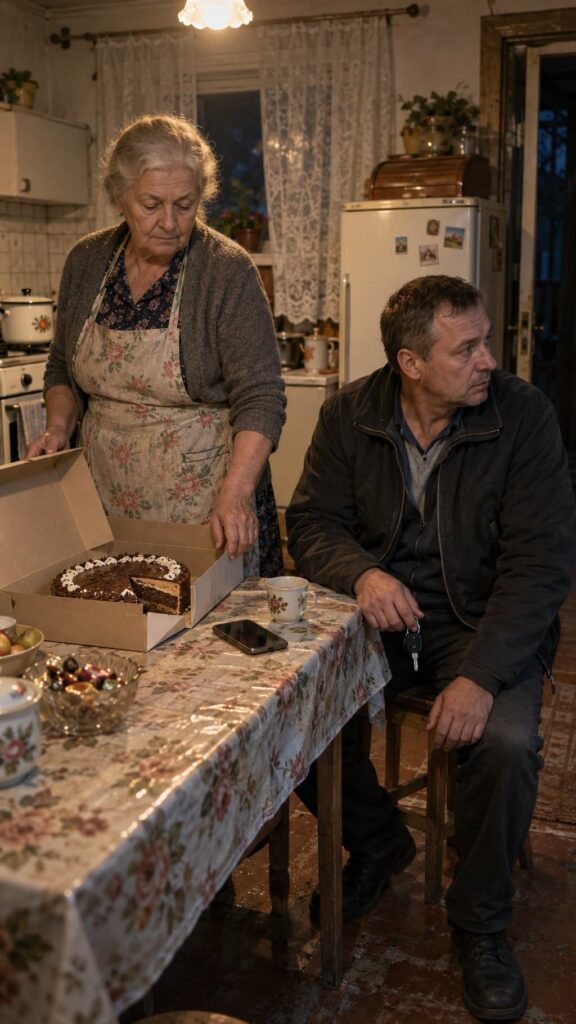
But on her kitchen table sat a cake from which someone had already cut a single slice.
Vlad arrived on Wednesday evening at half past seven without calling first. He put a box on the table.
“Mom, I know you love Prague cake.”
Hanna Tarasovna wiped her hands on her apron and opened the box.
The cake was almost untouched.
Only one slice was missing.
It hadn’t been broken off or hurriedly torn away. Someone had cut it neatly with a knife, exactly the way a person cuts a slice while sitting at the table.
There had been a cream inscription across the top.
Now only the end remained:
“…the deal!”
Hanna stared at it for several seconds.
“Sit down,” she finally said. “I’ll make you some tea.”
Vlad sat in his usual place.
For the past three years, he had always arrived the same way: still wearing his jacket, sitting only on the edge of the chair, with his phone placed beside his cup, screen facing upward.
“Mom, we need to sort out the house. They raised the property tax. You’d have to pay it from your pension, but I qualify for a benefit. It’s just a formality. One piece of paper. I already made an appointment for Thursday at ten.”
Hanna placed the tea in front of him.
It was her own chipped cup.
The matching good cup remained in the cabinet for guests.
Vlad was not a guest.
“Thursday,” she repeated.
“Why wait? We’re family. There’s no need to involve strangers.”
He drank the tea in three quick swallows and left.
The cake remained on the table.
Hanna sat beside it for a long time.
She remembered how, in the spring, Vlad had walked through every room with a measuring tape, entering numbers into his phone.
In the summer, he began bringing groceries she had never asked for and taking the empty jars away with him.
She remembered everything.
She had always been good at remembering numbers.
For forty-one years, Hanna had worked in a school cafeteria.
Forty-one years of counting flour, sugar, milk and rice.
Forty-one years of signing delivery slips and checking every quantity.
And during those years, she had learned one rule that she never forgot:
When someone rushes you into signing something, there is usually a reason.
On Thursday morning, Hanna woke at six.
She ironed the blouse she had once worn to graduation ceremonies. Then she took a brown handbag from the wardrobe and placed an old oilcloth folder inside.
One word was written on the folder in faded white paint:
“MEALS.”
She carried it with her.
The notary’s office was on the second floor above a pharmacy.
In the hallway, a woman in a beige coat was talking on the phone.
“Sixty. Yes. They’re signing today. I’m here.”
When she noticed Hanna, she turned toward the window.
Inside the office, the air smelled of paper and printer ink.
Olga Stepanovna, the notary, placed two documents in front of Hanna.
Vlad sat beside his mother.
His knee was almost touching hers.
His wife, Tanya, remained near the door. She kept looking at her phone while glancing around the room.
“There’s no outlet here? My battery is dying.”
Nobody answered her.
Olga Stepanovna looked directly at Hanna.
“Hanna Tarasovna, do you understand that by signing this power of attorney, you are giving your son the right to sell your house and receive the money from the sale?”
“Mom,” Vlad interrupted immediately. “That’s just legal language. It’s for the tax office. Just sign here and here. Where the checkmarks are.”
Hanna opened her handbag.
She took out her glasses, which she kept in an old medicine case.
She put them on.
Then she picked up the first page.
“I’m going to read it.”
“Mom, seriously? It’ll take forty minutes.”
“Then it will take forty minutes.”
And she began reading.
Slowly.
Line by line.
The same way she had once checked every delivery slip at the school cafeteria.
What was delivered.
How much.
Who delivered it.
Who signed for it.
Vlad shifted impatiently.
He checked his phone.
Then his watch.
Then the hallway, where the woman in the beige coat was still waiting.
“Mom, couldn’t you read a little faster? Other people are waiting.”
Hanna looked up.
“Who is waiting, son?”
“Mom… you weren’t exactly an office worker. You cooked.”
Hanna finished the page.
She placed it neatly on the desk.
Then she looked at her son over the top of her glasses.
“Vlad. Tell me something. Where are you taking me after we leave here?”
His mouth opened.
No answer came.
Finally, he forced a laugh.
“Home, Mom. Where else would I take you?”
“Home,” Hanna repeated.
“And from October first?”
The smile disappeared from Vlad’s face.
Hanna opened her brown handbag.
She pulled out the old folder marked “MEALS.”
Then she removed a single sheet of paper.
Not ten.
Not twenty.
One.
“Olga Stepanovna,” she said quietly. “Would you please tell us whose house this is?”
The notary took the document.
She read it.
Then turned toward her computer.
A few clicks.
Silence.
“Vladislav Lvovich,” she finally said, “the house on Sadovaya Street has been registered to another person since September 27, 2023.”
Vlad went pale.
“Who?”
“Yelizaveta Vladislavovna Gladun.”
He stared at her.
“Yelizaveta…”
“Your daughter,” the notary confirmed.
Vlad opened his mouth.
Nothing came out.
“The house belongs to your daughter,” Olga Stepanovna continued. “Your mother cannot give you permission to sell property that she no longer owns.”
“That’s fake!” Vlad suddenly snapped. “Mom, someone forged this!”
“It’s the original,” Hanna said calmly. “Liza has another copy. The third is in the notary’s archive.”
Vlad grabbed his phone and called his daughter.
No answer.
He called again.
Still nothing.
“I would have given her everything!” he finally said.
Olga Stepanovna remained calm.
“There is nothing about that in the power of attorney.”
Silence filled the room.
Then the woman in the beige coat stepped inside.
“I think I should explain something too.”
She placed a folded piece of paper on the desk.
“I gave him six thousand dollars as a deposit.”
Hanna turned toward her son.
Vlad lowered his eyes.
“He told me his mother was selling the house because she was moving into a care home.”
Hanna’s heart tightened.
Now she understood.
She understood where her son intended to send her.
And she understood why someone had taken the first slice from the cake.
Three years earlier, Vlad had brought a man to her house.
“A roofing specialist,” he had said.
But the man never climbed onto the roof.
Instead, he walked through the rooms with a measuring tape.
He photographed the walls.
Checked the corners.
Asked when the house had been built.
Hanna said nothing.
The next day, her neighbor warned her.
“Hanna, that man was asking how much houses cost around here. He even asked what documents were needed if the owner was elderly.”
That week, Hanna went to the district center.
But she did not go alone.
She took Liza with her.
At the time, her granddaughter was studying pastry-making.
Hanna had been paying for her courses out of her pension.
At the notary’s office, Olga Stepanovna explained their options.
A will.
Or a gift transfer.
Hanna chose the second.
She transferred ownership of the house to Liza while she was still alive.
But she insisted on one condition:
She would live there for the rest of her life.
No one could evict her.
No one could force her to leave.
For three years, nothing happened.
Then Vlad started coming around more often.
He brought sugar she already had three kilograms of.
Coffee she never drank.
And, more importantly, his measuring tape.
In July, he casually asked:
“Mom, where are the house documents? In the wardrobe? Maybe you should put them in a bank deposit box. You never know. Fire, theft…”
“With Olga Stepanovna,” Hanna replied.
“In the proper place.”
Vlad nodded.
He never asked again.
The folder marked “MEALS” was hidden behind the bed linen in that very wardrobe.
And for three years, he had never once asked what was inside.
Then, on September 7, Hanna stepped outside to get water.
Vlad was standing on the porch with his back toward the door.
He was talking quietly on the phone.
“Keep the room from October first. Yes. A double room. She isn’t picky.”
Hanna filled the water jug.
Carried it inside.
And never spilled a drop.
That evening, she called the care home.
A cheerful woman answered.
“Yes, Hanna Tarasovna. We have your reservation. October first. Double room. Six hundred dollars a month. Three months paid in advance. Your son arranged everything. Bring only personal belongings. No furniture is needed.”
“Thank you,” Hanna said.
She hung up.
She could have called Vlad immediately.
She could have told him the truth.
The house was no longer hers.
It belonged to Liza.
But she didn’t.
She simply washed her cup, covered the cake with a towel and went to bed.
For forty-one years, she had fed other people’s children.
And she had learned one thing about children:
A child keeps lying as long as someone keeps believing them.
And as long as someone else keeps speaking for them.
Hanna did not go to the notary’s office to humiliate her son.
She gave him one final chance.
One last opportunity to tell the truth himself.
To admit the truth about the care home.
About the six thousand dollars.
About the woman waiting outside.
He could have stopped everything.
Instead, he said:
“Just sign where the checkmarks are.”
And that was the moment she knew there was nothing left to save.
“Mom, wait,” Vlad suddenly turned toward her. “What have you done?”
“I understand exactly what I’ve done.”
“I took a deposit!” he shouted, slamming his palm against the desk. “Six thousand dollars! Cash! I have to return it in two weeks!”
The woman in the beige coat looked at him.
“You should have thought about that before taking my money.”
Vlad turned to Hanna.
“Mom, Liza will transfer it back to you. Just tell her to do it. She listens to you. You raised her!”
“I did,” Hanna said.
“So?”
“We won’t transfer anything.”
He stared at his mother as though she were a machine that had suddenly stopped working.
“Mom, think about it. You’re almost eighty. Heating the stove, carrying water, clearing snow… The care home has doctors. They feed you four times a day.”
“A double room,” Hanna said quietly. “Six hundred dollars a month. Three months paid in advance. Personal belongings only. No furniture.”
Vlad fell silent.
Tanya closed her eyes.
Then she took out her phone.
“I already messaged Liza.”
Vlad slowly turned toward her.
“What did you do?”
“I told her everything.”
She looked at Hanna.
“For three years, I kept telling him to tell you the truth. He never did.”
Hanna reached for her daughter-in-law’s hand.
“I’m sorry, Tanya.”
“For what?”
“I thought you wanted my house.”
Tanya’s eyes filled with tears.
“If I were you, I would have thought the same.”
At that moment, the door opened.
Liza stood in the doorway.
She was still wearing her white pastry chef’s uniform.
There was flour on her eyebrow.
“Grandma!”
She rushed to Hanna.
Then she turned toward her father.
“Dad…”
Her voice was quiet.
“Did you deliberately arrange this for today? You knew today was the first day I was opening my bakery?”
Vlad said nothing.
Liza looked at him for a long moment.
Then she turned to Hanna.
“The house isn’t for sale.”
She looked back at her father.
“Not today. Not ever.”
Hanna stood.
She straightened the blouse she had worn to graduation ceremonies.
Then she faced her son.
“Listen carefully. The house belongs to Liza. I will live there until the end of my life. You will return that woman’s six thousand dollars yourself. Sell your car if you have to.”
Vlad lowered his head.
“You can visit me on Saturdays.”
Hanna paused.
“But leave the measuring tape at home.”
The woman in the beige coat was the first to leave.
Tanya followed.
Vlad remained sitting alone, staring at his hands.
Nobody reached out to him.
On October first, the care home called Hanna to confirm her arrival.
“Should we expect you?”
“Give the room to someone who needs it,” Hanna replied. “I have a stove at home.”
In November, Vlad sold his car and returned the money.
After that, he began visiting his mother every Saturday.
He repaired the gate.
Fixed the summer kitchen.
Cleaned the chimney.
But he stopped measuring the rooms.
The measuring tape remained in the glove compartment of his car.
He never mentioned it again.
Once, in February, he quietly tied his mother’s apron behind her back because she could no longer reach the strings herself.
Then he went outside to chop wood.
Hanna did not forgive him immediately.
But she did not declare war on him either.
She simply gave him Saturdays.
Tanya began coming on Fridays.
She brought medicine for Hanna’s knees and stayed for tea.
The chipped cup that had once been Hanna’s became Tanya’s cup.
The good cup was finally brought out for guests.
It was a small thing.
But sometimes peace begins with something small.
Liza opened her bakery.
And Hanna, at seventy-eight, began working again.
Every morning she baked sixty school cakes using the same recipe she had used for forty-one years.
By nine o’clock, they were gone.
Above Liza’s bakery hung a simple sign:
“Bakery.”
No family name.
No explanation.
Everyone in the neighborhood already knew whose cakes they were.
The old folder marked “MEALS” remained in the wardrobe behind the bed linen.
Once a month, Hanna wiped the dust from it.
Not because she was afraid anymore.
Just because she had always done it.
Then, one Saturday in March, Liza placed a cake on the kitchen table.
Prague cake.
Made with walnuts, just the way Grandma liked it.
This time, the cake was whole.
Not a single slice was missing.
There was one word written across the top in cream.
Every letter was visible.
Liza picked up the knife.
“Should I cut it?”
Hanna smiled.
“Yes.”
“Cut it.”
And Liza placed the first slice on her grandmother’s plate.