The package arrived in the middle of the table with a soft rustle. My mother-in-law unpacked the little boxes as if they were props in a carefully rehearsed performance: one to the right, one to the left, arranged in a perfect row.
“Katalin, move the salad over,” she said without looking at me.
It was March 8th. Her apartment on Timiryazev Street, the festive table stretched all the way to the wall, the chatter of relatives, and me, once again the first to arrive. I had been cooking since morning: I had made the aspic the night before, the chicken was roasting in the oven, I had mixed two salads, and I had layered the Napoleon cake until midnight so it would be perfect by morning.
Meanwhile, she had been watching a TV series in the living room.
“Girls, I brought everyone a gift!” she announced ceremoniously, holding up the first box. “Perfume. Real perfume, not some cheap market junk.”
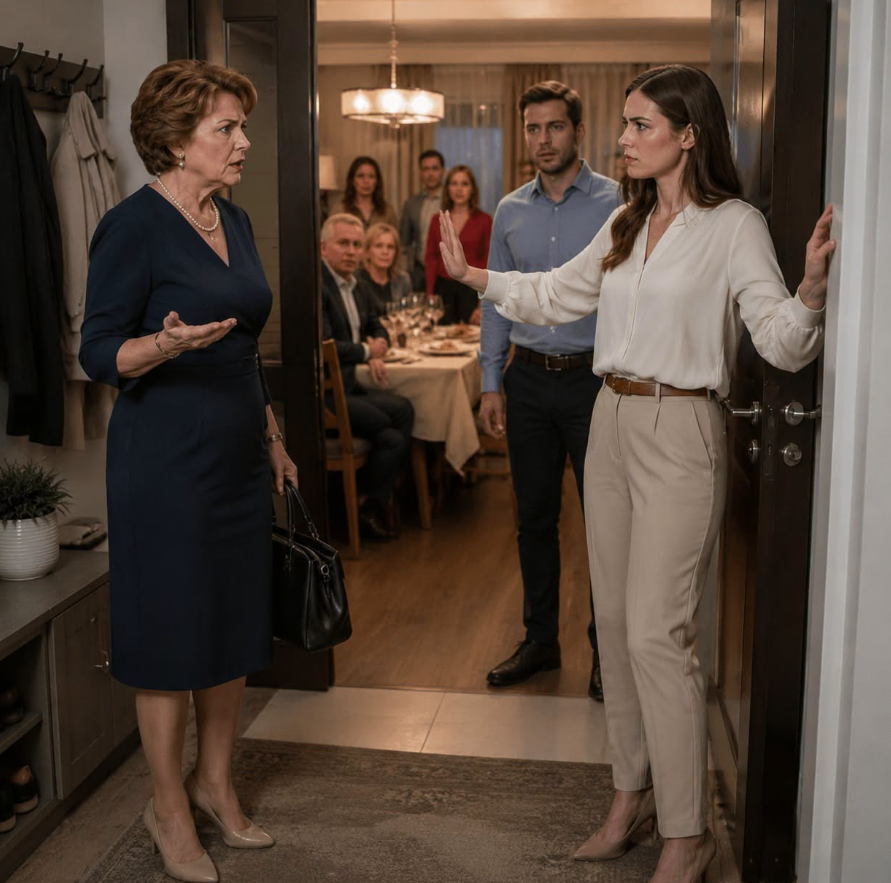
The boxes went around the table. First, her daughter received one, then the aunt who had come from the countryside, then the neighbor whom they invited every year because “poor thing, she’s all alone.” Then someone else who, in this house, apparently mattered more than I did.
I sat at the corner of the table and counted.
Ten boxes.
Eleven women.
The last one was claimed. My mother-in-law gathered up the empty bag and carefully slid it under her chair, as if there were nothing more left to do.
“Mom, what about Kata?” Igor finally asked.
The silence fell so suddenly that I could hear the kitchen faucet dripping.
For the first time that evening, my mother-in-law looked at me.
“Katalin isn’t a woman yet,” she said calmly, as though she were talking about the weather. “A child is what makes a woman a woman. Until then, she’s just a girl. Perfume is too early for girls.”
Someone snickered. Zhanna suddenly found the little bottle in her hands extremely fascinating.
“Oh, come on, Rimma Zakharovna…” the aunt began cautiously.
“What do you mean, ‘come on’? I’m telling the truth. You’ve been married for five years and still no children. In my day, by this point we were already buying schoolbags, not spending our time in cafés.”
I tightened my grip on the fork and stared at the glass cabinet. Family photographs stood there in rows: Zhanna holding her newborn, Zhanna outside the maternity hospital, Zhanna pushing a stroller in the courtyard. I wasn’t in a single one. At first, it had hurt. Later, I stopped even noticing.
“Don’t take it personally,” she added in a sweeter voice. “Once you give birth, you’ll have everything. Perfume too.”
Igor quietly warned her:
“Mom…”
“What do you mean, ‘Mom’? The truth hurts, but it’s still the truth.”
She raised her glass.
“To real women! To mothers! Anyone who has stayed up all night with a child will understand me.”
Everyone drank. So did I. I didn’t want to make a scene.
Later, everyone praised the aspic, praised the chicken, and when my mother-in-law pulled the cake toward herself, she smiled and called to me:
“Well, Katic, cut your own cake.”
My own cake.
I stood up, took the cake dish with both hands, carried it into the kitchen, and put it back on the top shelf of the refrigerator. Then I returned and stopped in the doorway of the dining room.
“Dessert is for women,” I said calmly. “I’m only a girl here. Girls don’t serve cake.”
Every head turned toward me at once.
My mother-in-law burst out laughing.
“Did you hear that? She’s offended over a little bottle of perfume! Over a three-hundred-ruble bottle!”
I looked at her.
“I wouldn’t have stood up over three hundred rubles.”
I went into the hallway for my coat.
Igor caught up with me in the stairwell. Once we were in the car, he didn’t start the engine for a long time.
“Why did you have to make such a big deal out of it?” he asked tiredly. “She didn’t mean it maliciously.”
A week later, my mother-in-law showed up at our apartment on Saturday morning without calling first. She looked around the place, criticized the new shower curtain, peeked inside the refrigerator, and then pulled out a flower-patterned notebook.
“There’s a woman in Kovilkino,” she said. “She gives people herbs and says prayers. Women who go to her have children. Go see her for two weeks.”
I said nothing.
Then she delivered the final blow:
“It’s not Igor’s fault that he ended up with someone like you. A man needs a son.”
I took the notebook, walked over to the trash can, and threw it in.
“This is my home,” I said quietly. “In my house, no one talks about my womb. Ever.”
That evening, I learned something that changed everything.
In the autumn, we really had gone to a doctor. Together. Holding hands. I knew the test results by heart. The problem wasn’t with me.
“Did you tell your mother?” I asked Igor.
He was silent for a long time, then lowered his eyes and nodded.
“I told her in December.”
“And what did she say?”
His voice was barely audible.
“She said, ‘Don’t humiliate yourself. Let them think something is wrong with Katalin. You’re a man.’”
At that moment, everything fell into place: the perfumes, the toast to “real women,” the hints, the pitying looks. She hadn’t been mistaken. She hadn’t hurt me by accident. She knew the truth and still chose me as the scapegoat so her son’s masculinity could remain untouched.
Months later, just before Easter, Igor brought it up again.
“Mom is inviting everyone over for lunch,” he said cautiously. “And she asked you to bake that Napoleon cake.”
“That Napoleon cake.”
She didn’t send word that she missed me. She didn’t say she was sorry. She simply placed another order, as if I were still the family’s free pastry chef.
I sat down across from him.
“I will never set foot in her house again,” I said. “Not this year, not ten years from now, not on her birthday, not even at her funeral.”
Igor stared at me in shock.
“You hate her that much?”
“I don’t hate her,” I replied. “I’m just finally paying attention to the way people treat me.”
Two years later, our daughter Asya was born.
My mother-in-law called once to say she had knitted her a pink jumpsuit with little ears.
“After all, I’m her grandmother,” she said hopefully.
I held on to the phone and answered calmly:
“No. You’re Rimma Zakharovna. And that difference will remain forever.”
When I hung up, Asya was in the hallway trying on my boots, putting each one on the wrong foot. I sat down beside her on the floor and watched as she tried to figure it out all by herself.
That was when I finally understood: It isn’t a child who makes someone a woman. It’s the moment she finally dares to say that she, too, deserves respect.