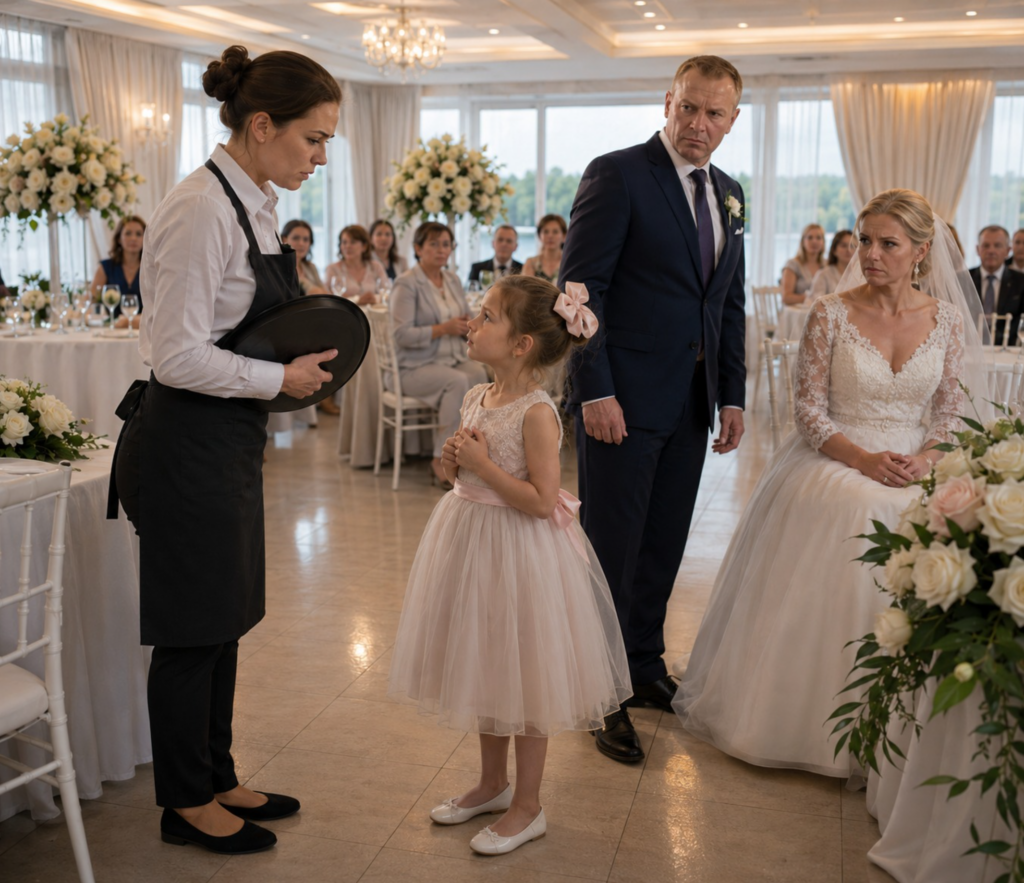
In the banquet hall, the heavy, mingling scent of fried fish and damp roses lingered—too many flowers had been brought in, and the steam rising from the vases made the entire room feel like an overheated greenhouse. Taisiya balanced a tray of glasses and had learned how to move in a way that made people barely notice her. Especially not the newlyweds.
The groom sat broadly at the head table, as if the entire hall were an extension of himself. He was a man in his fifties, his face flushed, his tie too tight, as if trying to discipline his own neck. His hand rested on the back of the bride’s chair—not gently, more possessively.
The bride was a woman in her forties, beautiful, but somehow distant, as if part of her had been switched off. She sat upright, smiling. Not out of joy—rather out of duty, like someone who knew perfectly well that a smile was now expected behavior.
Next to the chair, a nine-year-old girl fidgeted in a white dress, a bow in her hair. She would cling to her mother’s fingers, hide behind a column, then run back again—and every time the groom looked at her, she would suddenly freeze. She did not cry. She simply went silent.
Meanwhile, the guests laughed, raised their glasses, and applauded the host’s jokes. No one saw what Taisiya saw.
She knew that kind of gaze. From her childhood. Her stepfather didn’t shout—he just looked like that. And sometimes, that was enough for a child to learn how to live quietly.
She had escaped Uglich and started a new life in Rybinsk, working as a waitress. She thought the past had stayed behind on the dirt roads. But some things don’t stay behind. They simply follow quietly.
“Miss, what are you staring at?” hissed the event manager behind her, Styopan Lvovich. “The tables are empty!”
Taisiya nodded and moved on.
Then the girl stepped out from behind the column.
With a quick motion, she slipped a crumpled napkin into Taisiya’s apron.
“Auntie… please…” she whispered. “Call someone. Tell them… Varya is here. And Mama is crying.”
Inside the napkin was a carefully written phone number. Under it: “Tell Semyon Arkadyevich. Mama can’t leave.” Beside it, a crumpled five-thousand-ruble note, still warm from a child’s hands.
Styopan Lvovich appeared almost instantly. With a smile too pleasant to be genuine.
“Oh, what a considerate little girl…” he said. “Everything is handled officially here.”
He quickly took the money. The napkin, however, remained—in the depth of Taisiya’s apron.
The girl looked at Taisiya. She wasn’t asking for much. Just a glance, a sign that someone understood.
Taisiya gave a barely noticeable nod.
And in that moment, she knew: there was no turning back.
In the back storage room of the kitchen, she made the call. The music seeped through the walls, muffled.
“Hello,” said an older man’s voice.
“This is Taisiya from the Nyirfapart banquet hall… A little girl told me to call. Varya is here. Her mother is crying and can’t leave.”
There was a long silence on the other end.
“Who is the groom?” the voice finally asked.
Pavel Romanovich.
Another silence.
“Does the woman have her phone?”
“They took it from her, according to the girl.”
“Where are they?”
Taisiya gave the address.
“I’m coming,” the man said. “Keep an eye on the child.”
When she returned, a toast was in progress.
“My wife had a difficult life…” said the groom, pulling the bride closer. “But now there will be order. Finally, order.”
Laughter. Clinking glasses. The bride lowered her head.
The little girl twisted the hem of her dress.
Then the groom called her over.
“You talk too much today,” he said loudly. “You’re disturbing the adults.”
A brief silence fell.
The bride spoke softly:
“Pavel… not here.”
“Why not?” the man smiled. “Order begins here.”
The girl did not cry. She just stared at the floor.
Taisiya’s fingers tightened around her tray.
And then the doors opened.
A tall, gray-haired man stepped inside. He did not hurry. He did not look around much. One glance was enough.
“Varya,” he said quietly.
The girl immediately ran to him.
“Semyon Grandpa!”
He embraced her, then looked up.
“I see what is happening here.”
The music stopped. The atmosphere changed.
The groom stood up.
“Semyon Arkadyevich… this is a family matter.”
“Not anymore,” the man replied.
The conversation was short. Too short for anyone to argue.
The bride finally spoke. At first in a trembling voice, then more clearly. Her phone had been taken. She had been threatened. Trapped in a situation with no visible way out.
The guests no longer laughed.
The groom’s face hardened, but his authority slowly collapsed like a poorly tied knot.
The next day, Styopan Lvovich fired Taisiya.
But that was not the end of the story.
A week later, another call came. The man—Semyon Arkadyevich—wanted to meet her.
And there, in a quiet conversation, Taisiya learned the truth.
About an old contract. A missing woman. A past decision signed with money and fear.
And when the name was spoken—Raisa Lukina—Taisiya felt the air shift.
That was her mother’s name.
At home, they did not speak for a long time. Then her mother began to talk. Not excusing herself. Only explaining how she had ended up where there were no good choices anymore—only survival.
“I made a mistake,” she said at last.
Taisiya did not answer immediately. She simply took her hand.
“Then let’s leave this place.”
And they left.
The new life was built slowly. From documents, work, quiet mornings. And from the decision that fear would no longer be the one in charge.
Semyon Arkadyevich asked for nothing in return. He only helped.
“I don’t want a monument to my guilt,” he once said. “I want someone to finally live.”
Years later, Taisiya became the manager of a hotel restaurant.
Nyirfapart became hers.
At the end of the first day, she fired Styopan.
That evening, snow was falling. The lights in the hall were warm, the sound of people’s voices born not from fear, but from real life.
Her mother stood beside her.
“Funny how things fall into place, isn’t it?” she asked.
“How do you mean?” her mother looked at her.
Taisiya smiled.
“I just made a call.”
Her mother hugged her.
“Sometimes that’s enough. One call. One door. The rest is what a person does themselves.”