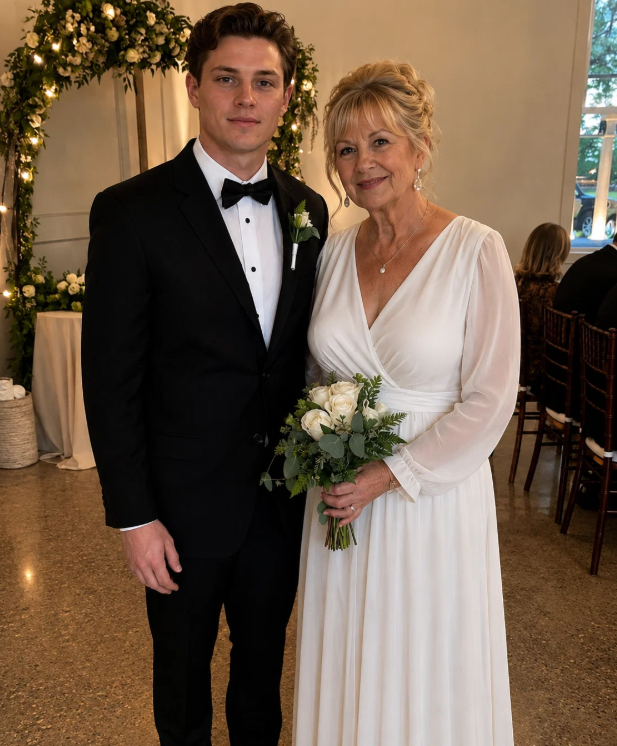
I married Evie because I needed shelter, stability, and a future I convinced myself she could provide. For a long time, I called it survival, because survival sounded cleaner than what I really was.
Evie was seventy-one, a widow with quiet hands and a gentleness that made people lower their voices around her without realizing why.
I was twenty-five, broke beyond pride, buried in debt, and sleeping in my truck behind a grocery store where the night manager looked through me like I was already gone.
So when Evie asked me to marry her, I said yes before I allowed myself the space to question it. Not because I loved her.
Because I was tired of cold nights, sink-water face washes in gas station bathrooms, and pretending I wasn’t one missed paycheck away from disappearing completely.
The first person I told was Jesse.
We were at a bar when I said, “I’m getting married.”
He nearly choked on his drink. “To who?”
“Evie.”
“The widow with the blue house?”
I told him to keep his voice down, but he only laughed.
“Damon,” he said, shaking his head, “that’s not a marriage. That’s an exit plan.”
“It’s a roof,” I said.
“And if you play it right,” he replied, leaning closer, “it’s everything.”
That word followed me longer than it should have.
Two weeks before the courthouse wedding, Evie placed a folder on her kitchen table.
“What’s this?” I asked.
“A prenuptial agreement,” she said calmly.
I almost laughed, thinking she was joking. But she wasn’t.
“The house remains mine,” she said. “My savings remain mine. And my will is final.”
My throat tightened. “You think I’m after your money?”
She studied me for a long moment. “I think hunger makes people creative in ways they don’t always like to admit.”
I signed anyway.
Because I told myself I wasn’t that kind of hungry.
At first, Evie didn’t feel like a mistake.
She filled rooms with warmth I didn’t know how to accept—clean towels folded in perfect stacks, a stocked kitchen, medicine bottles arranged like she was quietly organizing time itself.
She bought me boots. A coat. Things I didn’t ask for.
“I can take care of myself,” I said once.
“Can you?” she replied gently.
And I had no answer.
In public, people adored her.
That was the part I resented most.
At diners and shops, strangers smiled at her like she belonged everywhere. And I stood beside her feeling like a shadow someone forgot to remove.
One afternoon, she watched me more carefully than usual.
“You get quiet when people are kind to me,” she said.
“I’m just tired,” I lied.
“No,” she said softly. “You look like you’re waiting for someone to notice you don’t belong here.”
I should’ve denied it again.
Instead, I looked away.
And she didn’t push.
That was Evie—she never forced truth out of you. She simply let silence do the work.
But silence didn’t change me.
I started noticing everything instead.
The pill bottles. The doctor appointments. The slower way she moved when she thought I wasn’t watching.
Not out of care.
Out of calculation.
Then Jesse texted again.
“How’s married life?”
Evie was humming in the kitchen, rinsing dishes I should’ve been washing.
“All good,” I typed. Then added, “Once she’s gone, I’m set.”
I stared at the message.
For two seconds, I felt something like shame.
Then I sent it anyway.
Three mornings later, she collapsed while making breakfast.
One moment she was standing there with a spoon. The next, she wasn’t.
At the hospital, the doctor used words like “heart failure” and “too late.”
All I could say was, “She was just eating jam.”
The funeral came quickly.
I wore the coat she had bought me.
Claire noticed immediately.
“Of course you wore that,” she said flatly.
“It’s cold,” I muttered.
“No,” she replied. “You just still know how to use what she gave you.”
That sentence stayed.
Then came the will.
I sat across from Evie’s lawyer expecting something—anything—that would make it feel like my time with her had amounted to something I could hold.
Instead, he placed a shoebox on the desk.
My name was written on it in Evie’s handwriting.
“She said this is what you wanted,” he said.
Inside was a printed message.
The text I had once sent Jesse:
“All good. Once she’s gone, I’m set.”
Cold. Preserved. Returned.
Beneath it were receipts.
Boots. Coat. Medical bills. Repairs. Groceries.
Each one annotated in Evie’s careful handwriting.
“You were ashamed here.”
“You thanked me here.”
“You almost told the truth here.”
The last note was on the coat I wore to her funeral:
“You looked ashamed when I noticed you were cold. That was the first honest thing I saw in you.”
My stomach turned.
Then came her letter.
She didn’t insult me.
She didn’t punish me.
She simply said she had known from the beginning.
Not just what I needed—but what I was willing to become to get it.
“I did not leave you nothing,” she wrote. “I left you the truth. Because it is the only thing you cannot keep and hide at the same time.”
She gave me a choice: disappear quietly, or stand in front of the people who loved her and stop pretending.
The next day, I chose to stand.
In the church basement, surrounded by people who had known her far longer than I had, I told them everything.
The marriage. The motive. The message. The calculation.
No excuses.
No soft edges.
Just truth.
And instead of outrage, I got silence—heavy, uncomfortable, honest.
Later, I asked that my name be removed from the charity she had created.
“I didn’t earn it,” I said.
“It should carry hers.”
Months passed.
I worked. I paid back what I could. I showed up when I was needed.
Not because I was trying to become someone else overnight.
But because I finally understood what Evie had seen before I did:
You don’t escape your worst self by being exposed.
You escape it by refusing to lie anymore.
One evening, I stood at her grave with the printed message in my pocket.
I tore it into pieces and let them fall.
“I get it now,” I said quietly.
“You didn’t leave me your house.”
“You left me my life.”
And for the first time, I didn’t feel like I had stolen it.