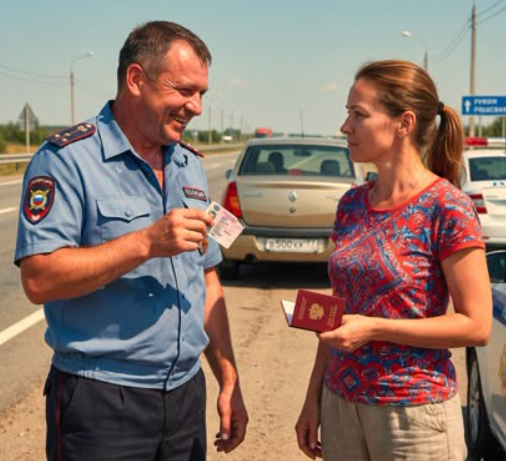
“Turn off the engine. Documents. Now.”
A heavy hand slammed against the frame of the open window of my faded beige Logan, making the old glass rattle inside the door. The sound echoed across the empty highway before disappearing into the oppressive silence of the summer afternoon.
The heat was unbearable.
The dashboard was so hot it burned my fingertips, and the air inside the car felt like the inside of an oven. The air conditioner had died back in May, but I had deliberately chosen this battered department vehicle. It was forgettable—the kind of car no one noticed.
I was returning from an unannounced inspection in a neighboring district, and on the back seat rested a thick folder containing evidence against several officers suspected of corruption. The less attention I attracted, the better.
The cabin immediately filled with the smell of melting asphalt, roadside dust, and the overpowering scent of stale peppermint gum drifting from the traffic officer standing beside my window.
“Good afternoon,” I said evenly, keeping both hands on the steering wheel. “May I know why you’ve stopped me?”
“I am the reason,” he replied with a smug grin.
He looked to be in his forties, broad-shouldered but out of shape, with a flushed face glistening beneath the blazing sun. Dark circles hung beneath his tired eyes, and sweat soaked the collar of his uniform. Behind him, a patrol car sat diagonally across the shoulder with its emergency lights turned off. Another officer remained inside, watching from the passenger seat.
I was forty-six years old and had spent the last twenty years working for the Internal Security Department.
My job wasn’t chasing thieves or murderers.
My job was catching corrupt police officers.
After two decades, I could recognize them within seconds. Their posture, their confidence, the way they spoke—it all gave them away.
Today I wore plain gray trousers, a simple T-shirt, and no makeup. My hair was tied into a careless bun. To him, I was nothing more than a middle-aged woman driving an old government sedan.
An easy victim.
“We asked for your documents,” he said impatiently, tapping his fingers against my door. “License and registration.”
“You stopped me outside a checkpoint,” I answered calmly. “You haven’t introduced yourself or shown your identification. Is there a special operation taking place?”
His chewing slowed.
He studied me more carefully.
This wasn’t the response he expected.
Most drivers became nervous the moment they saw a patrol car. They apologized before they had done anything wrong. They searched frantically for their paperwork.
My calmness irritated him.
He leaned through the open window until I could smell the mixture of peppermint, cigarettes, and coffee on his breath.
“You smell like alcohol,” he said. “Maybe you had a little too much to drink yesterday?”
I almost smiled.
The accusation was old, predictable, and effective. Frightened drivers usually begged not to be tested, making it easy to hint that the problem could disappear for the right amount of cash.
“I don’t drink before driving,” I replied. “But if you genuinely suspect I’m intoxicated, let’s do everything according to procedure. Prepare the paperwork, call two independent witnesses, produce a certified breathalyzer, and we’ll record the entire examination.”
His expression hardened.
There wasn’t another vehicle anywhere in sight.
No witnesses.
No certified device.
Only an empty highway stretching for miles beneath the scorching sun.
“So,” he muttered through clenched teeth, “you know the law.”
He spat onto the pavement beside my front tire.
“I’ll call a tow truck. Your car goes to impound, and we’ll spend the next several hours at the district hospital. You’ll lose your whole day.”
“Go ahead,” I said with a shrug. “Just remember to explain why your certified breathalyzer isn’t available.”
His patience snapped.
I quietly reached for my phone, opened the camera, and placed it on the dashboard with the lens pointed directly at him.
The tiny red recording light appeared.
“What are you doing?” he demanded.
“Recording our interaction,” I answered loudly. “The officer refuses to identify himself, makes unsupported accusations, and threatens to impound my vehicle without following legal procedure. Please state your name and rank.”
His face darkened with anger.
“You’re filming me?”
Before I could react, he thrust his arm through the window and snatched my driver’s license from my hand.
“Give that back,” I said sharply.
“What license?” he sneered.
Holding the card with both hands, he bent it slowly until the plastic cracked with a sharp snap.
Then he tore it completely in half.
Without hesitation, he crushed the broken pieces and tossed them into the roadside ditch.
“Walk home,” he laughed. “You’re so smart—you don’t need a license.”
He leaned closer.
“Go complain to whoever you want. I’ll tell them you destroyed it yourself. Nobody’s going to believe you.”
For a long moment I remained perfectly still.
Six months earlier, the retired father of one of my colleagues had been stopped on a highway just like this. Terrified by similar threats, he’d handed over nearly all the money he had. The humiliation had taken months to overcome.
Quietly, I unfastened my seat belt.
The click echoed in the silence.
I stepped out, climbed into the dry ditch, and searched through the weeds until I found the two torn halves of my license. Returning to the road, I carefully placed them together on the hood of my car and photographed the damage from several angles.
The inspector watched with open amusement.
“Finished making your little movie?”
Instead of answering, I walked directly toward him.
“What’s your surname?”
“What difference does it make?”
“Your surname. And your rank.”
He rolled his eyes.
“Senior Lieutenant Ilya Savchenko.”
I looked at him for several seconds before reaching into my waist pouch.
From inside, I removed a burgundy leather identification wallet embossed with gold lettering.
I opened it directly in front of his face.
“Internal Security Department.”
“Lieutenant Colonel Svetlana Yurievna Soboleva.”
The holographic seal flashed in the sunlight.
I’ve seen that moment many times.
First came confusion.
Then recognition.
Finally, absolute terror.
Every trace of color vanished from Savchenko’s face. His confident smile disappeared, replaced by a look of complete disbelief.
“You have just destroyed the official identification of an Internal Security officer while she was performing her duties,” I said quietly. “You’ve abused your authority, threatened unlawful detention, and attempted extortion. Every word has been recorded.”
“I… Comrade Lieutenant Colonel…” His voice barely worked anymore. “I didn’t know…”
“No,” I interrupted. “You didn’t know who I was. But you knew exactly what you were doing.”
The younger officer climbed nervously out of the patrol car, staring at me, then at his partner, who suddenly looked twenty years older.
I took out my phone and pressed a speed-dial number.
“Duty desk.”
“Lieutenant Colonel Soboleva. Highway Forty-Five. Immediate response required. Officer deliberately destroyed official documents and attempted extortion. The incident has been recorded.”
“Understood. Response team arriving in twenty minutes.”
I ended the call.
Savchenko slowly sank onto the hood of his patrol car, wiping sweat from his forehead with shaking hands.
“Please,” he whispered. “I have children. My wife is ill. I’ll lose everything. I’ll replace your license today. I’ll pay for all the damages. Please cancel the call.”
“The people you robbed had families too,” I replied. “Did you think about them?”
He lowered his head without answering.
I turned to the younger officer.
“Your name?”
“Lieutenant Roman Tumanov,” he answered quietly.
“You have a choice, Roman. Tell me what has been happening here, or become an accomplice.”
He hesitated.
“I… didn’t see anything.”
“Don’t lie,” I said firmly. “I’ve investigated officers like you for twenty years. You’re terrified, and for good reason.”
Savchenko suddenly shouted, “Keep your mouth shut!”
“One more word,” I said coldly, “and I’ll add witness intimidation to your charges.”
Roman swallowed hard.
“He does this every shift,” he admitted at last. “He targets women driving alone… elderly people… anyone who looks vulnerable. He threatens alcohol tests and impoundments until they hand over money. I told him to stop, but he said frightened people were easy money.”
The distant wail of sirens cut through the heavy summer air.
Two unmarked vans rounded the bend, raising clouds of dust before stopping beside the patrol car. Internal Security investigators stepped out with practiced precision.
Their team leader, Pavel, approached me, glanced at the broken license lying on the hood, then at the pale, trembling inspector.
“Everything under control, Svetlana Yurievna?”
I nodded once.
“Yes.”
Then I looked at Savchenko.
“Now the real investigation begins.”