At the shelter, euthanasia was scheduled for 8:00 a.m.
At 7:46, the door opened.
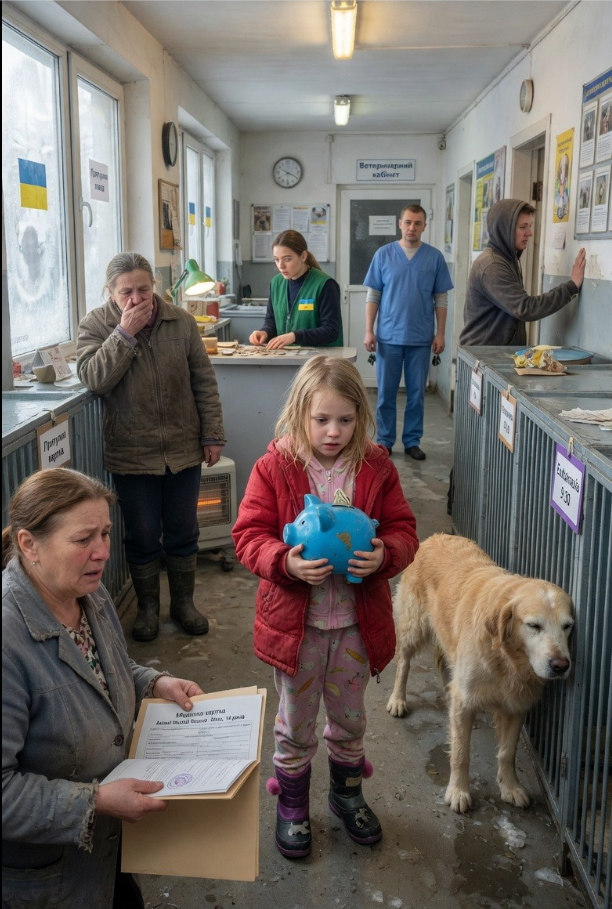
A little girl stepped inside. She held a heavy piggy bank with both hands, as if afraid that letting go of it would make everything else disappear too. Her voice was barely more than a whisper, yet it cut cleanly through the cold corridor:
“I came for the golden retriever that no one has taken.”
That December morning, the cold was not just cold. It was something slower, deeper. It worked its way into seams of coats, into gloves, into fingers that volunteers used to lift metal bowls.
The sound of those bowls hitting concrete felt sharper than usual.
Dogs breathed out white mist, as if each one was holding onto the last piece of warmth it had left.
From the staff room drifted cheap tea, disinfectant, and the damp, earthy smell of fur.
On the paperwork, he was nothing more than a number: Kennel 14.
Not Barney.
Not Rex.
Not “someone’s dog.”
Just Kennel 14.
A twelve-year-old golden retriever with a faded honey-colored coat, a greying muzzle, and a body that moved as if every step required permission.
He had been at the shelter for 147 days.
They had found him in summer behind an abandoned trailer near the edge of town. The ground had been hot, the air thick with dust and rusted metal. He lay in the shade and barely lifted his head when they approached.
The veterinary report was long and clinical: exhaustion, severe dermatitis, arthritis, heart murmur, partial hearing loss, cloudy vision, dental disease.
And an old, poorly healed fracture in his hind leg.
On paper, it was just a line.
In reality, it lived in every movement he made.
When he stood up, it felt as if his bones negotiated with each other before agreeing to move. Every step seemed to require permission from pain itself.
In the first days, they fed him in small portions. His body could not handle sudden nourishment, so care came slowly, carefully measured.
They removed ticks from his skin and placed them in metal trays.
They treated his wounds.
They washed his eyes.
They soaked his food so he could chew at all.
He did not growl. He did not snap. He did not resist.
He only looked.
The volunteers later said there was something in that gaze that was heavier than fear.
It was expectation.
Every morning, when the main corridor of the shelter opened, Kennel 14 would sit in the same place: right at the front of the bars.
As close as his aching legs would allow.
He did not bark at visitors.
He did not scratch the gate.
He did not try to push through the metal.
He simply sat and watched.
When footsteps approached, one of his ears would lift slightly.
His tail would tap the concrete once—carefully, almost uncertain.
And then the people would walk on.
Most of them came for something else.
For puppies that still stumbled over their own feet and made everyone laugh.
For young, photogenic dogs that could become instant stories: *new family member found today*.
Kennel 14 was not that kind of story.
He was something people passed by without realizing they were choosing not to see.
For 147 days, not a single family stopped in front of his kennel.
No one asked his name.
Not that he truly had one.
At the shelter, everyone knew the system too well. They knew how many spaces were left. How many dogs arrived after abandonment. How many were returned because they “didn’t work out.” How many puppies were left in boxes outside the gate after holidays.
And they knew the oldest truth of all: old, sick, imperfect dogs are always last.
The file for Kennel 14 was moved between folders ten times.
Officially, it was called “postponement.”
In reality, it was quiet resistance—people who cleaned cages every morning, fed the animals, treated wounds… but still could not bring themselves to sign the final line.
And on that morning, at 7:46, the little girl stood in the middle of the cold corridor, clutching her piggy bank, and said again—this time more firmly:
“I came for him.”
And for a moment, it felt like even the cold inside the shelter paused, listening.