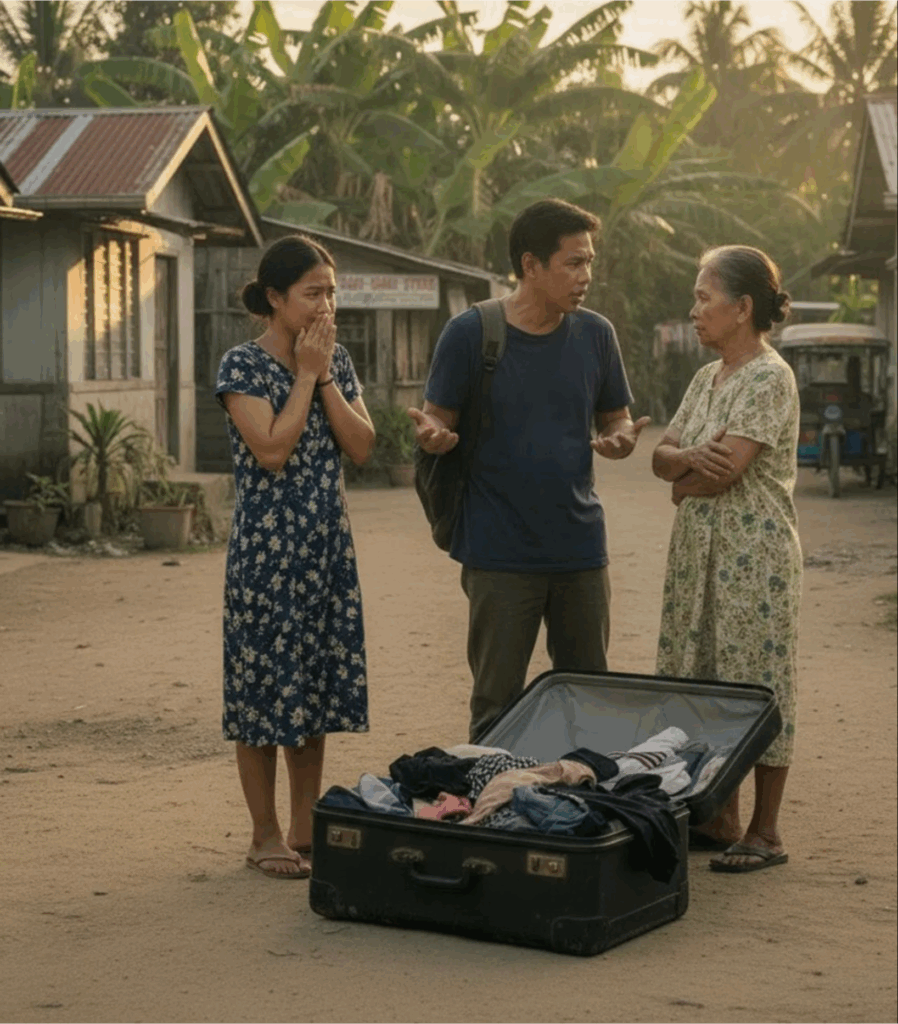
The suitcase was already standing by the door, and on the stove the borscht was still slowly simmering. With pampushki. Just the way he liked it.
Marina wiped her hands mechanically on the kitchen towel. She wasn’t in a hurry. As if every movement was trying to delay something that had already happened.
She looked at the man. At the back of his head. At the small mole behind his ear that she had once kissed a thousand times. Now it seemed like it belonged to a stranger.
— Business trip? — she asked quietly at last.
— No, Marin. I’m leaving.
The sentence didn’t sink in immediately. It just hung in the air, like smoke.
— Where?
— To someone else.
The kitchen towel slipped from Marina’s hands.
— Igor…
— Don’t start. We both know this doesn’t work anymore. You just never said it out loud.
— Doesn’t work? — Marina laughed, but her voice shattered. — Tomorrow would be eighteen years.
— Exactly. Eighteen years of the same borscht.
It was like a slap. Not loud. Precise.
Marina fell silent for a moment.
— I gave up my postgraduate studies because of you. I could have become someone…
— You are someone — he cut in calmly. — Just not the one you wanted to be.
Then he smiled. Not kindly. More like tired superiority.
— A restorer. Who can live off that? I gave you life, Marin. An apartment. A car. Holidays.
— You gave me that? — Marina’s voice quieted.
— Who else?
He looked at the clock.
— The apartment is in my name, but I’m not cruel. Stay here for a while. Then we’ll see.
Marina gripped the edge of the table. Her fingers turned white.
— Who is she?
— It doesn’t matter.
— Who is she?!
Silence.
— Liza. Thirty-two. She’s alive. You just… exist.
The word was colder than winter.
— And you didn’t even notice when you disappeared from yourself.
He picked up the suitcase. At the door he looked back once more.
There was no pity in him. Only impatience. As if he were getting rid of an old object.
— Don’t worry. Thirty-eight is not a verdict. Just the end of a chapter.
The door closed.
The borscht kept cooking. Then slowly cooled.
In the first days, Marina did not cry.
She moved through the apartment like a stranger in a museum. Every object spoke about her, but no longer to her.
A shirt on the chair. A toothbrush in the glass. A half-finished sentence in the air.
On the eighth day, Tanja called.
— Marinka, are you alive?
And then something broke.
— I’m thirty-eight, Tanja… and I have nothing. Eighteen years of my life are gone. I don’t even know when I last held a brush in my hand…
Silence on the other end of the line.
— And why did you want to become a restorer? — Tanja finally asked.
The question was strangely simple.
Marina closed her eyes.
And suddenly it was all there: the halls of the Tretyakov, the silence, the nineteen-year-old girl crying in front of an icon because a person is capable of creating beauty.
— I remember — she whispered.
— Then start again.

In the storage room she found the box.
The paints had dried out. Most were beyond saving. But the brushes… the brushes were alive.
Marina sat on the floor, and for the first time in a long while she didn’t cry emptily, but with memory.
The next day she cut her hair.
The braid that Igor “liked” fell to the floor.
In the mirror stood a stranger. Sharp-faced. With too-awake eyes.
— So here you are — she said quietly.
The course was difficult. The money ran out. So did her pride.
But her hands remembered.
At night she painted. At first uncertainly, then angrily, then more and more precisely.
As if something that had been asleep for years had finally awakened inside her.
Then came the first job.
An old house in Kaluga. Icons. Neglected, almost dying pieces.
— They wanted to throw this away — said the client.
Marina leaned closer.
Her heart was beating fast.
— This doesn’t need to be thrown away — she said quietly. — It needs to be saved.
Six months.
Six months on bread, solvents, and quiet obsession.
Sometimes she almost gave up.
But when the first icon “spoke” again after cleaning, Marina cried.
Not from pain.
But from recognition.
— This is not a miracle — she later said. — This is work.
The news spread faster than she expected.
One job. Then two. Then a gallery.
Her name slowly became known.
Years later, Marina lived in another apartment.
Not large. Not luxurious. But her own space.
The studio window looked out onto Chistye Prudy.
And there was something in her she had once lost: a quiet inner strength.
One day Dmitry Sergeyevich Volokhov walked in.
He didn’t say much. Just sat down and watched her work.
— Am I disturbing you? — he asked later.
— No.
Nothing was ever said between them.
But Marina sometimes noticed she was waiting for the moment he would appear in the doorway.
One evening she went to a gallery event.
In a black dress. In heels. As a woman who no longer runs away.
Dmitry took her there.
— You… shine today — he said quietly.
Marina smiled.
And this smile was no longer survival.
It was life.
In the hall, under the lights, Marina stood beside a painting.
— Marina?
She turned.
Igor.
Aged. Tired. Beside him Liza, looking bored.
— Is this… you? — the man asked.
— Yes.
Silence.
— I… was wrong.
— I know.
— Liza isn’t the right one. I… would come back. Let’s start over.
Marina looked at him. For a long time.
Then she said calmly:
— Igor. You didn’t lose me.
— You lost yourself.
Silence.
— And I finally found myself.
She turned and walked away.
Not quickly. Not angrily.
But definitively.
The air outside was cold.
Marina stopped for a moment.
And for the first time she cried not because something hurt.
But because the life she had lived too long for someone else was finally over.