There is a kind of silence that only comes after years of hard work, sacrifice, and learning how to protect your peace. Not the silence of loneliness.
Not the silence of emptiness. The kind that settles over your life when you’ve finally escaped the chaos and built something that belongs entirely to you.
My name is Carter. I’m thirty-six years old, an architectural consultant who works remotely, and I live alone on three wooded acres overlooking Lake Superior.
My house wasn’t a mansion, but every beam, every window, and every square foot represented years of eighty-hour workweeks and missed weekends.
It wasn’t just a house.
It was my sanctuary.
The one place where my family’s endless drama couldn’t reach me.
At least, that’s what I believed.
Everything changed on a freezing Tuesday evening.
I was working upstairs when bright headlights swept across my windows. At first, I assumed someone had taken a wrong turn on the private road.
But when the lights stopped in my driveway, a knot formed in my stomach.
I walked to the window and looked down.
A large U-Haul truck sat directly in front of my house.
Behind it was my father’s old Buick.
My phone lit up with missed calls and frantic messages.
Thirteen missed calls.
Twenty-three text messages.
Nobody rents a truck that size for a casual visit.
I hurried downstairs and opened the front door.
My parents were already standing on the porch.
“Mom? Dad? What’s going on?”
My father climbed the steps with the confidence of someone arriving at his own property.
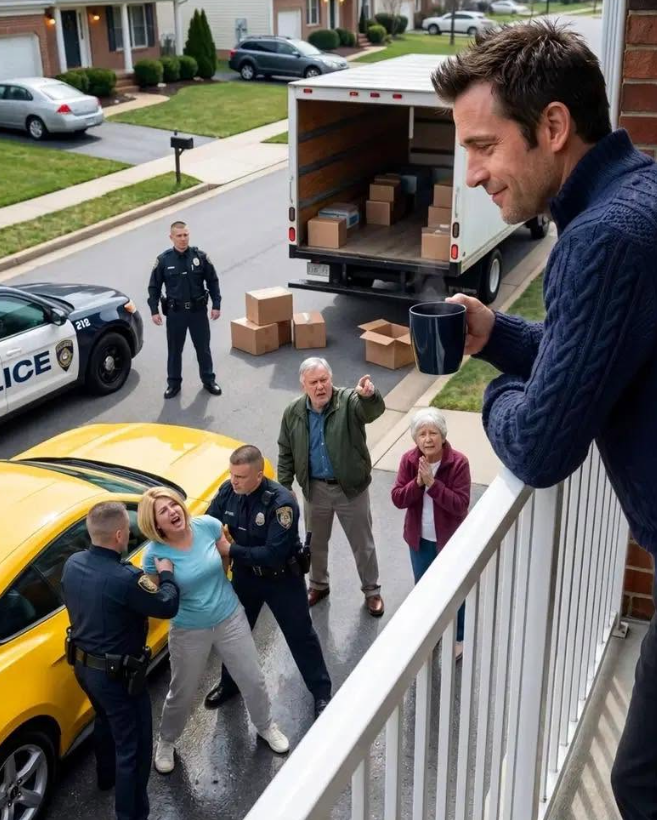
“Grab your coat,” he said. “We need to unload before the weather gets worse.”
I stared at him.
“Unload what?”
He frowned as if I had asked a ridiculous question.
“Our things. We’re moving in.”
For a moment, I thought I had misunderstood him.
“You’re what?”
My mother stepped forward with an exhausted sigh.
“Please don’t make this harder than it needs to be.”
I looked from one of them to the other.
“You have a house in Ohio. What are you talking about?”
My father shrugged.
“We sold it.”
The explanation that followed felt like a punch to the chest.
My younger sister Chloe—the golden child of the family—had supposedly gotten herself into financial trouble. According to my parents, she needed help.
So they sold their fully paid-off home for more than six hundred thousand dollars, paid off her debts, and handed her the rest so she could “start over.”
Then, without asking me a single question, they decided they would simply move into my house.
As if it were the most natural thing in the world.
“You made this decision without talking to me?”
My father’s expression hardened.
“We’re your parents. Family helps family.”
Then he tried to walk past me and into the house.
Something inside me snapped.
“No.”
He stopped.
“What did you say?”
“I said no.”
I stepped in front of the doorway and pushed it shut.
The next thirty minutes were chaos.
My father pounded on the door, kicked it, and shouted my name loud enough for the entire property to hear. My mother cried and begged me to reconsider.
But I didn’t move.
I knew that if I let them stay for even one night, getting them out later could become a legal nightmare.
By midnight, my phone was exploding.
Aunts.
Uncles.
Cousins.
Family friends.
Every message sounded the same.
How could I abandon my elderly parents?
How could I be so selfish?
How could I turn my back on family?
Then I discovered why.
My mother had already posted a dramatic story online, claiming I had thrown my helpless parents out into the cold without warning.
She conveniently left out the part where they had never asked permission to move in.
Later that night, I reviewed footage from my security cameras.
That’s when I noticed something disturbing.
My father was walking around the property.
A few minutes later, he approached the main electrical panel.
Then he shut off the power.
The lights inside the house went dark for only a few seconds before my backup system restored everything automatically.
Apparently, he had hoped I’d come outside.
I didn’t.
The next morning, I started digging through public records and social media.
And what I found changed everything.
Chloe wasn’t struggling financially.
Not even close.
Just hours earlier, she had posted photos from a luxury resort, holding champagne beside an infinity pool.
Two days before that, she had shared pictures of herself standing next to a brand-new yellow Porsche with an oversized red bow on the hood.
My parents hadn’t rescued her.
They had funded her fantasy lifestyle.
Around noon, Chloe finally arrived.
Designer clothes.
Expensive sunglasses.
Perfect hair.
She strutted toward my porch like she owned the place.
“Stop being dramatic and let them in,” she called out.
I laughed.
“If you’re doing so well, why are Mom and Dad sleeping in their car?”
Her smile didn’t even fade.
“My money is tied up in investments,” she replied. “I’m temporarily illiquid.”
Illiquid.
Such an elegant word for broke.
A few hours later, I found a handwritten document shoved under my front door.
At the top, someone had written:
Family Living Arrangement Agreement.
I read it twice because I couldn’t believe what I was seeing.
According to the document, my parents would take the master suite.
Chloe would get the guest room overlooking the lake.
I would move my office into the basement.
And I would continue paying most of the household expenses.
I grabbed a marker.
Across the front page, I wrote two words.
ABSOLUTELY NOT.
When my father saw it, he exploded.
First, he tried hiring a locksmith to open my front door.
The locksmith left immediately after realizing my father wasn’t the property owner.
Then my father lost his temper completely.
He grabbed a heavy garden ornament and hurled it through one of my living room windows.
Glass shattered everywhere.
That was the moment I stopped trying to handle things myself.
I called the police.
When the officer arrived, I showed him the property records, security footage, and the broken window.
My father tried to claim that I was mentally unstable and that the house belonged to the entire family.
The officer listened patiently.
Then he asked a few simple questions.
“Do you have keys?”
No.
“Do you have a lease?”
No.
“Do you receive mail here?”
No.
The conversation ended there.
After reviewing the footage, the officer gave them two choices.
Leave peacefully.
Or face charges for trespassing and property damage.
For the first time in my life, I saw my father with no one left to rescue him from the consequences of his own actions.
An hour later, they quietly loaded their belongings back into the truck.
No shouting.
No arguments.
Just silence.
Before climbing into his car, my father looked at me one last time.
“You’re dead to us.”
I held his gaze.
Then I answered calmly.
“I haven’t had a family in years. I just didn’t realize it until now.”
That evening, I posted the evidence online.
The relatives who had spent days attacking me suddenly became very quiet.
Months have passed since then.
The broken window has been replaced.
The truck is gone.
The phone calls have stopped.
And my house is silent once again.
Sometimes that silence feels lonely.
There is grief in realizing that the people who were supposed to love you unconditionally chose pride, entitlement, and fantasy instead.
But there is also freedom.
Because I finally learned something that took me thirty-six years to understand.
Being related by blood does not give anyone permission to destroy your peace.
Family is not a blank check written against your mental health.
And sometimes protecting yourself means closing the door.
Then finding the strength to keep it closed.