Thirty-eight-year-old Vera was sitting alone on a cold autumn evening when, for the first time in her life, she truly dared to face what she had always feared.
She was alone.
Not in the way people usually mean when they say that. Not because her husband had left her for another woman, not because he had turned to alcohol, and not because he had simply grown tired of life.
Vera’s husband had died five years earlier in a forest accident. A piece of machinery had overturned, and by the time help arrived, there was nothing they could do to save him.
They had never had children.
Her parents had long since been laid to rest in the village cemetery. Her older brother had moved north for work. At first, he wrote regularly, then less and less often, until eventually he fell completely silent. Her younger sister had married, moved to a large city, and slowly, life had carried them apart as well.
And so Vera was left alone.
In the village, everyone simply called her Verka.
And later, when she made the strangest decision of her life, she was given another name:
Verka the Crazy.
She lived in a small village hidden among forests, in the old wooden house she had inherited from her father. The porch leaned to one side, the roof leaked after every heavy rain, and the paint on the window shutters had long since peeled away.
Vera worked as a postal carrier.
Every morning she slung a heavy bag over her shoulder and set off through the surrounding villages. She delivered pensions to the elderly, brought letters, and handed out newspapers. She did not earn much, but it was enough for bread, flour, potatoes, and feed for her goat.
Years passed like that.
Then one evening, as rain drummed against the leaking roof, Vera sat by the window and suddenly saw the future so clearly that her heart ached.
In a few years, she would be old.
Alone.
She would sit behind the curtains and stare at the empty road.
No one would open her door.
No one would ask:
“Vera, how are you?”
No one would say:
“Mom, I’m home.”
And then the most frightening thought struck her:
What was the point of growing old if no one needed you?
That night, Vera did not sleep.
She sat by the window until dawn.
In the morning, she put on her warmest sweater, gathered her documents, and went to the district center.
There was an orphanage there.
Vera had never been inside it before.
The building was gray, with plaster crumbling from the walls and sparse bushes clinging to the ground beneath the windows. About forty children lived there.
Vera entered the director’s office.
The gray-haired woman looked up from her papers.
“How can I help you?”
Vera did not beat around the bush.
“I want to adopt a child.”
The woman raised her eyebrows.
“One?”
“Yes. Preferably a boy. Around ten years old.”
“Why ten?”
Vera shrugged.
“I’m not sure I could manage a little one. A ten-year-old can already help around the house. And you can talk to him.”
The director looked at her for a long moment.
“Come back tomorrow. You can meet the children.”
Vera returned the next day.
The director led her into a large, cold room.
Iron beds stood in rows along the walls.
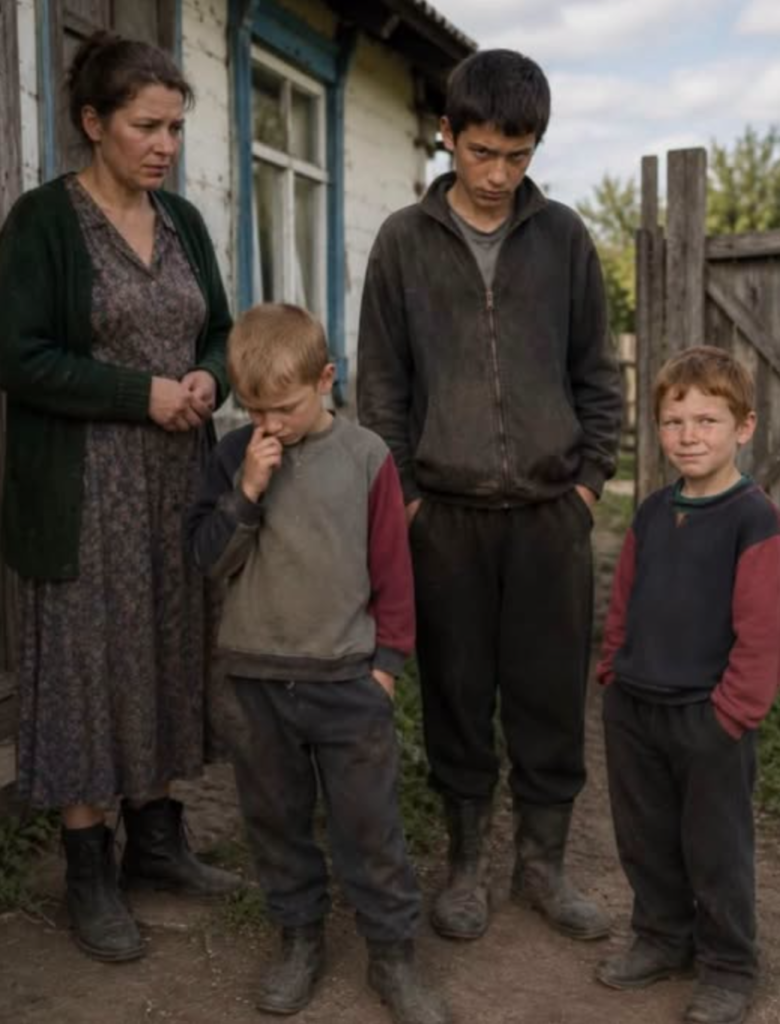
Three boys were standing by the window.
“This is Andrei, twelve years old. This is Ilya, ten. And this is Roma, eleven. They are brothers.”
Vera looked up.
“All three?”
“Yes. We try not to separate them.”
Andrei was the oldest. Tall and thin, with eyes so serious that he looked as though he were already thirty. He did not look Vera in the eyes.
Ilya stood with his head lowered. His blond hair fell over his forehead, and he scraped the toe of his shoe against the floor.
Roma was the youngest. He had a freckled, chubby face. He was the first to try to smile.
Only for a moment.
Then Andrei looked at him, and the smile disappeared.
Vera stared at them for a long time.
And the three boys stared back at her.
They all knew what would happen next.
An adult would come in.
Look at them.
Choose one.
And the other two would stay behind.
Vera’s heart tightened.
Then she took a deep breath.
“Well, pack your things.”
Andrei looked up sharply.
“Where?”
“To my house.”
The boy stared at her in confusion.
“Who’s going?”
Vera pointed toward the three brothers.
“All of you.”
Silence.
“All three?” Andrei asked.
“Of course. Or would you rather they separate you?”
The boys did not answer.
Tears appeared in Roma’s eyes.
For the first time, Ilya raised his head.
Andrei stared at Vera for a long time, as if trying to decide whether he could believe what he had just heard.
The director spoke in astonishment:
“Vera Nikolayevna… you wanted one child.”
Vera turned toward the three boys.
“I wanted to take one home for myself.”
Then she smiled.
“But I’m taking three because of them.”
The village erupted in scandal.
Verka, the postwoman, had brought three children home.
Three strange boys.
From an orphanage.
Aunt Zina was the first to confront her.
“Verka, have you completely lost your mind?!”
Vera calmly looked at her.
“I don’t think so.”
“Three children! Three! Do you even know what kind of family they came from?”
“No.”
“Their mother was an alcoholic!”
Vera remained silent.
“Who knows what kind of genes they have! They’ll steal your money! They’ll burn down your house! They’ll ruin you!”
Vera simply said:
“I don’t know what they brought with them.”
Zina triumphantly raised an eyebrow.
“See?”
“But I do know what I want to give them.”
“What?”
Vera opened the gate.
“A home.”
Then she closed it in Zina’s face.
From that day on, Vera became known as “Verka the Crazy.”
But she no longer cared.
Because three boys were waiting for her at home.
The first few months were terrible.
Andrei stole.
Not because he was evil.
But because the orphanage had taught him that if you did not take something quickly, someone else would take it from you.
A jar of jam.
A few eggs.
Little things.
Every time, Vera made him return what he had taken, apologize, and then sit down and talk with her.
One evening, she finally asked:
“Why do you do it?”
Andrei lowered his head.
“Because I need to.”
“What do you need?”
“Anything.”
“But there is food here. You have clothes. You have a bed.”
The boy gave a bitter laugh.
“You do.”
Vera froze.
“We don’t.”
Behind the boy’s terribly serious eyes was all the fear of the years he had lived through.
Vera slowly reached out and took his hand.
“Andrei, you don’t have to be afraid anymore that tomorrow someone will take away what you have.”
The boy was silent for a long time.
“And what if you change your mind too?”
Vera’s heart broke.
“Even then, I will still be your mother.”
“Why?”
“Because I chose you.”
Andrei did not understand.
Perhaps no one had ever chosen him before.
Ilya ran away.
Not once.
Three times.
Always carrying the same old backpack.
Bread, a shirt, and a worn-out toy.
And every time, Vera went after him.
In the rain.
In the snow.
At night.
She searched for him in the forest, in the neighboring village, in abandoned sheds, along the roadside.
She always found him.
Freezing.
Hungry.
Defiant.
Once, she found him in a forest cabin.
“Where are you going, Ilyusha?”
“To my mother.”
Vera swallowed her tears.
“Then come home.”
“You’re not my mother.”
Vera knelt in front of him.
“I know.”
Ilya looked surprised.
“You know?”
“I didn’t give birth to you. But I’m the one who comes after you when you run away.”
The boy was silent.
“I’m the one who searches all night when I can’t find you.”
Tears filled Ilya’s eyes.
“I’m the one who takes you home even when you still don’t believe you have somewhere to go home to.”
The boy did not answer.
He simply held out his hand.
And together they walked home.
Roma did not speak.
For weeks.
Then months.
The doctors said he had withdrawn because of trauma.
“Don’t pressure him,” they advised. “He may speak with time.”
Vera did not pressure him.
Every evening, she told him stories.
About the goat.
About her garden.
About the weather.
About the apple tree.
About the coming winter.
Roma simply sat and listened.
Until one evening.
All three boys were sitting at the table.
They were having porridge for dinner.
Roma emptied his bowl.
Then he quietly said:
“Can I have some more?”
The spoon fell from Vera’s hand.
Andrei choked.
Ilya froze.
Vera hardly dared to breathe.
“What did you say?”
Roma looked up.
“I want some more porridge.”
Tears streamed down Vera’s face.
Roma looked at her in confusion.
He did not understand why she was crying.
After all, he had only asked for another serving of dinner.
But Vera knew.
That evening, he had not simply asked for more porridge.
He had asked for a little more of life.
The years flew by.
The three boys grew up.
Andrei became a mechanic.
Ilya became a welder.
Roma entered the field of education.
And Vera was once again alone in the old house.
Except this loneliness was different.
The rooms were filled with books.
Old notebooks.
Coats.
Marks on the wall showing how tall they had grown.
And there was always a letter.
A phone call.
A holiday visit.
The boys never forgot where they had come from.
And they never forgot the woman who had once chosen three children instead of taking only one home.
Then Vera began to grow old.
Her back hurt.
Her eyesight weakened.
She could barely carry the heavy postal bag anymore.
She even had to sell her goat.
But the boys came home more and more often.
They chopped wood.
Carried water.
Repaired the porch.
Patched the roof.
And every time they sat together around the table, Vera felt as though the entire house had filled with life.
Then one July evening, the sound of engines broke the silence.
One car arrived.
Then another.
Then another.
Three cars stopped in front of Vera’s gate.
Andrei got out of the first.
Ilya from the second.
Roma from the third.
But they had not come alone.
Wives.
Children.
Grandchildren.
Vera simply stared at them.
“What happened?” she asked.
Andrei smiled.
“Mom, we’ve discussed something.”
“What?”
“Your house.”
Vera glanced behind her.
“What about it?”
“It leaks. The beams are rotten. The stove smokes.”
Ilya continued:
“We’re going to build you a new one.”
Vera laughed.
“For me? Why? By the time I die, you won’t even get your money’s worth out of it.”
Andrei looked at her seriously.
“We’re not building it so that it will someday be ours.”
“Then why?”
Roma stepped closer.
“Because twenty years ago, you gave us a home.”
Vera fell silent.
“Now we’re giving you one.”
The whole village helped.
Even those who had once called her crazy.
Andrei left his job for weeks.
Ilya took time off.
Roma came home every weekend.
They tore down the old house.
They poured a new foundation.
They built the walls from fresh larch wood.
A new roof was installed.
Large windows.
A bright kitchen.
A warm bathroom.
A wide veranda.
And an upstairs room for the grandchildren.
When it was finished, Vera stood in front of it for a long time.
She did not know what to say.
Aunt Zina was standing by the fence too.
For years, she had never spoken about what had happened.
But now she lowered her head.
“Verka…”
“Yes?”
“Do you remember what I told you back then?”
Vera smiled.
“You said many things.”
Zina awkwardly rubbed her hands together.
“I thought the children would become what their mother had been.”
A long silence followed.
“I was wrong.”
Zina looked at the new house.
“Very wrong.”
The entire village gathered for the housewarming.
Long tables were set up in the yard.
Laughter.
Tea.
Pastries.
Children’s voices.
And three men who had once been afraid that no one would ever choose them.
Suddenly, Andrei stood up.
“I want to say something.”
Everyone fell silent.
Andrei turned toward Vera.
“I’m not good at speeches. I repair cars. That’s what I’m good at.”
Laughter rippled through the crowd.
Then his expression became serious.
“But I know one thing.”
He looked into Vera’s eyes.
“This woman is our mother.”
Silence.
“Not because she gave birth to us.”
Andrei’s voice trembled.
“But because she chose us.”
Vera lowered her head.
“She could have taken one child.”
Andrei looked at his brothers.
“But she took three.”
“She could have returned us when we stole.”
“But she didn’t.”
“She could have returned us when we ran away.”
“But she came after us.”
“She could have returned us when we wouldn’t speak to her.”
Andrei smiled.
“But she waited for us.”
Then he raised his glass.
“To Mom.”
Ilya stood too.
Roma stood beside him.
Then everyone else.
“To Vera Nikolayevna!”
Vera cried.
She did not wipe away her tears.
She did not want to.
Because these were not tears of loneliness.
They were proof that sometimes life gives us ourselves back in the place where we least expect it.
That evening, after everyone had gone home, Vera stepped onto the new veranda.
The windows of the house glowed warmly.
Inside, her daughters-in-law were washing the dishes.
Children’s voices came from upstairs.
In the living room, Andrei and Ilya were quietly arguing about something.
And Roma was trying to put a little child to bed.
Vera sat down on the veranda.
She looked at the river.
She looked at the forest.
And she remembered that evening twenty years earlier.
When she had been terrified that one day she would grow old alone.
Now she knew how wrong she had been.
Happiness does not always arrive the way we imagine it.
Sometimes it is not the birth of your own child.
Sometimes it is three wounded boys standing in a cold room in an orphanage.
Sometimes all it takes is one decision.
One sentence:
“You’re all coming with me.”
And from that moment on, the entire lives of four people change.
Vera looked at the new house.
Then she closed her eyes.
“Thank you,” she whispered.
She did not know to whom.
Perhaps to God.
Perhaps to fate.
Perhaps to the unknown woman who had given birth to the three boys but had been unable to stay by their side.
They had lost a mother.
And Vera had found three boys.
And in the process, she found what she had been searching for all her life:
a family.
Then a voice called from inside:
“Mom! Where are you? The tea is getting cold!”
Vera smiled.
She stood up.
“I’m coming!”
She was just about to turn the handle when something stopped her.
She looked back at the dark forest.
At the same road she had once watched alone from the window.
Then she saw three tiny lights in the distance.
Her grandchildren were running toward her with flashlights.
“Grandma! Wait for us!”
Vera laughed.
And at that moment she understood:
all our lives, we think home is a place.
But home is not in the walls.
Not in the roof.
Not in the house you inherited or built with your own hands.
Home is where someone notices when you are not there.
Where someone waits for the sound of your footsteps.
Where a sleepy child asks:
“Mom, where are you?”
Vera closed the door behind her.
And for the first time in her life, she was no longer afraid that one day she would be alone.
Instead, she was afraid that there would not be enough time left to spend with the people who were waiting for her to come home.
The tea was already steaming in the kitchen.
Her three sons, three daughters-in-law, and the grandchildren were gathered around the table.
Roma looked up.
“We thought we’d lost you.”
Vera set down her scarf.
“Me?”
She smiled.
“I found you twenty years ago.”
Andrei stood up and hugged her.
Ilya stepped forward too.
Roma quietly squeezed her hand.
Vera looked around.
And then, at last, she said the words she had once longed so desperately to hear:
“It’s good to come home.”
Outside, the rain began to fall.
Inside, no one was alone.