Why Should I Fix a House Where I’m Not Welcome?
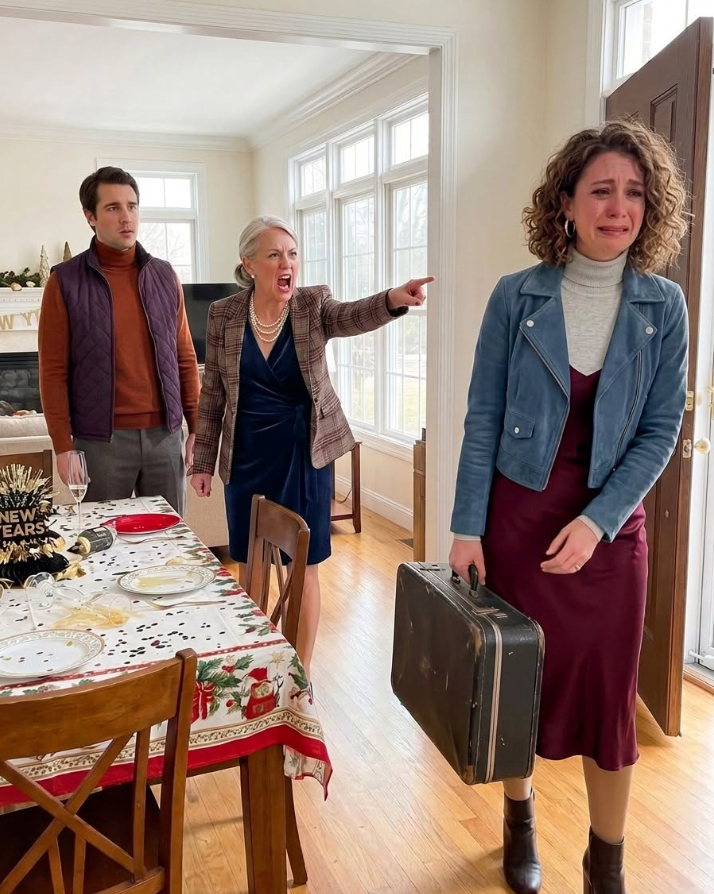
By the time my mother-in-law ordered me out of the house on New Year’s Eve, the champagne hadn’t even been opened.
I had spent the entire afternoon preparing dinner in the kitchen of the Connecticut house my husband, Daniel, had inherited from his father. I had roasted the vegetables, prepared the dessert, set the table, and made sure there was enough food for everyone.
Then Margaret looked at me across the dining room and said, almost casually:
“You know, Emily, this family managed perfectly well before you arrived.”
I slowly put down the serving spoon.
“What exactly is that supposed to mean?”
Her smile was cold.
“It means tonight is about family.”
“I’m Daniel’s wife.”
“You’re his wife,” she said. “That doesn’t make this your home.”
The room went silent.
Daniel stared at his plate.
His sister, Claire, suddenly became fascinated by her wineglass.
I looked at my husband, waiting for him to say something.
Anything.
Instead, he murmured, “Mom, come on.”
Margaret ignored him.
“Actually, I think it would be better if you left.”
I waited for Daniel to stand up.
He didn’t.
My heart sank.
I looked directly at him.
“Are you asking me to leave too?”
He rubbed his forehead.
“Emily, maybe just go cool off. We can talk tomorrow.”
That was the moment I understood.
He wasn’t choosing me.
So I chose myself.
I picked up my purse, put on my coat, and walked out without making a scene.
What none of them seemed to remember was that I was the person who kept that house running.
The leaking sink?
Me.
The broken garbage disposal?
Me.
Property-tax deadlines?
Me.
Insurance renewals?
Me.
And the boiler?
Especially the boiler.
It had been unreliable for months. A replacement part was due to arrive in January, but until then, whenever the pressure dropped, someone had to manually reset the valve.
I had shown Daniel how to do it more than once.
He had never bothered to learn.
So I drove to a hotel twenty minutes away.
I checked in, ordered a sandwich, turned off my phone, and tried to forget the entire night.
At 11:58 p.m., curiosity got the better of me.
I switched my phone back on.
Seven missed calls.
Three from Daniel.
Two from Claire.
Two from Margaret.
Then, at exactly midnight, Daniel called again.
I answered.
“Emily,” he said, his voice tense, “the heat stopped working. It’s freezing in here.”
I said nothing.
“Mom’s shaking. I’ve been trying the thermostat for an hour.”
I could hear Margaret complaining in the background.
Then came the question.
“Can you come back and fix it?”
I looked around my warm hotel room.
Then I remembered Daniel sitting silently while his mother told me I didn’t belong in my own home.
“No.”
There was a pause.
“What?”
“Why should I fix a place I’m not welcome in?”
I ended the call.
Daniel called six more times before one in the morning.
I ignored every single one.
At 1:17, Claire texted me.
I know Mom was out of line, but the house is seriously freezing. Daniel can’t figure out the boiler.
I typed a response.
Deleted it.
Typed another.
There’s an emergency HVAC number taped inside the kitchen cabinet. Call them.
Her answer came almost immediately.
They’re charging holiday emergency rates.
I laughed so loudly that the woman in the room next door knocked on the wall.
Apparently, that was the real emergency.
Money.
Daniel earned more than enough to pay for an emergency service call. He simply hated spending money on anything he considered unnecessary.
For two years, I had been the unpaid emergency department of that house.
Leaking sink?
Emily.
Broken appliance?
Emily.
Boiler pressure?
Emily.
Insurance renewal?
Emily.
And now, suddenly, my labor had a price.
At 2:03 a.m., Daniel finally texted.
Technician is coming. $650 emergency fee. Happy now?
I stared at the screen.
And that’s when something inside me shifted.
He still didn’t understand.
He thought the problem was the $650.
I replied:
No. I’m disappointed it took a broken boiler for you to notice what I do around there.
He didn’t answer.
For the first time in months, I slept peacefully.
On January 1, I woke around nine to a voicemail from Daniel.
His voice sounded different.
Calmer.
“The technician came around three. There was nothing seriously wrong. He reset the pressure valve. Mom and Claire left for a hotel. Can we please talk?”
I agreed.
But not at the house.
We met at a coffee shop.
Daniel looked exhausted. He was still wearing the sweater from dinner beneath his winter coat.
He started with an apology.
“I should have defended you.”
“Yes.”
“I froze.”
“So did the house.”
He almost smiled.
Then he realized I wasn’t joking.
“Emily, Mom was angry because she thinks you’re changing things.”
“What things?”
“The house. Our routines. Me.”
I stared at him.
“Daniel, we’re thirty-four years old. Change is supposed to happen when you get married.”
“I know.”
“No, you don’t.”
He looked down.
I leaned forward.
“Your mother insulted me in front of everyone, told me I didn’t belong in the home where I pay half the expenses, and ordered me out. And you let her.”
“It technically doesn’t have a mortgage.”
I blinked.
“That isn’t the point.”
“I know.”
“Stop saying that.”
His jaw tightened.
Then he said something I hadn’t expected.
“Mom thinks Dad intended the house to stay in the family.”
“It is in the family. You own it.”
“She means our family.”
There it was.
The sentence hiding underneath every argument we’d had since moving into that house.
I leaned back.
“Then maybe she should live there.”
Daniel looked alarmed.
“What are you saying?”
“I’m saying I’m not going back under the same conditions.”
“She doesn’t live with us.”
“She practically does. She has a key. She comes over whenever she wants. She rearranges things. She criticizes everything I change. And apparently, she can throw me out.”
“She can’t.”
“She did.”
Daniel reached across the table.
I moved my hand away.
“I want the locks changed.”
His eyes widened.
“And she doesn’t get another key.”
“Emily—”
“And if she insults me in my home again, she leaves.”
He was silent.
Then he whispered, “If I do that, she’ll say you’re making me choose.”
I stood.
“No, Daniel.”
I put on my coat.
“She already made you choose.”
I looked him straight in the eye.
“The question is whether you noticed.”
Daniel didn’t follow me out.
I stayed at the hotel for three days.
He sent messages.
Mom is devastated.
No response.
Claire thinks you’re taking this too far.
No response.
Then:
Can we please figure this out together?
That one received an answer.
Yes. When you’re ready to discuss our marriage instead of your mother’s feelings.
After that, he went quiet.
On January 4, he asked to meet again.
This time, he chose a small Italian restaurant halfway between the hotel and our house.
He was already waiting when I arrived.
“I changed the locks,” he said before I even sat down.
I stopped.
“All of them?”
“Front door. Side door. Garage.”
“And your mother?”
“She doesn’t have a key.”
I sat down slowly.
“She found out yesterday.”
“How?”
“She came over.”
Of course she did.
“She tried her key. It didn’t work. Then she called me.”
“What did you tell her?”
“That we changed the locks.”
“We?”
Daniel looked at me.
“I told her I changed them.”
That mattered.
“And?”
“She demanded another key.”
I waited.
“I said no.”
For the first time since New Year’s Eve, I didn’t know what to say.
Daniel rubbed his hands together.
“She cried. Then she yelled. Then she said Dad would be ashamed of me.”
“What did you say?”
“I said Dad left the house to me. Not to her.”
I slowly exhaled.
Daniel looked down.
“I should have said that two years ago.”
“Yes.”
“I know you’re angry.”
“I’m more disappointed than angry.”
“That might be worse.”
“It is.”
He nodded.
Then he told me Claire had started standing up to Margaret too.
Apparently, Margaret didn’t like Claire’s boyfriend, Mark, because Claire sometimes spent holidays with his family.
Daniel gave a humorless laugh.
“I think I’ve been making excuses for Mom for a long time.”
“Because your father died?”
“Partly.”
His father, Richard, had died of a heart attack four years earlier.
Afterward, Margaret had turned grief into a set of rules.
The furniture couldn’t be moved because Richard had placed it there.
The dining room had to remain blue because Richard liked blue.
Christmas had to happen at the house because Richard had always hosted it.
Every demand came wrapped in the same sentence:
“Your father would have wanted it this way.”
Daniel had treated every demand as grief.
Eventually, so had I.
But grief had quietly become authority.
“I understand why you felt responsible for her,” I told him.
He nodded.
“But understanding it doesn’t mean I’m willing to live under it.”
“I know.”
I gave him a warning look.
“Sorry.”
That almost made me smile.
Then Daniel took a breath.
“I told Mom she can visit when invited. She has to call first. And if she insults you again, she leaves.”
Those were almost my exact words.
“What did she say?”
“That you’ve poisoned me against her.”
“And what did you say?”
“That I’m thirty-four and perfectly capable of disappointing her without assistance.”
I laughed.
Daniel smiled.
Then he became serious.
“I want you to come home.”
I studied him.
“Changing the locks doesn’t fix everything.”
“I know.”
“At dinner, you let her humiliate me.”
“I did.”
“You knew exactly what she was doing.”
“Yes.”
“You stayed silent because confronting her would have been uncomfortable.”
“Yes.”
“And you expected me to absorb that discomfort for you.”
Daniel flinched.
“Yes.”
That answer helped more than another apology could have.
I picked up my coffee.
“If I come home, there are no more situations where your mother says something cruel and you explain afterward that she didn’t mean it.”
“Agreed.”
“No private conversations about how unreasonable I am.”
“Agreed.”
“No blaming me for decisions you’re afraid to own.”
He hesitated.
Then nodded.
“Agreed.”
“And counseling.”
Daniel blinked.
“For us?”
“For us.”
He clearly hated the idea.
That made his answer more convincing.
“Okay.”
I studied him.
“You mean that?”
“Yes.”
The next afternoon, I went home.
The house looked exactly the same.
Same walls.
Same hardwood floors.
Same photographs of Richard fishing, Daniel graduating, Claire as a teenager.
But something had changed.
The spare key that had always hung beside the pantry was gone.
Daniel had also left a sheet of paper on the kitchen counter.
It was a list.
Boiler reset.
Main water shutoff.
Electrical panel.
Insurance agent.
Plumber.
HVAC company.
Garbage collection schedule.
Property-tax date.
I looked at him.
“What’s this?”
He shrugged.
“I realized I don’t know how our own house works.”
“Our house?”
He nodded.
“Our house.”
I didn’t praise him.
He wasn’t a child who deserved a gold star for learning how to maintain his own home.
But I appreciated the effort.
The weeks that followed were quieter.
Not peaceful.
Quieter.
Margaret called almost every day.
Daniel stopped answering every time.
Then, one Saturday afternoon, she appeared without warning.
Daniel met her on the porch.
I watched through the living-room window.
They talked for nearly twenty minutes.
Margaret gestured angrily toward the house.
Daniel kept shaking his head.
Eventually, she left.
He came inside looking pale.
“She wanted to talk to you.”
“About what?”
“She says she wants to clear the air.”
“Did she apologize?”
“No.”
“Then there’s nothing to clear.”
Daniel nodded.
“She says you’re holding a grudge.”
“I’m holding a boundary.”
“I told her that.”
That was new.
A month later, Margaret asked me to lunch.
I accepted.
Not because I trusted her.
Because I wanted to know what she would say when Daniel wasn’t standing between us.
She arrived at a restaurant in Hartford wearing a camel coat and pearl earrings.
For ten minutes, we talked about weather, traffic, and Claire.
Then she folded her hands.
“I suppose Daniel told you I was upset about the locks.”
“He did.”
“I think it was unnecessary.”
“I don’t.”
“That house has been part of my life for almost thirty years.”
“I understand.”
“I raised my children there.”
“Yes.”
“My husband died there.”
Her voice cracked slightly.
For the first time, I saw the woman underneath the anger.
“I know the house matters to you,” I said.
“Then you understand why being locked out hurts.”
“I understand why it hurts.”
She looked relieved.
Then I continued.
“But you walked into that house whenever you wanted. You criticized how I lived. You rearranged things. And eventually, you told me to leave.”
Her expression hardened.
“You behaved as though your history there gave you authority over my marriage.”
“I was angry.”
“So was I.”
“You embarrassed Daniel.”
“No. Daniel was embarrassed because he realized he had allowed something indefensible.”
Margaret stared at me.
“You’ve changed him.”
“No.”
I shook my head.
“He changed himself.”
“He never spoke to me this way before you.”
“Maybe he never had a reason to.”
She looked toward the window.
Then, quietly:
“You think you won.”
I almost smiled.
“This isn’t a competition.”
“It feels like one.”
“That may be the problem.”
Silence settled between us.
Then Margaret surprised me.
“After Richard died, that house was the only thing that still felt the same.”
I said nothing.
“I used to walk in and expect to hear him.”
My anger softened, just a little.
“I’m sorry.”
She swallowed.
“When Daniel moved back, it felt like I still had part of my family there.”
“You do.”
She looked at me.
“But the house can’t remain frozen in the year Richard died.”
Her face tightened.
I thought the conversation was over.
Then she said:
“I shouldn’t have told you to leave.”
It wasn’t graceful.
It wasn’t warm.
But it was an apology.
“No,” I said. “You shouldn’t have.”
She looked almost offended by how easily I accepted it.
“Are you going to make me beg?”
“No.”
“Then what happens now?”
“You call before visiting.”
She sighed.
“I know.”
“You don’t get a key.”
“I know.”
“And if you’re angry with me, you speak directly to me. You don’t pressure Daniel to handle me for you.”
Margaret studied me.
“You’re very stubborn.”
“So are you.”
For the first time, she smiled.
“I suppose that’s why we dislike each other.”
“I don’t dislike you.”
“You could have fooled me.”
“I dislike being treated like a guest in my own life.”
Her smile disappeared.
But she nodded.
We never became close.
That would have made a prettier ending.
It just wouldn’t have been true.
Margaret still irritated me.
I still irritated her.
She thought I rearranged furniture too often, cooked vegetables too long, and spent too much money on coffee.
I thought she treated boundaries like opening offers in a negotiation.
But she began calling before visiting.
When she forgot, Daniel reminded her.
When she made a sharp remark, he no longer stared at his plate.
Sometimes he disagreed with me.
Sometimes he disagreed with her.
The difference was simple.
He finally spoke.
Three months after New Year’s Eve, our marriage counselor asked Daniel when he first realized something had to change.
He looked at me.
“The boiler.”
I laughed.
The counselor looked confused.
Daniel explained.
“My mother threw my wife out of our house. A few hours later, the heat stopped working. I called Emily expecting her to come back and fix it.”
The counselor stared at him.
“And what did she say?”
Daniel smiled.
“She asked why she should fix a place where she wasn’t welcome.”
“And what did you learn?”
Daniel thought for a moment.
“That I had confused avoiding conflict with keeping peace.”
I looked at him.
It was probably the most honest thing he’d said since we started counseling.
The following New Year’s Eve, Daniel and I hosted dinner again.
Claire came with Mark.
Margaret arrived at six-thirty.
She had called first.
Dinner wasn’t perfect.
Margaret complained that the roast was slightly overdone.
Claire rolled her eyes.
Daniel told his mother it was fine.
Margaret looked at me.
I raised an eyebrow.
She sighed.
“Fine. It’s fine.”
At 11:55, we opened the champagne.
The house was warm.
Daniel had replaced the unreliable boiler in October.
This time, he had researched the models, called contractors, compared estimates, and arranged everything himself.
At midnight, we raised our glasses.
Margaret stood across the table from me.
For a moment, I remembered the previous year.
Her pointing toward the door.
Daniel staring at his plate.
The cold parking lot.
The hotel room.
The midnight phone call.
The anger.
The silence.
Then Daniel slipped an arm around me.
“To a better year,” he said.
Margaret raised her glass.
“To fewer arguments.”
Claire laughed.
“That seems unrealistic.”
Even Margaret smiled.
I looked around the dining room.
To a stranger, almost nothing had changed.
The same walls.
The same windows.
The same old hardwood floors.
But I felt completely different.
I wasn’t waiting to be accepted anymore.
I wasn’t asking permission to belong.
I lived there.
I belonged there.
And Daniel finally understood something that should never have needed explaining:
A wife should never have to earn her place in her own home.
And no mother-in-law, no matter how much history she shared with a house, had the power to decide whether she belonged in her own life.
That New Year’s Eve, the house wasn’t just warm.
For the first time, it finally felt like home.